This posting is, however, a reminder to researchers to look carefully at the images of documents Ancestry provides along with its transcriptions. When you compare what the original document says with what the Ancestry transcription or commentary says, you’ll often find glaring inconsistencies and conflicts. You’ll find that the Ancestry transcription or commentary is flatly wrong.
Two cases in point:
Eliza Jane Smith is enumerated on the 1840 federal census in Iberville Parish, Louisiana (p. 56A). But you would not know this if you relied on the transcription of that census provided at the Ancestry site. As the posting linked above (which includes links to other previous postings that provide documentation) notes, we can know that Eliza Jane was in Iberville Parish in 1840 because a number of documents state explicitly that she was living there at that time. She sold her property there in 1841 and went at that point to Natchitoches Parish, where she rejoined her first husband Samuel Kerr Green and where she died at his house in March 1843.
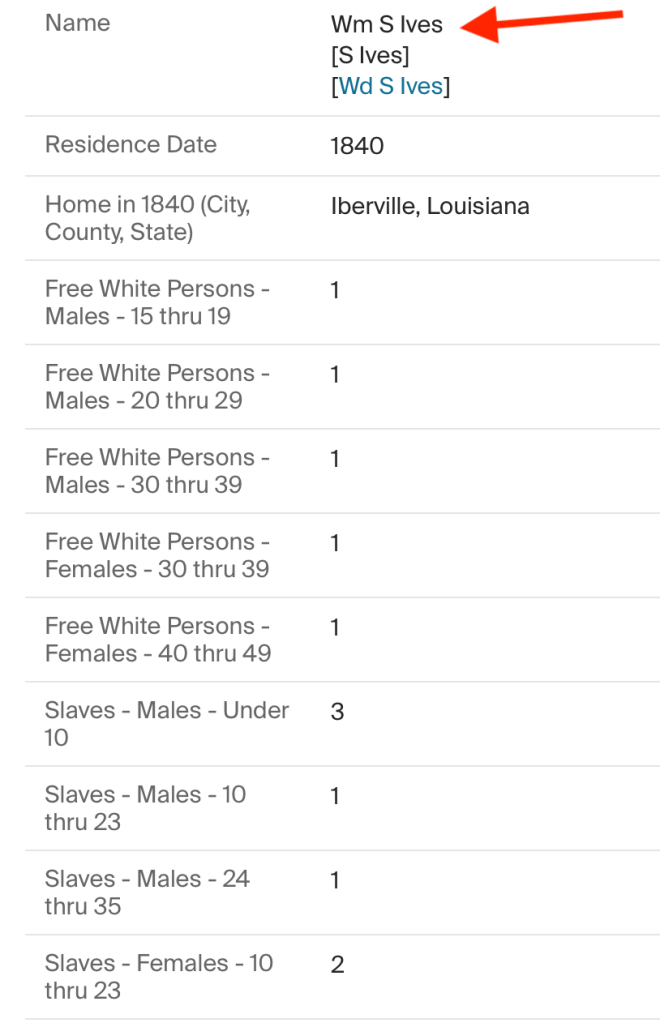
Eliza Jane appears on the 1840 federal census in Iberville Parish as Wd S Ives. Enlarge the original census and look closely at the entry for Eliza Jane, and this is very clear. In 1830 or shortly after that, Eliza Jane had married Samuel Ives, a Connecticut native living in New Orleans who had previously been a seafaring man and had owned or operated a foundry in New Orleans, finally opening a sawmill in Iberville Parish. By 1835, it appears that marriage had ended and Eliza Jane and Samuel were living in separate residences in Iberville Parish in 1840 when the census enumerated them.
Samuel Ives appears in the 1840 census enumeration in Iberville Parish as Captain Ives. Eliza Jane is the other Ives on the 1840 federal census in Iberville Parish, listed as Samuel Ives’ “widow” — Wd S Ives. But you would not know this if you relied on Ancestry’s transcription of this census as a guide, since it lists Wd S Ives as Wm S Ives. The transcript has misread Wd S Ives as Wm S Ives.
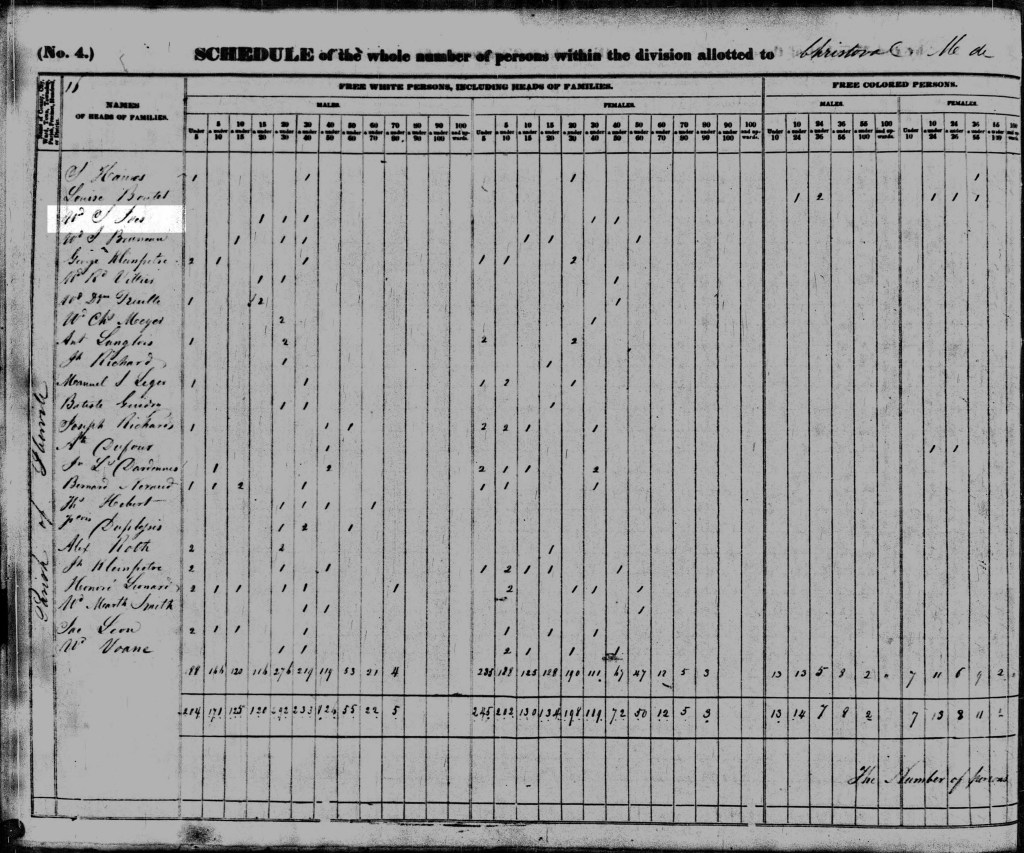
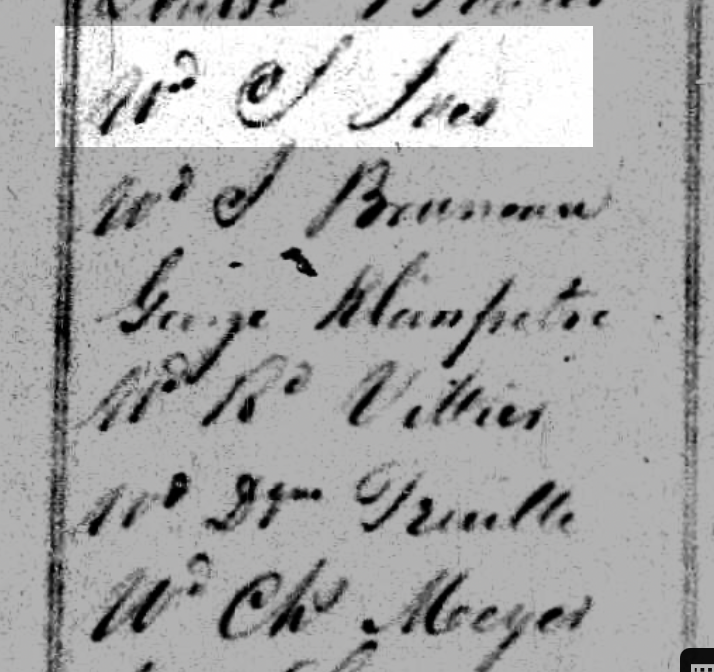

The census page on which Eliza Jane is listed in 1840 designates six people as Wd somebody or other. Immediately after Eliza Jane is Wd J Bruneau, and after that, two households away, there are three more people listed as Wd, Wd R Villier, Wd Dqe Truelle, and Wd Chs Meyer. Then down the column near the end of the page are two more Wd listings, Wd Marth[a] Smith and Wd Voane. Martha Smith was not, as far as I can determine, a relative of Eliza Jane Smith. She was the widow of Peter W. Smith, who died testate in Iberville Parish with a will written 20 August 1839, naming wife Martha.
All of these listings are listings for women living alone. They are “widows.” Some may have been, as with Martha Smith, actual widows whose husbands had died. Others, including Eliza Jane, may have been “widows” in the sense that they were now without a husband, but their husband was still living, as was Eliza Jane’s former husband Samuel Ives. It was not uncommon for women separated or divorced from their husbands to be designated on federal censuses in this time frame as “widows” though their ex-husbands were still alive.
The Wm S Ives that Ancestry points us to on this census with its erroneous transcription is, in fact, Eliza Jane Smith, Wd S Ives. In her household in 1840 are the enslaved people she would name in her Natchitoches Parish will on 5 March 1843. There are also a number of non-enslaved white persons one of whom is likely her son Ezekiel, and the others of whom are likely either boarders at her house or working on her farm.

And here’s the second document for Eliza Jane that Ancestry has misread: in its collection of U.S. wills and probate records for Louisiana, Ancestry has an entry for Eliza Jane’s 5 March 1843 will in Natchitoches Parish, which is recorded in Natchitoches Parish’s Record Bk. 34, p. 130 (see the head of the posting for a digital image of the will). Read that will — the image is linked to Ancestry’s entry, which abstracts pertinent pieces of information from the will — and you’ll find at the end of it is a record of when it was probated.
The image of the original document states very clearly that the will was probated in Natchitoches Parish on 18 March 1843. But look at Ancestry’s abstract of pertinent data provided in this document, and Ancestry tells you that this will was probated on 22 February 1862. The Ancestry abstract also cites a case no. 3622 for this probate, while the original document has the case no. 3422.
The February 1862 date is nowhere in the original document. Eliza Jane Smith had died by March 1843. Her first husband Samuel Kerr Green, in whose hands the will places her enslaved persons until his death, died in March 1860 in Grimes (now Waller) County, Texas. Eliza and Samuel’s son Ezekiel had sued his father in 1856 for claiming ownership of the enslaved persons which belonged to Ezekiel as Eliza Jane’s son, and in 1859, the Louisiana Supreme Court confirmed the verdict of the Pointe Coupee Parish court on behalf of Ezekiel.
Why would this will have been probated in February 1862? And when the record of the will itself states clearly that one of its witnesses, John Weathers Wray, proved the will in Natchitoches on 18 March 1843, why would Ancestry’s notes for this document state that the will was probated in February 1862?
To repeat what I say above: Ancestry provides a wonderful assortment of digitized records from many places. The transcriptions of many of those records are very helpful.
But sometimes the transcriptions and notes Ancestry provides for records are flatly wrong, as with the two documents I’ve just discussed. Just as with transcriptions and notes provided anyplace at all, one should use Ancestry transcriptions and notes with care, and always consult the original document.
 BEGATS AND BEQUEATHALS
Or, Subtitled: When a Widow Isn’t a Widow….. During WWII my great grandmother Cambray applied for citizenship. She had been born in England and moved to Canada with her family. Miss Mary Jane Cambray never married, but on that application is a picture of one very tough looking cookie and the box “Widow” is checked. My sister Lynn and I got a huge kick out of that when we found it back in 1983. Lynn’s comment was, “Would you argue with that woman? I wouldn’t!”
LikeLike
Funny, Marcia, and a good illustration of how widely the term “widow” was used in the past to cover a number of “situations” that we today wouldn’t technically call widowhood. Good for Miss Mary Jane, finding ways to prevail in a world not easily pliable for single women to navigate.
LikeLike