In what follows, I’m sharing a set of notes I’ve compiled as I engage in this research. These notes focus on a George Montgomery (abt. 1699- abt. 1758) who is said to have been the son of a Hugh Montgomery (abt. 1670 – 1707) who had Northern Irish roots but spent time in Cork while he was in the military, marrying an heiress of Killee there. This family story, recorded in the diary of Joseph P. Montgomery in 1817, has not been confirmed by historical documents.[1] Joseph states that George Montgomery had a son Hugh, though George’s will does not name a son Hugh; Joseph was a son of George Montgomery’s son Hugh (1738-1793).[2]
I have not been able to find any record of a Hugh Montgomery who was, according to the diary of Joseph Montgomery, the father of the George Montgomery on whom these notes focus, or any indication that this Hugh Montgomery came to South Carolina. My goal with these brief notes is not to try to provide a complete documented sketch of George Montgomery’s life, but to provide an overview that documents key pieces of information about his life.

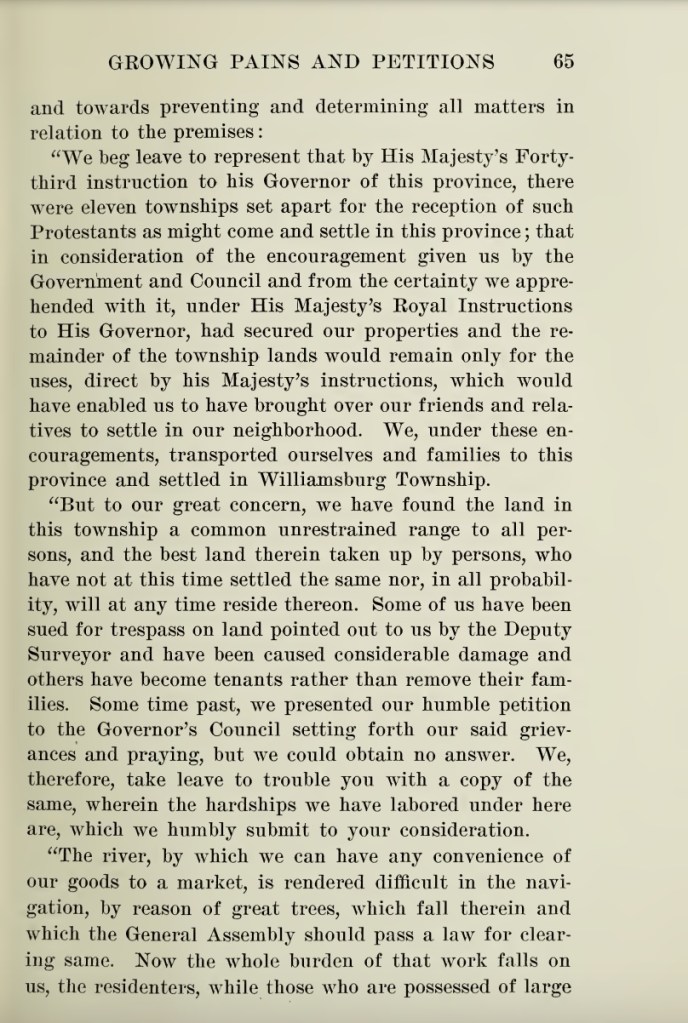
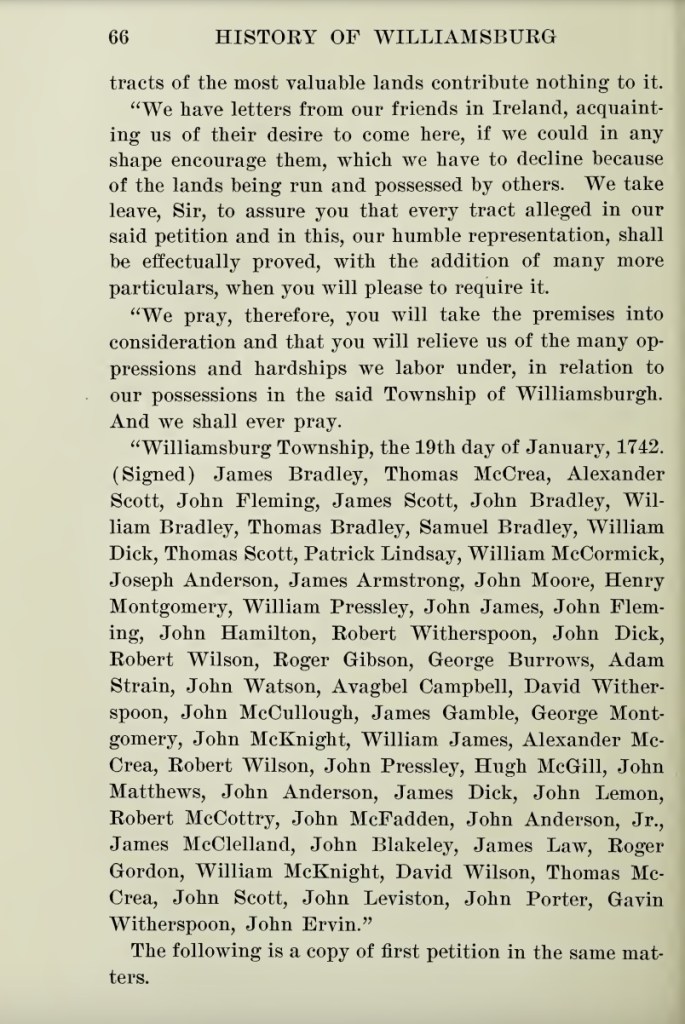
1. George Montgomery was in Williamsburg township, Prince Frederick Parish, Craven County, South Carolina, by 19 January 1742, when he and other inhabitants of Williamsburg signed a petition to Henry McCulloch, who was overseeing grants by the colony of South Carolina, asking that he confirm their titles to the land on which they were settled. The petition is transcribed in full by William Willis Boddie in his History of Williamsburg and discussed by Boddie in an article entitled “Undesirable Aliens in Ancient Williamsburg.”[3] Both of these sources state the names of all those signing this petition. Also signing was a Henry Montgomery who was, I think, George Montgomery’s brother – more on that in a moment.
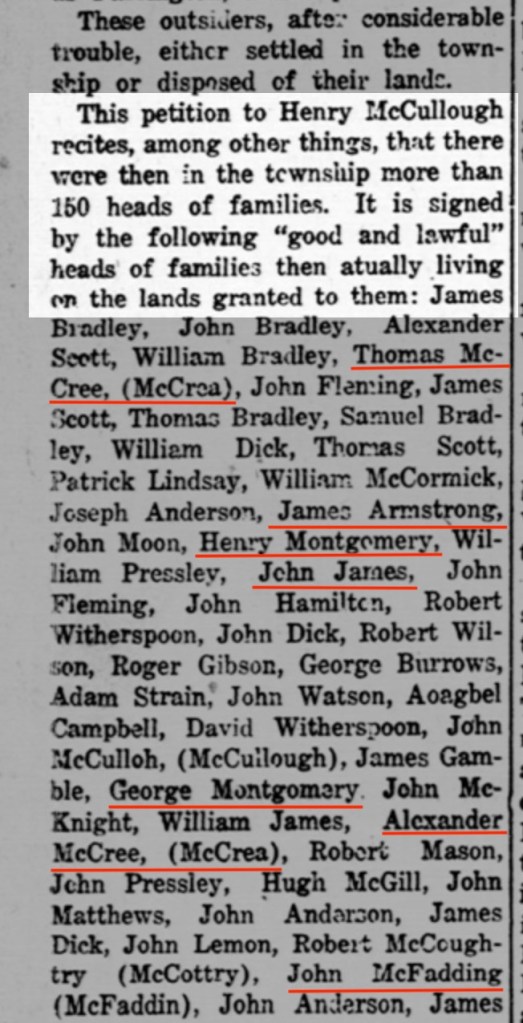

The January 1742 petition establishes that George Montgomery was in Williamsburg township prior to January 1742. The petition also suggests that all or many of those signing the petition came to South Carolina from Ireland, since it states,
We have letters from our friends in Ireland, acquainting us of their desire to come here, if we could in any shape encourage them, which we have to decline because of the lands being run and possessed by others.
As Boddie notes,[4]
In 1732, a colony of forty Scotch-Irish under the leadership of Roger Gordon settled about the King’s Tree on Black River on lands now within the immediate vicinity of Kingstree. Making up this colony of forty, were the families of the following men: Roger Gordon, Edward Plowden, Robert Ervin, James Armstrong, David Johnson, Adam McDonald, William James, Archibald Hamilton, David Wilson, and John Scott.
As we’ll see in a moment, a number of documents focusing on George Montgomery show him connecting to James Armstrong and John Scott.

An historical marker in Kingstree states,[5]
In 1732 Roger Gordon led 40 Scotch Irish to found Williamsburg Township, (Kingstree), one of 11 inland sites granted by the Provincial Governor in King George’s plan to develop a successful English colony in South Carolina. In 1738 the town acquired 2 acres of his land to build Williamsburg Meeting House, original site of the Williamsburg Presbyterian Church and this cemetery. Capt. Gordon died in 1750.
Wikipedia’s entry for the early history of Williamsburg, South Carolina, indicates that in 1732 a colony of forty Scots-Irish led by Roger Gordon came up the Black River by boat and settled in the vicinity of the King’s Tree (i.e., Kingstree).[6] This source identifies these immigrants as “poor Protestants” from Northern Ireland.
W.S. Fleming states the following:[7]
From 1730 to 1734, this colony, the parent of one in this country of Maury, to be mentioned presently, migrated to Williamsburg District, South Carolina, of which Kingstree is the county seat. Of those who came during the above period were the following heads of families: James McClelland, William and Robert Wilson, James Bradley, William Frierson, John James, Roger Gordon, James Armstrong, Erwin, Stuart, McDonald, Dobbins, Blakely, Dickey and perhaps a few others. In the last named year, to wit, 1734, John Witherspoon, of the same family with the distinguished signer of the Declaration of Independence, born near Glasgow, Scotland, in 1670, and who had removed to County Down, Ireland, came to Williamsburg, bringing with him his four sons, David, James, Robert, and Gavin and his daughters, Jennet, Elizabeth and Mary and their husbands, John Fleming, William James (father of Major John James, of revolutionary memory and distinction) and David Wilson. All these colonists were from County Down, Ireland. They were all members of the Presbyterian Church or reared and indoctrinated in its faith.
A query by S. Davis at South Carolina GenWeb site for Williamsburg County, South Carolina, states that Roger Gordon’s son John Gordon married Janet Montgomery, possibly a daughter of George Montgomery.[8] As we’ll see when we look at George Montgomery’s will, it names a daughter Janet/Jannet.

Craven County, one of South Carolina’s original counties, existed from 1664-1768, and was a county in name only with no county seat and no county records.[9] Records were kept at the parish level. Prince Frederick Parish was created in 1734 when Prince George Parish was split.[10] The parish was in Craven County 1734-1768, and Georgetown District 1768-1800. By 1790 Prince Frederick Parish (as well as Prince George’s to the east) took up all or part of six present-day South Carolina counties: Williamsburg, Florence, Marion, Dillon, Horry and Georgetown.
Williamsburg township was part of Craven County originally, and comprised much of the present Pee Dee region. It was later divided and became several counties including Williamsburg County. In 1868, Williamsburg District became Williamsburg County.
2. George Montgomery may have been in South Carolina prior to 1742 if the George Montgomery in Williamsburg township by January 1742 is the George Montgomery of the following two documents listed in the consolidated index to South Carolina Archives records. An entry in the consolidated index says that between 1720-3, George Montgomery gave a power of attorney to Elizabeth Montgomery. The original records is in South Carolina’s Conveyance Books Public Register.[11] To obtain a copy of the original, one must go to the South Carolina Archives or contact them for a copy. The entry for this record in the consolidated index contains no information about a specific place in which this power of attorney was given.
Another entry in the consolidated index says that on 18 May 1733, a memorial to Thomas Lynch for 300 Acres in Prince George Parish, Craven County, summarizes a chain of title to a grant to George Montgomery. The original record is in South Carolina’s Memorial Books and is available only by visiting or contacting the South Carolina Archives.[12]
I think these two records may refer to a George Montgomery other than the man settled in Williamsburg township prior to January 1742. I tend to think that George came to that township after Roger Gordon had led his colony of Ulster Scots there in 1732. If the information in Joseph P. Montgomery’s diary is correct, then George Montgomery’s son Hugh was born in Ireland in 1738, and that would mean George came to South Carolina after that date.
3. George Montgomery acquired land in Williamsburg township on 23 March 1750, when James Akin Esq. of Berkeley County deeded to George Montgomery, a planter of Williamsburg township in Craven County, 1,000 acres in Williamsburg township bounding southwest lands formerly owned by Thomas Dial but now owned by heirs of Nathaniel Drew deceased, northeast lands of James McNealy and William Grimes, and also on the southwest land owned by George Montgomery. All other sides were vacant. James Akin signed with witnesses Alexander McCree and Edward Howard. On 9 August 1751 in Berkeley County, McCree proved the document and it was recorded 10 August. Added to the deed is a document dated 24 March 1750 which states that 500 of the 1,000 acres were granted to James Akin on 9 April 1736 and on the same day Charles Codnor had a grant for 500 acres joining Akin’s land which Codnor sold Akin on 1-2 May 1736.[13]
Alexander McCree, whose surname is also sometimes given as McCrea or McCrae, was signatory of the January 1742 petition of Williamsburg township inhabitants to Henry McCulloch. He witnessed George Montgomery’s will and as we’ll see in a moment, he and a Thomas McCree/McCrea/McCrae appear often in records of George.
On 16 December 1751, George Montgomery sold Alexander McCree, both of Williamsburg township, 250 acres of the 1,000 acres he had bought from Akin, for £207 pounds 10s. George and Janet Montgomery both signed this deed by mark with witnesses John Liviston and John Scott. On 18 December 1751 in Berkeley County, Liviston proved the conveyance and it was recorded 13 December 1752.[14] Note that though George Montgomery signed by mark here, he signed his name to his will.
John Liviston/Leviston was another of the signatories to the January 1742 petition to Henry McCulloch.
As we’ll see in a moment, George Montgomery’s will names a wife Rebekah. Since a number of sources indicate that George had a son Hugh born in 1738, who is not named in George’s will, I think it’s likely that George had a wife prior to Rebekah, and if that’s true, then she may be the Janet signing this deed. If the Janet signing the deed with George is his wife, then she appears to have died after December 1751, and George then married Rebekah, by whom he had several children before he made his will in May 1758.
4. On 15 June 1756, Henry Montgomery deeded to George Montgomery, both of Craven County, South Carolina, for 7s 6d 100 acres in Prince Frederick Parish, Craven County, bounding on the northwest land laid out to James Akin and Charles Codner, now owned by George Montgomery and Alexander McCrea. The deed is signed by Henry with witnesses Robert Stivenson, Thomas McCree, and Henry Price. Thomas McCree proved the deed 13 June 1760 and it was recorded 14 September 1778.[15]
The diary of Joseph P. Montgomery says that the Hugh Montgomery it claims was George Montgomery’s father had only one son, George. I think it’s very likely, however, that Henry and George Montgomery were brothers. Henry Montgomery is said to have been born abt. 1700 – and to have died abt. 1769 in Williamsburg, and to have married Sarah McRae (McRee) about 1744, and to have died in Williamsburg. Note the McRae/McRee surname. Henry’s will was proved 26 January 1769.[16] It mentions wife, Sarah, sons, William and Henry; daughters, Sarah Jannett Dunn and Mary Armstrong and nephew, Hugh Montgomery. It was witnessed by Alexander McCrea, John McElveen, and William McCullough.
Note Alexander McCrea’s/McCree’s appearance in Henry Montgomery’s will, and also that Henry’s daughter Mary married an Armstrong. And note, in particular, that Henry named a Hugh Montgomery as his nephew. I think in all likelihood this is the Hugh who is said to have been a son of George Montgomery, if Joseph P. Montgomery’s claim that George had a son Hugh is accurate.
5. On 8 November 1757, George Montgomery had a township grant of 150 acres in Williamsburg township, Craven County.[17] People mentioned in the grant record include James Akin, William Grimes, John Holden, and Thomas McCree. (This citation is from the consolidated index to South Carolina Archives records; to obtain a copy of the original, one must go to the archives or contact them for a copy.)

6. On 10 May 1758, George Montgomery made his will, noting that he was of Williamsburg, Prince Frederick Parish, Craven County.[18] The will names wife Rebekah, older children James and Jannet, and a younger son George. The will indicates that all three children are not yet aged 20 years. To James, George leaves 250 acres he bought from James Akin and 150 acres that George “runs” (i.e., farms, I think), and if James dies before reaching 20, the land is to go to Jannet. Another tract of 100 acres is left to George, and if George dies before reaching 20, the land is to go to Jannet. Executors are Rebekah, Henry Montgomery, James Armstrong, and William Stuart. George signs with Samuel Paxton, Alexander McCree, and John McFadden witnessing, with McCree and McFadden signing by mark. The will has no probate date.
Again, note that Henry Montgomery was one of George’s executors, as was James Armstrong, who is mentioned previously and who signed the January 1742 petition along with Henry and George. Note that Alexander McCree was a witness to the will. John McFadden, another witness, was another signatory to the January 1742 petition to McCulloch.

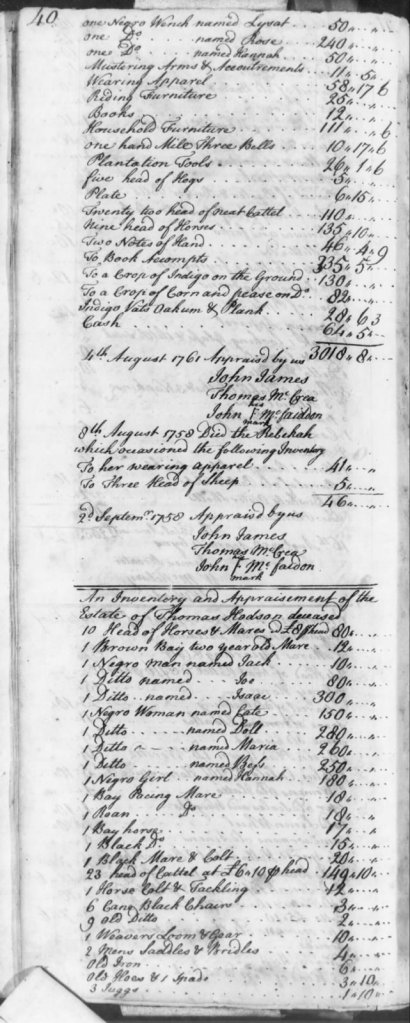
7. On 4 August 1761 the estate of George Montgomery was inventoried and appraised by John James, Thomas McCrea/McCree, and John McFaiden/McFadden.[19] Included in the inventory and appraisement is a statement that “the Rebekah” died 8 August 1758, and her inventory, done by the same three appraisers on 28 September 1758, is appended to George’s. George’s estate included seven enslaved persons whose names are given. It includes books, which suggests that George or other family members were likely literate. It also includes mustering arms and accoutrements, suggesting he was likely in a militia and may have been an officer. It also indicates that he grew indigo, corn, and peas (likely field peas).
George Montgomery’s will and his inventory and appraisement indicate that he died between 10 May 1758 and 4 August 1761. Note that the Montgomery and Rowntree Families and Genealogy site has George Montgomery dying in 1800.[20]
Again, notice the recurrence of Thomas McCree and John McFadden’s names in the inventory and appraisement. Both were signatories of the January 1742 petition. A Thomas McCrea Jr. left a will in Williamsburg naming wife Mary, children Mary Ann, Susannah, and Thomas Armstrong, all with the surname McCrea.[21] Thomas’ executors were his wife Mary, Alexander McCrea, and James McFaddin. The will was witnessed by James McFaddin, Alexander McCrea, and John Scott Jr. The appraisers of Thomas McCrea’s estate were John Scott Jr., James McElveen, and James Montgomery.
As noted previously, John Scott and James Armstrong were members of the colony of Ulster Scots that Roger Gordon brought to Williamsburg township in 1732. A John Scott Sr. made his will in Williamsburg township on 29 April 1820.[22] The will names his sons by his first wife, Joseph, John Thomas, William Robert, Albert Alexander McCrea, and Samuel James Washington Scott, as well as his current wife Rebecca Gordon and their unborn child who became John Ervin Scott. Executors were wife Rebecca, John’s brother Joseph Scott, and his son John Thomas Scott. Witnesses were James McFaddin, Mary M. Flagler, and Samuel Scott. John’s appraisers were James McFaddin, Samuel Scott, and John Montgomery.
If the information that many of the Ulster Scots colonists of Williamsburg township came from County Down, Ireland, is correct, then the recurring surnames found in George Montgomery’s documents – McCree/McCrea/McCrae, Armstrong, Scott, McFadden, etc. – might provide some clues as to the specific whereabouts in County Down from which this Montgomery family came to South Carolina.
[1] A typescript excerpt of the 1817 diary of Joseph P. Montgomery is attached to WikiTree pages for George Montgomery and his son Hugh, and is entitled “Brief Story of Hugh Montgomery’s Ancestors.” The typed diary extract states that the diary was owned (at the time the typescript was made?) by Mrs. Forest L. Jordan of Gable, South Carolina. The typescript was uploaded to WikiTree by Ruth Montgomery.
[2] See Find a Grave memorial page for Hugh Montgomery, Orrs Field cemetery, Williamsburg County, South Carolina, created by Donna McPherson, with a tombstone photo by zack_23.
[3] William Willis Boddie, History of Williamsburg (Columbia: State, 1923), pp. 64-6; Boddie, “Undesirable Aliens in Ancient Williamsburg,” in the County Record newspaper of Kingstree, South Carolina on 16 March 1922 (p. 4, col. 1-2).
[4] Boddie, History of Williamsburg, p. 10.
[5] “Captain Roger Gordon,” Historical Marker Database website, information and photo submitted by Anna Inbody.
[6] “Early history of Williamsburg, South Carolina” at Wikipedia.
[7] W.S. Fleming, “Scotch-Irish Settlers in South Carolina, and Their Descendants in Maury County, Tennessee,” in The Scotch-Irish in America, Proceedings of the Scotch-Irish Congress (Cincinnati: Robert Clarke & Co., 1889), pp. 202-3.
[8] S. Davis, “160 – GORDON / MONTGOMERY / MCKNIGHT / BENNETT,” at South Carolina GenWeb site for Williamsburg County, South Carolina.
[9] See “Craven County, South Carolina Genealogy,” in FamilySearch’s Research Wiki section.
[10] “Prince Frederick Parish, South Carolina,” in ibid.
[11] South Carolina Conveyance Books Public Register Bk. B0, p. 207.
[12] South Carolina Memorial Books, Copy Series, Bk. 3, p. 417.
[13] Public Register Conveyance Bk. 2I0, pp. 186-192.
[14] Public Register Conveyance Bk. 2M0, pp. 88-91.
[15] Register of Mesne Conveyance Bk. 4Y0, pp. 221-3.
[16] See Boddie, History of Williamsburg, pp. 84-5.
[17] Williamsburg, Craven County, South Carolina, Township Grants Bk. 2F, p. 198.
[18] South Carolina Will Bk. 1757-1760, pp. 150-1.
[19] South Carolina Inventory and Appraisement Bk. T, pp. 39-40.
[20] “George Montgomery (1715-1800),” Montgomery and Rowntree Families and Genealogy site.
[21] See Boddie, History of Williamsburg, p. 231.
[22] Ibid., p. 236.
 BEGATS AND BEQUEATHALS
One thought on “Notes about George Montgomery (abt. 1699 – abt. 1758) of Williamsburg, Craven County, South Carolina”