That posting discussed John’s bible, in which the name John Mills is written twice: John Mills signed his name twice in the bible. As the previous posting tells you, the John Mills writing in John Lauderdale’s bible is a John Mills (bef. 1743 – 1833) who fathered a child by John Lauderdale’s sister Elizabeth and then reneged on a promise to marry her. The posting notes that the Mills family lived close to the Lauderdale and Looney families on Looney’s Creek in Botetourt County, Virginia, all thickly connected to each other, with members of all three families leaving Botetourt County together for Sumner County, Tennessee, and other places to the west.
As the linked posting also indicates, on 31 October 1782, John Lauderdale appears along with his brothers James and William in a list of men serving in a Botetourt militia company headed by Captain John Mills.[1] Keep that October 1782 date and the fact that John Lauderdale served in John Mills’ Botetourt militia with his brothers James and William Lauderdale in mind. This information will frame the discussion that follows of how — I think — it happened that John Lauderdale ended up less than two years later filing a petition on 25 May 1784 for bounty land in Franklin County, Georgia, for service as a “Refugee soldier” in Georgia during the Revolution.[2] A digital copy of that petition is at the previous posting. This is the other framing document I encourage you to keep in mind as we think about what was going on with John in the years immediately prior to his appearance in Georgia records in May 1784.
At some point between October 1782 and May 1784, John Lauderdale must have been in Georgia, serving as a soldier, if these two framing documents refer to the same John Lauderdale and provide reliable information about him. The question is, then, how a man living in western Virginia up to 1784 could also have been spending time in Georgia and have done Revolutionary military service there prior to May 1784.
I do not have documentation to fill in every gap in the picture I’m now going to sketch, but in my view, the documents I’ll be citing as I sketch this picture provide a plausible foundation for suggesting that, while John Lauderdale was enrolled in a Botetourt County militia, he and other Botetourt County soldiers were involved in military campaigns to the southwest of Botetourt County, including perhaps in Georgia.
John Lauderdale is in Botetourt County records up to 1783, and then he disappears from county records. His nephew John Lauderdale, son of James Lauderdale Jr., begins showing up in Botetourt County records in the late 1780s. This younger John was born 16 September 1768 in Botetourt County.[3] When this younger John Lauderdale begins to appear in county records in the late 1780s, he is not designated as Jr., an indicator that the older John who was his uncle had left Botetourt County.[4]
From the time that John Lauderdale, son of James Lauderdale Sr., drops from Botetourt records after 1783 up to the late 1780s when John’s nephew of the same name begins appearing in Botetourt records, John Lauderdale is absent from Botetourt records, an indication that the older man left the county after 1783. Not only does John disappear from Botetourt records after 1783, he’s almost never mentioned in them before this point. This suggests to me that he may well have been spending time on military expeditions to the southwest while serving in the Botetourt militia, a pattern that is easily demonstrated in records of other Botetourt County men serving in the county militia during these years.

A possible indicator that John may already have been spending time to the south of Botetourt County prior to 1780, while keeping a foothold in Botetourt: On 15 April 1774, Botetourt court minutes note that in the case of John Mills for Anne vs. James Walker, a commission had been granted to take the oath of John Leatherdale in North Carolina.[5] I do not have proof positive that this is John Lauderdale son of James Sr., but I think that this is possible and that John might already have been spending time in North Carolina, perhaps in Sullivan County to which his sister would move by 1776 (I’ll discuss this later) as early as 1774.

It’s also possible that the John Leatherdale of this court records is an older John Lauderdale also found in Botetourt records. On 5 March 1771, this older John Lauderdale, who is likely a brother of James Sr. and an uncle of James’ son John, signed a receipt in Botetourt to William Preston, executor of Colonel Buchanan, for two shillings six pence for weighing hemp for Buchanan’s estate.[6]
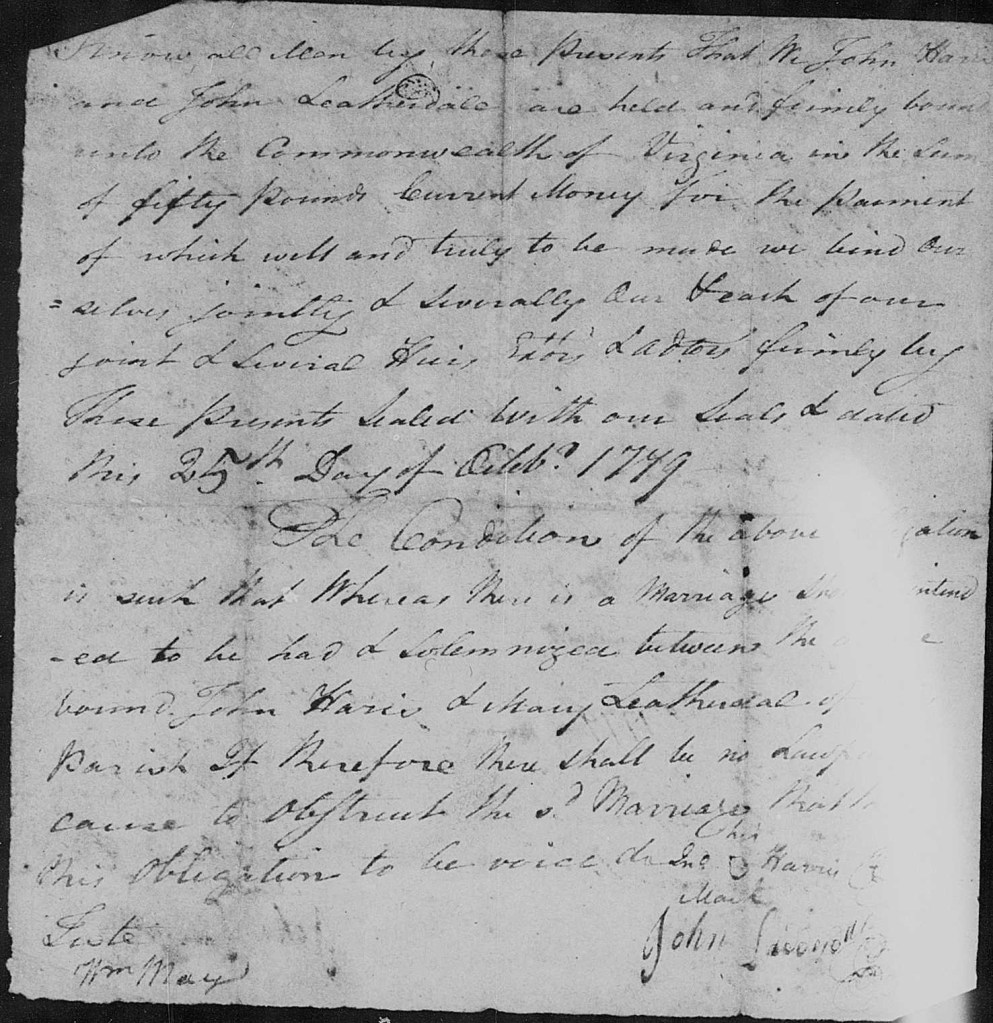
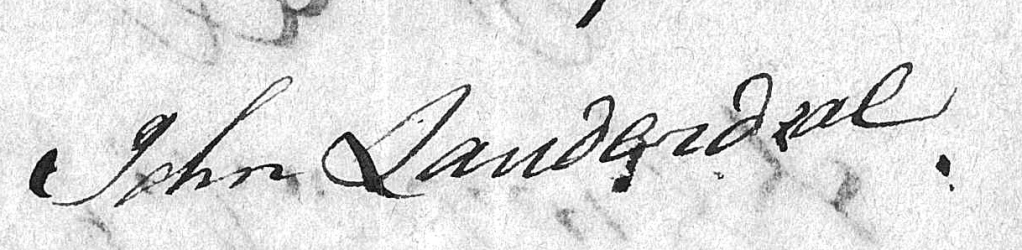
Clint Lauderdale proposes that this March 1771 receipt was signed by John Lauderdale son of James Sr., but that is not correct.[7] But the signature of the John signing the 1771 receipt — he signs as John Lauderdeal — does not match the signature of John Lauderdale on his May 1784 petition for bounty land in Georgia. The same John Lauderdeal signed a bond on 25 October 1779 in Botetourt County for John Harris’ marriage to his daughter Mary. The bond spells John and Mary’s surname as Leatherdale, but John signed as Lauderdeal. The signature on the bond matches the signature on the 1771 receipt to Preston.[8]
Note, by the way, the variant spellings of the surname Lauderdale found in colonial Virginia records. They include, in addition to Lauderdale, Lauderdal, Lauderdel or Lauderdell, Lauderdeal, Leatherdale, Letherdale, or Leatherdeal, Lederdale, and Lidderdale or Liddledale.

A 6 October 1780 record in Botetourt County could, I think, belong to either of these two John Lauderdales who are likely uncle and nephew: on this date, John Lauderdale appears in a public service claims list for supplying two bushels of wheat to militia troops.[9] A certificate for this service was issued to him by Patrick Lockhart and William Ward, commissioners for provisions purchased in Botetourt County.
Then moving again to 1782: The 31 October 1782 record for John Mills’ Botetourt militia company showing James, William, and John Lauderdale serving in Mills’ company is, as I stated in the previous posting, a snapshot of three brothers with these names, all named as the three sons of James Lauderdale Sr. in his 22 September 1796 will in Sumner County, Tennessee, doing militia service together under Captain John Mills.[10]


This reading of the 1782 militia list is reinforced by 1783 tithables list and the 1783 personal property tax list in Botetourt County, the latter showing the following Lauderdale men taxed in Captain Mills’ company: James, William, William, Robert, Joseph, John, and James Sr.[11] James Sr., James, William, and John are obviously a family unit, a father and his three sons. Robert, William, and Joseph are, I believe, brothers of James Sr. (See the digital image at the head of this posting.)

After he appears on this 1783 tax list, John, son of James Sr., then drops from Botetourt records, while his brothers James Jr. and William remain there, appearing together with their father James Sr. on subsequent tax lists until they and their families went to Tennessee in the 1790s, with William apparently preceding his father and brother James there by several years. As far as I know, John Lauderdale’s disappearance from Botetourt tax lists after 1783 has not been noted by other researchers working on this man. An interesting record which may indicate that John Lauderdale had already left the county by May 1783 is a note in Botetourt County court minutes on 8 May 1783 that John Leatherdale was among men on whom the court had levied a fine for failing to appear in court for jury duty.[12]
As I noted in a previous posting about Moses Birdwell, a neighbor of these Lauderdales in Botetourt County who, like them, had ties to the Looneys, a Revolutionary pension affidavit that Richard Cavett made on 19 August 1834 at Huntsville, Madison County, Alabama, suggests that Botetourt County people were already moving to Sullivan County, North Carolina (later Tennessee), where the Birdwells moved in 1779-1780, as early as the mid-1760s.[13] Cavett states in his affidavit that he was 70 years old and had been born on the headwaters of the James River in Botetourt County, Virginia, and that soon after his birth, his father Moses Cavett had moved the family from Virginia to Sullivan County, North Carolina.
In July 1757, Margaret Lauderdale’s first husband Peter Looney gave a fascinating account of his captivity in June 1756 by native Americans allied with the French during the French and Indian War. Looney told his captivity story to a Philadelphia representative of the London Chronicle: or Universal Evening Post, and the narrative was printed in that newspaper in its 6-8 September edition in 1757.[14] In his report, Looney (whose name is given as Lewney in the London paper) recounts that he was an ensign in a company of Rangers in the back parts of Virginia in June 1756 when members of his troop went to aid settlers of western Virginia under attack from the French and Indians as he, Captain Smith, and others were blockaded in a blockhouse.
On 25 June, the blockhouse was attacked by a group of native Americans and French and those who survived and surrendered were then taken by the native Americans, with Looney being brought to Fort Detroit. In June the following year, he accompanied a group of native Americans to Niagara, and managed to escape along with one William Phipps. The two reached Albany, New York, by 12 July and then Looney went to Philadelphia, where he was born, and from there intended to return to Virginia, where his parents lived (in Augusta County). The report states that Peter Looney was aged about 23 in 1757.
At some point before 6 November 1777, John Lauderdale’s sister Margaret left Botetourt County with her second husband James McCain to move to Washington County, Virginia, contiguous to Sullivan County, North Carolina. Following Peter Looney’s death in 1760, she remarried to James McCain, who posted bond on 16 March 1768 with her father James Lauderdale in Augusta County, from which Botetourt was formed, on behalf of Margaret’s administration of Peter’s estate.[15]
John Mills elder, father of Captain John Mills, gave bond with James Lauderdale (Lidderdale in the original) and Margaret Looney (Luney here) in Augusta County on 18 November 1760 when Margaret filed for administration of Peter Looney’s estate, and John then appears in records of the estate.[16] On 15 September 1773 in Botetourt, William Crow, John Looney, and John Mills Jr. were ordered to allot to Margaret McCain, late Looney, wife of Peter Looney, deceased, her dower in lands of which her husband was possessed at his death.[17] On 15 November 1775, with approval of the Botetourt Court, Peter Looney, orphan of Peter Looney, deceased, chose James Letherdale Jr. for his guardian.[18]
As these records show, the Lauderdale, Looney, and Mills families living on Looney’s Creek in Botetourt County were thickly intertwined by the time James Lauderdale Jr. and his brothers William and John were serving in Captain John Mills’ militia company in 1782. As historian F.B. Kegley notes, John Mills lived on Looney’s Creek, where James Lauderdale Sr. and his family also lived, and was inspector at Crow’s warehouse on the creek until 1792.[19] As a previous posting notes, the same page of Augusta Parish vestry minutes that shows George Birdwell’s land being processioned by the vestry shortly before 28 January 1765 also shows James Lauderdale’s 366 acres on Looney’s Mill Creek processioned.[20]
Members of the Looney family as well as Margaret Lauderdale’s husband James McCain (his surname often given as Cain) begin appearing in records of Washington County, Virginia, and contiguous Sullivan County, North Carolina, by 1776 just after Botetourt County men serving under Colonel William Christian, including James McCain, had engaged in a military expedition to these areas in the latter part of 1776, a point to which I’ll return on a moment. On 6 November 1777 in Washington County, Virginia, James Cain and a number of Looney men including Margaret’s son Peter signed a petition of inhabitants of the lower part of the county to protest the erection of a courthouse.[21]
At this point, it appears that James and Margaret McCain were living on the Holston River on land granted to members of the Looney family. As Muriel C. Spoden notes, until 1779, when a North Carolina-Virginia boundary survey proved they were mistaken, those living in the part of Washington County where James and Margaret and the Looneys settled thought they were in Washington County but were actually living in Sullivan County, North Carolina.[22] The first court of Sullivan county was held at the house of Moses Looney in February 1780, a brother of Margaret Lauderdale’s first husband Peter Looney, and on 23 October 1782, James Cain had a grant of 240 acres on both sides of Big Creek in Sullivan County.[23] By 1787, James and Margaret had moved their family to Sumner County, Tennessee, where her father James Lauderdale and her brothers James Jr. and William would soon settle.
I just mentioned the Cherokee Expedition of Colonel William Christian of Botetourt County in the latter part of 1776, which is sometimes called the Christie Expedition, since many of the men serving in it referred to their commander as Colonel Christie. Christian had previously commanded a company of men in the 1760s in an expedition against the Cherokee Indians on the southwestern frontier. So Botetourt County men were traveling back and forth between the frontier, between the North Carolina-Virginia border and areas even further south, as early as the 1760s.
On 1 August 1776, due to reports of predation by the Cherokees on settlements in southwest Virginia and what’s now northeast Tennessee (then North Carolina), the Virginia government ordered Colonel William Christian to gather troops for an expedition against the Cherokees.[24] As F.B. Kegley states, in response to this commission, troops began assembling in Botetourt County in August and by October, the Botetourt troops had gathered at the Great Island of the Holston and had begun invading and burning Cherokee towns.[25] Among those taking part in this expedition from Botetourt were James McCain, husband of Margaret Lauderdale, and Margaret’s son Peter by her first husband Peter Looney.[26]
Also offering support to Christian’s troops was the Lauderdales’ neighbor Robert Birdwell, son of George Birdwell, who supplied horses to the troops and by 1789 had moved to Sullivan County, North Carolina, to join other family members there.[27] On 12 September 1776, Robert Birdwell signed receipt for £8 10s for beef purchased from him by Andrew Henry for the use of troops in the Cherokee expedition.[28] The money was paid to Birdwell by Thomas Madison and Patrick Lockhart.
I hope you’re seeing the pattern emerging here: From the 1760s into the 1770s and 1780s, men serving in military units in Botetourt County, Virginia,[29] were engaging in military operations that brought them to southwest Virginia and what’s now northeastern Tennessee, with not a few of those men returning after their military service to occupy land in these areas. Names that appear on records in Botetourt County in this period can be names of people who still had a foothold in the county but were actually spending time to the south and west of Botetourt County.
The whereabouts of men who appear to be living in Botetourt County during these years, but who were involved in military operations south and west of the county, sometimes become elusive, and gaps develop in information about where these men were actually living or doing military service for periods of time in these years. Another of my Botetourt County ancestors, Richard Pryor (1735/1730 – 1797), becomes difficult to trace for a number of years after 1764, when he’s found in William Christian’s militia company in Augusta County, Virginia, up to the late 1770s, when he begins showing up in records in what’s now northeast Tennessee. As J.D. Lewis notes, those serving in the Christie expedition were themselves sometimes confused about whether they were representing and serving in a Virginia or a North Carolina unit, in part because, though William Christian (Colonel Christie) was himself a Virginian, many of the captains in his Cherokee Expedition were North Carolinians.[30]
In the same period in which Colonel Christian led Botetourt troops against the Cherokees in southwest Virginia and what’s now northeast Tennessee, John Mills, James and William Leatherdale, and Robert Birdwell were also sent to the western frontier of Virginia to guard against Cherokee attacks. Historian Lewis Preston Summers indicates that at some point in 1776, the Virginia governor ordered Colonel William Fleming to gather troops to guard the frontier of Fincastle County, and Captain Thomas Rowland then brought troops including the men named above to the Fincastle frontier.[31] Before Fincastle County was abolished in December 1776 and Montgomery, Washington, and Kentucky Counties were formed from it, Fincastle County had an indeterminate and far-reaching western boundary. Fincastle was theoretically thought to extend as far west as the Mississippi River, so “guarding the western frontier” of Fincastle County could involve military expeditions quite a bit to the west of the later boundaries of Virginia.
It’s interesting that, if Preston’s list of men serving in Rowland’s company on the Fincastle frontier in 1776 is accurate, brothers James and William Lauderdale were involved in this operation along with John Mills, but James and William’s brother John was not involved. Unless Preston has somehow overlooked John Lauderdale’s name in the list of Rowland’s company, John may have remained at home while his older brothers took part in this act of service. John was the youngest of the three sons of James Lauderdale Sr.
A Revolutionary pension affidavit given by Isaac Depew in Sullivan County, Tennessee, on 7 June 1832 contains important information about what John Mills’ militia company was doing in 1780-1.[32] Depew states that in 1776, while residing in Bottatourt [sic] County, Virginia, he enlisted in Gilmore’s company under command of Col. Christy (i.e., William Christian) and “was marched through the now western portion of Virginia into the then Indian Country now East Tennessee to what was called the Long Island on Holston” where he took part in engagements with the Cherokees. After returning to Botetourt County, he then enrolled twice again under Captain John Mills, first to guard the lead mines (in what was later Wythe County) and then to march into North Carolina to engage the British in 1780 or 1781. In 1784 he settled in what became Tennessee, evidently in Sullivan County where he made his deposition.
So in 1780-1, it appears that John Mills was involved in an expedition in North Carolina to engage the British, taking Botetourt County men with him…. On 11 February 1780, William Leatherdale Jr. (son of James Lauderdale Sr.) was serving in Captain Bullett’s company of regulars of the Old Virginia Regiment, and in 1780 he received a warrant for 50 acres of land for this service.[33] It’s not clear to me which Captain Bullitt this was and whether Bullitt’s company was connected in some way to John Mills’ company. Thomas Bullitt, who was a military officer, died in 1778.
I’ve been speaking of military campaigns mounted from Botetourt County, Virginia, and movement of families from there to southwest Virginia and what’s now northeast Tennessee. My point in doing so is to underscore that there was considerable movement out of Botetourt County in the 1760s and 1770s to those areas, with military campaigns organized in Botetourt County and involving Botetourt County men connected to this movement. I’ve noted that men whose names appear on documents in Botetourt County in this period (and into the 1780s) can often actually be spending time on the western frontier of Virginia and in what’s today Tennessee while appearing in Botetourt records.

But the second record framing this discussion of John Lauderdale after his appearance on John Mills’ militia list in October 1782 shows John claiming land in Franklin County, Georgia, on 25 May 1784. John’s bounty-land claim was preceded by a note written on the preceding day, 24 May, by Major Boikin, who states,[34]
This is to certify that John Lauderdeal was a Refugee and is intitled to a Bounty of Land as per Certificate.
At some point prior to 24 May 1784, John Lauderdale was, it seems, in Georgia engaged in military campaigns there as a “Refugee soldier.” Who were these Georgia Refugees and what role did they play in the Revolution? Historian Wayne Lynch explains:[35]
No official regiment known as the Georgia Refugees ever existed. When government in Georgia collapsed, these men simply refused to surrender and carried on as an insurgency. They played key roles in the victories at Musgrove’s Mill, Blackstock’s Plantation, Cowpens, and 2nd Augusta.
In another article focusing on the role played by Georgia general Elijah Clarke as leader of the Refugees and head of the Wilkes County, Georgia militia, Wayne Lynch explains that after Charleston fell in May 1780 and after the siege of Augusta in September 1780 failed, in October 1780 Clarke brought soldiers serving with him to the Watauga settlement where they gathered with other soldiers congregating there.[36] Clarke and his soldiers went to the Watauga settlement to regroup and then took part in military actions in the Carolinas and Georgia, including the successful re-taking of Augusta in May-June 1781. Note that the Watauga settlement comprised what became Sullivan County, Tennessee, in 1779 — where John Lauderdale’s sister Margaret was living with her husband James McCain.[37]
The Major Boikin who endorsed John Lauderdale’s claim for bounty land as a Refugee soldier was Tobias Boykin (1747-1812), a Virginian who served in the Burke County, Georgia, militia and then as a lieutenant in the Georgia Continental Line. Following the Revolution, he returned to Virginia to marry and then settled in Sampson County, North Carolina. The forces Boykin commanded with Elijah Clarke included men from colonies other than Virginia and Georgia, as we learn from two interesting affidavits George Bruton gave on 25 September 1832 and 30 November 1833 in Wayne County, Kentucky, as he applied for a Revolutionary pension.[38] (On George Bruton, who is discussed in previous postings due to his connections to the Lindsey family in Spartanburg County, see here and here.)
In these affidavits, George Bruton states that, after having volunteered for service under Captain George Roebuck in the fall or winter of 1780 in Spartanburg County, South Carolina, where Bruton lived, he marched to the western frontiers and “continued ranging & guarding the frontiers, from the time we first marched, for the term of six months daily, against the Indians, British & Tories.” Then returning to Spartanburg County, with “the British & Tories pressing hard in Georgia,” Bruton says,
I marched & volunteered with others to go to the American Army in Georgia and not far from or in about 30 miles of Augusta in Georgia I with others joined the company commanded by Byas Boykin and shortly afterwards we marched to the siege of Augusta. The British, Indians and Tories then in possession, we fought under General Clark, almost a continued skirmishing & fighting for four weeks & at that time we entrenched up near the walls. And the British, Indians & Tories commanded by Colonel Brown surrendered and were guarded by us for some time & the Prisoners were sent to Savannah as I was informed. I was then discharged by my Captain Byas Boykin at Augusta having served in this tour seven months and had I think a written discharge from Captain Boykin. But have lost it.
Byas Boykin was Tobias Boykin, the officer who authorized John Lauderdale’s claim for bounty land in Georgia based on his service as a Refugee soldier. As George Bruton’s affidavits demonstrate, serving under Elijah Clarke (a North Carolinian) and Tobias Boykin (a Virginian) were not only men living in Georgia at the time of the Revolution, but men living in other colonies like South Carolina. Though I haven’t turned up one particular document showing exactly how and when John Lauderdale made his way from Botetourt County, Virginia, to Georgia to serve as a Refugee soldier, if he claimed land in Georgia in May 1784 based on his service as a Refugee, then at some point while he continued appearing in Botetourt records up into 1783, he evidently spent time in Georgia serving under Clarke and Boykin — and, again, note John’s familial connection to the Watauga settlement, where Elijah Clarke brought his soldiers in the fall of 1780 and rendezvoused with other soldiers before returning to Georgia to mount further military campaigns.
Figuring out precisely who served as a Georgia Refugee soldier and what those soldiers did is complicated by the fact that there are few records of their activities, as Wayne Lynch notes:[39]
So, why are the Georgia Refugees almost completely unknown to history? The answer might be their lack of definition as a unit or possibly that Elijah Clarke is thought to have been illiterate and therefore left almost no record of their activities. The problem could also be the very nature of the southern campaigns. Such a messy place overall that few go to the trouble for a real understanding of events there.

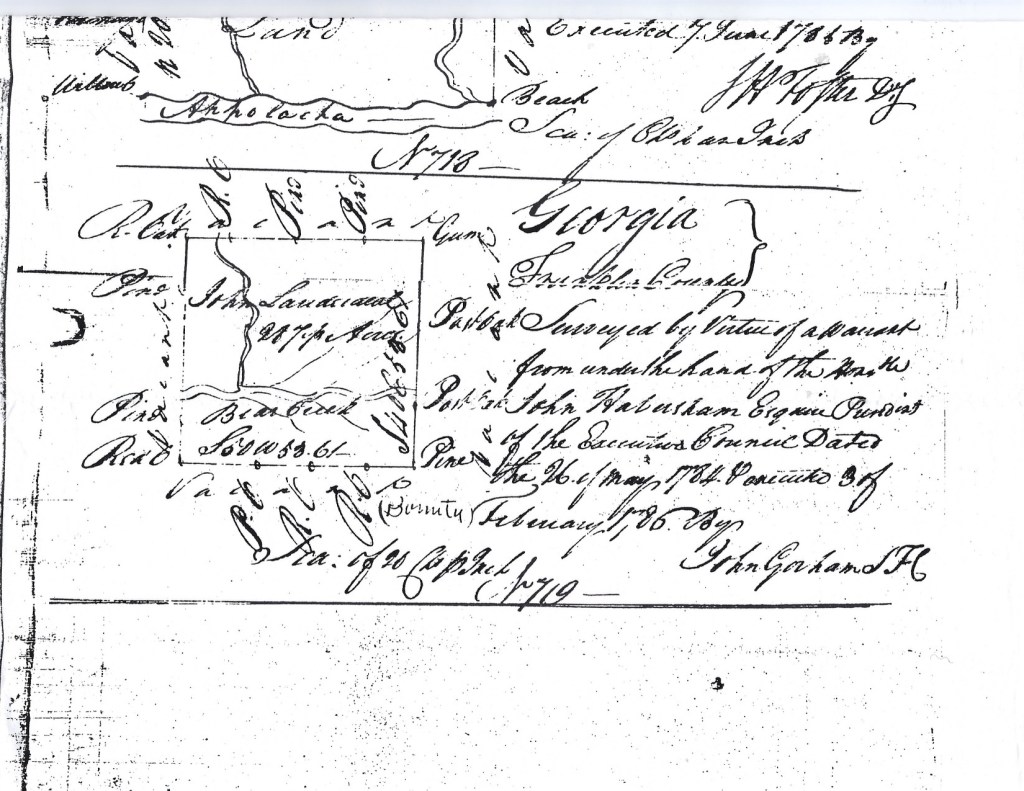

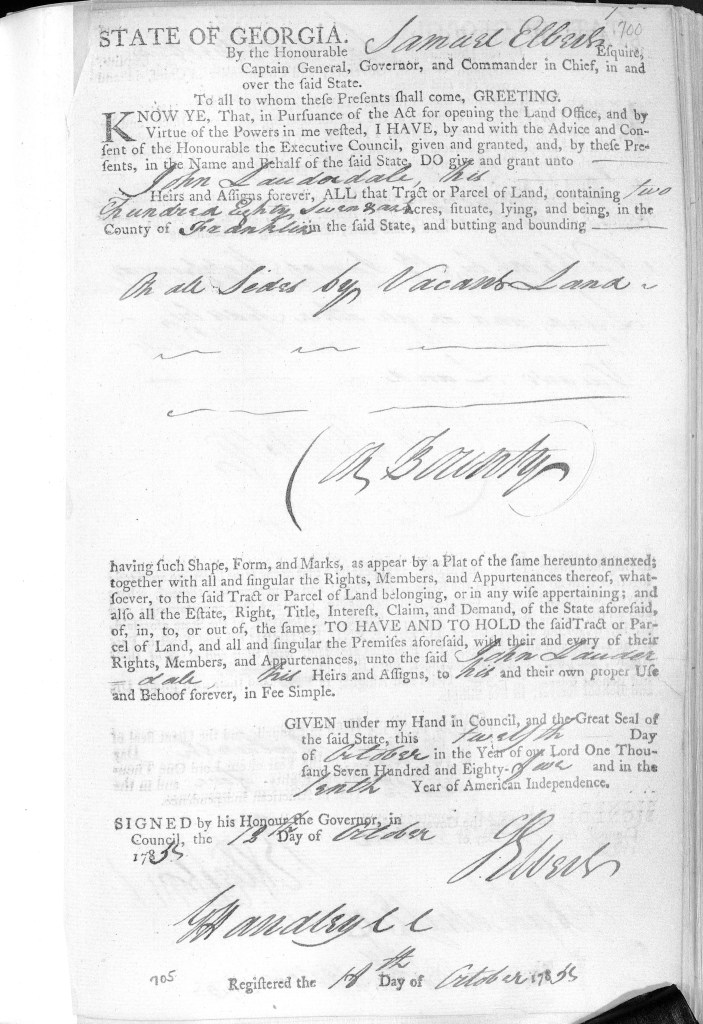
John Lauderdale’s bounty-land claim was honored and he did receive a land grant in Franklin County, Georgia. On 26 May 1784, a warrant for a survey of 287½ acres of bounty land for him was issued, and on 3 February 1785, the land, which was on Bear Creek in Franklin County, was surveyed. On 12 October 1785 the land grant was made.
As has been previously noted, Franklin County is in northeast Georgia with the Savannah River forming part of its eastern border and with Oconee County, South Carolina, across the river. Oconee was formed in 1868 from Pickens County, which was formed in 1826 from Pendleton County, where John Lauderdale was living by the latter part of the 1780s. As the posting I’ve just linked notes, from about 1790, Moses Birdwell, a son of George Birdwell, a neighbor of John Lauderdale’s family in Botetourt County, Virginia, who moved to Sullivan County, North Carolina, in 1779-1780 was living in Franklin County, Georgia, on the same Bear Creek on which John Lauderdale was granted land.
In my next posting about John, I’ll discuss what I know of John Lauderdale’s life from the late 1780s, when he begins appearing in records in Georgia and Pendleton County, South Carolina, up to 1806, when family tradition states that he moved his family from South Carolina to Sumner County, Tennessee, to join his relatives there.
[1] Anne Lowry Worrell, Early Marriages, Wills, and Some Revolutionary War Records, Botetourt County, Virginia (Baltimore: Genealogical Publishing Co., 1976), p. 48, citing the original militia lists on file in Botetourt Co. courthouse. F.B. Kegley reports that Captain Mills’ company was comprised of men living on the lower half of Looney’s Mill Creek and Back Creek, extending as far west as James Moore’s and Thomas Rowland’s: see Kegley’s Virginia Frontier: The Beginning of the Southwest, the Roanoke of Colonial Days, 1740-1783, with Maps and Illustrations (Roanoke: Southwest Virginia Historical Society, 1938), p. 418. On 10 August 1780, Botetourt County court minutes state that John Mills Jr. had been made captain in Thomas Rowland’s militia company, with James Leatherdale appointed lieutenant: see Lewis Preston Summers, Annals of Southwest Virginia (Abingdon, Virginia: Summers, 1929), p. 327, abstracting court minutes
[2] 25 May 1784 petition of John Lauderdall for bounty land, Franklin County, Georgia, for service as a “Refugee soldier,” John Lauderdale loose-plats file, Georgia Surveyor General Department.
[3] This date of birth is recorded on John Lauderdale’s tombstone in Lauderdale cemetery, Hartsville, Trousdale County, Tennessee: see Find a Grave memorial page of John W. Lauderdale, created by M. Luna, with a tombstone photo by M. Luna. The tombstone gives John’s name as John and not John W. John’s date of birth is also written in the bible of his son Samuel Holmes Lauderdale, published by Daniel D. Smith, New York, in 1828. A transcription of the register of this bible by Frank Lauderdale Saffarrans is at the USGenweb site for Sumner County, Tennessee. See also Jay Guy Cisco, Historic Sumner County, Tennessee, with Genealogies of the Bledsoe, Gage and Douglass Families and Genealogical Notes of Other Sumner County Families (Nashville: Folk-Keelin, 1909), p. 276.
[4] On 29 and 31 August 1789, John Lauderdale witnessed deeds made by his grandfather James Lauderdale Sr. in Botetourt to James Henry for 60 acres of land (Botetourt County, Virginia, Deed Bk. 4, pp. 107-8); to William Martin for 147 acres (ibid., pp. 110-112); and to William Lauderdale for 202 acres (ibid., pp. 112-3). The deed to James Henry was witnessed as well by James Lauderdale Jr. and William Lauderdale. The deed to William Martin was witnessed as well by William Lauderdale and James Henry, with James Lauderdale Jr., John Lauderdale, and James Henry witnessing Martin’s initial payment for the land. The deed to William Lauderdale was witnessed as well by James Lauderdale Jr. and James Henry. James Sr. signed all these deeds by mark, with the other men signing their names, and William sometimes signing as Lauderdeal or Lauderdel. All these tracts were on Looney’s Creek. James Lauderdale Sr.’s daughter Anna married James Henry and his daughter Elizabeth married William Martin.
[5] Botetourt County, Virginia, Court Order Bk. 1772-6, p. 436.
[6] The receipt is in Virginia Historical Society’s Preston Family Papers (Mss1 P9267).
[7] Clint A. Lauderdale, History of the Lauderdales in America, 1714-1850 (Bowie, Maryland: Heritage Books, 1998), p. 23.
[8] John Lauderdale is mentioned in Botetourt County court minutes on 11 September 1792, when the court granted Nicholas Carper leave to build a mill on land he had bought from John Lauderdale (Botetourt County, Virginia, Court Order Bk. 1788-1792, p. 541). But the land on which Carper built the mill was actually sold to him by James Lauderdale Sr. on 12 July 1790, when James Lauderdale sold Nicholas Carper for £200 1,160 acres on both sides of Looney’s Mill Creek, with son James Jr. witnessing (Botetourt County, Virginia, Deed Bk. 4, pp. 194-5). The name John Lauderdale in the September 1792 court record regarding Carper’s mill appears to be a mistake.
[9] Revolutionary War Public Service Claims, Botetourt County, Virginia.
[10] Sumner County, Tennessee, Will Bk. 1, pp. 39-41.
[11] 1783 Tithables List, Botetourt County, Virginia; 1783 Personal Property Tax List, Botetourt County, Virginia, Captain Mills’ Company, p. 6.
[12] See Lewis Preston Summers, Annals of Southwest Virginia (Abingdon, Virginia: Summers, 1929), p. 372, citing court minutes.
[13] NARA, Case Files of Pension and Bounty-Land Warrant Applications Based on Revolutionary War Service, compiled ca. 1800 – ca. 1912, documenting the period ca. 1775 – ca. 1900, RG 15, file of Richard Cavett, North Carolina, R 1820, available digitally at Fold3.
[14] The 6-8 September 1757 report in London Chronicle: or Universal Evening Post was republished as “Captivity of Peter Looney” in Mississippi Valley Historical Review 15,1 (June 1928), pp. 95-6.
[15] Augusta County, Virginia, Will Bk. 4, p. 93. See also Botetourt County, Virginia, Court Order Bk. 12, p. 87, showing John Mills going security for James Lauderdale in what seems to be a debt case having to do with Peter Looney’s estate, the suit of Samuel Mcfarrin v. James Lauderdale and James McKain.
[16] Augusta County, Virginia, Will Bk. 2, pp. 421-2.
[17] Botetourt County, Virginia, Court Order Bk. 1772-1776, p. 273.
[18] See Summers, Annals of Southwest Virginia, p. 248, abstracting original court minutes.
[19] F.B. Kegley, Kegley’s Virginia Frontier: The Beginning of the Southwest, the Roanoke of Colonial Days, 1740-1783, with Maps and Illustrations (Roanoke: Southwest Virginia Historical Society, 1938), pp. 424-5.
[20] Augusta County, Virginia, Augusta Parish Vestry Minutes 1746-1776, p. 409. The minutes are held by Augusta County Circuit Court and are available digitally online at the website of Augusta Circuit Court.
[21] The petition is transcribed — “1777 Petition of Holston Men” — at Roberta Tuller’s An American Family History website.
[22] Muriel C. Spoden, “A Note on Sullivan County,” Tennessee Historical Quarterly 25,2 (summer 1976), p. 220.
[23] North Carolina Revolutionary War Land Grants, Roll 23, Bk. 15, p. 228, no. 91.
[24] Lewis Preston Summers, History of Southwest Virginia, 1746-1786, Washington County, 1777-1870 (Richmond: J.L. Hill, 1903), p. 236; Gail S. Terry, “William Christian,” Dictionary of Virginia Biography, online at Library of Virginia website; J.D. Lewis, “Cherokee Expedition 1776 – ‘Christie’s Campaign,’” at Carolana;
[25] Kegley, Kegley’s Virginia Frontier, p. 631.
[26] Summers, History of Southwest Virginia, pp. 239, 245. See also “Cherokee Expedition of 1776, Roster,” at the Southwest Virginia Tapestry Project of WeRelate.
[27] Kegley, Kegley’s Virginia Frontier, p. 631; and
[28] Lyman Draper, Draper Manuscripts, Virginia Papers, series ZZ, vol. 5, p. 97.
[29] Before Botetourt’s formation in 1770, these men were from Augusta County.
[30] Lewis, “Cherokee Expedition 1776 – ‘Christie’s Campaign.’”
[31] Summers, History of Southwest Virginia, pp. 233-4.
[32] NARA, Case Files of Pension and Bounty-Land Warrant Applications Based on Revolutionary War Service, compiled ca. 1800 – ca. 1912, documenting the period ca. 1775 – ca. 1900, RG 15, file of Isaac Depew, Virginia, R2892, available digitally at Fold3.
[33] Lloyd Bockstruck, Virginia’s Colonial Soldiers (Baltimore: Genealogical Publishing Company, 1988), pp. 247, 301, citing muster list and warrant held by Library of Virginia.
[34] John Lauderdale loose-plats file, Georgia Surveyor General Department.
[35] “Victory for the Georgia Refugees,” Journal of the American Revolution (29 September 2014), published online.
[36] “Elijah Clarke and the Georgia Refugees Fight British Domination,” Journal of the American Revolution (15 September 2014), online. See also Robert Scott Davis, “Elijah Clark and the Revolutionary American Frontier,” Journal of the American Revolution (18 March 2025), online, noting that after Augusta fell, Clarke took some 400 to 700 people to the Watauga settlement for safety, and that researching Clarke and his activities during the Revolution is challenging, in part, because his correspondence was lost in a house fire in 1845.
[37] Roberta Tuller provides a helpful map of the extent of the Watauga settlement: “The Watauga Settlement,” An American Family History.
[38] NARA, Case Files of Pension and Bounty-Land Warrant Applications Based on Revolutionary War Service, compiled ca. 1800 – ca. 1912, documenting the period ca. 1775 – ca. 1900, RG 15, file of George Bruton, South Carolina, S30891, available digitally at Fold3.
[39] “Victory for the Georgia Refugees.” As Douglas R. Dorney Jr. notes regarding soldiers who served in the Georgia Continental Line and militias during the Revolution, “A vast majority of these men (94 percent) were not born in the colony of Georgia. Virginia accounts for the highest number of total births at 37 percent. North Carolina was second among all states with 24 percent of the total”: see “A Demographic View of the Georgia Continental Line and Militia: 1775-1783,” Journal of the American Revolution (23 February 2022), online.
 BEGATS AND BEQUEATHALS
2 thoughts on “John Lauderdale (1745 – 1830/1840): Revolutionary War Records, Virginia to Georgia (2)”