The Question of When and Where George Birdwell Was Born
This bible register provides no information about when or where George Birdwell was born. George’s date of birth has been stated by a number of researchers as around 1721.[1] I have not found a document substantiating that date of birth. The idea that George Birdwell was born around 1721 seems to have originated with genealogist Edythe Rucker Whitley, who researched the Birdwell family for a number of Texas descendants and produced a manuscript about George Birdwell and his descendants for those clients in the 1950s. I have seen a copy of this manuscript but do not have a copy of my own.
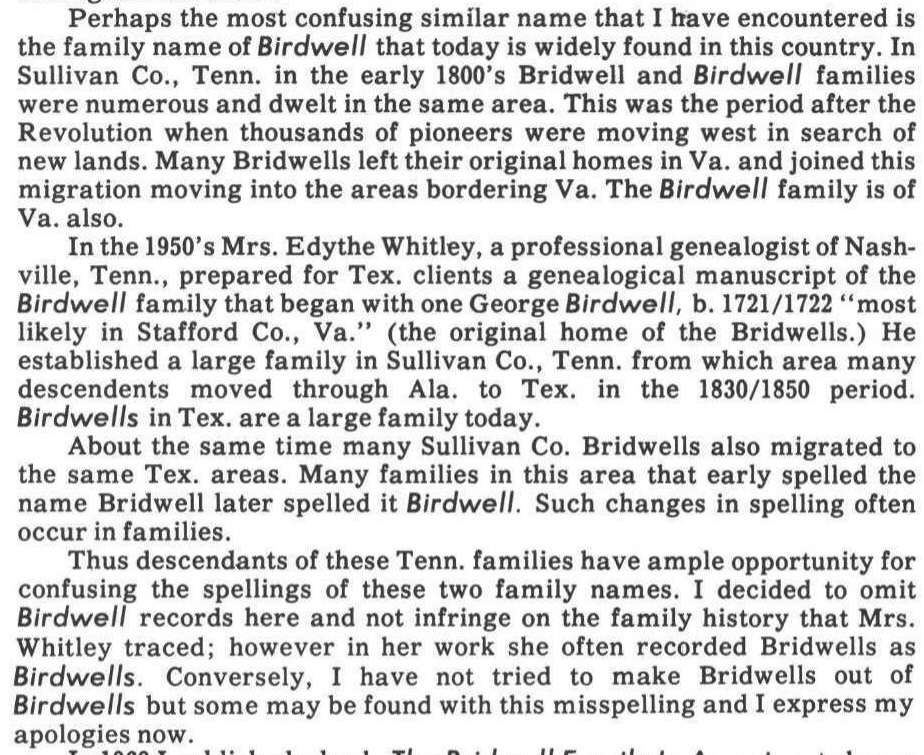
As Erbon W. Wise states in his book The Bridwell Family in America, Whitley linked George Birdwell to a Bridwell family of Stafford County, Virginia, and suggested that George was born in that county about 1721-2.[2] As General Wise indicates, for a variety of reasons including the similarity in spelling of the two surnames, the family descending from George Birdwell has been mixed up with the Stafford County, Virginia, Bridwell family from whom he descends – though these are entirely different families and there’s no evidence at all that George Birdwell had any connection to this Bridwell family, that he was born in Stafford County, Virginia, or that he was born in or around 1721.[3] As Birdwell researcher Jane LeFevre Teal concludes, there’s no documentation showing that George Birdwell was ever in Stafford County, Virginia, at any point in his life, and it’s highly unlikely that he was a descendant of the Bridwell family seated in that county.[4]
I have read claims that there are DNA matches between known descendants of George Birdwell and members of the Stafford County Bridwell family, but I have seen no evidence to document those claims. I do think that Y-DNA analysis of men who can document descent from George Birdwell and men who can document descent from the Stafford County Bridwell family should tell us quickly whether the George Birdwell line descends from the Bridwells in Stafford County. In the absence of that kind of information – I myself have not seen it, that is – I remain very skeptical of the claim that George Birdwell was born in Stafford County, Virginia, to a Bridwell father. The large majority of those living in Orange County, Virginia, where George is first found by 1745, either came there as immigrants from abroad or came down from the Middle Colonies, where their parents or grandparents were immigrants.
As we’ll see in a moment, George Birdwell was of age by 8 April 1745 when he appears in an Orange County, Virginia, court record as a witness in a trial. George’s first known child, a son Robert born to a wife prior to Mary whose name has not been found, was of age by 1771 when he appeared on a jury in Botetourt County, Virginia.[5] Robert Birdwell’s first child, a son William, was born in 1765 or 1766, so it’s likely that Robert Birdwell was born by or prior to around 1745.[6] These pieces of information suggest a birthdate by or before about 1725 for George Birdwell. To the best of my knowledge, the April 1745 Orange County, Virginia, court record is the first record yet found of George. Where he was before he showed up in Orange County records, and then in Augusta and Botetourt Counties, Augusta being formed from Orange and Botetourt from Augusta, no one has determined.
The Birdwell Family Bible
As I’ve noted above, in a previous posting I discussed a family bible published in Edinburgh in 1767 that appears to have belonged to George Birdwell’s son John (1770-1854). As I stated above, the register of this bible records the names and birthdates of George’s children by his last wife Mary. The posting I’ve just linked provides digital images of two pages from the bible, the publication page and the page of names and birthdates of George Birdwell’s first five children by wife Mary, George, Elizabeth, Benjamin, Joseph, and Moses.
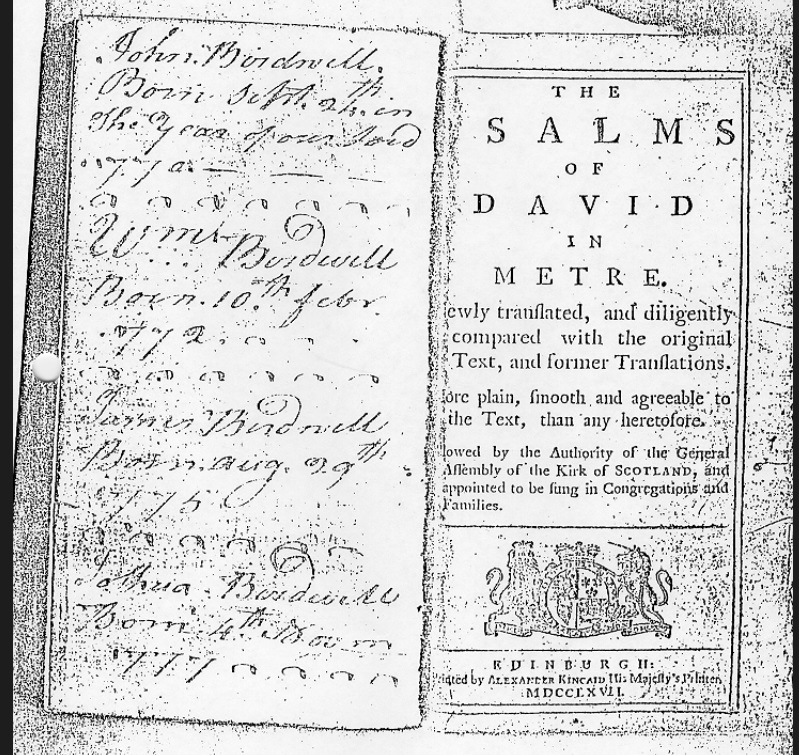
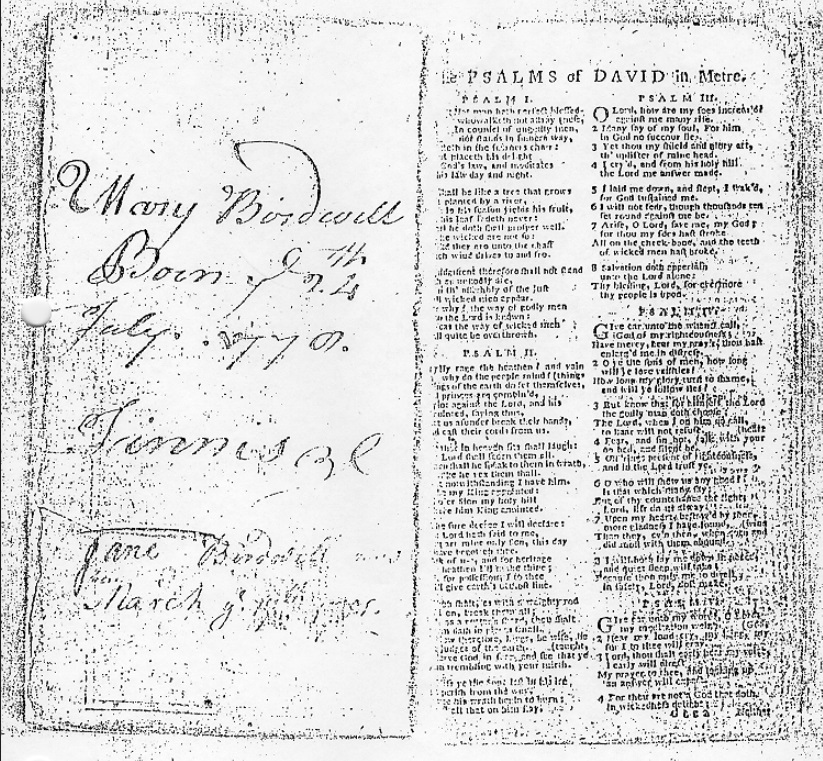
As the posting linked in the preceding paragraph says, Ray Isbell has uploaded digital images of photocopies of four pages of the bible register to the Find a Grave memorial page of George Birdwell, and a collection of Birdwell records coped by Texas DAR in 1955 also has photocopies of pages of the bible register.[7] Above is an image of the page in the bible register that continues the listing of names and birthdates of George and Mary Birdwell’s children born after Moses: John, William, James, and Joshua. The names and birthdates of the last two children, daughters Mary and Jane, are on a subsequent page of the register. Jane’s name appears to have been written in a hand different from the one recording the names and birthdates of George and Mary’s other children.
As the linked posting notes, the Texas DAR collection of records states that in 1955, this bible belonged to Mrs. H.L. Stone of San Angelo, Texas. Lucille Stone was a granddaughter of Colonel Allen Birdwell (1802-1893), son of George Birdwell’s son John, who brought this bible to Texas from Alabama.[8] I have not found clear information about who may own this bible currently.
As the posting linked above also indicates, we know the names of George Birdwell’s children by wife Mary not only from the bible register but also from George’s 14 September 1781 will, which he made in Sullivan County, North Carolina (later Tennessee), but which is filed in Bedford County, Virginia.[9] The will also names George’s children by his wife prior to Mary, whose name is not known. As I’ve already noted, the names of that first set of children and their birthdates don’t appear in this Birdwell bible register.
All the names and birthdates of George’s children entered into the bible register except the name and date of birth of his last child Jane give the appearance of having been written by the same hand. There’s no indicator in the bible register of who made these entries. Since the bible is contemporaneous with George, who is thought to have been born about 1720 and who died between 14 September and 26 November 1781, many researchers have thought George Birdwell himself made these entries in the bible register.
As the linked posting to which I keep referring also says, though researchers long thought that George Birdwell himself recorded the names and dates of birth of his children by Mary in the Birdwell family bible, after looking closely at the handwriting in the bible register and comparing it to known examples of George’s handwriting, I’ve concluded that some hand other than his wrote the entries in this bible register. The linked posting points to two documents capturing George’s signature, his September 1781 will I’ve just mentioned, and a receipt he signed on 9 August 1759 for payment made to paid to him by Colonel John Buchanan at Fort Fauquier, Virginia, for furnishing beef to troops at the fort.[10]
The handwriting of George Birdwell’s signature in both of those documents does not match the handwriting in the entries in the Birdwell bible register. In both cases, George spelled his surname Birdwel. All entries in the Birdwell bible use the Birdwell spelling. I’ve concluded that George’s son John Birdwell wrote the names and dates in the Birdwell bible register. I provide my reasons for concluding this in the linked posting.
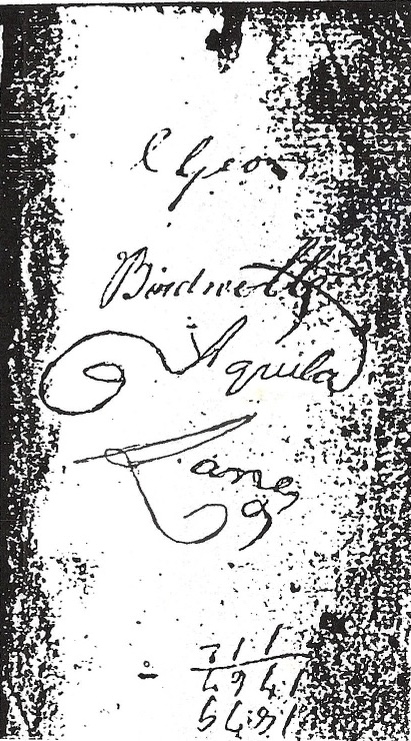
One page in the bible register appears to have only the names Geo. Birdwell and Aquila Lane. It’s clear to me when I look at the Geo. Birdwell name that this does not match George Birdwell’s signature in the two documents I’ve just mentioned that have George’s signature. There’s no explanation in the bible register for why Aquila Lane’s name is recorded here. Aquila Lane (1753 – 1819) served in 1779 in Captain William Russell’s company of Colonel William Christian’s First Virginia Regiment.[11] This service record appears to place Aquila in Fincastle County, from which most of those in Russell’s company served. Fincastle was formed out of Botetourt County, where George Birdwell lived up to 1779 when he moved to Sullivan County, North Carolina (later Tennessee). Aquila Lane received a land grant in Sullivan County in February 1779 and seems to have spent some time there before moving to Greene County, North Carolina (later Tennessee), where he lived on land that fell into Jefferson County, where he died testate with a will dated 29 April 1816, proved in March 1819.[12]
So it appears there was some rough geographic overlap in the lives of George Birdwell and Aquila Lane, though Aquila was of the generation of George’s children, and I haven’t found records showing the two men interacting in either Virginia or North Carolina/Tennessee. I can’t explain why Aquila Lane’s name is written on a page in the Birdwell bible that has George Birdwell’s name written on it.
According to Jane LeFevre Teal, the Birdwell bible also records the following names and birthdates on some inner pages: George Ford, 15 December 1784; Ninian Riggs, 13 November 1783; Mary Riggs, 20 May 1808; James Riggs, 21 May 1807 [sic]; Jessie Riggs, 31 July 1808; and Joseph Riggs, 21 January 1810.[13] Teal notes that Ninian Riggs was in Sullivan County, Tennessee, in 1812. The pages with these names written on them are not included in Ray Isbell’s digitized images of the bible register – and I do not know why these names are recorded in the bible. George Birdwell’s daughter Elizabeth married Alexander Ford: were he and George Ford relatives of each other? The Riggs family evidently settled in Jefferson County, Tennessee, where Aquila Lane ended up, and I think that both the Lanes and Riggs had Maryland roots.
George Birdwell Begins Appearing in Virginia Records, 1745
As stated above, the first record researchers have (to my knowledge) found of George Birdwell is an 8 April 1745 court record in Orange County, Virginia.[14] Orange court minutes for that date say that George Birdwell along with Peter Wallace/Wallice and John Collier were sworn and examined in court regarding Matthew Young’s charges for the felonious killing of Andrew Hemphill. The county court then decided to refer the case to the general court at Williamsburg for its next session on 19 April. The three witnesses then gave bond in the amount of £20 each to assure their appearance at the Williamsburg court, to give testimony in the trial.
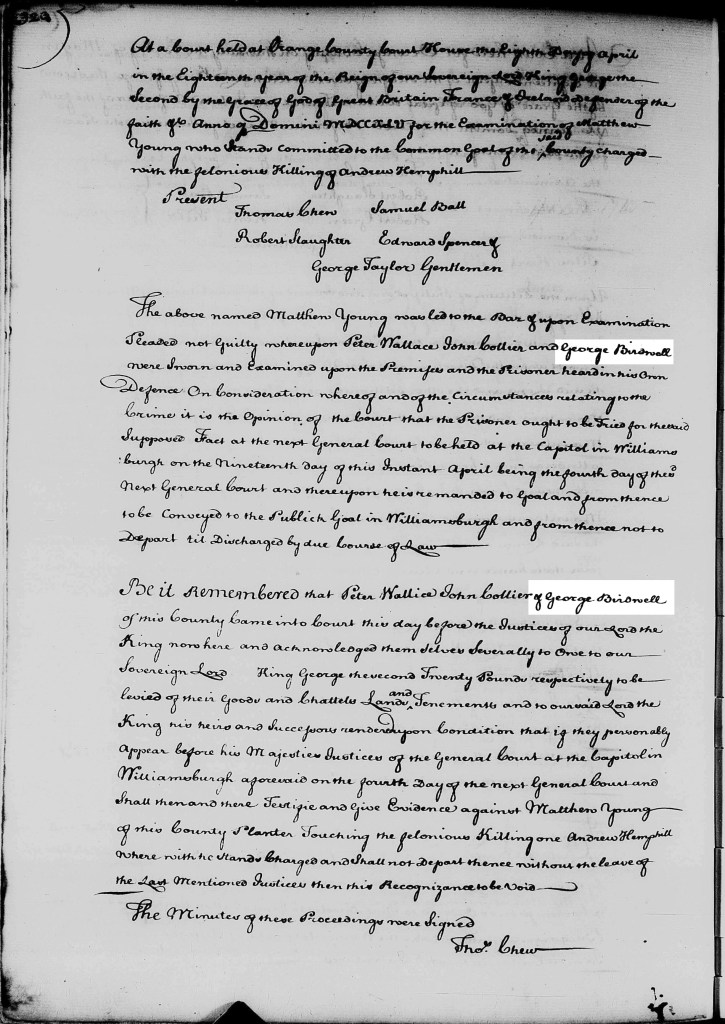
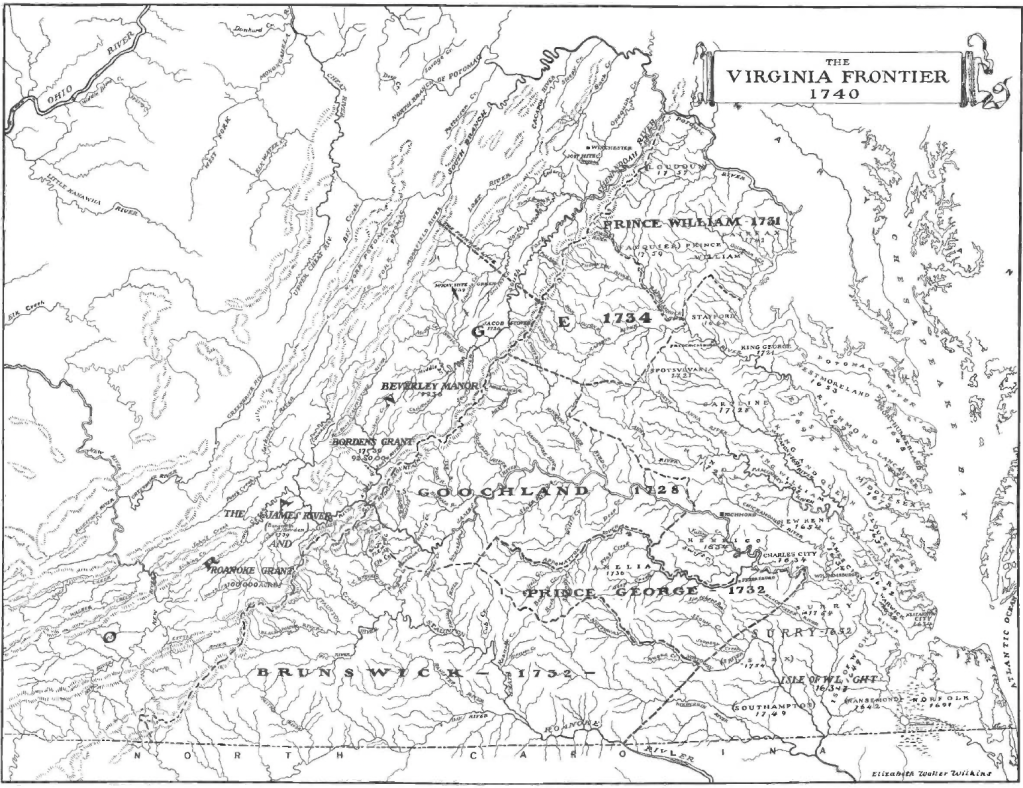
As I’ve noted previously, this court record indicates that George Birdwell was of age by 1745, so he was likely born by or before 1725. It also suggests that he was already established in Orange County by April 1745. Up to 1738, when Augusta and Frederick Counties were formed out of Orange, Orange was the westernmost county in Virginia, covering extensive territory. Augusta County, where George Birdwell was definitely living by 1750 when he acquired land there, was formed from Orange in 1738 but not organized officially until 1745. Augusta’s records were kept in Orange up to 1745. I suspect that when George testified in the Orange County trial, he was actually already living in Augusta County.
Matthew Young (abt. 1708 – 1783), Peter Wallace/Wallice (1717-1784), and John Collier (1707-1765) were all living in Augusta County by the latter half of the 1740s. Collier had a grant of 400 acres on Buffalo Creek of the James River in 1746.[15] F.B. Kegley notes that this and other early grants in that section of Augusta (later Botetourt) County were issued on surveys done by James Wood of Orange County.[16] As we’ll see in a moment, George Birdwell bought land in a bend of the James River in November 1751, downstream some 30 miles from the tract on Buffalo Creek and the James acquired by John Collier in 1746. And if George was living on that land when it was surveyed in February 1747, he may already have been in Augusta County at that location by the 1747 date.
Matthew Young shows up in Augusta County records on 1 September 1747 charged with beating Michael Bready with the butt end of a musket.[17] Matthew Young appears to have had a connection to a James Young who had a deed on 17 July 1742 from Benjamin Borden for 401½ acres on Whistle Creek in Augusta (later Botetourt) County.[18] On 4 January 1750, Matthew Young and wife Agnes sold 150½ acres out of this trace of James Young to Peter Wallace.[19] As F.B. Kegley shows in a map in his Kegley’s Virginia Frontier, James Young’s tract was in the forks of the James where Whistle Creek joined the James some miles upriver from Fort Fauquier, in whose vicinity George Birdwell settled.[20]
As with so many of the early settlers of old Augusta County, Peter Wallace and the Youngs appear to have had Ulster Scots roots. The page for Peter at WeRelate’s Old Augusta Project has him born in Ireland in 1717 and coming down to Augusta County from Cecil County, Maryland.[21] Many of the early settlers of old Augusta County moved there from Pennsylvania, Maryland, and adjacent colonies.
George Birdwell Purchases Land in Augusta (Later Botetourt) County, November 1751
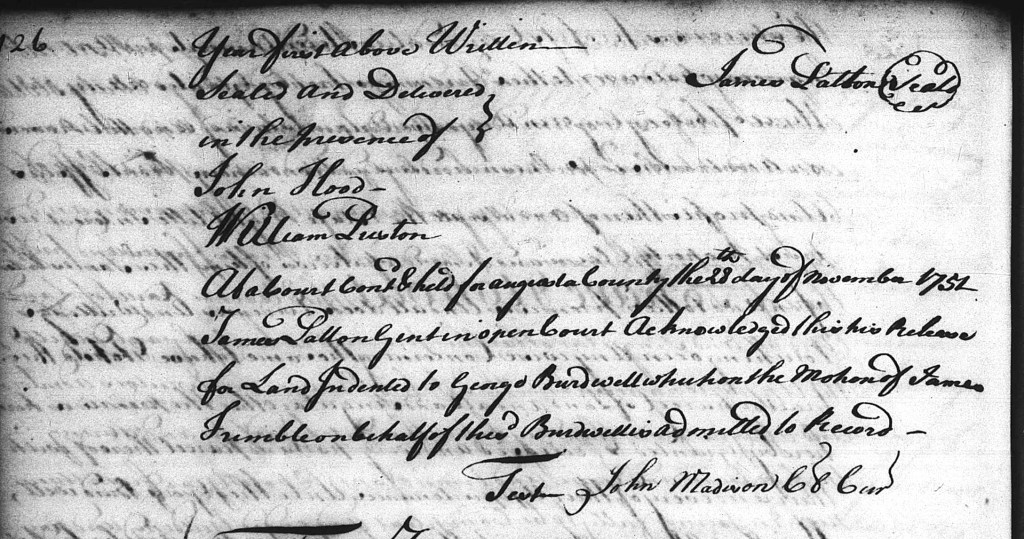
On 28 November 1751, George Birdwell bought 140 acres on the James River in Augusta (later Botetourt) County, Virginia, from James Patton.[22] The deed spells George’s surname Burdwell, and states that the land had been patented to Patton on 3 November 1750 and was in a “bent” of the James River. George paid £7 for the tract. The land description gives names of no neighbors and is a metes-and-bounds description of the land. James Patton signed the deed with John Flood and William Paxton as witnesses.
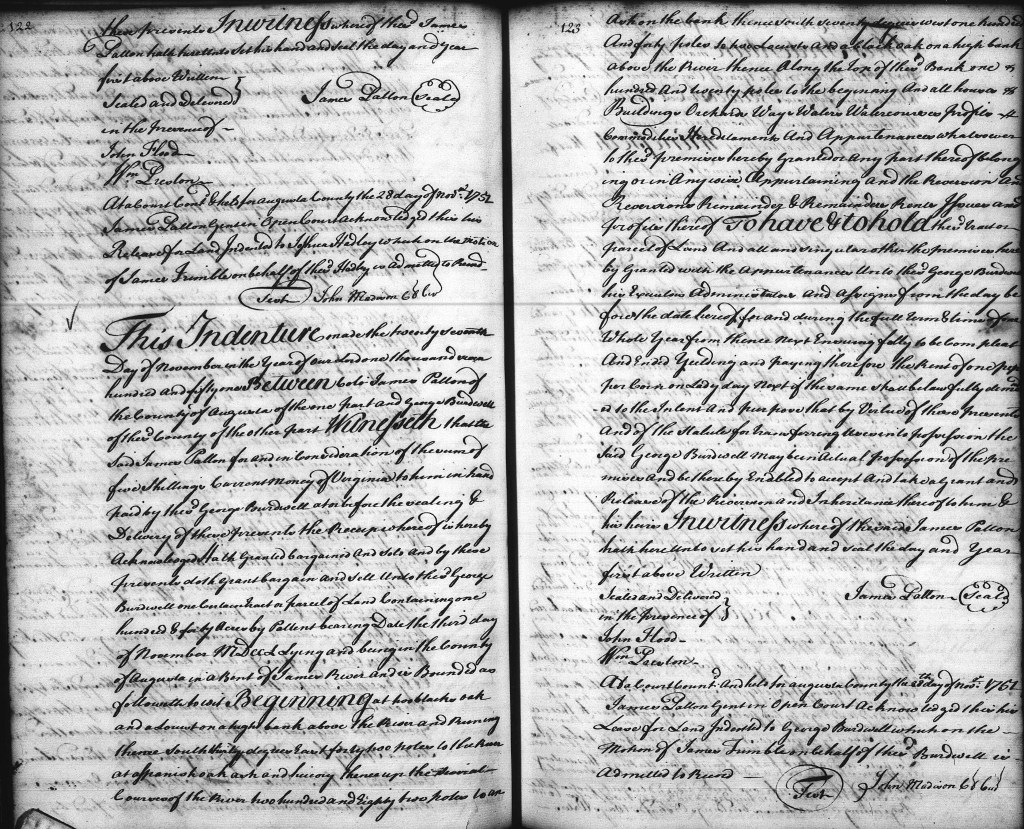
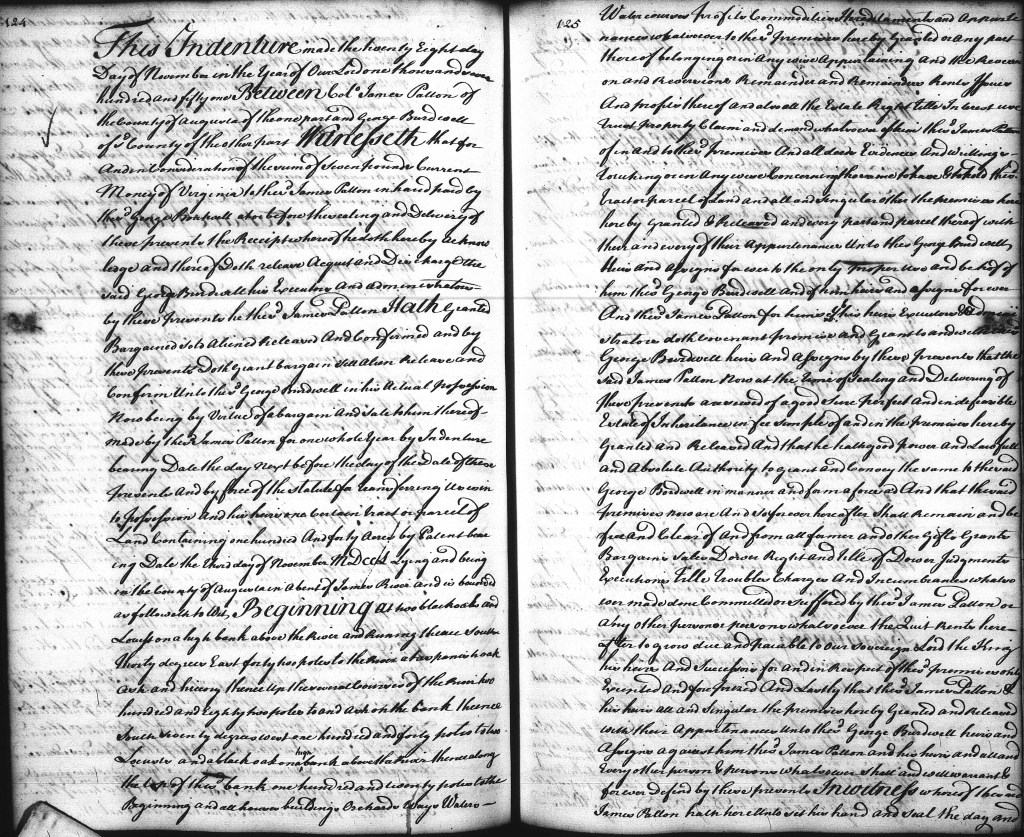
Scottish-born James Patton (abt. 1692 – 1755), who appears to have been in Ulster before coming to Pennsylvania and then Virginia, was an extensive landowner in western Virginia and a prominent Augusta County citizen in the mid-1700s. As Jim Glanville and Ryan Mays note, he held the county offices of justice of the peace, lieutenant colonel of the militia, president of the county court, and sheriff. He was also president of the Augusta Parish vestry and represented the county in the House of Burgesses.[23] Glanville and Mays state, that
Probably his single greatest achievement was obtaining his “great grant” of 100,000 acres in 1745 on the Mississippi watershed, the first ever such grant made by Virginia.
As F.B. Kegley indicates, on 3 November 1740, the Virginia State Council granted John Smith, Zachary Lewis, William and Benjamin Waller, and Robert Green leave to enter and survey 100,000 acres of land in Orange (later Augusta) County below the forks of the James River.[24] The Council’s order for this survey was renewed in May 1745 and again in 1750 to Zachary Lewis. Patton purchased the rights of all the partners of the land company except those of Smith and Lewis, and in this way, he became director of the land company. Kegley says that the grants in the region where George Birdwell settled were first issued on surveys made by James Wood of Orange, the first surveys being recorded in 1747. When Augusta was organized, James Trimble was appointed deputy county surveyor, along with Thomas Lewis and John Poage.[25]
According to Kegley, when Patton became a partner in the James River and Roanoke Grant company in 1750 and began to direct its affairs, he began granting deeds to those buying tracts of land and paying their respective sums for the land with interest due.[26] Kegley notes that Patton obtained a grant for the 140-acre tract in the “bent” of the James River that George Birdwell purchased in 1751, and on 28 November 1751, when he made his deed to Birdwell, “James Patton made conveyance to the people who had purchased tracts of land that had been patented to him as manager of the company.”[27] The tracts were scattered over the whole territory from Borden’s Great Tract on the north branch of the James to the ridge that divides the waters of New River from the waters of the James and Roanoke. These deeds Patton made on 28 November 1751 begin in Augusta Deed Book 4 on p. 76 and continue for pages thereafter.[28]
I’ve discussed James Patton in previous postings, noting that Patton was Benjamin Borden’s chief land agent in locating settlers on his Borden tract in Augusta County,[29] and that many of the tracts Patton sold to early Augusta County settlers were actually being lived on by those settlers before they acquired title to their land. I think it’s very likely that George Birdwell and his family were living on the land in the bend of the James River that he bought from Patton in November 1751 prior to Patton’s sale of that land to them.
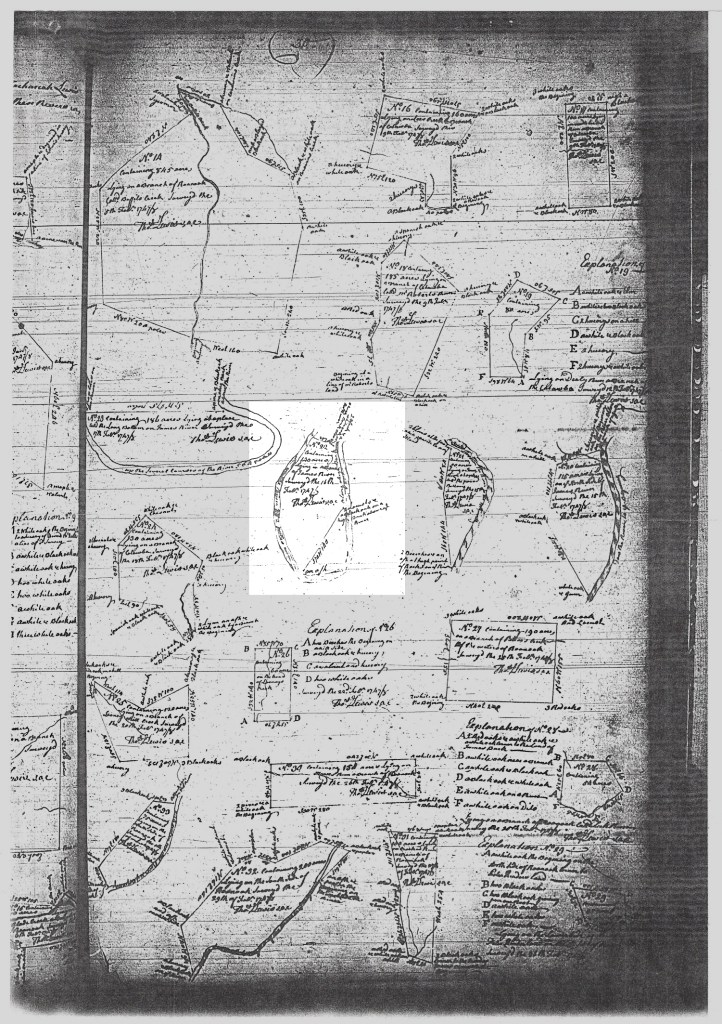
The original survey for the 140 acres George Birdwell bought from James Patton is recorded in Augusta County’s first survey book (see the close-up image of this document at the head of the posting).[30] This shows that the land was surveyed on 16 February 1747 by Thomas Lewis. The survey record does not name a particular person for whom the land was surveyed in 1747. We know from the deed Patton made to George Birdwell in November 1751 that Patton had obtained title to this land in November 1750. To me, it seems likely that George Birdwell and his family had been living on the 140 acres for some time before George purchased the land from Patton. A report issued by the Fourth Annual Birdwells Across America Reunion held in Roanoke, Virginia, in July 1997 states that George Birdwell had the land surveyed in February 1747, but that appears to me to be a misreading of these land records – though I think it’s possible George and his family were already occupying the land when it was surveyed in 1747.
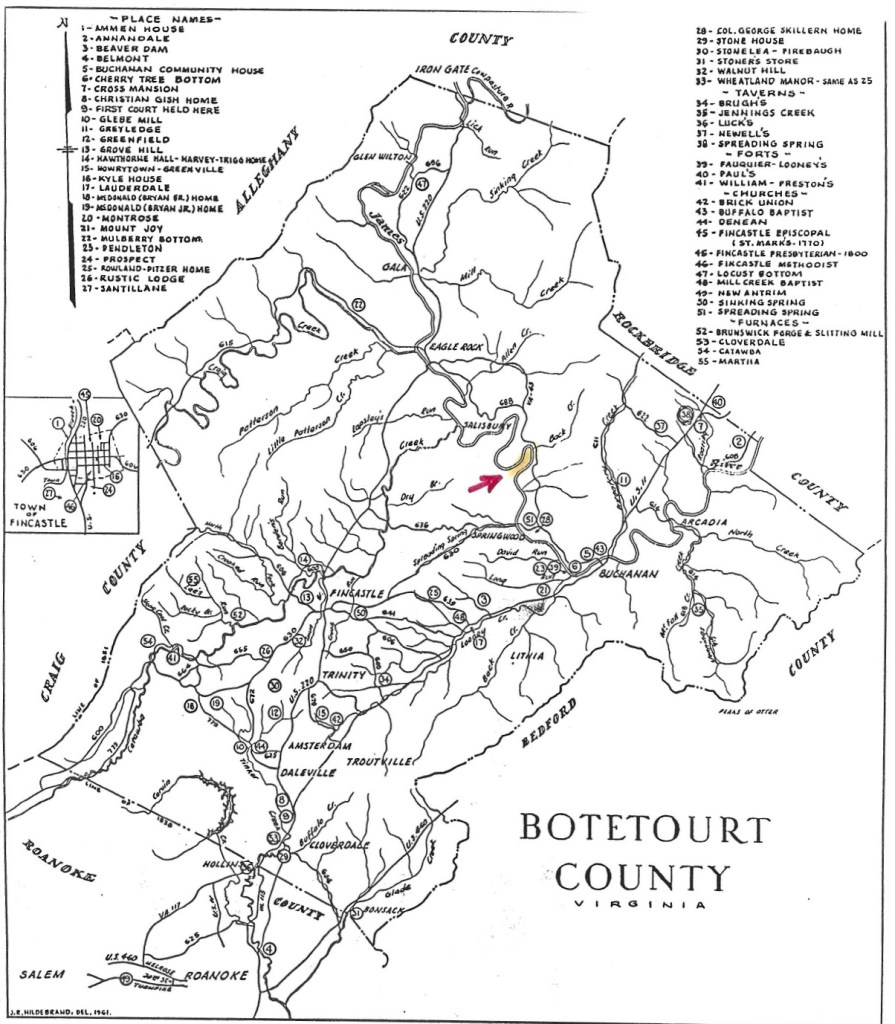
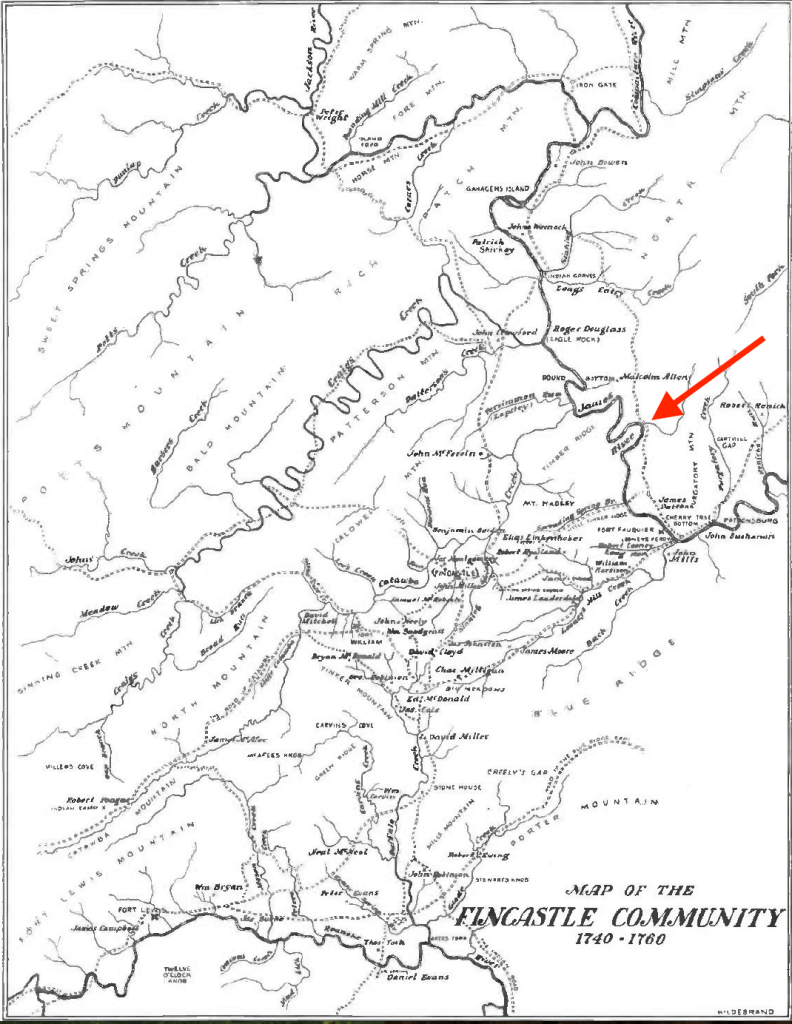
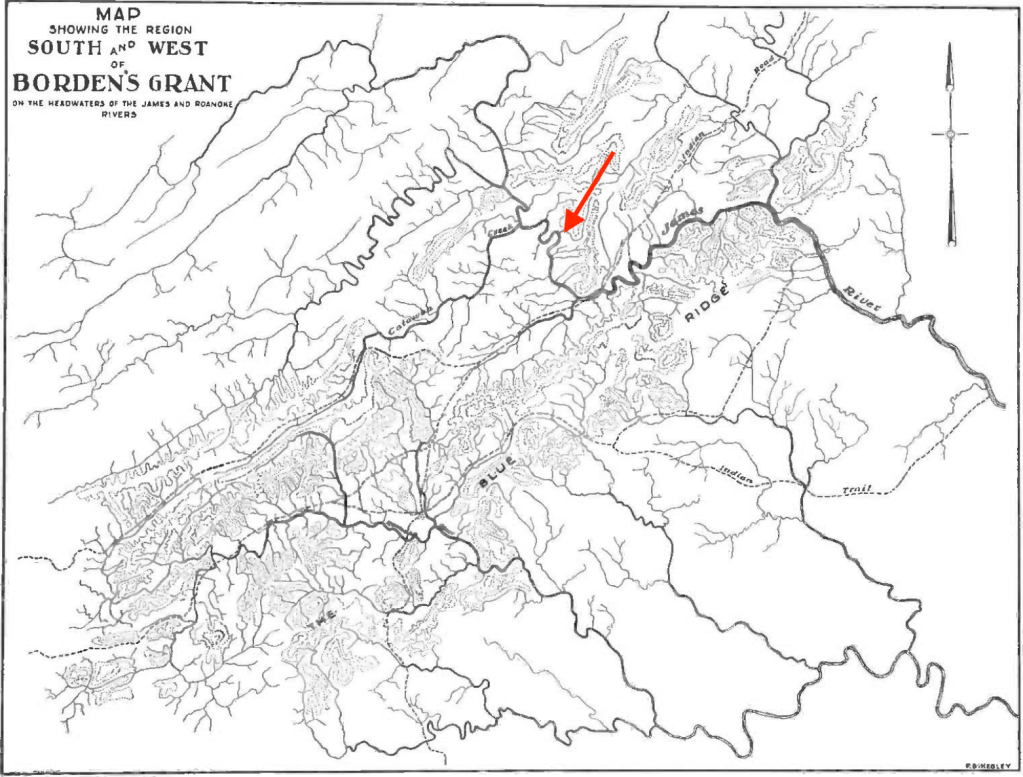
A number of maps, including several produced by Roanoke cartographer John Raymond Hildebrand, show George Birdwell’s land in the bend of the James River and allow us to place it in relation to other landmarks and communities in Botetourt County. A Hildebrand map of Botetourt drawn in 1961 shows this tract – the bend in the James – not far northeast of Botetourt’s county seat Fincastle and just northwest of the town of Buchanan.[31] F.B. Kegley’s Kegley’s Virginia Frontier also includes maps of the Fincastle community from 1740-1760 showing the bend in the James just upriver a few miles from Fort Fauquier and Looney’s ferry where Looney’s Mill Creek empties into the James, and a map showing the region south and west of Borden’s Grant which also indicates the location of this land not far south of where Catawba Creek flows into the James.[32] The town of Buchanan was founded close to the site of Fort Fauquier, where John Buchanan was commander of the militia forces in the 1750s and into the 1760s; Fort Fauquier occupied the site of a fort formerly called Fort Looney.
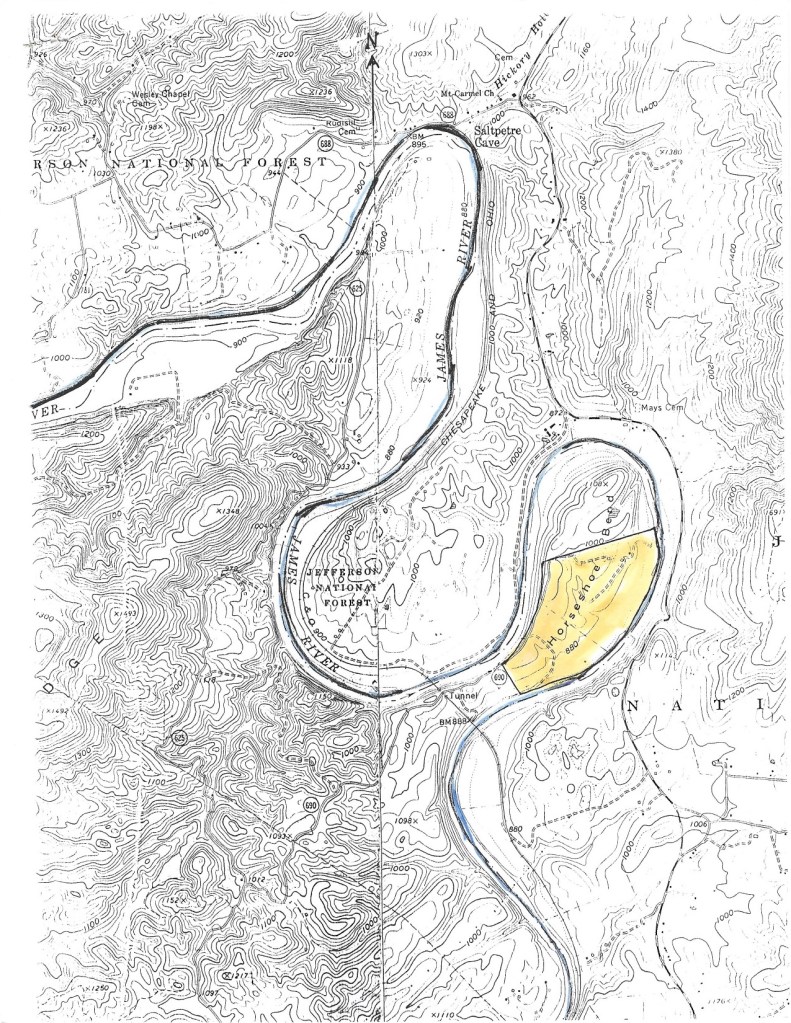
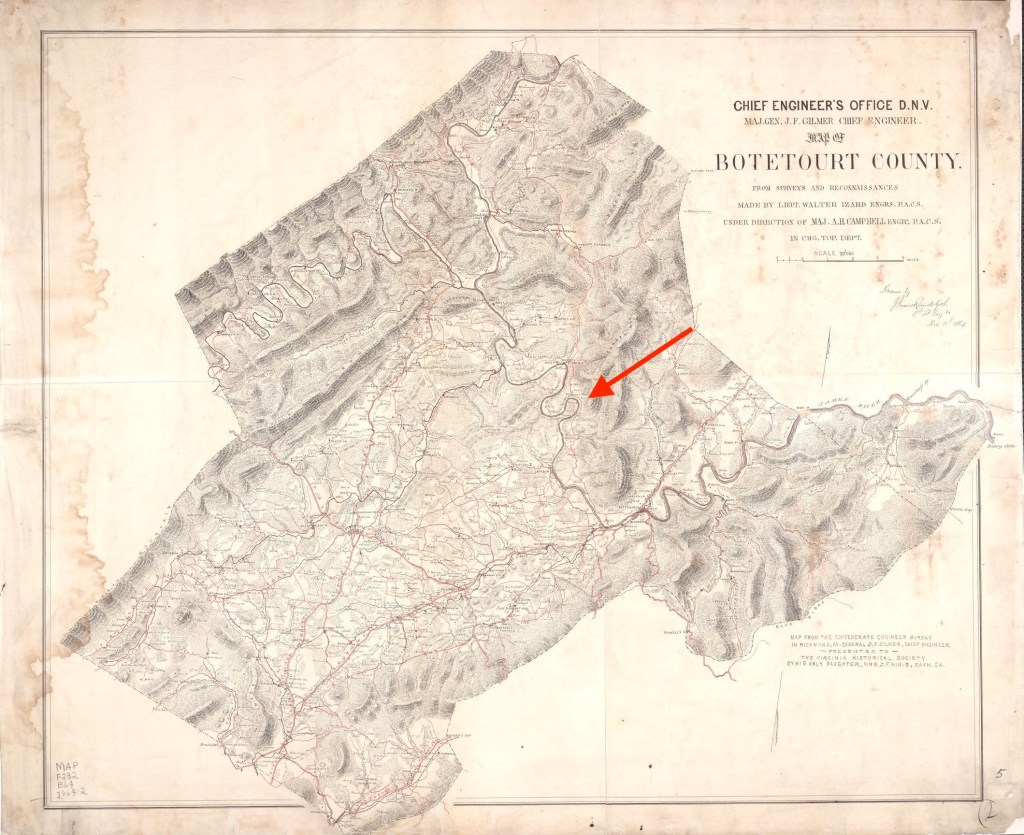
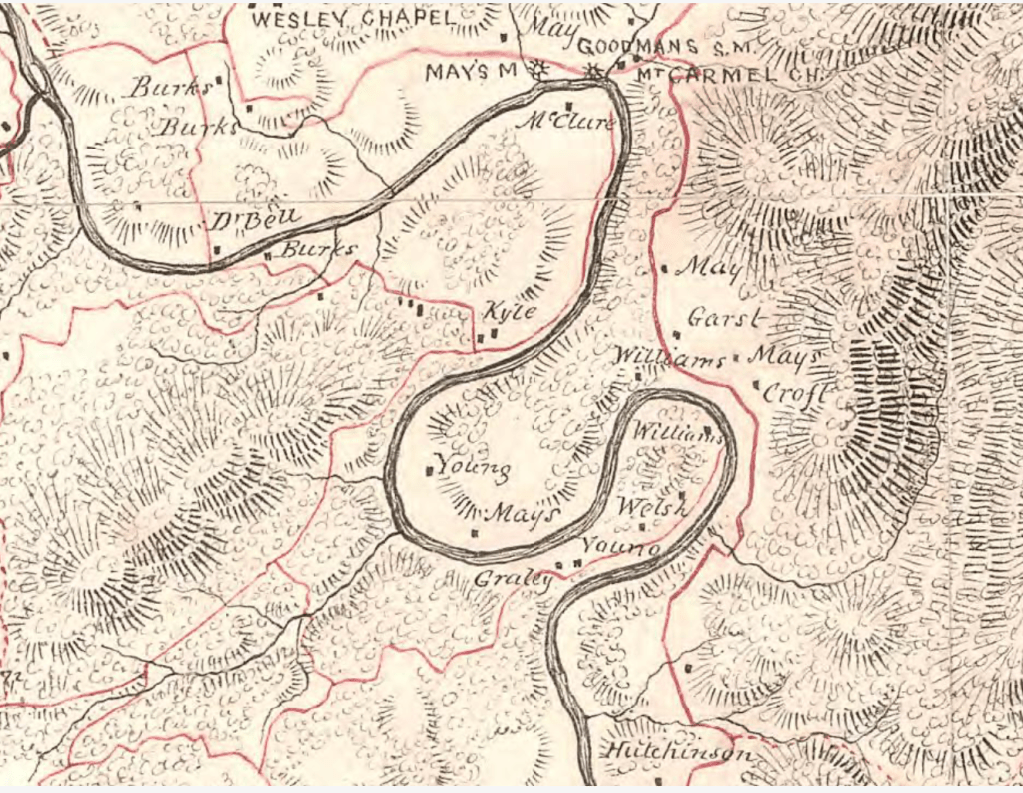
A contemporary USGS map included in the report of the Fourth Annual Birdwells Across America Reunion in 1997 identifies the land on which George Birdwell lived as “Horseshoe” and shows it adjacent to Jefferson National Forest, which borders Horseshoe on the west. A map produced by the Confederate Engineer’s Office of Virginia in 1864 and held by Virginia Historical Society indicates that in 1864, landowners named Young and Mays either owned or lived on the horseshoe bend tract.[33] John May was a county surveyor in the 1770s and today a cemetery just northeast of the horseshoe bend tract, Mays cemetery, is named either for him or his descendants.
The 1961 Hildebrand map of Botetourt County shows Malcolm Allen adjacent to George Birdwell. Allen acquired his land in 1764 in a curve on the north side of the James west of Saltpetre Cave and Grassy Island just northwest of George Birdwell’s tract. George Birdwell’s son John married Malcolm Allen’s granddaughter Mary Allen about 1794 in Sullivan County, Tennessee.
In my next posting, I’ll continue discussing records of George Birdwell in Augusta and Botetourt County, Virginia, after 1751, and his final days in Sullivan County, North Carolina (later Tennessee).
[1] See Daughters of the American Revolution (Texas), Genealogical Records Committee, Family Genealogical Records, Birdwell, 1721-1900 (1955), available digitally at FamilySearch, “George Birdwell”; notes and a family history chart compiled by Jerry H. Birdwell of Bryan, Texas, 10 November 1992.
[2] Erbon W. Wise, The Bridwell Family in America (Alexandria, Louisiana: Louisiana Offset Printers, 1968; rev. 1978), p. 4. Jerry Birdwell’s chart (see n. 1) states that he was citing as a source a handwritten, unpublished manuscript compiled by Edythe Rucker Whitley for Texas descendants of George Birdwell, which he thought was compiled about 1940. In letters he sent me on 6 November 1988, 1 February 1989, and 3 October 1989 Erbon Wise (who then lived in Sulphur, Louisiana), told me that the Whitley manuscript was composed about 1951, and that he had a typescript copy sent to him by a member of a Texas Birdwell family about 1977, which he had placed (in part, at least) in a folder labeled something like “Texas Birdwells” in his “Wise” filing cabinet in the Louisiana State Archives genealogical library in Baton Rouge. In 1989, Erbon Wise visited me and showed me this manuscript, indicating that it was apparently also in the archival holdings of Southern Methodist University’s library in a collection of Birdwell papers. I wrote the DeGolyer library at Southern Methodist University after that visit to ask for further information and got no reply.
[3] Wise notes (ibid., pp. 20-1) that a George Bridwell born about 1730 and listed on a Virginia census in Stafford County in 1785 could have been George Birdwell of Augusta and Botetourt County, Virginia, but note that George Birdwell died before 26 November 1781. The George Bridwell born about 1730 was the son of Samuel Bridwell of Stafford County. Wise traces the Stafford County Bridwell family to brothers Richard (born abt. 1648 in Virginia, died aft. 1691 in Stafford County) and Abraham Bridwell (born abt. 1650 in Virginia) (p. 12). These were presumably sons of the immigrant, Thomas Bridewell, who is mentioned as a headright of William Eyres for 750 acres in Upper Norfolk County on an arm of the west branch of the Nansemond River on 23 May 1642 (p. 10, citing Nell Marion Nugent, Cavaliers and Pioneers, p. 129, who is citing Virginia Patent Bk. 1642, p. 777). Wise assumes that Thomas Bridewell was born in England about 1620 (p. 11).
[4] Teal discusses this matter in an unpublished 1991 article entitled “Birdwell Questions–The Big Ones.” I have a copy of this article sent to me in August 1997 by Aggie Birdwell of Lubbock, Texas. See also Aggie Birdwell and Jane LeFevre Teal, “Introduction,” at A.J. Lambert’s Denny-Loftis Genealogy website.
[5] Robert Birdwell’s 1771 jury record in Botetourt County is referenced Jane LeFevre Teal’s “Birdwell Questions–The Big Ones.”
[6] On 11 April 1823, the Alabama Republican of Huntsville reported that William Birdwell, aged 57, had escaped from jail in Lawrence County, stating, “William Birdwell, recently convicted of murder in Lawrence county, aged 57, 5 feet 7 inches high, square built, and fleshy; has short grey hair, has five feet of chain attached to one ancle (sic), rather a florid countenance.” See Find a Grave memorial page of William Birdwell, burial details unknown, created by Ray Isbell.
[7] See Find a Grave memorial page of George Birdwell, burial details unknown, created by Ray Isbell; and Daughters of the American Revolution (Texas), Genealogical Records Committee, Family Genealogical Records, Birdwell, 1721-1900 (1955), available digitally at FamilySearch, “George Birdwell.”
[8] A discussion of this bible is found in Jane LeFevre Teal’s “Birdwell Questions–The Big Ones.”
[9] Bedford County, Virginia, Will Bk. 1, pp. 408-9.
[10] Lyman Draper, Draper Manuscript Collection: The Preston and Virginia Papers, series QQ, vol. 2., p. 5.
[11] See NARA, Case Files of Pension and Bounty-Land Warrant Applications Based on Revolutionary War Service, compiled ca. 1800 – ca. 1912, documenting the period ca. 1775 – ca. 1900, RG 15, file of Aquila Lane, R 6116, North Carolina and Virginia, available digitally at Fold3.
[12] Jefferson County, Tennessee, Will Bk. 2, p. 215.
[13] Jane LeFevre Teal, “Birdwell Questions–The Big Ones.”
[14] Orange County, Virginia, Court Order Bk. 4, 323.
[15] F.B. Kegley, Kegley’s Virginia Frontier: The Beginning of the Southwest, the Roanoke of Colonial Days, 1740-1783 (Roanoke, Virginia: Southwest Virginia Historical Society, 1938), p. 68.
[16] Ibid.
[17] Lyman Chalkley, Chronicles of the Scotch-Irish Settlement in Virginia, Extracted from the Original Court Records of Augusta County 1745-1800, vol. 1 (1912; republ. Baltimore: Genealogical Publishing Company, 1974), p. 529, abstracting loose court judgment papers of Augusta County. See also Augusta County, Virginia, Court Order Bk. 1, p. 289 (16 September 1747).
[18] Kegley, Kegley’s Virginia Frontier, p. 64.
[19] Augusta County, Virginia, Deed Bk. 3, pp. 160-2.
[20] Kegley, Kegley’s Virginia Frontier, p. 138.
[21] “Peter Wallace,” Old Augusta Project, Early Settlers of Augusta County, Virginia, at WeRelate.
[22] Augusta County, Virginia, Deed Bk. 4, pp. 122-6.
[23] Jim Glanville and Ryan Mays, “The Mysterious Origins of James Patton. Part 1,” Smithfield Review, 15 (2011), pp. 37-8.
[24] Kegley, Kegley’s Virginia Frontier, p. 60.
[25] Ibid., p. 68.
[26] Ibid., p. 73.
[27] Ibid., pp. 74-5.
[28] Ibid.
[29] Joseph A. Waddell, Annals of Augusta County, Virginia, 1726-1871 (Bridgewater, Virginia: C.J. Carrier, 1958), p. 30; and ibid., p. 162.
[30] Augusta County, Virginia, Survey Bk. 1, p. 30, no. 22.
[31] Aggie Birdwell of Lubbock, Texas, sent me this map in 1997. My notes indicate that it may be in Kegley, Kegley’s Virginia Frontier, but I do not find it in that book, which was published in 1938. A 1965 edition of this Hildebrand map of Botetourt County was produced for Roanoke Historical Society, noting that it has annotations by F.B. Kegley, as does the 1961 copy Aggie Birdwell sent me. Effie N. Birdwell notes in her essay “The Birdwell Family of Sullivan County,” in Families and History of Sullivan County, ed. Holston Territory Genealogical Society (Marceline, Missouri: Walsworth, 1992) that George Birdwell’s land was near Fincastle (p. 349).
[32] Kegley, Kegley’s Virginia Frontier, pp. 159, 52.
[33] Confederate States of America, Army, Department of Northern Virginia, Chief Engineer’s Office, Map of Botetourt County (1864), available digitally at Library of Congress website.
 BEGATS AND BEQUEATHALS
5 thoughts on “George Birdwell (bef. 1725 – 1781): Orange and Augusta County, Virginia, Years to 1751”