
Limestone County, 1818-1830
I’ve noted previously that Limestone County was created in 1818 from the Cherokee and Chickasaw Cessions of 1816 and 1817 and that it borders Madison County on the west, with both counties bordering Tennessee on their northern borders. The linked posting also states that Moses Birdwell had begun acquiring land in Limestone County by 24 February 1818, when James Isbell, husband of Moses’ niece Elizabeth Birdwell (a daughter of John Birdwell and Mary Allen), assigned to Moses a certificate (no. 1156) for 158.60 acres in Limestone County, at a cost of $317.20. Moses paid James Isbell $77.30 in stock and cash on 23 February 1818.[1] On 16 October 1818, James Isbell completed the transfer of the land to Moses Birdwell.

On 4 September 1821, Moses received a payment schedule (certificate no. 664) for installments he needed to pay to receive the patent to the land. He made these payments with aid from Congress under a law that gave relief to purchasers of public lands prior to 1 July 1820. The payment schedule shows Moses owing $237.90 for the land in 1821. Moses made his final payment on 27 September 1822 and received the certificate for the land (certificate no. 1156) on 1 May 1824.[2]
As also previously noted, Moses Birdwell was living in Limestone County by 1820 when the membership list of the first Baptist church established in that county, Round Island church on Round Island Creek, shows him joining that church by letter in 1820.[3] Moses’ wife Hannah joined the same church by letter in 1822[4].

Dave Hurst notes that the Round Island church predates both the county and state, having begun before 1816 in Madison County when it was still Mississippi Territory.[5] Hurst says that the church was probably first located just north of present Ripley Road southwest of Athens, less than a mile from Round Island Creek, where Richard Henderson lived by 1816. Minutes of the Flint River Baptist Association in 1816 report that Jeremiah Tucker (1782-1841) attended the first annual meeting of this association as a messenger for Round Island church. The church was constituted 17 June 1817. Its original ministers were Thomas Obanion/O’Banion and Jeremiah Tucker, Tucker having come to Alabama from Tennessee and having been ordained by Flint River Association. From 1816-1838, Round Island was part of this association. After Limestone County was created in 1818, Jeremiah Tucker was selected in 1819 as the building commissioner for Limestone County.
In May 1818, Round Island church appointed a committee to secure a place to build a new meeting house. Church minutes for January 1820 say that the church voted that month to move the meeting house. In April 1822, the church secured a lot from John Favor Sr. to build a new church near where Brownsferry Road crosses Briley Creek about five miles southwest of Athens. The church has been at this location since this date.
Moses Birdwell also appears on the 1820 Alabama state census in Limestone County with one male over 21, four males under 21, one female over 21, and 4 females under 21.[6] As noted previously, it seems that by 1820, Moses’ son James had joined him in the move from Madison to Limestone County and that James married about 1820 in Limestone County.
The Huntsville newspaper The Democrat published a notice on 26 July 1826 of unclaimed letters in the Mooresville post office.[7] The list of names included Moses Birdwell. Mooresville is some fifteen miles south of Athens near the Tennessee River.
As a previous posting states, on 18 August 1826 Moses Birdwell gave bond in Limestone County for administration of the estate of Thomas Lawrence with his son James Birdwell as bondsman along with Joseph Johnston, whose son Samuel married James Birdwell’s sister-in-law Minerva Leonard.[8] Thomas Lawrence’s estate was appraised by James Birdwell’s father-in-law Thomas Leonard, Stephen Flinn (to whom Moses Birdwell sold the land he acquired in Limestone County from James Isbell), and Jonathan Cottingham. At the sale of Lawrence’s estate on 18 September 1826, James Birdwell was a buyer. The 1820 Alabama census (cited above) enumerates Jonathan Cottingham on the same page as Moses Birdwell and suggests that they lived near each other.
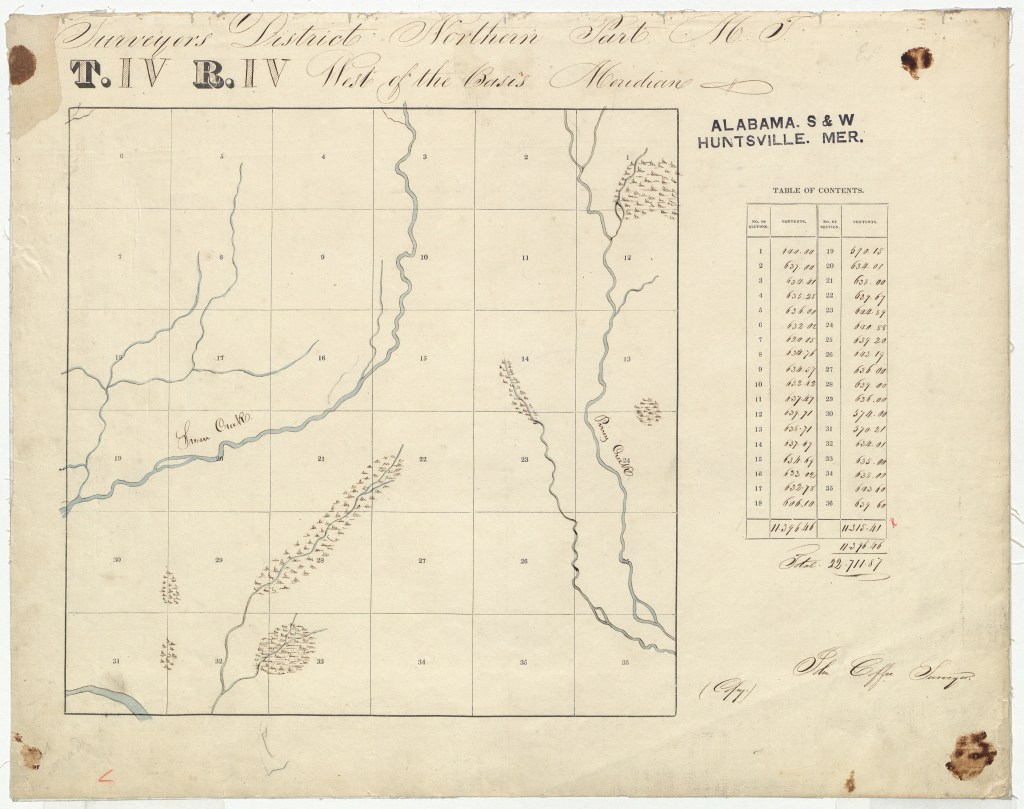
On 25 October 1826, Moses Birdwell sold Stephen Flinn, both of Limestone County, the land he had acquired from James Isbell in 1818 (see above).[9] Moses sold the land for $1,000 with wife Hannah signing along with him. On the day of the sale, Moses verified the deed and Hannah relinquished her dower rights and it was recorded. The deed states that the land was the southwest ¼ of section 3, township 4, range 4W. The coordinates indicate that these 160 acres were just east of Athens. The original federal plat for the land shows Swan Creek, a watershed of the Tennessee River that runs just east of Athens, running through the tract.
This land was not far north of 660 acres in sections 9 and 10, township 4, range 4 west that Thomas and Sarah Lauderdale Leonard, the parents-in-law of Moses’ son James Birdwell, sold in 1839. That tract was near the present community of Tanner south of Athens.[10] Stephen Flinn, who bought Moses’ 160 acres near Athens in October 1826, was closely associated with Joseph Johnston, whose son Samuel married Thomas and Sarah Lauderdale Leonard’s daughter Minerva, as noted above. Joseph Johnston, who lived near Tanner, represented Limestone County in the Alabama legislature in 1831 and 1835.[11]
On 14 December 1826, as administrator of Thomas Lawrence, Moses Birdwell petitioned Limestone County court for permission to sell a land certificate belonging to Thomas Lawrence in Limestone County.[12] The certificate was for the southwest ¼ of section 18, township 3, range 3 west.
Huntsville’s The Democrat published a notice on 22 December 1826 that on 14 December, Moses Birdwell had filed a petition in Limestone County court to sell real estate of Thomas Lawrence, deceased, for whom Birdwell was administrator.[13] The notice appeared again in the same paper on 5 January 1827.
Moses apparently filed another petition for the sale of Lawrence’s land certificate on 15 January 1827.[14] On 27 May 1828, Moses reported to the court that Lawrence’s estate was insolvent, and Joseph Johnston, Stephen Flinn, and Thomas Leonard were appointed commissioners to examine claims against the estate. Publication of the insolvency notice was ordered to be published in The Athenian of Limestone County.[15]
Jackson County, 1830-1836
As a previous posting notes, by 1830, Moses Birdwell had moved from Limestone to Jackson County, which joins Madison County on the east, bordering Tennessee on the north. Jackson County was created in 1819 from the Cherokee Cession.

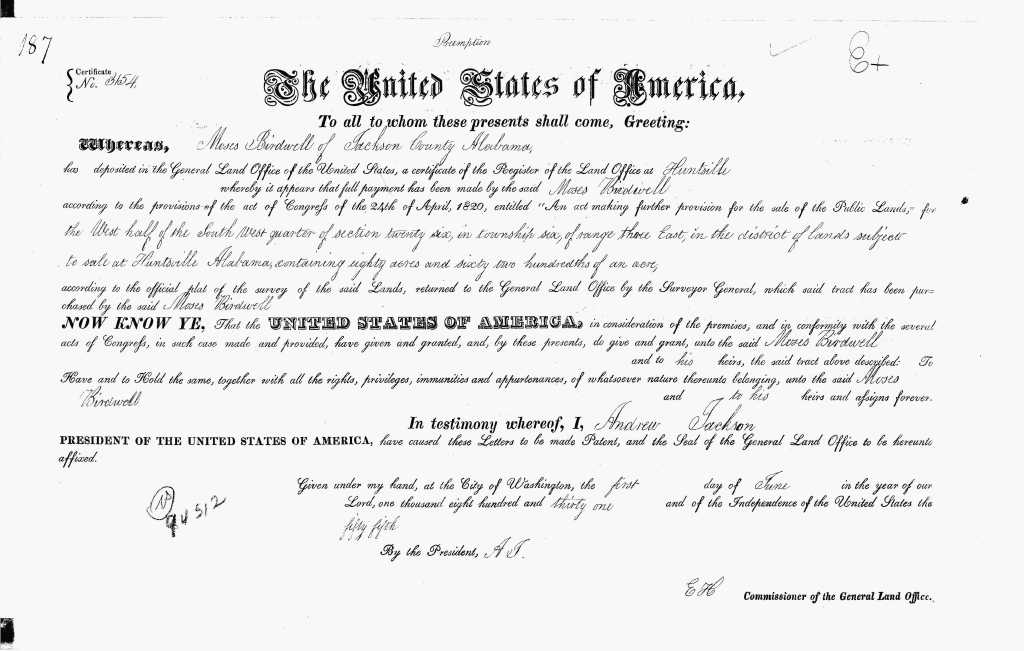
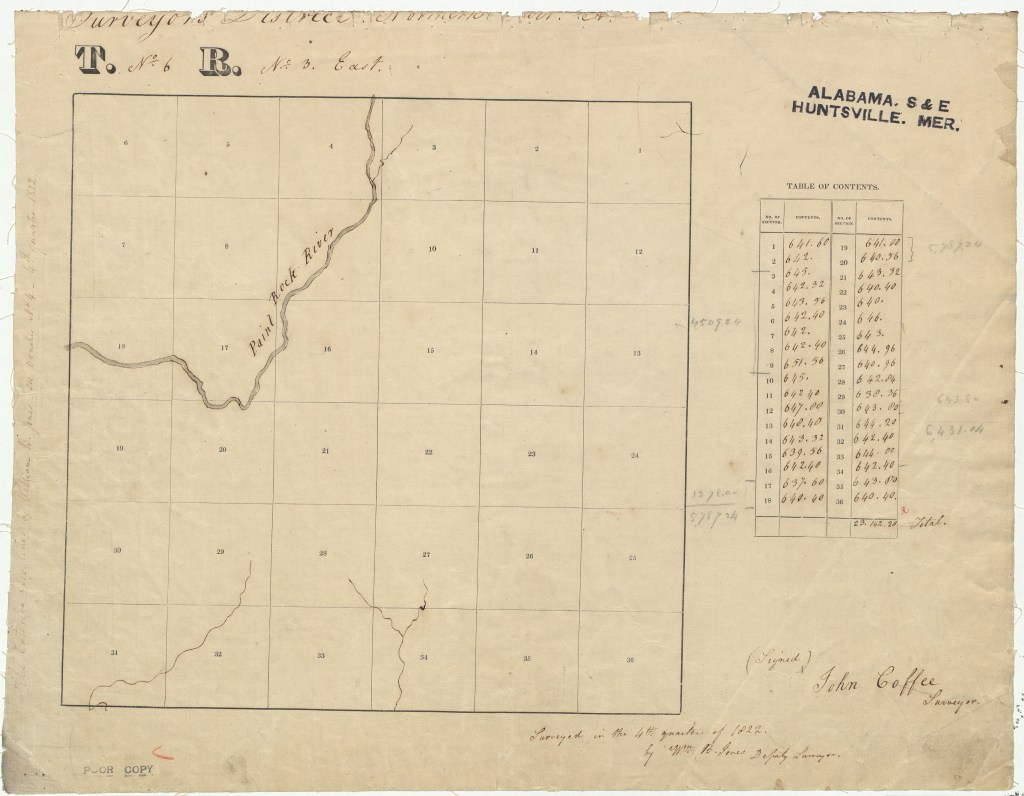
As the posting linked in the previous paragraph states, on 28 September 1830 at the federal land office in Huntsville, Moses Birdwell purchased two tracts of land, each 80+ acres, in township 6, range 3 east, section 26 in Jackson County, and another tract of 80+ acres in township 6, section 27.[16] These tracts were near Grant and Grassy Mountains in what would become Marshall County in 1836. The patents issued to Moses Birdwell for this land state that he was living in Jackson County, Alabama, when the land was patented to him on 1 June 1831.The homestead files for these two land patents show that on 28 September 1830, Moses Birdwell of Jackson County, Alabama, paid $100.15 for the 80 acres patented with certificate 3153, and $100.78 for the 80 acres patented with certificate 3154.
As noted previously, soon after Moses moved from Limestone to Jackson County, his son James joined him there. The linked posting also indicates that it’s difficult to track families in Jackson County during its formative years since destructive courthouse fires in 1864 and 1920, destroyed many of the county’s early records.
One Jackson County record mentioning both Moses and his son James that has survived courthouse fires is a 13 September 1832 deed of trust discussed previously.[17] This trust deed shows Moses indebted to James Johnson ($75, with $14 interest), Morris Chenault ($75, with $12.86 interest), and his son James Birdwell ($41, with $7.77 interest), with James as Moses’ trustee as he mortgaged property to secure the debt. These notes of Moses Birdwell had come into the hands of Andrew McKee White and James Birdwell, and were due the first Monday in January 1837. The deed of trust states that James Birdwell was living in Jackson County along with Moses when it was made on 13 September 1832. It was recorded 7 March 1835. The deed was witnessed by Edmund Bridges and Thomas Manning. On Edmund Bridges and his connection to James Birdwell, see this previous posting.
On 4 February 1835 in Jackson County, Moses Birdwell witnessed a deed of trust of George Loy to David Ricketts, with Thomas Manning, Edmund Bridges, and William Rich as trustees.[18] The other witness to this trust deed was John A. Maroney. As has been previously shown, on 22 July 1837 Moses’ son James Birdwell gave bond for $300 along with William S. Johnson for David Ricketts’ administration of the estate of Adam Nichor/Nicar in Marshall County.[19]
Marshall County, 1836-1846
After Marshall County was formed from Jackson in January 1836, Moses Birdwell’s land fell into Marshall County and from this time forward until he left Alabama for Texas late in his life, he appears in Marshall County records. As was discussed previously, on 10 February 1838 in Marshall County, Moses mortgaged property to secure his debt to his son James Birdwell.[20] The deed notes that Moses owed James $251.00. Josiah Tidwell acted as trustee for this mortgage, in which Moses placed in trust livestock and household furniture, with the understanding that the property would remain in his hands until 8 February 1839, when Tidwell would sell it if Moses had not paid his debt to James. The deed was signed by Moses, James, and Josiah Tidwell, who verified it on 20 February 1838, when it was recorded.
James Birdwell was making plans to move to Louisiana at this time and was setting his affairs in order in Alabama as he prepared for that move. As noted in a previous posting, on 30 November 1839, James and wife Aletha sold to John Kirkland the tracts of land that Moses Birdwell had purchased in Jackson County in September 1830, which had fallen into Marshall County at that county’s formation. It appears that James had come into possession of this land through his father’s indebtedness to him and the deed of trust Moses had made to his son James. Not long after the November 1839 land sale, James moved his family to Natchitoches Parish, Louisiana.
Moses Birdwell appears on the 1840 federal census in Marshall County, Alabama, with two males 10-15, one male 15-20, two males 20-30, and one male 70-80, as well as one female 5-10, two females 10-15, one female 15-20, and one female 40-50.[21] As we’ll see down the road when we discuss Moses’ (probable) children, by his second wife Hannah, who was between 20 and 30 years younger than Moses, he continued having children up to at least 1832. A family account written prior to 1903 by Moses’ grandson Walter Scott Cunningham, preserving information given to him by Moses’ daughter Nancy Birdwell Cunningham, says that Moses had ten children by each of his two wives. No record naming all of them has yet been found.
In 1840, apparently in September, Moses gave testimony in a Marshall County circuit court case, Alabama vs. Ludwell Drinkard.[22]And in 1841, when Zacheus Kennamer died on 1 July 1841 in Marshall County, he died owing Moses Birdwell a debt of $2 according to an affidavit signed by Moses and found in Zacheus’ loose-papers estate file (see image at the head of the posting).[23]
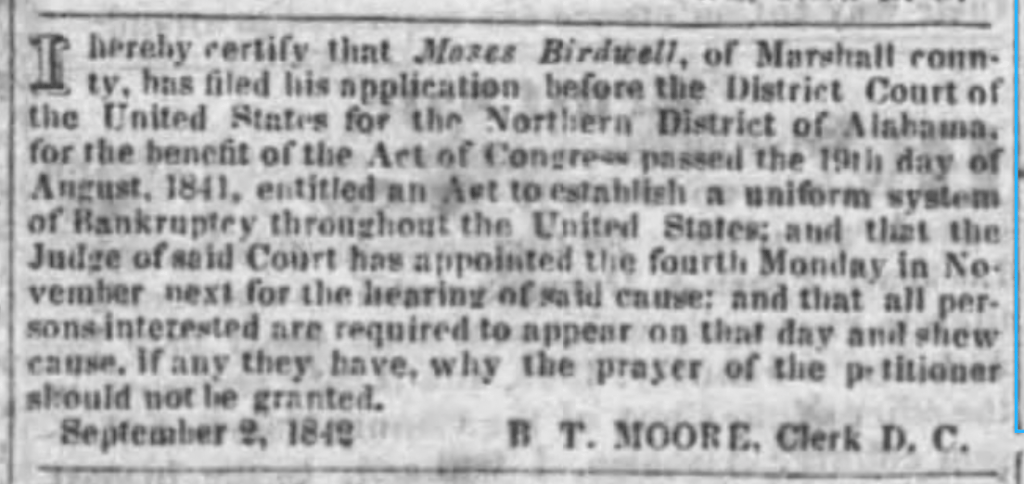
On 2 September 1842, Moses Birdwell petitioned for bankruptcy in Marshall County. On 1 October 1842, the Huntsville Democrat published a notice of this petition with the date of 2 September 1842.[24] The notice states that Moses had filed for bankruptcy under provision of an act passed by U.S. Congress on 19 August 1841 to establish a uniform system of bankruptcy in the U.S. The page of the Huntsville Democrat on which Moses’ petition for bankruptcy was announced consists almost entirely of such announcements made about men living in counties in north Alabama.
As David A. Skeel Jr. notes, the “lightning rod” for the bankruptcy act of 1841 was the 1837 panic, which devastated the American economy.[25] The depression of those years hit particularly hard for farmers and planters in north Alabama on the growing edge of the cotton kingdom. Many of them had overextended themselves financially, borrowing extensively, extending credit for friends, signing as security on notes of friends. When these chits and debts were called in, many farmers and planters in north Alabama went bankrupt. The devastation of many Alabama farmers and planters is discussed in a previous posting, which notes that following the 1837 economic bust, many of these Alabama agriculturalists left for places west like Alabama and Louisiana. The economic situation in Alabama is what caused Moses’ son James Birdwell to sell his property in Marshall County in 1839 and move to Natchitoches Parish, Louisiana, as discussed previously.

On 11 February 1843, the Huntsville Democrat published a notice stating that on 28 November 1842, Moses Birdwell had been declared bankrupt by the U.S. District Court, Northern District of Alabama.[26] This notice was republished by the Democrat weekly for several months following the initial February 1843 publication.
My notes about Moses Birdwell state that he appears on 10 December 1842 along with sons Joseph and Amos owing a debt to the estate of a Hillian Kirby in Marshall County. The notes cite information shared with me by a Birdwell researcher in the past, who cited Marshall County, Alabama, Final Record Bk. 3, p. 97, for this information. The debt Moses owed to the Kirby estate was $50.31, according to these notes.
However, I do not find a Hillian Kirby living in Marshall County in this period, and I have not found an estate record for someone of that name. I do find that there was a Hillian’s store in Marshall County associated with the Kirby family, and I wonder if this is actually a record about a debt Moses owed to that store.
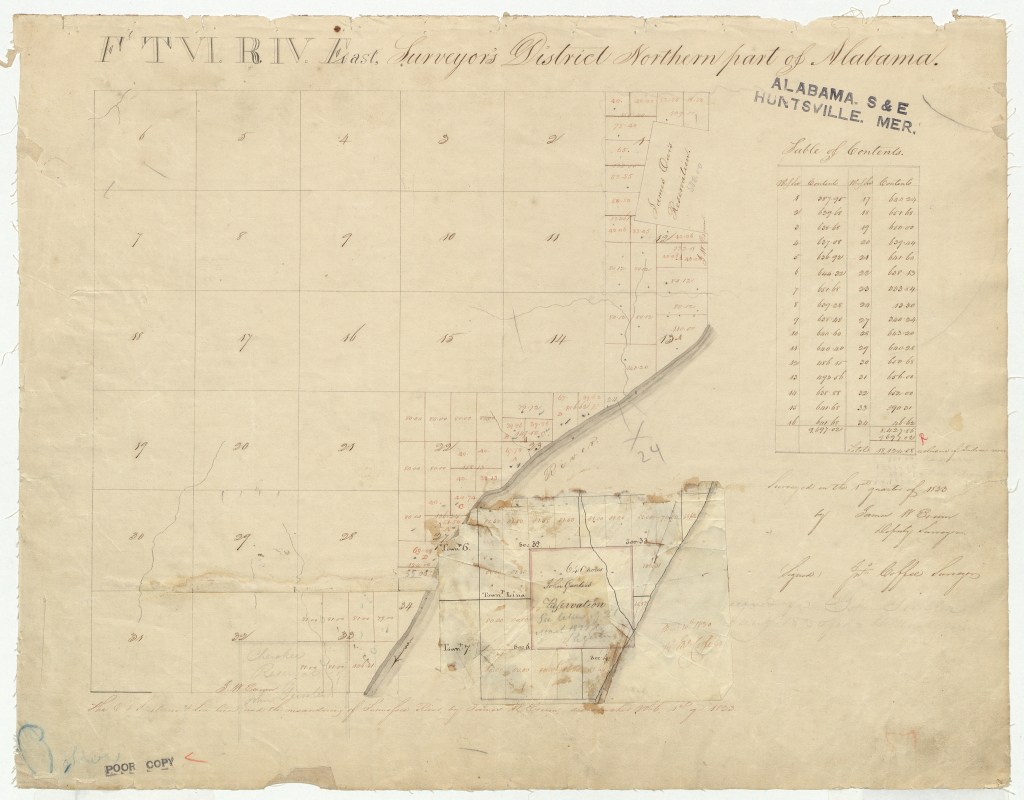
According to notes sent to me by researcher Shannon Birdwell, on 10 April 1843, in Marshall County, Moses Birdwell petitioned for a patent on 79.96 acres in Marshall and DeKalb Counties, the west ½ of the northeast ¼ of section 36, township 6, range 4 east.[27] Shannon Birdwell’s notes do not cite a source for this information. The source appears to be a homestead file. Shannon Birdwell’s notes state that Moses’ petition for the patent says that he had lived on this land since before 1 June 1840, and had a house, wife, and children on it. Moses’ affidavit was verified by Craven Sullivan and Jonathan Martin. According to Shannon Birdwell, this tract was in Marshall County near the DeKalb County line or perhaps straddled the county lines, and was in the Town Creek country just east of Guntersville, the Marshall County seat. On the same day that Moses bought this land for $99.95, he assigned it to Alva Finley (certificate 7231).[28]
The original survey for this land shows it in John Gunter’s reservation just east of the Tennessee River. This would have placed the land at or near Gunter’s Landing just north of Marshall County’s seat, Guntersville, I think. John Gunter is said to have been the first white settler in what became Marshall County, where he operated a store and ferry on the Tennessee River with his Cherokee wife.[29]
Colonel Alva Finley (1805-1843) lived at Bellefonte in Jackson County and represented that county in the Alabama legislature in 1838-9 and 1842-3.[30] He was a trustee of Bellefonte Academy before his early death in 1843.[31]
The final record researchers have found of Moses Birdwell in Marshall County is his listing as a bankrupt debtor to the estate of Malcolm McDuffie on 29 May 1845.[32] As the next posting focusing on Moses’ final years in Texas, where he died, will discuss, in January or February 1846 he left Alabama with his daughter Ritha and her husband George Madison Connally and died in Hopkins County, Texas, where Ritha and George M. Connally settled, having been preceded in their move to northeast Texas by Ritha’s brothers George Washington Birdwell, Abraham Marshall Birdwell, and Zachariah Birdwell.
[1] See Find a Grave memorial page for James R. Isbell, Blue Spring cemetery, Larkinsville, Jackson County, Alabama, created by Ray Isbell. This assignment is apparently recorded in Old Land Records, Limestone County, Alabama. See also Carolyn Murray Greer, “James Richardson Isbell’s Find-a-Grave Memorial,” Remembering the Shoals.
[2] Huntsville Federal Land Office Credit Volume Patent Bk. 116, p. 265, certificate no. 1156; Tract Bk. 273, p. 196.
[3] “The Membership of the Round Island Baptist Church, As Recorded in the Minutes, 1817-60,” Limestone Legacy 1,1 (January 1979), p. 36.
[4] Ibid.
[5] Dave Hurst, The History of Round Island Baptist Church, the First 175 Years (Round Island Baptist church, 1994; a pamphlet in the church history file of Limestone County Archives in Athens, Alabama). See also Lee Hattabaugh, “Round Island Baptist Church,” Historical Marker Database website.
[6] Alabama state census, 1820, Limestone County, p. 24. See also Alabama Historical Quarterly 47,4 (October 1994), p. 471.
[7] The Democrat (Huntsville, Alabama) (26 July 1826), p. 3, col. 6.
[8] Limestone County, Alabama, Will Bk. 3, pp. 19-20; and Limestone County, Alabama, Orphans Court Minutes 1824-30, pp. 62-3. See also Pauline Jones Gandrud, Alabama Records, vol. 88: Limestone County, p. 2, vol. 237, p. 41; Huntsville Land Office, vol. 7, pp. 186-7.
[9] Limestone County, Alabama, Deed Bk. 2, pp. 278-9. See also Gandrud, Alabama Records, vol. 24: Limestone County, p. 45.
[10] Limestone County, Alabama, Deed Bk. 5, pp. 567-8.
[11] See William Garrett, Reminiscences of Public Men in Alabama (Atlanta: Plantation, 1872), pp. 755-6.
[12] Limestone County, Alabama, Orphans Court Minutes 1824-1830, pp. 81-2. See also Gandrud, Alabama Records, vol. 237: Limestone County, p. 7.
[13] The Democrat (Huntsville, Alabama) (22 December 1826), p. 3, col. 3.
[14] Limestone County, Alabama, Orphans Court Minutes 1824-1830, p. 90. See also Gandrud, Alabama Records, vol. 24: Limestone County, p. 50.
[15] Limestone County Orphans Court Minutes 1824-1830, p. 161.
[16] Federal Land Office, Huntsville, State Volume Patent Bk. 1210, pp. 186-8, certificates 3153-4; and see Margaret Matthews Cowart, Old Land Records of Marshall County, Alabama (Huntsville, 1988), pp. 116-7, citing Marshall County Tract Books.
[17] Jackson County, Alabama, Deed Bk. A, p. 16-9; see also Gandrud, Alabama Records, vol. 226: Jackson County, p. 19.
[18] Jackson County, Alabama, Deed Bk. A, p. 5.
[19] Marshall County, Alabama, Final Records Bk. 1, pp. 93-6.
[20] Marshall County, Alabama Deed Bk. A, pp. 136-7.
[21] 1840 federal census, Marshall County, Alabama, p. 80A.
[22] Marshall County, Alabama, Circuit Court Grand Jury Records, 1840, pp. 60-1, as abstracted by Valley Leaves 24,3 (March 1990), p. 145.
[23] Marshall County, Alabama, loose-papers estate files, file of Zacheus Kennamer; see also Marshall County, Alabama, Final Record Bk. 2, p. 171.
[24] Huntsville Democrat (1 October 1842), p. 4, col. 3. See also Gandrud, Alabama Records, vol. 15: Marshall County, p. 49.
[25] David A. Skeel Jr., “Bankruptcy Act of 1841,” Encyclopedia.com.
[26] Huntsville Democrat (11 February 1843), p. 5, col. 2.
[27] The BLM-GLO site indexes this patent, referencing both Moses Birdwell and Alva Finley, and giving certificate number 7231. But when one clicks the link for that patent, the search engine returns a patent to Isabel Adams and Alva Finley as assignee of John H. Berry, certificate 7238. I have been unable to get the search engine to find the patent for certificate 7231,
[28] Huntsville Federal Land Office Tract Bk. 368, p. 85.
[29] See Northern Alabama, Historical and Biographical (Birmingham: Smith & De Land, 1888), p. 58. See also Find a Grave memorial page of John Gunter, Gunter cemetery, Guntersville, Marshall County, Alabama, created by Ray Isbell; and Lee Hattabaugh, “John Gunter,” Historical Markers Database website.
[30] See Willis Brewer, Alabama: Her History, Resources, War Record, and Public Men, from 1540 to 1872 (Montgomery: Barrett & Brown, 1872), p. 288; and Find a Grave memorial page of Col. Alva Finley, Bellefonte cemetery, Bellefonte, Jackson County, Alabama, created by NatalieMaynor, maintained by Dawn Kelley, with tombstone photos by NatalieMaynor and Annette Bradford.
[31] Ann B. Chambless, “Bellefonte, Alabama, Remembered,” Jackson County Chronicles 17,2 (April 2005), p. 8.
[32] Marshall County, Alabama, Final Record Bk. 3½, p. 6; and see Gandrud, Alabama Records, vol. 96: Marshall County, p. 53.
 BEGATS AND BEQUEATHALS
3 thoughts on “Moses Birdwell (1769-1849): Years in Limestone, Jackson, and Marshall County, Alabama, 1818-1846”