Though various published accounts of and trees for James Montgomery’s family state that James and his wife Ann may have had daughters and provide names for those daughters, I have seen no documentary evidence establishing that James had daughters. Such evidence may well exist, but if it does, I haven’t seen it cited in accounts of James’ family that name his daughters, or in first-hand documents I’ve searched.
Mary Montgomery
Published accounts of the family of James Montgomery list either three or four daughters for James: Mary, Margaret, Anne, and Elizabeth. Mary Montgomery appears as a daughter of James in a page at the Early Settlers of Augusta County, Virginia, project at WeRelate entitled “James Montgomery, Sr., of Catawba Creek.”[1] However, the page for James at Keith Montgomery’s Montgomery and Rowntree and Families Genealogy site does not include Mary as James’ daughter,[2] but makes Mary James’ sister instead.[3]

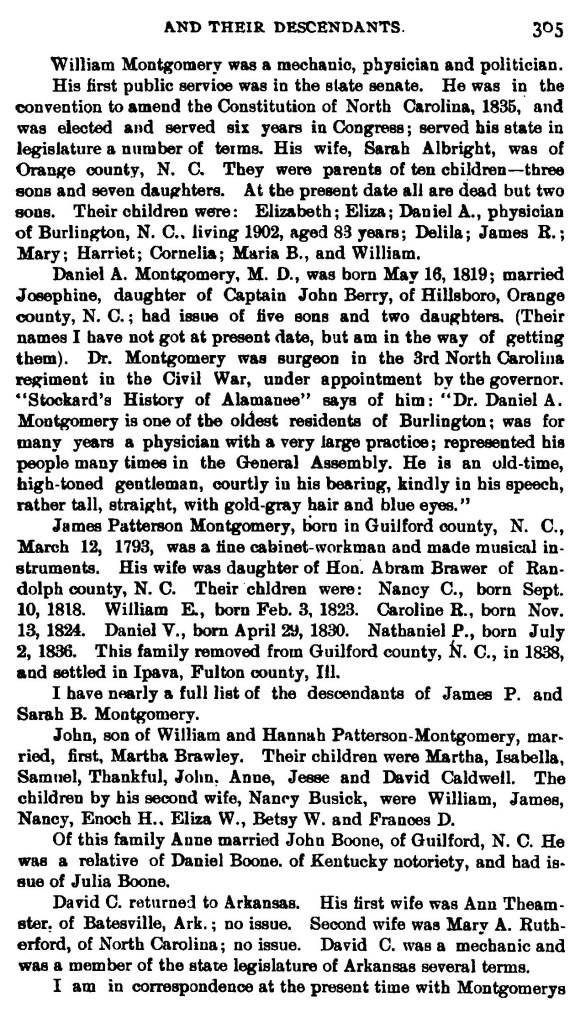

In the absence of any documentation – at least, any that I’ve discovered – naming daughters of James Montgomery, it’s unclear where those attributing daughters to him have obtained information identifying those daughters. In the case of Mary, it appears that one source is repeatedly cited to establish her link to James Montgomery as a sister. This is a letter written by George M. Black on 14 April 1902 from Oak Park, Illinois, to D.B. Montgomery of Owensville, Indiana (for the first part of this letter, see the image at the head of this posting). George Black was a great-grandson of Mary Montgomery and her husband James Patterson. His parents were Rachel Montgomery and John Black. Rachel was a daughter of James Patterson (born 1803), who was a son of Mary Montgomery and James Patterson.[4]
Black’s letter is transcribed and published in D.B. Montgomery’s A Genealogical History of the Montgomerys and Their Descendants.[5] The letter states that Mary Montgomery, of Ulster Scots ancestry, came to America in 1731 or 1732 and married James Patterson, a native of County Antrim, Ireland, who arrived in America in 1728 and lived in Little Britain township, Lancaster County, Pennsylvania.[6]
George M. Black also indicates that Mary Montgomery had brothers James and Thomas and a sister Jane who married James Ramsay. He states that he had no further information about James and Thomas. At no point in his letter does George Black identify James Montgomery of Catawba Creek in Augusta County, Virginia, as Mary Montgomery Patterson’s brother James of whom the letter speaks.
The Black letter goes on to say that Mary and husband James Patterson had a daughter Hannah who married a relative, William Montgomery, whose family was from Mongomo [sic] in Scotland and which had gone from there to the north of Ireland. According to Black, William and Hannah Patterson Montgomery left Lancaster County, Pennsylvania, in 1768 or 1770 intending to move to Abbeville District, South Carolina, where their Calhoun relatives had settled, but as they reached Guilford County, North Carolina, they met old friends from Ireland who persuaded them to remain there.[7]
George Black explains the connection of the Calhoun family to this Montgomery family as follows:
Mary Montgomery was niece of Hon. John C. Calhoun’s mother’s father, or rather first cousin of that statesman.
Oral Montgomery’s Montgomery Heritage is among the published accounts citing George M. Black’s letter and depending on it to ground a story of an immigrant Montgomery family including purported siblings Mary (married James Patterson), James, Thomas, Catherine (married Patrick Colhoun), and Jane (married James Ramsay).[8] Oral Montgomery doesn’t cite Black’s letter per se, but cites “family tradition” that is clearly the information reported in George Black’s letter. It seems to be from Oral Montgomery’s account of the Montgomery family, which is clearly heavily dependent on George Black’s letter for its picture of the first generation of this family in America, that we have undocumented claims now found everywhere that a “Mr. Montgomery” (often named as Hugh) and wife Jane Patrick had the children listed above, who were siblings and all of whom came from Ireland to America.[9]
Because George Black’s 1902 letter to D.B. Montgomery relating “family tradition” handed down by some Montgomery families has become so influential in establishing a picture of one set of Irish Montgomery immigrants to America, it’s important that we take a critical look at this letter and ask ourselves about the reliability of the information it reports.
First, as I’ve noted, the Black letter does not at any point state that the James Montgomery who died in Augusta County, Virginia, in 1756 and who was very likely a brother of Catherine Montgomery Colhoun was the James Montgomery whom Black identifies as Mary Montgomery Patterson’s brother. Those making that link between Mary Montgomery Patterson and James Montgomery of Augusta County, Virginia, are making a connection that the letter itself does not spell out anywhere.
Second, note that though the letter indicates that Mary Montgomery was a relative of the Calhoun family that settled on the Long Cane in South Carolina in February 1756, it does not name the Montgomery progenitor of that Calhoun family, Catherine Montgomery Colhoun (1684-1760), as a sister of Mary Montgomery and the other siblings the letter gives her, James, Thomas, and Jane Montgomery (married James Ramsay). The letter states instead, as I’ve just said, that Mary Montgomery was a niece of John C. Calhoun’s mother’s father.
But that statement garbles the connection of the South Carolina Calhoun family to the Montgomery family. John C. Calhoun’s mother was Martha Caldwell, who married Patrick Calhoun. The Montgomery connection to the Calhoun family runs through the Calhoun line and not the Caldwell line. Patrick Calhoun’s parents were Patrick Colhoun and Catherine Montgomery, the immigrant progenitors of this Calhoun family.
To the best of my knowledge, no one has ever located a place in Scotland with the name Mongomo or a name similar to that spelling, where a set of Montgomerys are said in Black’s letter to have lived before they went to Ireland. I think it’s likely that Mongomo is a mangled version of a place in Italy, Monte Gomero, that various books about the Montgomery family including D.B. Montgomery’s Genealogical History of the Montgomerys speak of as a mythic Ur-place to which the surname Montgomery points.[10]
Please note that in making these points that I think need to be taken into consideration by those establishing the first immigrant generation of an Ulster-Scots Montgomery in America, I’m not seeking to discount claims that Mary Montgomery Patterson may be a relative of James Montgomery of County Donegal, Ireland, Lancaster County, Pennsylvania, and Augusta County, Virginia. I’m just pointing to some pieces of information that need to be taken into consideration as one evaluates the letter of George M. Black as a source for information about James and Mary Montgomery and their purported siblings. In my view, much more research needs to be done to sort out this family. Before I conclude that Mary Montgomery Patterson was a sister of James Montgomery of Augusta County, Virginia, and Catherine Montgomery Colhoun, I’d like to see some sound documentation going beyond the hazy family traditions George Black shares in his 1902 letter to D.B. Montgomery.
Margaret Montgomery
As I stated previously, more than one published account of the family of the James Montgomery who died in 1756 in Augusta County, Virginia, gives James a daughter Margaret Montgomery who married Peter Looney.[11] But as other published sources state,[12] the Margaret who was Peter Looney’s wife was the daughter of James Lauderdale of Augusta County, Virginia, and not a daughter of James Montgomery. James Lauderdale happens to be one of my direct ancestors. I have quite a bit of documentation about him and his family, and can confidently state that Margaret, wife of Peter Looney, was James Lauderdale’s daughter and not James Montgomery’s daughter.
When Peter Looney’s widow Margaret posted bond in Augusta County on 18 November 1768 to administer Peter’s estate, her bondsmen were her father James Lauderdale (the surname is spelled Litherdale in this document) and John Miller.[13] Augusta County records show a number of lawsuits following Peter Looney’s death regarding the guardianship of Peter’s orphan Peter Looney Jr. which spell out the connection between Peter’s widow Margaret and her father James Lauderdale.
Following Peter Looney’s death, Margaret remarried to James McCain/McKain, who had posted bond along with James Lauderdale on behalf of Margaret Looney on 16 March 1768.[14] On 18 May 1768, Margaret Looney witnessed the sale of a wagon and stock in Augusta County from James McKain to Jonathan Smith, Robert Faris, and James Lauderdale.[15] James Lauderdale’s will, written on 22 September 1796 in Botetourt County, Virginia, states that he was intending to move to Tennessee soon and names as his oldest child his daughter Margaret, the widow and relict of James Cain [sic].[16] The will was filed in Sumner County, Tennessee, where James moved after writing the will and where he died.
I have no idea whether James Montgomery of Catawba Creek in Augusta County, Virginia, had a daughter Margaret. I’ve seen no documentation indicating this. I can say with good confidence, though, that Peter Looney’s wife Margaret was not the daughter of James Montgomery but of James Lauderdale, who lived on Looney’s Mill Creek in what’s now Botetourt County, and not in the vicinity of the Catawba settlement in which James Montgomery lived some thirteen miles north.
Anne Montgomery
As I note above, a number of published accounts of James Montgomery’s family also state that he had a daughter Anne Montgomery.[17] Keith Montgomery’s Montgomery and Rowntree and Families Genealogy states that Anne married Colonel William Lewis.[18] As one tries to track sources proving that James Montgomery of Augusta County, Virginia, had a daughter Anne who married Colonel William Lewis, one sets forth on quite an interesting journey.

Two primary sources for the information that William Lewis’ wife was Anne Montgomery – though these sources do not identify her father as James Montgomery – are a history and biography written by John Lewis Peyton, a great-grandson of William Lewis and Anne Montgomery. Peyton’s History of Augusta County, Virginia, states the following:[19]
Col. William Lewis, of the Sweet Springs, called the “Civilizer of the Border,” m Anne Montgomery April 8th, 1754. Her father, when a child, was sent to Scotland from Ireland to avoid persecution. There he married Miss Thomson, a relative of the famous poet, James Thomson, of Roxburgshire, the author of “The Seasons.”
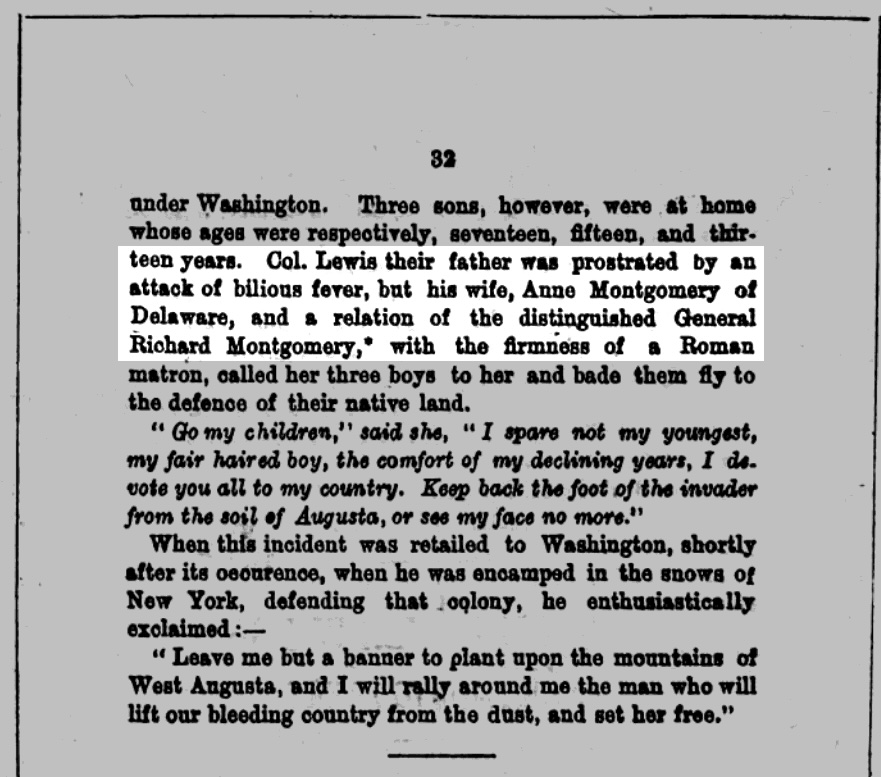
In his Biographical Sketch of Anne Montgomery Peyton, John Lewis Peyton states that William Lewis’ wife Anne Montgomery was “of Delaware, and a relation of the distinguished General Richard Montgomery.”[20] As with his History of Augusta County, in this biography of William Lewis and Anne Montgomery’s daughter Anne Montgomery Peyton, John Lewis Peyton does not provide a name for Anne Montgomery’s father.
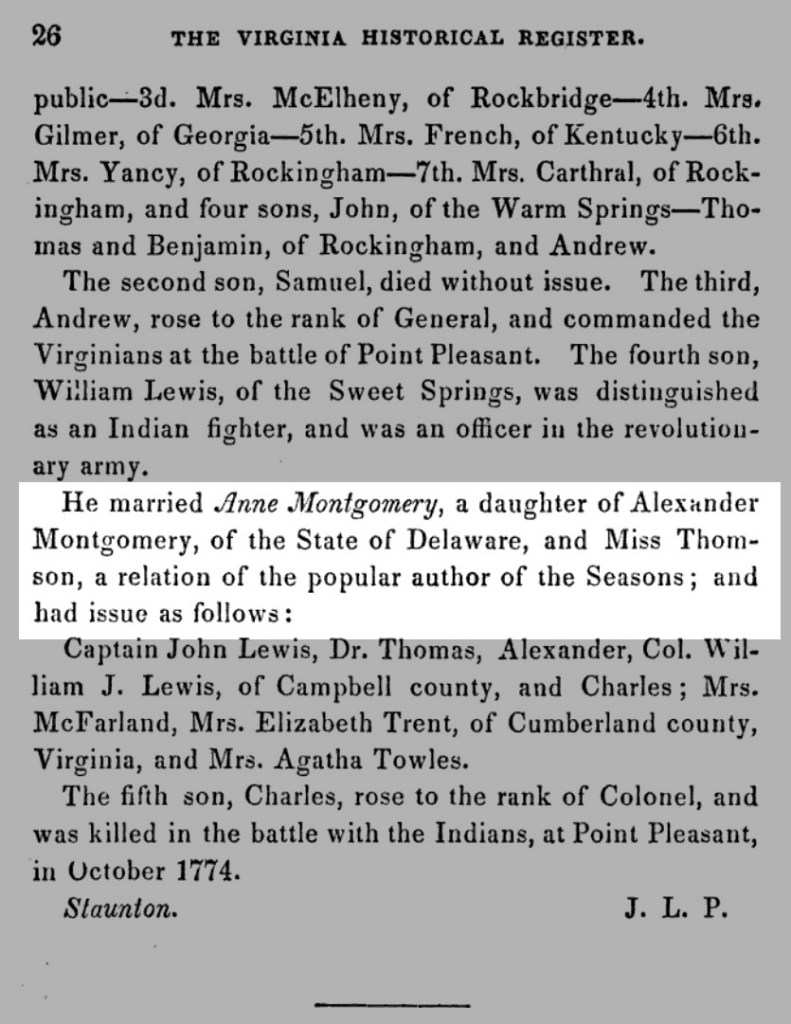
However, in an article entitled “John Lewis and His Descendants” that he published in The Virginia Historical Register in 1852, John Lewis Peyton does, in fact, name Anne Montgomery Lewis’ father. He states,[21]
He [i.e., William Lewis] married Anne Montgomery, a daughter of Alexander Montgomery, of the State of Delaware, and Miss Thomson, a relation of the popular author of the Seasons….
A Find a Grave memorial page for Anne Montgomery, wife of William Lewis, gives her the name Ann Margaret Montgomery and states (no source is cited) that she was born 1 September 1737 at New Castle, Delaware.[22] This source states that Anne died 8 July 1808 at Sweet Springs in Monroe County, Virginia (today West Virginia), again without documenting the date and place of death. No father is stated for Anne on this Find a Grave memorial page. I see no documents anywhere indicating that William Lewis’ wife Anne Montgomery also had the name Margaret.
A page for William Lewis’ wife Anne Montgomery at FamilySearch’s tree pages is a nightmarish mishmash of undocumented misinformation. This page gives the dates and places of birth and death I’ve just stated, adding that Anne was the daughter of one James Seaton [sic] Montgomery who died 11 September 1756 at “Catawba, Halifax [sic], Virginia, British Colonial America.” James Seaton [sic] Montgomery’s wife is given as Anne Thompson, and he’s said to be the son of a Hugh Montgomery with wife Jane Patrick and to have had siblings “Mary Catherine” Montgomery (married “James Patrick” Calhoun and a Stewart), Jane Montgomery (married James Ramsay), Thomas Montgomery, and Mary Hamilton Montgomery (married James Patterson). This FamilySearch tree page also has Anne Montgomery marrying William Lewis on 18 April 1754 in Wilmington, Delaware. We know with certainty that the James Montgomery linked to Anne as her father in many published accounts of his family was living in Augusta County, Virginia, on that date, far from Delaware.
I also have seen no documents anywhere showing James Montgomery of Lancaster County, Pennsylvania, and Augusta County, Virginia, with the middle name Seaton or any other middle name for that matter. Ditto for “Mary Catherine” Montgomery Calhoun, who is plain Catherine in every document I’ve found for her.
My conclusion as I make my way through the maze of sources that seek to establish the claim that James Montgomery of Catawba Creek in Augusta County, Virginia, had a daughter Anne who married William Lewis: the jury is still out – way out – on that claim. If William Lewis and Anne Montgomery’s great-grandson John Lewis Peyton is to be believed, his great-grandmother Anne Montgomery was the daughter of Alexander Montgomery, and was born in New Castle, Delaware, a place in which the James Montgomery who moved from Lancaster County, Pennsylvania, to Augusta County, Virginia, in the mid-1740s never lived, as far as I can see.
Note, by the by, that John Lewis Peyton’s testimony also makes one wonder – or so it seems to me – about the oft-repeated claim that Ann, the wife of James Montgomery of Augusta County, Virginia, was Ann Thompson or Thomson. It seems to me that in making the claim that James married Ann Thompson/Thomson, people have likely borrowed from Peyton’s accounts stating that the Anne Montgomery who married William Lewis was the daughter of an Ann Thompson/Thomson – who married Alexander Montgomery, as Peyton tells us in the one instance in which he names the father of Anne Montgomery Lewis.
And what to make of John Lewis Peyton’s statement that the father of Anne Montgomery Lewis – i.e., Alexander Montgomery, as Lewis tells us in his 1852 article – was sent from Scotland to Ireland as a child to escape persecution? This sounds strangely like some variation of the story that Lyman Draper tells in his brief biography of James Montgomery’s son John, which has John’s father taking part in a duel in Ireland and having to flee to Scotland before this Montgomery family came to America.[23] In accounts of the first generations of several Montgomery families that came from Ireland to America in the first part of the 18th century, are we dealing with family stories handed down within Montgomery family lines that may even be unrelated, which have taken different shapes in each family within which these tales have been transmitted?
Elizabeth Montgomery
Finally, as to the claim that James Montgomery of Augusta County, Virginia, had a daughter Elizabeth Montgomery who, in Oral Montgomery’s view, married (John?) Calhoun:[24] I’ve found no documentation showing that either claim is correct. About Elizabeth and the tradition that James Montgomery had a daughter of that name and that this daughter may have married a Calhoun, I draw a blank.
It’s important to pay attention to family stories transmitted generation to generation within family lines. But it’s also important to look at those stories critically as we try to winkle facts out of them – since sound genealogies are based on facts and solid documentation. And without sound genealogies, DNA findings just cannot magically solve our questions about how one line of a family with a shared surname relates to another line, or doesn’t relate at all.
[1] “James Montgomery, Sr., of Catawba Creek,” Early Settlers of Augusta County, Virginia, project at WeRelate.
[2] “James Montgomery, Sr.,” Montgomery and Rowntree and Families Genealogy.
[3] “Mary Montgomery,” ibid.
[4] D.B. Montgomery, A Genealogical History of the Montgomerys and Their Descendants (Owensville, Indiana: J.P. Cox, 1903), p. 306.
[5] Ibid., pp. 303-6.
[6] See also W.U. Hensel, “Patterson-Andrews Genealogy,” Historical Papers and Addresses of the Lancaster County Historical Society 42,4 (1913), who states that James Patterson came from County Antrim, Ireland, to Little Britain township in Lancaster County, Pennsylvania, in 1728, aged twenty, and that Mary Montgomery arrived in Pennsylvania three or four years later and married him. Biographical Annals of Lancaster County, Pennsylvania Containing Biographical and Genealogical Sketches of Prominent and Representative Citizens and Many of the Earlier Settlers (Chicago: J.H. Beers, 1903), p. 826.
[7] Robert W. Ramsey states that a James, John, and Arthur Patterson were among the earliest settlers of the Susquehanna Valley (i.e., in Lancaster County, Pennsylvania), and that James and John Patterson were among early Lancaster County settlers of the Irish settlement centering on Thyatira Presbyterian church in Old Rowan County, North Carolina: see Carolina Cradle: Settlement of the Northwest Carolina Frontier, 1747-1762 (Chapel Hill: University of North Carolina Press, 1964), p. 119 and n. 13.
[8] Oral Montgomery, Montgomery Heritage, vol. 3 (San Antonio, 1987), pp. 3-7.
[9] Ibid., p. 3.
[10] Montgomery, A Genealogical History of the Montgomerys and Their Descendants, p. 11. See also John Holland and James Everett, Memoirs of the Life and Writings of James Montgomery; Including Selections from His Correspondence, Remains in Prose and Verse, and Conversations on Various Subjects, vol. 1 (London: Longman, Brown, Green, and Longmans, 1854), p. 1, noting that the name is found in John Chetwode Eustace’s Classical Tour Through Italy, vol. 1 (London, 1812), p. 298.
[11] See, e.g., Oral Montgomery, Montgomery Heritage, p. 8; and Keith Montgomery, “Margaret Montgomery,” Montgomery and Rowntree and Families Genealogy.
[12] See, e.g., “Margaret Montgomery,” Early Settlers of Augusta County, Virginia, project at WeRelate.
[13] Augusta County, Virginia, Will Bk. 2, p. 421.
[14] Ibid., Will Bk. 4, p. 93.
[15] Augusta County, Virginia, Deed Bk. 14, p. 445.
[16] Sumner County, Tennessee, Will Bk. 1, p. 39.
[17] See, e.g., Keith Montgomery, “Anne Montgomery,” Montgomery and Rowntree and Families Genealogy; and “Anne Montgomery,” Early Settlers of Augusta County, Virginia, project at WeRelate. Oral Montgomery, Montgomery Heritage, p. 8, does not show James with a daughter Anne, but speaks of “other daughters” in addition to Margaret who is said to have married Peter Looney and Elizabeth who married a Calhoun. The “other daughters” are not named.
[18] Keith Montgomery’s pages for Anne Montgomery and William Lewis cite Daniel Cameron Montgomery Jr., The Descendants of Hugh Montgomery (Greenville, Mississippi, 1976), pp. 8-10.
[19] John Lewis Peyton, History of Augusta County, Virginia (Staunton: Yost, 1882), p. 287.
[20] John Lewis Peyton, Biographical Sketch of Anne Montgomery Peyton (Guernsey: Clarke, 1876), p. 32. Peyton cites Henry Howe, Historical Collections of Virginia (Charleston, South Carolina: Babcock, 1849), p. 183, for his sketch of Anne Montgomery Lewis, though Howe does not give a name to William Lewis’ wife.
[21] J.L.P., “John Lewis and His Descendants,” The Virginia Historical Register and Literary Companion 5,1 (January 1852), p. 26.
[22] See Find a Grave memorial page of Ann Margaret Montgomery Lewis, Lewis family cemetery, Monroe County, West Virginia, created by Great Stone Face, maintained by DL.
[23] Lyman Draper Collection, series U, Frontier Wars Papers, 1754-1885, vol. 21, originals held by Wisconsin Historical Society.
[24] Oral Montgomery, Montgomery Heritage, p. 8.
 BEGATS AND BEQUEATHALS