
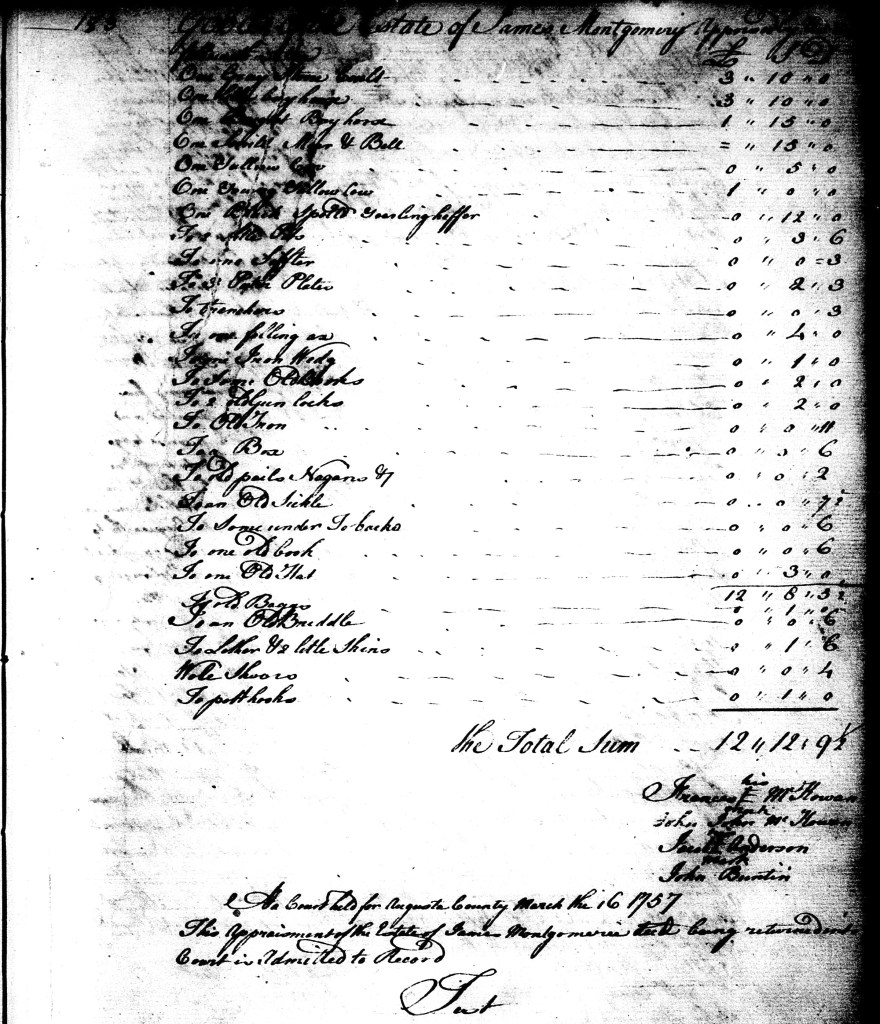

This is the sum total of the estate documents extant for James Montgomery in Augusta County. Note that none of them names any of James’ heirs other than his widow Ann. As I cite these estate records, I also think it’s important to note that questions have been raised by some researchers about whether they are estate records of the James Montgomery of Catawba Creek in Augusta County, or records belonging to another James Montgomery of Jackson River who lived near present-day Covington, Virginia.
Wythe County, Virginia, historians Mary B. Kegley and Frederick B. Kegley take the 1756-8 Augusta County estate records of James Montgomery with wife Ann(e) to refer to the James who, as we’ll see in a moment, can be proven by a set of depositions dating to the second half of the 1790s to be father of sons Robert, James, John, and Joseph Montgomery.[4] Montgomery researcher David B. Trimble reaches the same conclusion.[5] However, as I’ve just noted, a number of other Montgomery researchers have challenged this conclusion and have proposed that the James Montgomery with wife Ann of these estate records may be a different James Montgomery living in a different part of Augusta County than Catawba Creek, where the James with the sons named above lived.[6] These researchers note that the names of Ann Montgomery’s bondsmen and of the estate appraisers are names found not in the Catawba Creek area of Augusta County but along the Jackson River to the northeast of Catawba Creek.
Though I keep an open mind, I’m inclined to trust Mary B. and Frederick B. Kegley’s conclusion that the 1756-8 estate documents cited above refer to the James Montgomery who settled on Catawba Creek in Augusta (now Botetourt) County, Virginia, in 1746. However, for the purposes of determining the children of James Montgomery of the Catawba settlement, it’s immaterial, in a sense, whether these estate documents belong to that James or another man of the same name, since neither these nor any other estate documents found to date in Augusta County records name the children of James Montgomery of the Catawba settlement. What can be firmly established from extant documents is that the James Montgomery who settled on Catawba Creek in 1746 came there from Lancaster County, Pennsylvania, and had (inter alia) sons Robert, James, John, and Joseph.
The Depositions of James’ Sons James, John, and Joseph, Wythe County, Virginia
As a previous posting has noted, we have very good documentary evidence about when James Montgomery came to Augusta County, where he was living prior to his move to Virginia, and the names of several of his sons. This documentation is found in a number of depositions made by several sons of James Montgomery in Wythe County court in the latter half of the 1790s. We know from these depositions that James had sons Robert, James, John, and Joseph. The depositions also tell us some of these sons’ ages, that James elder came to Augusta County, Virginia, from Lancaster County, Pennsylvania, and about when that move took place.
As the posting linked in the previous paragraph states, on 6 November 1797 in Wythe County, James’ son James made a deposition in which he stated the following:
James Montgomery, aged 68, deposes, in Wythe County, 6th November, 1797, that he lived with his father, James, in Lancaster County, Pennsylvania. His father sent deponent’s oldest brother, Robert, to Virginia to buy lands, and bought 654 acres on Catawba Creek, but one Clarke had bought part of the tract. Robert contracted as part payment to bring two uncommon large bells from Pennsylvania. Robert left his brother John on the land, returned to Pennsylvania, and then the father and family came. John was then about 21 years old.
As the linked posting explains, this abstract of James Montgomery younger’s 1797 deposition is from Lyman Chalkley’s Chronicles of the Scotch-Irish Settlement in Virginia, which indicates that the original deposition is in a book of court records held in Augusta County with the title “Records.”[7] I have been unable to locate a copy of the original deposition abstracted by Chalkley.
Chalkley also abstracts a deposition given in Wythe County on 11 August 1795 by John Montgomery, which states that John was “an aged witness” and was a brother of Robert Montgomery, who bought land from Borden.[8] This is clearly the John Montgomery referred to as James Montgomery’s brother in James’ 1797 deposition. These depositions identify three brothers, Robert, John, and James, as sons of a James Montgomery who sent his sons Robert and John from Lancaster County, Pennsylvania, to Virginia in the mid-1740s to buy land in Augusta County. In addition, Chalkley states that another brother of these Montgomery men, Joseph, made a deposition in Wythe County, apparently in November 1797, stating that he was a brother of James.[9]
Between them, these depositions identify four sons of James Montgomery of Augusta County, then: Robert, John, James, and Joseph. They also tell us that James Montgomery elder was living in Lancaster County, Pennsylvania, prior to his settling on Catawba Creek in Augusta County, Virginia. In addition, they show that Robert was the oldest son of James elder, that James younger was born in 1729, and that John was twenty-one years old when his family moved from Lancaster County, Pennsylvania, to Augusta County, Virginia. As Mary B. Kegley notes, some researchers place John’s birth around 1721 and others around 1725, so this would place the move of James Montgomery’s family from Lancaster County, Pennsylvania, to Augusta County, Virginia, in either 1742 or 1746.[10]

The correct year is 1746. As the posting linked above states, an Augusta County deed shows Robert and John Montgomery purchasing 654 acres on Catawba Creek from Benjamin Borden on 19 June 1746.[11] This was the land on which James Montgomery elder settled his family. As Botetourt County historian Robert Douthat Stoner notes in his history of that county entitled A Seed-Bed of the Republic,[12]
James [Montgomery] and his sons, John and Robert, were among the first to settle in Botetourt. As early as 1746, we find James on Catawba Creek, where he did much to aid in the establishment of the first roads.
James Montgomery is mentioned in an August 1747 judgment issued by Augusta County court in the case of Brown vs. Smith, which states that Captain James Montgomery, gent., was living at “the Cutappa” prior to 15 July 1747.[13] F.B. Kegley notes that James Montgomery was among the first settlers in the Catawba valley of what was previously Augusta County but is now Botetourt County: he writes,[14]
Perhaps there was no man in this back settlement more important than Capt. James Montgomery, Gent., who with a family of grown sons came from Lancaster County, Pennsylvania, to Virginia to purchase lands and help develop the country. His sons, Robert and John, came first and contracted for a choice homestead in Borden’s Middle Tract. A payment was to be made with two “uncommon large bells.” The title to the land was finally made in Robert’s name, though his father was a Justice of the county and an active member of the community until his death in 1757. The mother, Ann, returned to Pennsylvania after the death of her husband, James.
As the preceding posting I’ve linked above – for convenience’s sake, I’ll link it again now – states, the depositions of James Montgomery’s sons and other documents placing his family’s move from Lancaster County, Pennsylvania, to Augusta County, Virginia, in 1746 also provide valuable information in telling us that this Montgomery family moved from Pennsylvania to Virginia in roughly the same time frame in which the family of Catherine Colhoun/Calhoun made a similar move from Lancaster County, Pennsylvania, to Augusta County, Virginia. Catherine has long been believed to be James Montgomery’s sister. The Calhoun family moved from Pennsylvania to Virginia between 4 May 1744 and 8 October 1745, a point discussed and documented in the posting I’ve just linked.
Both Mary B. Kegley and David B. Trimble speak of “family traditions” indicating that James Montgomery came to Pennsylvania from County Donegal, Ireland – where it can be documented that Patrick and Catherine Colhoun also lived before coming to Pennsylvania.[15] These family traditions also apparently assign James Montgomery a birth year of around 1690, which fits well with Catherine Montgomery Colhoun’s documented year of birth, 1684. I suspect that accounts placing James Montgomery specifically at Chestnut Level in Lancaster County, Pennsylvania, prior to his move to Virginia may be echoing similar family traditions placing the family of Patrick and Catherine Montgomery Colhoun at Chestnut Level in Drumore township of Lancaster County from 1733, when they arrived in America, traditions discussed in a previous posting. The assumption is frequently made, and could perhaps have truth to it, that James Montgomery came with his family to Pennsylvania in the company of his sister Catherine and her husband Patrick Colhoun and their family.
The Journal of Alexander Noble
The depositions of James Montgomery’s sons filed in Augusta County, Virginia, are not the only source that helps us document the names of his sons. As a previous posting notes, a little journal kept by Alexander Noble, a son of Mary Calhoun and John Noble and a grandson of Patrick Colhoun and Catherine Montgomery, in the years 1762-1773, now held by the South Caroliniana Library at University of South Carolina in Columbia, documents trips that Alexander made back to Virginia from the Long Cane settlement in South Carolina in 1762-3 and 1770-1. On the first of these trips, Alexander was accompanied by his uncle William Calhoun; the two left South Carolina in late December 1762 and returned home in late March 1763. Alexander notes that on this trip, he and his uncle visited his Montgomery cousins on the Catawba in Virginia, though the journal does not record the names of those cousins.
In his notes for his second trip back from South Carolina to Virginia in December and January 1770-1, Alexander Noble does, however, name the Montgomery cousins he visited in Virginia. The journal states that having gone over the mountains from the Carolinas into Virginia on 23 December 1770, Alexander stayed with his cousin John Montgomery. Then on 2 January 1771, Alexander wrote:
Came to the old plantatio[n] & from thence to the cove to my cousin Samuels Mountgomery & from thence to Capt Croakets and Steayed Night athursday came to my Cousin Robert Mountgomerys to the Sarmon were Mr Commens preached.
This Robert is clearly the oldest son of James Montgomery named in the depositions discussed previously. The fact that Alexander Noble’s journal mentions Samuel Montgomery in connection with Robert suggests that Samuel is another son of James Montgomery. Mary B. Kegley positively identifies Samuel as a son of James, noting that in 1770, he bought 200 acres from Samuel Crockett’s Cove tract, with William Sayers and wife Esther Crockett Sayers selling this land to him.[16]
Cove Creek runs through Crockett’s Cove from northeastern Wythe County, Virginia, to Reed Creek, where the sons of Patrick Colhoun and Catherine Montgomery settled when they arrived in what was at that time Augusta County.[17] Patrick and Catherine’s son Ezekiel bought a large tract of land on Reed Creek across from the mouth of Cove Creek that his son John Ewing Colhoun would sell to Robert Montgomery on 5 September 1771 with witnesses who included James Montgomery and Samuel Crockett.[18] This Samuel Crockett was a son of the older Samuel Crockett to whom the Cove tract land that Samuel Montgomery purchased in 1770 had previously belonged. When that older Samuel died, his widow Esther Thompson Crockett remarried to William Sayers, and it’s for that reason that this was the couple selling Samuel Crockett’s Cove land to Samuel Montgomery in 1770. Alexander Noble’s journal suggests that by January 1771, Robert and Samuel Montgomery were living near each other, likely in the vicinity of Reed Creek in Crockett’s Cove – again, close to where Alexander’s Calhoun uncles had lived prior to moving to South Carolina in the latter part of 1755.
The connections between the sons of James Montgomery and the Calhoun family in its Augusta County years are evident in the 16 May 1753 appraisal of the estate of John Noble, father of Alexander Noble and husband of Mary Calhoun. The appraisers of John Noble’s estate were Robert Norris, Samuel Montgomery, and John Montgomery.[19] Robert Norris went with the Calhouns to the Long Cane settlement in South Carolina when they left Augusta County in late 1755, and after Ezekiel Calhoun, son of Patrick and Catherine Montgomery Colhoun, died at some point before 25 May 1762, Robert Norris married Ezekiel’s widow Jean/Jane Ewing Colhoun, Robert’s wife Elizabeth Wrentz Norris having been killed in the Long Cane massacre on 1 February 1760.
After recording that he stayed with Samuel and Robert Montgomery in early January 1771, Alexander Noble then wrote,
Came to my Cousin John & Williams at Cousen Williams Moungomerie the 6 Day at Sermoun.
This journal entry gives us the name of another of James Montgomery’s sons, I’d propose: William Montgomery. John is, of course, another of the “known” sons who can be identified as James’ son on the basis of the depositions discussed above. John and his wife Agnes Crockett, a daughter of Samuel Crockett and Esther Thompson, lived on a branch of Reed Creek where the Buffalo Lick was, not far from Fort Chiswell east of Wytheville.[20] Alexander Noble’s journal suggests that John’s brother William – I think we can confidently assume that William and John are brothers – was living close to John in 1771.
To conclude, Alexander Noble’s journal adds, it appears to me, two more names to the four names of sons of James Montgomery we can glean from the depositions discussed previously: as I noted above, those depositions tell us that James Montgomery had sons Robert, James, John, and Joseph. I think we can infer from Alexander Noble’s journal that, in addition to those four sons, James Montgomery also had sons Samuel and William. William Montgomery is, in fact, named at the outset of Alexander Noble’s journal, when he writes at the very beginning of the journal as he prepares to leave South Carolina for Virginia on 20 December 1762 that William Montgomery owed him a note of £2.1.2. William Montgomery appears in the estate records of John Noble in Augusta County as a creditor of that estate.[21] This is the same estate discussed previously for which Samuel and John Montgomery were appraisers with Robert Norris.
William Montgomery is a son of James Montgomery who sometimes gets missed as people compile their lists of James’ sons. In his Southwest Virginia Families, which was written in 1974, David B. Trimble did not include William as a son of James Montgomery. But when he wrote his 1992 book Montgomery and James of Southwest Virginia, it appears that David Trimble had acquired information that led him to recognize that William Montgomery was a son of James, since that book adds William to the list of James Montgomery’s sons.[22]
Lyman Draper’s Biography of John Montgomery
There’s one other document I’d like to point to as we discuss the documentation of sons of James Montgomery. This is a biography of James’ son John by Lyman Draper that I discussed in a previous posting. As the posting I’ve just linked states, the voluminous manuscript collection that constitutes the Lyman Draper Collection includes handwritten biographies compiled by Draper himself at an unidentified date, as he gathered material for a new edition of Alexander Withers’ Chronicles of Border Warfare, which had been published in 1831. Draper had not completed this project by the time he died in 1891. These handwritten biographies include one of James Montgomery’s son John Montgomery, which erroneously names John’s father as William and not James.[23]
As the posting linked in the last paragraph explains, in gathering material for these biographies and others he wrote for other purposes, Lyman Draper traveled extensively, visiting families some of whose members had been alive in the Revolutionary War period and interviewing them. Draper also corresponded with families who had living memories of the Revolution. Though nothing in Draper’s biography tells us exactly where he acquired information about John Montgomery, it seems likely he based the biography on information sent to him by members of the Montgomery family, some pieces of which appear to have been correct and others incorrect.
As I’ve noted, the biography incorrectly calls John Montgomery’s father William when we can prove that the correct name is James. The biography continues to state that John’s father had a son Robert who was the oldest of his sons. This piece of information we can verify from the depositions given by James Montgomery’s sons in Wythe County, Virginia, in the latter part of the 1790s. Draper also tells us that John was the second son after Robert. If that’s true and John was born in 1725, as I note above, then we can conclude that Robert was born prior to 1725.
Finally, Draper’s biography tells us that John Montgomery’s father had five sons. I’m inclined to put the tally at six on the basis of the documentation I’ve discussed in this posting: Robert, John, James, Joseph, Samuel, and William.
The Question of Hugh Montgomery of Salisbury, North Carolina, as a Son of James
As I state in a previous posting about Hugh Montgomery of Salisbury, North Carolina, one published source or family tree after another claims that Hugh was yet another son of James and Ann Montgomery of Augusta County, Virginia. The posting I’ve just linked shows that the Wikipedia entry for Hugh Montgomery makes this claim without offering proof.[24] The page for James Montgomery at the Old Augusta project at the WeRelate site also makes Hugh a son of James Montgomery of Catawba Creek, again without proof.[25] I have seen absolutely no proof that Hugh Montgomery of Salisbury, North Carolina, was a son of James and Ann Montgomery, though, as I state in the posting linked above and also here, for reasons that seem sound to me, I think (as Mary B. Kegley does, too) that Hugh was a relative of James and his sister Catherine Montgomery Colhoun.
For a number of reasons, though, I doubt that Hugh Montgomery was either James and Catherine’s brother, as Mary B. Kegley suggests might be the case, or a son of James. It’s interesting to note that when Alexander Noble and his uncle William Calhoun made their trip back to Virginia from South Carolina in late 1762 and early 1763, they went to Salisbury and stayed there after having spent time at the Waxhaws settlement on the North-South Carolina border, where Alexander notes that they spent time with cousins Archibald and John Crockett.
But though Alexander and his uncle spent time in Salisbury, he never notes that they visited Hugh Montgomery. This suggests to me that Hugh was not as closely related to Alexander as the other Montgomery cousins, sons of James in Virginia, whom he speaks of visiting on that trip and his next trip to Virginia in 1770-1. I’m inclined to think that, though Hugh Montgomery was likely a relative of James and of Catherine Montgomery Colhoun, the relationship was not as close as a sibling relationship or a parent-child relationship. It seems to me very important to note that neither James nor Catherine named a son Hugh (if we discount the unproven claim that Hugh of Salisbury is James Montgomery’s son), and the given name Hugh does not pass down generational lines in either family –something that makes me also call into question the claim, for which I’ve never seen proof, that James and Catherine are sons of a Hugh Montgomery.
[1] Augusta County, Virginia, Will Bk. 2, p. 176.
[2] Ibid., p. 183.
[3] Augusta County, Virginia, Court Order Bk. 6, p. 199.
[4] Mary B. Kegley, Early Adventurers on the Western Waters, vol. 3, pt. 2 (Marceline, Missouri: Walsworth, 1995), pp. 722-7; and F.B. Kegley, Kegley’s Virginia Frontier, the Beginning of the Southwest: The Roanoke of Colonial Days, 1749-1783 (Roanoke, Virginia: Southwest Virginia Historical Society, 1938), pp. 166-7.
[5] David B. Trimble, Southwest Virginia Families (San Antonio, Texas, 1974), p. 269; and Montgomery and James of Southwest Virginia (Austin, Texas: Snug Harbor Productions, 1992), p. 101.
[6] See “James Montgomery, Sr., of Catawba Creek” at the Old Augusta project at WeRelate, and the attached talk page, “Person talk: James Montgomery (16),” citing WeRelate users Papapi and Michael Shuman. See also Michael Shuman, “A Snippet of Where It Started,” at the Montgomery forum at Genealogy.com (26 September 2013).
[7] Lyman Chalkley, Chronicles of the Scotch-Irish Settlement in Virginia, Extracted from the Original Court Records of Augusta County, 1745-1800, vol. 2 (Rosslyn, Virginia: Commonwealth, 1912-3), p. 274.
[8] Ibid., p. 273.
[9] Ibid., p. 274.
[10] Mary B. Kegley, Early Adventurers on the Western Waters, vol. 3, pt. 2, p. 723.
[11] Augusta County, Virginia, Deed Bk. 1, pp. 123-5.
[12] Robert Douthat Stoner, A Seed-Bed of the Republic: Early Botetourt (Roanoke: Roanoke Historical Society, 1962), p. 325.
[13] This judgment is abstracted in brief form by Chalkley: Chronicles of the Scotch-Irish Settlement in Virginia, vol. 1, p. 296. Chalkley indicates that he is abstracting a court case file in a set of Augusta court papers marked “Judgments.” These original court case papers are (or were when Chalkley abstracted them) filed in bundles, wrapped, and labeled with the term at which final judgment was entered.
[14] F.B. Kegley, Kegley’s Virginia Frontier, pp. 166-7.
[15] Mary B. Kegley, Early Adventurers on the Western Waters, vol. 3, pt. 2, pp. 726-8; Trimble, Southwest Virginia Families, p. 269, and Montgomery and James of Southwest Virginia, p. 101.
[16] Mary B. Kegley, Early Adventurers on the Western Waters, vol. 3, pt. 2, p. 723.
[17] Ibid., p. 543.
[18] Botetourt County, Virginia, Deed Bk. 1, pp. 302-4.
[19] Augusta County, Virginia, Will Bk. 1, pp. 480-3.
[20] Mary B. Kegley, Early Adventurers on the Western Waters, vol. 3, pt. 2, p. 723.
[21] Ibid., p. 731.
[22] Trimble, Southwest Virginia Families p. 269, and Montgomery and James of Southwest Virginia, p. 101.
[23] Lyman Draper Collection, series U, Frontier Wars Papers, 1754-1885, vol. 21, originals held by Wisconsin Historical Society.
[24] “Hugh Montgomery (soldier),” Wikipedia.
[25] See supra, n. 6.
 BEGATS AND BEQUEATHALS
One thought on “Documenting the Sons of James Montgomery (abt. 1690 – 1756) of Catawba Creek, Augusta County, Virginia: Some Notes”