As the posting linked above notes, a small journal that Alexander Noble kept in 1762-1773 is extant and is now held by the South Caroliniana Library of the University of South Carolina at Columbia. In this valuable document, Alexander records notes about two trips he made from South Carolina to Augusta County, Virginia, from which the Calhoun family moved to South Carolina in the latter part of 1755. The first trip, on which Alexander’s uncle William Calhoun accompanied him, took place from 20 December 1762 to 29 March 1763. The second trip is the 1770-1771 trip noted in the previous paragraph. In his notes on both trips, Alexander speaks of visiting Montgomery cousins in Virginia. The notes for the second trip specify that he visited four sons of James Montgomery and Anne Thompson in Augusta County, whom he names as his cousins. These included the previously mentioned John, as well as John’s brothers Robert, Samuel, and William. When Alexander visited these Montgomery cousins in 1762-3, they were living in Augusta County, but by the time he returned to visit them in 1770-1, they were in Botetourt County, which was formed from Augusta in 1770.
As the posting linked above notes, a 6 August 1782 deed in Montgomery County, Virginia, shows John Montgomery acting as attorney for Alexander Noble of South Carolina as Alexander sold William Ewing of Montgomery County 556 acres lying on Cripple Creek, a branch of New River, in Montgomery County.[1] By 1782, the land that Alexander Noble was selling William Ewing had fallen into Montgomery County after that county was formed in 1777 from Fincastle, which had been formed from Botetourt. In 1790, this land would fall into Wythe County at that county’s formation. Mary B. Kegley states that the land Alexander Noble sold William Ewing in 1782 was west of the present town of Speedwell in Wythe County.[2] Speedwell is some thirteen miles south and a bit west of the county seat of Wytheville.
In the posting linked above, I state that I think, but do not know with certainty, that William Ewing was a relative of Jean/Jane Ewing, who married Alexander Noble’s uncle Ezekiel Calhoun, a son of Patrick Colhoun and Catherine Montgomery. In what follows, I’d like to follow this Ewing thread further. It’s a significant thread, since it ties together three families all of whom came to Pennsylvania from County Donegal, Ireland – the Calhouns, Montgomerys, and Ewings – and who migrated together down from Pennsylvania (and Maryland, in the case of the Ewings) to Augusta (later Wythe) County, Virginia. Follow this thread, and we come to a number of other threads tying these families together and showing how closely connected they were.
When I state that I think, but do not know with certainty, that William Ewing was a relative of Jean/Jane Ewing Calhoun, I don’t mean to say that I can’t place William Ewing – only that his relationship to Jean/Jane Ewing Calhoun isn’t definitively proven. William Ewing (1728/9 – 1793) was a son of Alexander Ewing, who was born in Elaghbeg, Burt parish, County Donegal, Ireland, before 18 January 1679/1680, and who brought his family to Chester County, Pennsylvania, in 1727.
Alexander Ewing (1676/7 – 1738) of County Donegal, Ireland, Chester County, Pennsylvania, and Cecil County, Maryland
Alexander Ewing and his family are discussed in detail in James R. McMichael’s well-researched book Alexander Ewing (1676/7-1738) & Descendants, which is available online in digital form at the Ewing Family Association website. As James McMichael explains, we know where Alexander Ewing was born and the approximate date of his birth because his baptism is recorded in a register kept by the Burt Presbyterian congregation that lists baptisms, marriages, and burials from 1677 to 1716. McMichael writes,[3]
The Burt congregation, near Londonderry, has an old register containing births, marriages, baptisms, and burials from 1677 to 1716. So far it has not been published. It is invaluable, and all the more so because early records, both church and state, are incomplete and not plentiful, Irish authorities tell me. J. W. Kernohan, Honorable Secretary of the Presbyterian Historical Society of Ireland, had the Ewing entries found in the old Burt register transcribed for me, and I give them below as he sent them.
What follows in McMichael’s book is a list of Ewing entries that Dr. Kernohan abstracted from the Burt register at McMichael’s request. James McMichael has helpfully made available on the Ewing Family Association website a transcription of the Burt kirk session book extracted in 1995 by Oliver D. Creswell: that resource is here.
The Burt congregation baptismal registry states that on 18 January 1679/1680, Alexander, son of Robert Ewing of Elaugh Beg was baptized. Elaghbeg, as this place is now usually spelled, is a townland in Burt civil parish, County Donegal, a bit over seven miles northwest of Derry.[4] As we’ll see in a moment, an old family bible that Alexander Ewing bought in Ireland in 1727 and which passed to his son James Ewing was extant in 1939 and entries in the bible were transcribed and published at that time. One of these states that Alexander Ewing died on 7 May 1738, aged sixty-one. This would place Alexander’s birth in 1677, and helps to confirm that the Alexander Ewing who came to Chester County, Pennsylvania, in 1727 is the Alexander, son of Robert Ewing, who appears in the Burt congregation registry being baptized on 18 January 1679/1680.
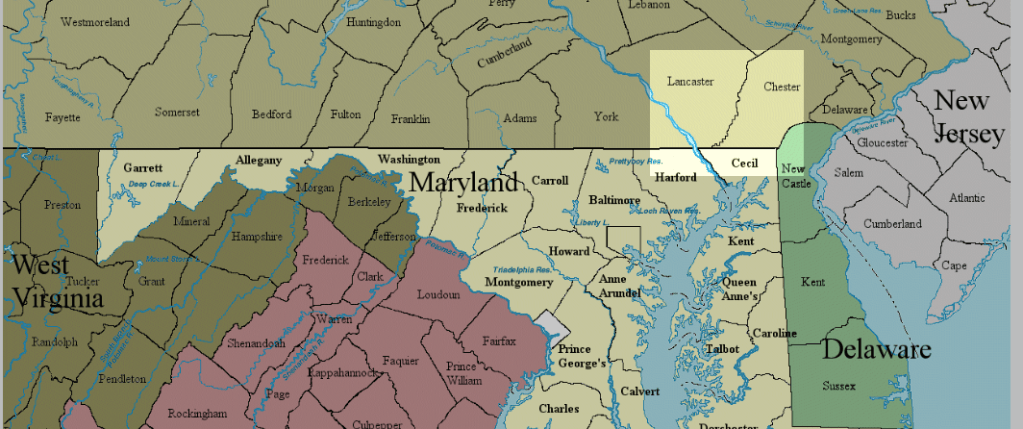
In 1727 – so it’s thought on the basis of several pieces of information coupled with family tradition – Alexander Ewing brought his wife Rebecca and their first three children to Chester County, Pennsylvania, where the family settled for several years in East Nottingham township before moving in 1731 across the Pennsylvania-Maryland line to Octorara Hundred in Cecil County, Maryland.[5] Octorara Hundred is in northwest Cecil County on the Pennsylvania-Maryland line. Chester County, Pennsylvania, and Cecil County, Maryland, are bordering counties. Chester is also contiguous to Lancaster County, where the Calhoun and Montgomery families that moved to Augusta County, Virginia, in the mid-1740s settled. As we’ll see in a moment, another Ewing family headed by Patrick Ewing settled in Drumore township in Lancaster County, where the Colhoun/Calhoun family is also thought to have lived, and then ended up in Little Britain township when that township was formed from Drumore in 1738. Little Britain township, where the Patrick Ewing family lived, is some nine miles west of East Nottingham township, where the Alexander Ewing family initially settled on immigrating to Pennsylvania.
After Alexander and Rebecca (or, as her name appears in contemporary records, Rebeckah) Ewing arrived in America from County Donegal, Ireland, in 1727 with three children, three more children were born to them.[6] Here’s James McMichael’s account of the family of Alexander and Rebecca Ewing:
- Eleanor Ewing was born abt. 1721 in Ireland (probably County Donegal), and died before 1740/1 in Cecil County, Maryland. About 1735 in Cecil County, she married Andrew Porter.[7]
- James Ewing was born 8 August 1723 in Ireland (probably County Donegal), and died before 8 November 1791 in Wythe County, Virginia. James appears not to have married.[8]
- John Ewing was born in 1725 in Ireland (probably County Donegal), and died between 25 January 1787 and 5 March 1788 in Montgomery County, Virginia.[9] John was married, but his wife’s name has not been found.
- William Ewing was born 8 January 1728/9 in Chester County, Pennsylvania, and died between 29 January and 11 June 1793 in Wythe County, Virginia.[10] William married Jane, daughter of Samuel and Margaret Ewing.
- Margaret Ewing was born about 1732 in Cecil County, Maryland, and died after 8 November 1800 in Prince Edward County, Virginia.[11] Margaret married Andrew Porter.
- Samuel Ewing was born 10 Mar 1736/7 in Cecil County, Maryland, and died about 1786 in Montgomery County, Maryland.[12] Samuel married Mary, whose surname may have been Porter.

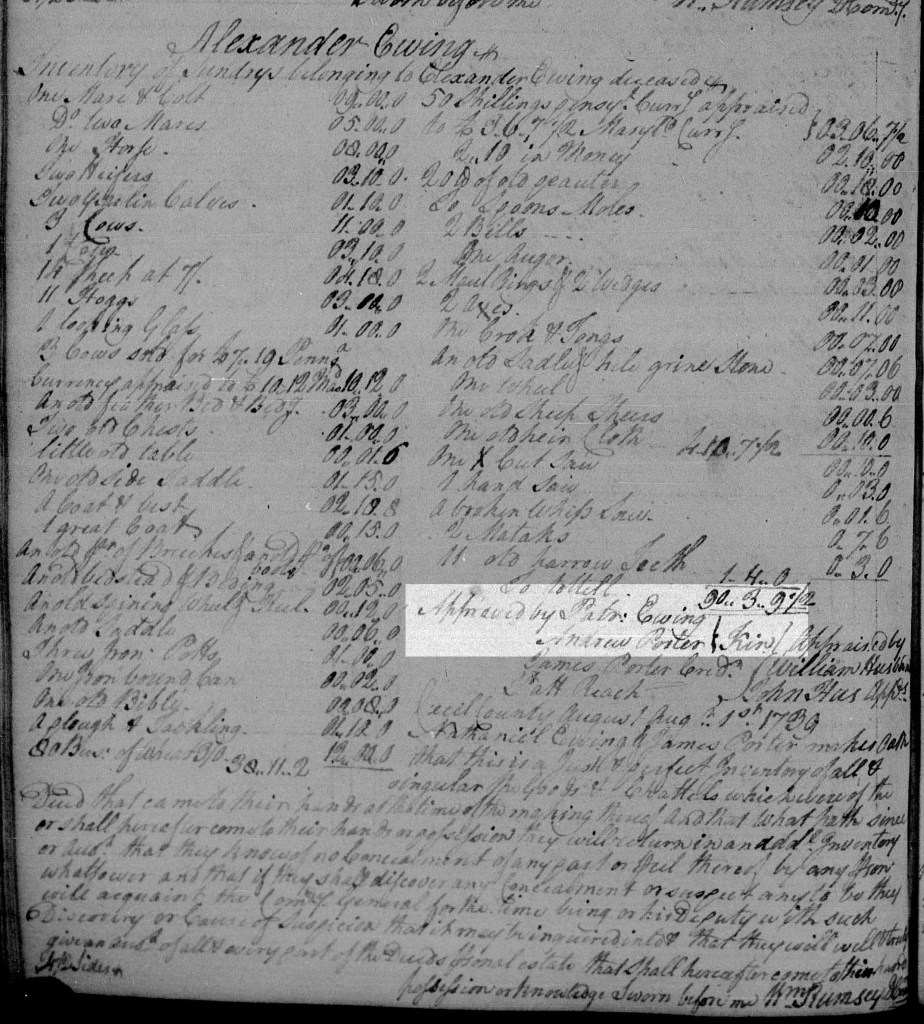
Alexander Ewing made his will in Cecil County, Maryland, on 18 April 1738, and the will was probated 10 March the following year.[13] Among the witnesses to Andrew Ewing’s will was Robert Gillespie, who married Frances Ewing, daughter of the Patrick Ewing of Little Britain township in Lancaster County, Pennsylvania, whom I mentioned above. Patrick Ewing also appears in Alexander Ewing’s estate records approving the inventory of Alexander’s estate,[14] which was returned to court 1 August 1739. Next to Patrick Ewing’s name as he signed his approval of the inventory is written the word “kin.”[15]
Two dates of death for Alexander Ewing appear to be recorded in an old bible that has passed down among Ewing-Porter descendants. On 7 February 1939, the Southwest Virginia Enterprise of Wytheville published an article about this bible entitled “Old Bible Proves to Be of Most Interesting ‘Find.’” In his Alexander Ewing (1676/7-1738) & Descendants, James McMichael offers a partial transcript of this article and a summary of the information provided in it.[16] In 1939, this bible belonged to a John Davis whose wife was a granddaughter of a B. Frank Porter, whose card was pasted on the inside cover of the bible. Written in the bible are the following inscriptions:
Jas Ewing his Book, Ye 21 January 1746/7.
James Ewing his bible, Bought in the year 1727. Bought by Alexander Ewing in Ir[e]land. He departed this life aged sixty one, May ye 7, 1738.
On another page, the bible gives the following death date for Alexander Ewing:
Alexander Ewing deces’t in May ye 1 day 1737/8.[17]
James McMichael says that for a variety of reasons he is inclined to think the 7 May 1738 date of death for Alexander Ewing is correct. Given that Alexander made his will on 18 April 1738, that death date sounds plausible to me, too. The bible also records the dates of birth of Alexander’s children James, John, William, Margaret, and Samuel, but of those birth records, only the dates for James, William, and Samuel can be made out clearly, it appears from the Southwest Virginia Enterprise report.
Patrick Ewing of Little Britain Township, Lancaster County, Pennsylvania
Now to turn to the Patrick Ewing who signed his approval of the inventory of Alexander Ewing, apparently on 15 March 1739: as a previous posting reports, Ewing researcher Margaret Ewing Fife has concluded on the basis of a number of pieces of evidence that Patrick Ewing was likely the father of Jean/Jane Ewing, who married Ezekiel Calhoun, son of Patrick Colhoun and Catherine Montgomery, the immigrant Calhoun ancestors. She also thinks that Alexander and Patrick Ewing were likely brothers. Noting that Lancaster County, Pennsylvania, tax records don’t begin until 1750, making it difficult to place people in the county’s earliest years, Fife indicates that on 5 August 1729 Patrick Ewing was a constable in Drumore township in Lancaster County, where it’s thought the Colhoun/Calhoun family settled when they arrived in Lancaster County in 1733..[18] As I noted previously, Little Britain township was formed from Drumore township in 1738, and it appears that the area of the township in which the family of Patrick Ewing lived then fell into Little Britain township.
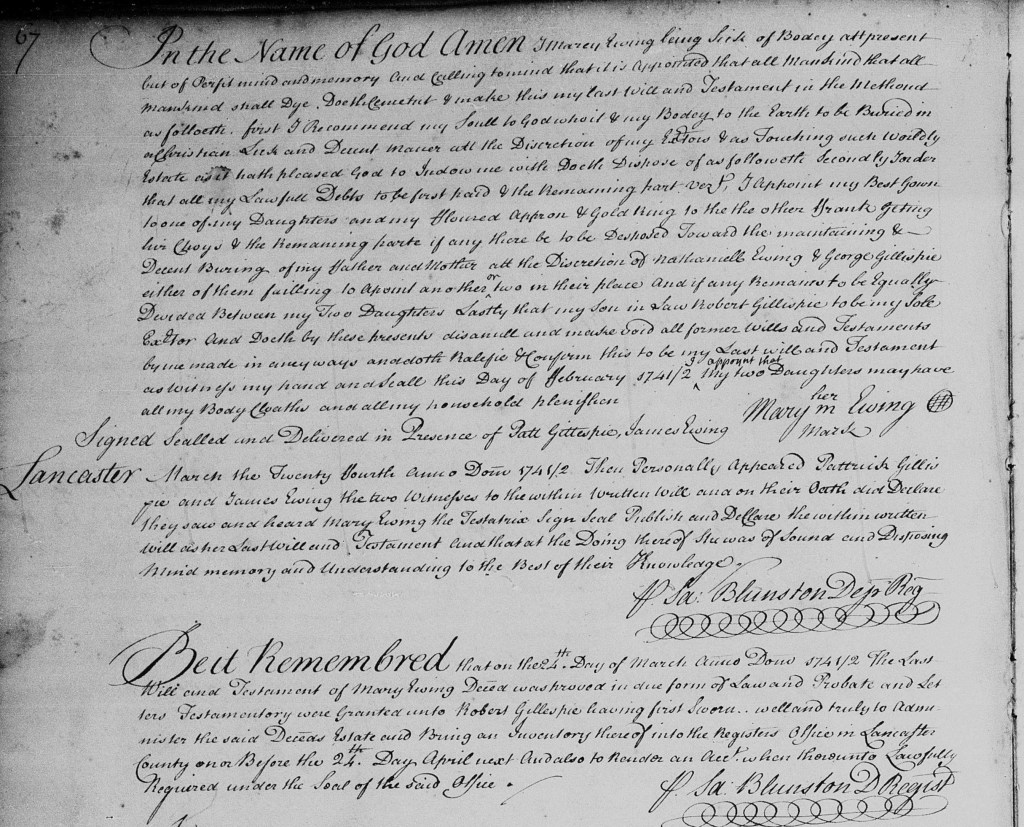
Margaret Ewing Fife thinks Patrick Ewing had a wife Mary who appears in Lancaster County records in the latter part of the 1730s keeping a public house in Little Britain township, and who died testate in Lancaster County before 23 March 1741/2.[19] In February 1741/2 (the day is not written) in Lancaster County, Mary Ewing made her will, noting that she had two daughters among whom her clothes including her best gown, flowered apron, and gold ring were to be divided along with her household furniture.[20] The will names only one of those two daughters, Franke (i.e., Frances). The rest of her estate Mary wanted to be for the maintenance and burial of her father and mother at the discretion of Nathaniel Ewing and George Gillespie. The will named Mary’s son-in-law Robert Gillespie, Franke’s husband, as estate executor. Mary signed the will by mark with witnesses Patrick Gillespie and James Ewing.
On 23 March 1741/2, Patrick Gillespie and James Ewing proved the will, and the estate was inventoried on 27 March 1741/2, with a plantation valued at £47, which Fife thinks on the basis of other documents went to a Patrick Ewing who was almost certainly the son of Patrick and Mary Ewing, a best gown valued at £4, a cow and heifer, a horse, and an old copper still.[21] There is no record of the final division of the estate.
Note that as Fife states clearly, she has not found proof positive 1) that Patrick Ewing was husband of the Mary Ewing who died testate in Lancaster County, Pennsylvania, in 1741/2, though this seems very likely; 2) that Patrick Ewing was a brother of Alexander Ewing who died testate in Cecil County, Maryland, in 1738, though the two were definitely kin; 3) or that Jean/Jane Ewing Calhoun was the unnamed daughter of Mary Ewing’s will. Her case for the deduction that Patrick and Mary were husband and wife rests on the fact that Patrick was in Drumore township, from which Little Britain township was formed, in 1729, and Mary then appears in Little Britain township in the 1730s as a publican, with a younger Patrick Ewing inheriting her land. And her case for concluding that Alexander and Patrick Ewing elder were likely brothers rests on the proximity of these families and the fact that Patrick Ewing signed approval of the estate inventory of Alexander Ewing, with the document noting that they were kin.
But there are some inconsistencies here that need to be noted. First, Fife suggests at one point that Patrick Ewing died prior to 4 August 1737 when Mary Ewing requested permission from Lancaster court to maintain a public house. If Mary’s husband Patrick died prior to 4 August 1737, he cannot have been the Patrick Ewing signing approval of Alexander Ewing’s estate inventory on 15 March 1739. At one point, Fife indicates that the Patrick signing approval of Alexander’s inventory is Patrick younger, son of Patrick elder and wife Mary. At other points, she states that she thinks the Patrick designated as Alexander’s kin in his estate inventory is Alexander’s brother and is the elder Patrick. None of this is solidly proven and cannot be proven with the sparse documents available to us to document these connections.
Second, nor has Fife proven that Jean/Jane Ewing, wife of Ezekiel Calhoun, is the unnamed daughter of Mary Ewing’s will. Her case for that assumption rests on the fact that the Calhoun family is known to have been living in the vicinity of this Ewing family from 1733 to about 1745 (again, as noted above, it’s thought the Calhouns settled in Drumore township in 1733, where the Patrick Ewing family also lived), and that Ezekiel and Jean/Jane Ewing Calhoun left Lancaster County for Virginia at roughly the same time Robert and Frances Ewing Gillespie did so, with the Gillespies going initially to the settlement that the Caldwell family of Lancaster County had made at Cub Creek in Lunenburg County, Virginia, in what’s now Charlotte County. This is the same Caldwell family into which Ezekiel Calhoun’s brother Patrick Calhoun married when he married Martha, daughter of William Caldwell of Cub Creek.
The Gillespies settled in Prince Edward County, contiguous to Charlotte County. Fife also notes that the Calhouns in Augusta County maintained contact with members of the Ewing family in this part of Virginia: she cites a 24 January 1755 deed for the sale of land in Augusta County by Robert Ewing and wife Mary of Lunenburg County to Benjamin Starrat of Augusta County, which was witnessed by Ezekiel Calhoun’s brothers James and Patrick Calhoun among others.[22] Robert Gillespie appears to have been born in the period 1716-1720, and his wife Frances was evidently born about 1720. As a previous posting notes, Ezekiel Calhoun is thought to have been born in or close to 1720. His wife Jean/Jane Ewing was likely born between 1720-5, probably closer to 1725 than 1720, since she continued having children into the mid-1760s by her second husband Robert Norris.
There are admittedly lots of “might be” and “what if” and “likely” and “probable” qualifications here. Even so, note that it’s undeniable that a Patrick Ewing – who is clearly either Patrick elder or younger of Little Britain township in Lancaster County, Pennsylvania – signed approval of the estate inventory of Alexander Ewing of nearby Octorara Hundred in Cecil County, Maryland, in 1739, with this document noting that Patrick and Alexander were kin. It’s also beyond dispute that the Mary Ewing who is in all likelihood wife of the elder Patrick had a daughter Frances who married Robert Gillespie, and that Robert Gillespie witnessed Alexander Ewing’s will. It also seems well-established that Mary Ewing’s land ended up in the hands of a younger Patrick Ewing who is in all likelihood her son. And, given the ongoing connections of the Calhoun and Ewing families after both moved from Pennsylvania to Virginia, their proximity in Lancaster County, and the probable birthdates of Ezekiel and Jean/Jane Ewing Calhoun, it is certainly not unreasonable to ask whether the unnamed daughter of Mary Ewing’s will is Ezekiel Calhoun’s wife Jean/Jane Ewing.
Connections of Alexander Ewing’s Family to Montgomery Family of County Donegal, Lancaster County, Pennsylvania, and Augusta (Later Botetourt, Wythe, Montgomery) County, Virginia
And now to return to the William Ewing thread with which I opened this posting: as I hope what I’ve written to this point in the posting shows, we can determine with certainty that the William Ewing to whom Ezekiel and Jean/Jane Calhoun’s nephew Alexander Noble sold land in Montgomery County, Virginia, in August 1782 with “Cousen John Mountgomery” acting on Alexander’s behalf in the land sale, was the son of Alexander Ewing of Elaghbeg in Burt parish, County Donegal, Ireland, and Chester County, Pennsylvania, and Cecil County, Maryland. What we cannot determine with certainty is the likely kinship connection between Jean/Jane Ewing Calhoun and William Ewing. If Margaret Fife’s deductions are correct, the two would have been first cousins – hence my previous qualifying statement that I think, but do not know with certainty, that William Ewing was a relative of Jean/Jane Ewing Calhoun.
Ewing Connections to Hugh Montgomery (1753-1833) of Wythe County, Virginia, and Tennessee, Son of Hugh Montgomery (abt. 1720 -1779) of Salisbury, Rowan County, North Carolina
The August 1782 sale of Alexander Noble’s land to William Ewing was not the only instance in which Alexander’s cousin John Montgomery appears in records of William Ewing. On 29 January 1793 as William Ewing made a deed of gift in Wythe County to his nephew Alexander Ewing of Davidson County, North Carolina (later Tennessee), John Montgomery witnessed the deed.[23] William Ewing was approaching death as he made this deed of gift: his will, dated 26 July 1791, was probated in Wythe County on 9 July 1793.[24]
Also important to note: when the inventory of William Ewing’s estate was made in 1793 (the inventory was not recorded until September 1805), the inventory showed Hugh Montgomery owing a note of £3 13s to the estate of William Ewing.[25] This Hugh Montgomery (1753-1833) is the son of Hugh Montgomery (abt. 1720 – 1779) discussed in a previous posting, who appears to have been a relative of Catherine Montgomery Colhoun and her brother James Montgomery, father of the John Montgomery who was Alexander Noble’s cousin.
As the posting I’ve just linked notes, the younger Hugh lived much of his adult life in Wythe County, Virginia, where land his father Hugh bought from Patrick Calhoun on Reed Creek in 1765 was located after Wythe’s formation; the elder Hugh willed this Reed Creek land to his son Hugh in 1779. The younger Hugh Montgomery was closely connected to members of Ewing family in Wythe County in significant ways. As the posting linked in the preceding paragraph notes, on 28 December 1790, Hugh Montgomery was made administrator of the estate of Mary Ewing in Wythe County.[26]
Mary Ewing was Hugh Montgomery’s mother-in-law. Prior to December 1790, Hugh had married Mary’s daughter by a previous marriage, Euphemia Purnell. In his latter years – following the lead of Marguerite and Vernon Brown, James R. McMichael thinks this was around 1770 – Samuel Ewing, son of Alexander Ewing, married Mary, the widow Purnell.[27] Samuel’s will, which he made in Montgomery County, Virginia, on 3 June 1783, names his loving wife Mary, and makes a bequest to Fanny (i.e., Euphemia) Purnall, when she comes of age.[28] The will was probated on 23 May 1786. The will notes that in addition to his Virginia land, which he left to his widow Mary, and land in Kentucky, Samuel Ewing owned 1,920 acres on the Cumberland River in North Carolina – soon to be Tennessee. This is a point I’ll return to in a moment.
The 31 March 1783 will of Samuel’s brother James Ewing in Wythe County also made a bequest of a mare to Euphemy Purnell, without stating any relationship to her.[29] The will bequeathed the rest of James’ estate to his brother Samuel Ewing, who was one of the executors of the will.

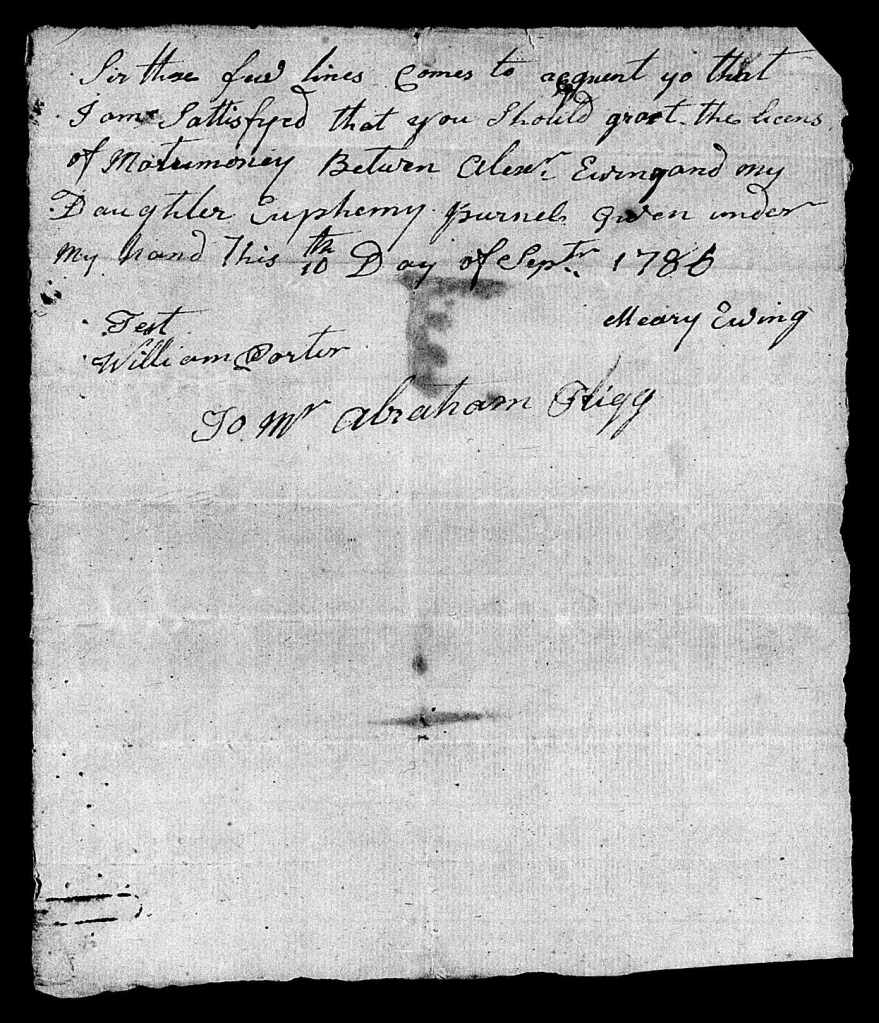
Following Samuel Ewing’s death, on 11 September 1786 an Alexander Ewing who hasn’t been positively identified gave bond in Montgomery County with Benjamin Cox to marry Euphemy Purnel, daughter of Mary Ewing. These family relationships are stated in the marriage bond and in the record of this marriage in the county marriage register, which shows that the marriage did take place after Alexander Ewing gave bond for it.[30] The loose-papers file for this marriage also contains a note of permission written and signed on 10 September by Mary Ewing, giving her consent for her daughter Euphemia Purnell’s marriage. James McMichael thinks that the Alexander Ewing who married Euphemia Purnell is likely the nephew of this name to whom Samuel’s brother William Ewing made a deed of gift in January 1793, by which point Alexander was living in Davidson County, North Carolina (later Tennessee), with a wife Sarah Smith.[31] Alexander was a son of William and Samuel Ewing’s brother John.
McMichael thinks that Euphemia died not long after she married Alexander Ewing, though he also notes that she witnessed a deed on 2 December 1786, signing her name as Euphame Parnell.[32] But Euphemia did not die: the fact that she signed as witness to this December 1786 deed indicates that, for whatever reason, her marriage to Alexander Ewing failed, and at some point soon after this, Euphemia married Hugh Montgomery.
A case heard by the Tennessee Supreme Court in December 1838, Montgomery v. Hobson, contains fascinating if somewhat garbled information about Euphemia’s whereabouts in the time frame just before she married Hugh Montgomery.[33] The case involved a dispute over land on the Cumberland River near Nashville that had come to Euphemia when her mother Mary Purnell Ewing died prior to 28 December 1790. The land dispute had to do with provision of the land of Hugh and Euphemia Purnell Montgomery after their son Lemuel Purnell Montgomery died testate at the battle of Horseshoe Bend in Alabama, on 27 March 1814.[34]
The summary of what was at stake in this legal dispute states that Euphemia Parnell [sic] was granted 640 acres by the state of North Carolina on the Cumberland River across from Nashville on 26 July 1793 (patent 380), by virtue of a preemption right given to her mother, whose name is not stated. Then the summary adds,
She was quite young at the time, then removed from Tennessee to Wythe County, Virginia, with her mother, on whose pre-emption right the grant was founded, and in Wythe County, married Hugh Montgomery.
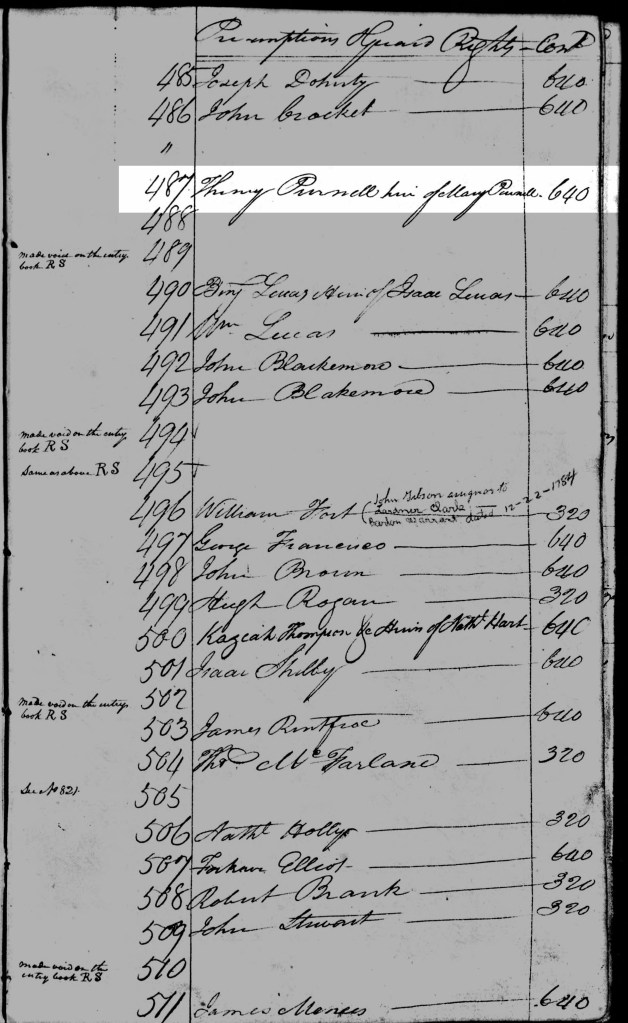
This is the part of the case summary that’s garbled. The statement that Euphemia was quite young at the time appears to refer to the date on which she had the patent for her Cumberland River land – 26 July 1793. What it actually refers to, however, is the fact that Euphemia’s mother, who is named in Davidson County’s 1790-1 preemption book as Mary Purnell when the 640-acre preemption grant went to Euphemia as Mary’s heir, claimed this Cumberland River land in what became Tennessee when her daughter Euphemia was young and then took Euphemia to Wythe County, Virginia, where Euphemia married Hugh Montgomery.[35]
The summary of the Montgomery v. Hobson case indicates that Hugh and Euphemia had married by 12 April 1797 when they made a deed in Wythe County to Moses Austin, which was recorded in Davidson County after Euphemia relinquished her dower interest in the land in Wythe County on 11 December 1807. It’s clear, though, that Hugh Montgomery and Euphemia Purnell married not long after Euphemia’s marriage to Alexander Ewing dissolved, since their oldest son Lemuel Purnell Montgomery was born around 1786. The case summary also notes, by the way, that Hugh Montgomery died 3 June 1833 and Euphemia died in January 1834, both dying in Campbell County, Tennessee, where they’re buried.[36]
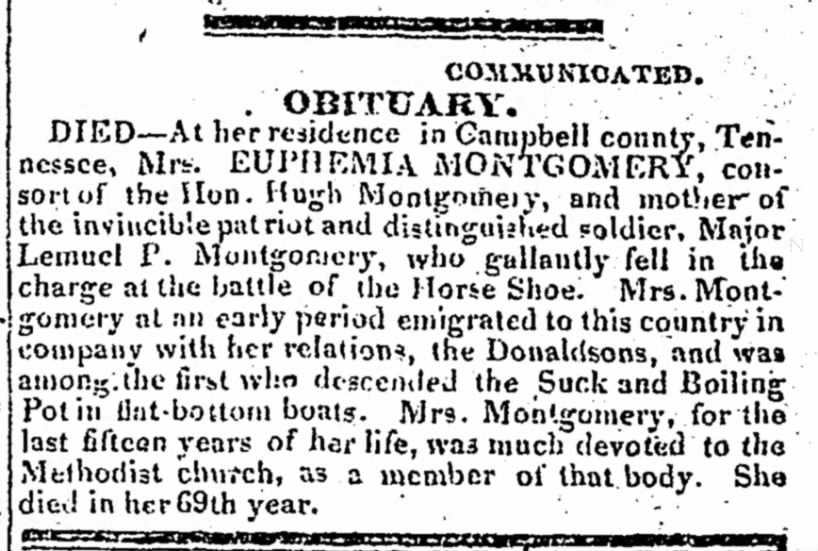
Information about the Purnell husband of Mary, who a number of researchers including James McMichael think was née Porter, can be gleaned from a number of sources.[37] A fascinating clue about Mary’s background is found in her obituary published by Nashville’s Tennessean on 8 February 1834.[38] The obituary reads,
DIED – At her residence in Campbell county, Tennessee, Mrs. EUPHEMIA MONTGOMERY, consort of the Hon. Hugh Montgomery, and mother of the invincible patriot and distinguished soldier, Major Lemuel P. Montgomery, who gallantly fell in the charge at the battle of the Horse Shoe. Mrs. Montgomery at an early period emigrated to this country in company with her relations, the Donaldsons, and was among the first who descended the Suck and Boiling Pot in flat-bottom boats. Mrs. Montgomery, for the last fifteen years of her life, was much devoted to the Methodist church, as a member of that body. She died in her 69th year.
Note the statement that Euphemia Montgomery was a relative of the Donaldsons – i.e., the Donelsons – who came to Tennessee in 1780. The family to which this statement refers is that of John Donelson and wife Mary Purnell, who were among the first settlers of Middle Tennessee. The kinship of Euphemia Purnell Montgomery to this Donelson family is also noted by S.G. Heiskell in his 1918 history of Andrew Jackson’s role in early Tennessee history, and in John H. Dewitt’s December 1916 publication of letters of General John Coffee to his wife in the Tennessee Historical Magazine.[39] Noting that Lemuel Purnell Montgomery was a major of note in the military and that Montgomery County, Alabama, is named for him, Dewitt states that Lemuel’s parents were Hugh and Euphemia Montgomery, the latter of whom “was related to the Donelsons.” Heiskell makes the same observation.
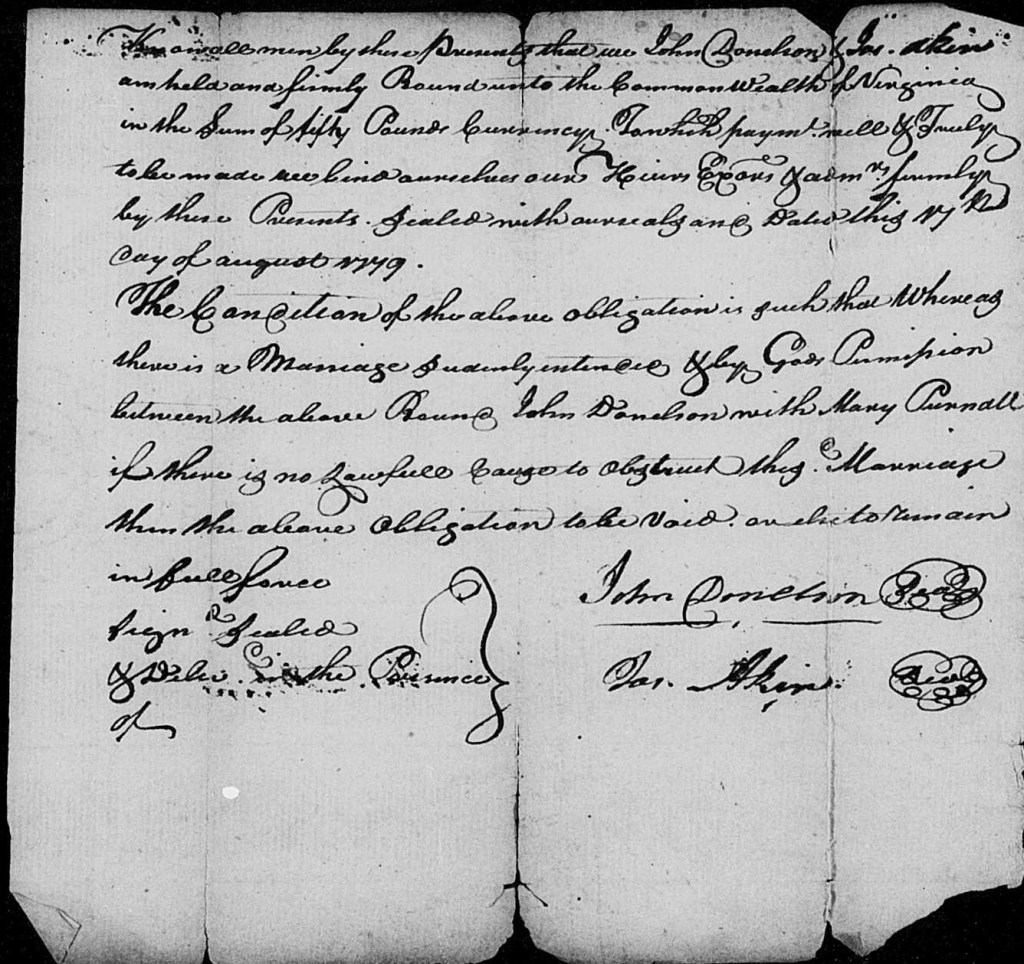
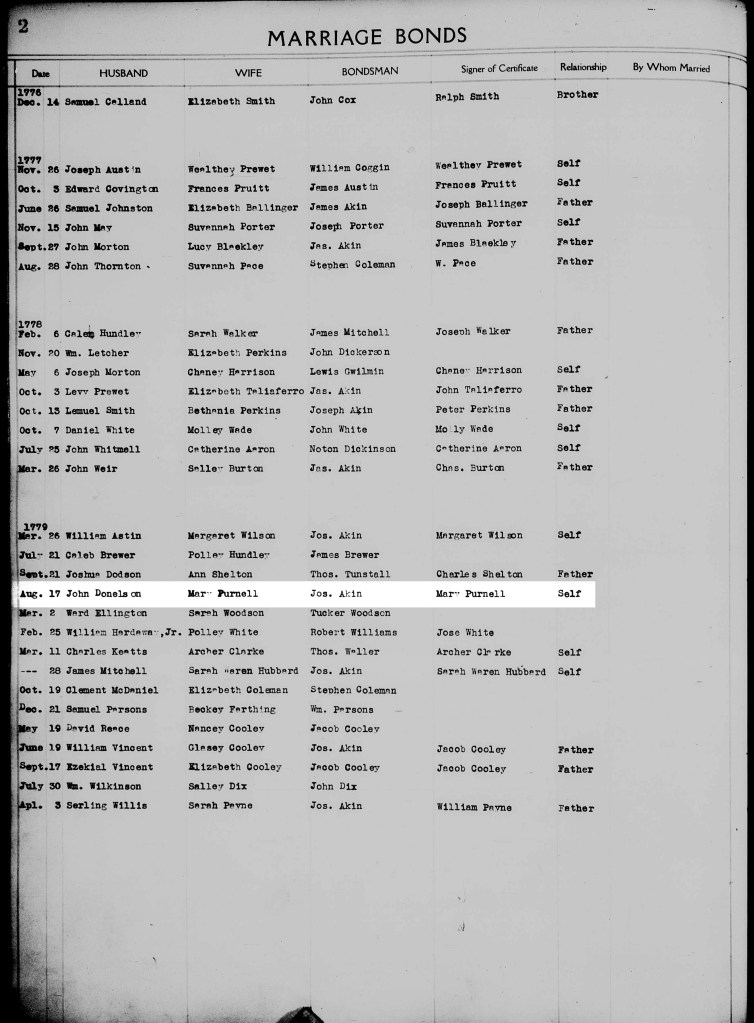
John Donelson married Mary Purnell on or just after 17 August 1779 in Pittsylvania County, Virginia, when he gave bond for the marriage with Joseph Akins.[40] According to an abstract of this marriage record published in William and Mary College Quarterly in 1911, the Pittsylvania County file for this marriage contains a letter of permission for the marriage from Mary Purnell’s mother Mary Purnell.[41] I do not find that permission letter in the loose-papers marriage bonds file in Pittsylvania County. Pittsylvania’s first marriage bonds book states that Mary Purnell signed the certificate for the marriage, but identifies this Mary as the bride.
If the information that Mary Purnell Donelson’s mother, also called Mary, wrote a note of permission for her daughter Mary’s marriage to John Donelson in August 1779 is correct, then John Donelson’s wife Mary was not the daughter of Tabitha Jones, as is widely stated, but the daughter of a mother named Mary. It has long been known that Mary Purnell Donaldson’s father was Chesed Purnell, who is thought to have died around 1772 in Worcester County, Maryland. A number of scholarly sources recognize that Chesed Purnell had wives Tabitha Jones and Mary, but none of those sources that I’ve seen connect that wife Mary with the Mary Purnell who married Samuel Ewing and was definitely the mother of Euphemia Purnell Montgomery. Ellen Davies-Rodgers identifies Chesed Purnell’s second wife as Mary Montgomery.[42]

Mary Purnell Donaldson’s detailed obituary in the Nashville Tennessean on 4 December 1848 states that she was born at Snow Hill, Maryland, on 18 May 1763, daughter of Chesed Purnell, and that at the age of sixteen, she married John Donelson, migrating with him and his father John to Tennessee soon after the marriage took place.[43] According to the obituary, the Donelson family arrived at the Big Salt Lick on the Cumberland, that is, at the site of what became Nashville, on 24 April 1780, having left Port Patrick Henry on the Holston River on 22 December 1779.
This is clearly the migration to Tennessee with the Donelson family spoken of as well in Euphemia Purnell Montgomery’s obituary in the Tennessean on 8 February 1834. Since the December 1838 Tennessee Supreme Court case of Montgomery v. Hobson states that Euphemia and her mother were in Tennessee, with her mother Mary Purnell claiming preemption rights on land on the Cumberland River across from Nashville, and that Mary and Euphemia Purnell then returned to Virginia to Wythe County where Euphemia married Hugh Montgomery, it would appear that Mary Purnell also took part in the migration of her daughter Euphemia with the Donelson family to Tennessee in 1779-1780 and then returned to Virginia, where she married Samuel Ewing late in his and her own life.
Euphemia Purnell Montgomery and Mary Purnell Donelson were, in fact, sisters, as the editors of The Papers of Andrew Jackson note in a footnote to an 18 August 1829 letter written by Hugh and Euphemia Montgomery’s son Chesed Purnell Montgomery to Andrew Jackson.[44] In this letter, Chesed states that Stockley Donelson, son of John Donelson and Mary Purnell, was his cousin. Another footnote to the same letter states that Andrew Jackson was a companion of Hugh Montgomery (younger) in Salisbury when Jackson was preparing for the bar.[45] Andrew Jackson’s wife Rachel Donelson was, of course, also a sister of Mary Purnell’s husband John Donelson, and it may be these family connections that caused Chesed P. Montgomery to make a “nuisance of himself” by writing repeatedly to Andrew Jackson to implore him for favors, and to threaten him when those favors didn’t materialize.[46]
Biographies of Andrew Jackson frequently note his lifelong friendship with Hugh Montgomery, which began when Jackson studied law with John Stokes in Salisbury, North Carolina, in the 1780s. Jackson biographer James Parton tells a story of a race in which Jackson and Hugh Montgomery, who is said to have been a large, athletic man, took part in Salisbury in 1785.[47] Robert Vincent Remini and a number of other Jackson biographers state that Hugh Montgomery studied law along with Jackson in Salisbury.[48] Biographies of Jackson also frequently note that when Hugh Montgomery’s son Lemuel Purnell Montgomery fell at the battle of Horseshoe Bend on 27 March 1814, Jackson was visibly overcome with grief at the loss of his friend’s son. According to Peter A. Brannon, following Lemuel’s death, Andrew Jackson mounted Lemuel’s pistols in silver holsters and sent them in June 1815 to “my old friend Col. Hugh Montgomery to preserve the pistols of his patriotic and gallant son.”[49]
The friendship of Andrew Jackson and Hugh Montgomery continued up to Hugh’s death in 1833 in Jacksboro, Tennessee, a town named for Jackson for whose courthouse Hugh donated land. In 1824, Jackson appointed Hugh Montgomery to be Indian Agent for the Cherokee Nation in Tennessee, North Carolina, and Georgia, a position he held to his death in 1833. In 1832, Jackson appointed Hugh’s brother-in-law Montfort Stokes, who married Hugh’s half-sister Rachel Montgomery, Indian Agent for Arkansas Territory, and Stokes resigned his position as North Carolina governor to take the position.[50] John Stokes, under whom Jackson studied law at Salisbury, was Montfort Stokes’ brother.
Note the thick connections here: Hugh Montgomery knew Andrew Jackson by 1785 and may have studied law with him in Salisbury, North Carolina, prior to marrying Euphemia Purnell in Wythe County, Virginia. Euphemia’s sister married John Donelson, whose sister Rachel married Andrew Jackson. The Purnell and Donelson families both hailed from Snow Hill in Worcester County, Maryland, and were already connected by intermarriages with a Davis family in Snow Hill before these families moved to Virginia – see Pauline Wilcox Burke’s book Emily Donelson of Tennessee (Knoxville: University of Tennessee, 2001), pp. 17-8 for information on these connections.
The strong connections are apparent as well between the families of John Donelson and Mary Purnell, and Hugh Montgomery and Euphemia Purnell. Both families named sons Chesed after Mary and Euphemia’s father Chesed Purnell, an unusual given name that those who read Hebrew will know is biblical, a Hebrew word meaning “mercy” or “loving kindness.” Both families also named sons Lemuel – in Hugh and Euphemia Montgomery’s case, Lemuel Purnell Montgomery – and claims have been made that John Donelson and wife Mary Purnell named their son Lemuel after his cousin Lemuel Purnell Montgomery, though I think it’s likely that both Euphemia and Mary named their Lemuels after a Purnell family member of the past.[51] And it’s of course the land near Nashville that Euphemia inherited from her mother Mary and Euphemia’s ties to the Donelson family of her sister Mary, movers and shakers in Nashville, that brought Hugh and Euphemia Montgomery out to Tennessee from Virginia in the first decade of the 19th century.
Note, too, how the shared Ewing connections in Wythe County to the Montgomery family constitute yet another tie suggesting kinship between Hugh Montgomery’s father Hugh Montgomery elder of Salisbury, North Carolina, and the family of James and Anne Thompson Montgomery in Augusta County (later Wythe and Montgomery), Virginia. As we’ve seen above, some threads bind together members of the James Montgomery family and that of Alexander Ewing, who came from County Donegal, Ireland, to Chester County, Pennsylvania, in 1727 and then died in Cecil County, Maryland, in 1738. But as we’ve also seen, another set of threads also binds members of this same Ewing family together with Hugh Montgomery, son of Hugh Montgomery of Salisbury.
In Conclusion: Ewings in Elaghbeg, Burt Parish, County Donegal, Ireland and Montgomerys in Monfad, Allsaints Parish, County Donegal
Given the probability that Catherine Montgomery, wife of Patrick Colhoun, was a sister of James Montgomery of Augusta County, Virginia, and keeping in mind that Catherine’s son Ezekiel married Jean/Jane Ewing, it’s worth noting once again, in conclusion, how these three families, the Montgomerys, the Colhouns/Calhouns, and the Ewings, all came to Pennsylvania from County Donegal, Ireland, in the first decades of the 18th century, and then migrated to the same places in Virginia. As I noted previously, the Alexander Ewing whose sons James, John, William, and Samuel went from Maryland to Augusta County, Virginia, was born in 1679/1680 in Elaghbeg, Burt parish, County Donegal. Catherine Montgomery Colhoun was born in 1684, in all likelihood also in County Donegal, and her brother James Montgomery is thought to have been born about 1690 in Donegal.
Visit the Montgomery Founder project at FTDNA that focuses on Montgomery families who share the J-Z35794 haplogroup indicating descent from the Montgomery clan founder Robert of Montgomery of Renfrewshire, Scotland, and search for participants reporting that they descend from the James Montgomery family of Augusta County, Virginia, and you’ll spot some information that’s exceptionally interesting.[52] In the section of the report of DNA results focusing on Montgomerys in a group called “R-M269>>>R-BY3374>R-BY194967 Founded ~1600 CE Donegal, Ireland,” you’ll find a number of descendants of James Montgomery. And you’ll also find one member of the same group reporting descent dating to around 1682 from a David Mountgomery of Monfad in County Donegal.
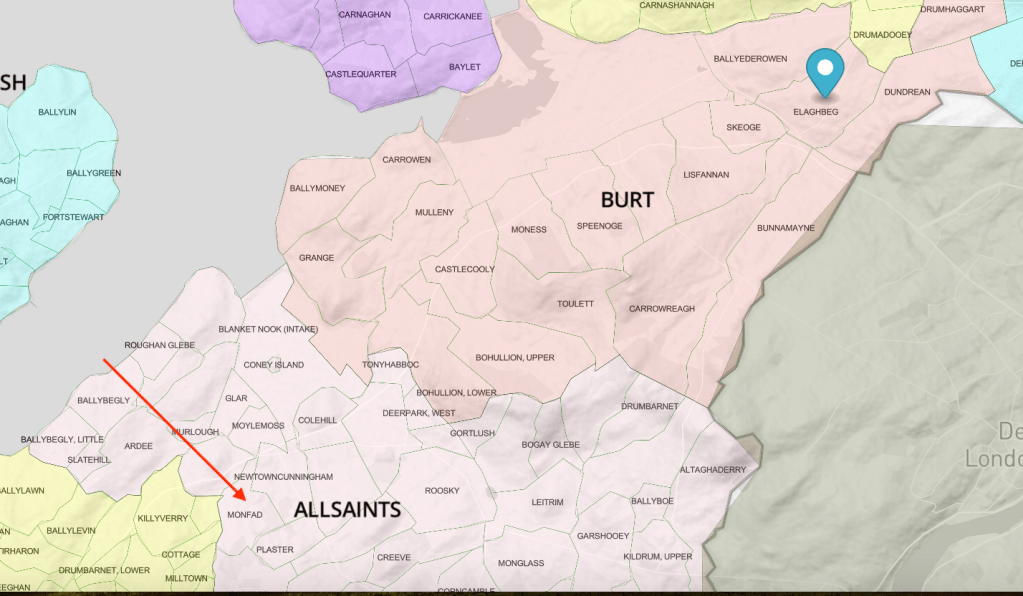
Do a bit of research to find information about Monfad in County Donegal, and you’ll discover that it’s in a civil parish, Allsaints, contiguous to Burt civil parish to which the Ewings can be traced in the latter part of the 1600s. Allsaints parish joins Burt parish on the south.
Look more closely and you’ll discover that the townland of Monfad is a little over eight miles southwest of Elaghbeg (see the map snapshot at the head of this posting). James McMichael’s research indicates clearly that Alexander Ewing, who came to Chester County, Pennsylvania, in 1727, then soon moved to nearby Cecil County, Maryland, with his sons heading to Augusta County, Virginia, in the 1740s, came from Elaghbeg in Burt parish. And that finding makes it interesting, indeed, to discover that descendants of a Donegal Montgomery family intermarried with the Colhouns/Calhouns, both families coming from Donegal to Lancaster County, Pennsylvania, in 1733 and then migrating to Augusta County, Virginia, and interacting with members of that Ewing family there, match the DNA of someone who can trace his ancestry back into the 1680s in Monfad, some eight miles from Elaghbeg.
[1] Montgomery County, Virginia, Deed Bk. A, pp. 259-260. See also Mary B. Kegley, Early Adventurers on the Western Waters, vol. 3, pt. 1 (Marceline, Missouri: Walsworth, 1995), p. 426.
[2] Kegley, Early Adventurers on the Western Waters, vol. 3, pt. 1, p. 426.
[3] James R. McMichael, Alexander Ewing (1676/7-1738) & Descendants (priv. publ., 1999), available digitally at the website of the Ewing Family Association. The digitized, online copy of McMichael’s book is not paginated; the passage I’m footnoting is found in chapter 2, “Out of Scotland and in Ireland.”
[4] See “Elaghbeg in Burt civil parish, Donegal,” at John Grenham’s Irish Ancestors website; and “Elagh Beg Townland, Co. Donegal,” at the Townlands.ie website.
[5] In this paragraph I’m summarizing information from McMichael, Alexander Ewing (1676/7-1738) & Descendants, chapter 6, “The Descendants of Alexander Ewing.” Documentation of the information cited is in the chapter I’ve just linked.
[6] Ibid.
[7] Ibid. and chapter 8, “The Descendants of Eleanor Ewing.”
[8] McMichael, Alexander Ewing (1676/7-1738) & Descendants, chapter 6, “The Descendants of Alexander Ewing,” and chapter 7, “James, William, and Samuel Ewing.”
[9] Ibid. and chapter 8, “The Descendants of Eleanor Ewing.”
[9] McMichael, Alexander Ewing (1676/7-1738) & Descendants, chapter 6, “The Descendants of Alexander Ewing,” and chapter 10, “The Descendants of John Ewing.”
[10] McMichael, Alexander Ewing (1676/7-1738) & Descendants, chapter 6, “The Descendants of Alexander Ewing,” and chapter 7, “James, William, and Samuel Ewing.”
[11] McMichael, Alexander Ewing (1676/7-1738) & Descendants, chapter 6, “The Descendants of Alexander Ewing,” and chapter 9, “The Descendants of Margaret Ewing.”
[12] McMichael, Alexander Ewing (1676/7-1738) & Descendants, chapter 6, “The Descendants of Alexander Ewing,” and chapter 7, “James, William, and Samuel Ewing.”
[13] Maryland Wills Liber DD1, ff. 52-3. The will is apparently also recorded in Cecil County, Maryland, Will Bk. AA1, p. 360. The will is transcribed in McMichael, Alexander Ewing (1676/7-1738) & Descendants, chapter 6, “The Descendants of Alexander Ewing.”
[14] According to Margaret Ewing Fife, the inventory of Alexander Ewing’s estate was compiled on 15 March 1739: see Margaret Ewing Fife, Ewing in Early America, part 1 (Atlanta, 1995), pp. 141f, a chapter (chapter 22) entitled “Introduction to a Cluster of Ewing/Frazier/Gillespie/Porter along the Border of Little Britain Twp., Lancaster Co., PA and Octorara Hundred, Cecil Co., MD [1729-1742]).” The inventory itself states that it was returned to court 1 August 1739. Fife’s book is available digitally at the website of the Ewing Family Association. Chapter 22 is here.
[15] Cecil County, Maryland Inventories, Bk. 3, p. 74.
[16] McMichael, Alexander Ewing (1676/7-1738) & Descendants, chapter 6, “The Descendants of Alexander Ewing.”
[17] Given the ease with which a 1 and a 7 can be confused, is it possible that this entry in the bible actually states that Alexander Ewing died 7 May, as the preceding one does?
[18] Fife, Ewing in Early America, part 1 (Atlanta, 1995), p. 141, citing Gary T. Hawbaker, Lancaster County, Pennsylvania, Quarter Session Abstracts 1729-1742 (Hershey, Pennsylvania, 1986), p. 1.
[19] Mary Ewing petitioned Lancaster court on 4 August 1737 to keep a public house and received permission to do so on 1 August 1738. Mary appears in Lancaster court records on 7 August 1739 and 5 August 1740 as a publican, and on 5 August 1741, the county court renewed her license to keep a pub, noting that she lived in Little Britain township: see Fife, Ewing in Early America, part 1, pp. 141-3, citing Hawbaker, Lancaster County, Pennsylvania, Quarter Session Abstracts 1729-1742, pp. 64, 73, 86, 98, 105.
[20] Lancaster County, Pennsylvania, Will Bk. A, p. 67.
[21] I have not found the original inventory of Mary Ewing’s estate; I’m relying here on Fife’s notes.
[22] Fife, Ewing in Early America, part 1, p. 144, citing Augusta County, Virginia, Deed Bk. 7, pp. 182-7.
[23] Wythe County, Virginia, Deed Bk. 1, p. 327. See also McMichael, Alexander Ewing (1676/7-1738) & Descendants, chapter 7, “James, William, and Samuel Ewing.”
[24] Wythe County, Virginia, Will Bk. 1, p. 22.
[25] Wythe County, Virginia, Will Bk. 1, pp. 405-9.
[26] Wythe County, Virginia, Court Order Bk. 1790-1, p. 40.
[27] See Marguerite and Vernon Brown, Ewing-McCulloch-Buchanan Genealogy (Dallas: Royal, 1957), p. 29; and McMichael, Alexander Ewing (1676/7-1738) & Descendants, chapter 7, “James, William, and Samuel Ewing.”
[28] Montgomery County, Virginia, Will Bk. B, p. 81.
[29] Wythe County, Virginia, Will Bk. 1, p. 15.
[30] The marriage bond is in the loose-papers marriage files of Montgomery County, Virginia. The marriage is recorded in Montgomery County, Virginia, Marriage Register 1777-1853, p. 12.
[31] McMichael, Alexander Ewing (1676/7-1738) & Descendants, chapter 7, “James, William, and Samuel Ewing.”
[32] Ibid. There’s no citation of the deed’s source.
[33] Tennessee Reports: Reports of Cases Argued and Determined in the Supreme Court of Tennessee During the Years 1838-9, vol. 19 (Nashville: Nye & Co., 1839), pp. 437-458.
[34] Laura King, “Montgomery, Lemuel P.,” Encyclopedia of Alabama maintained by Alabama Humanities Alliance and Auburn University.
[35] Davidson County, Tennessee, Preemption Bk. Series 11 Bk. 1, no. 487. Euphemia’s name appears here as Fhemy Purnell, and has been misread in transcriptions of this record as Heney or Heny.
[36] See Find a Grave memorial pages of Hugh Montgomery and Euphemia Purnell Montgomery, both buried in the Montgomery cemetery at Jacksboro, Campbell County, Tennessee, both created by Larry & Edie Doepel and maintained by Patsy Hunt. Neither grave has a marker.
[37] McMichael, Alexander Ewing (1676/7-1738) & Descendants, chapter 7, “James, William, and Samuel Ewing.”
[38] “Obituary,” Tennessean [Nashville] (8 February 1834), p. 3, col. 5.
[39] S.G. Heiskell, Andrew Jackson and Early Tennessee History (Nashville: Ambrose, 1918 p. 362); and John H. Dewitt, “Letters of General John Coffee to His Wife, 1813-1815,” Tennessee Historical Magazine 2,4 (December 1916), p. 283.
[40] The original bond is in loose-papers marriage files of Pittsylvania County, Virginia.
[41] “Marriage Bonds, Pittsylvania County,” William and Mary College Quarterly 20, series 1 (1911), p. 143.
[42] Ellen Davies-Rodgers, The Holy Innocents: The Story of a Historic Church and Country Parish (Haysville, Wythe Depot) Arlington, Shelby County, Tennessee (Brunswick, Tennessee: Plantation Press, 1965), p. 437.
[43] “Died,” Tennessean [Nashville] (4 December 1848), pp. 2, col. 7 and 3, col. 1. The header for the obituary states that the Tennessean was republishing an obituary that had appeared the same day in the Presbyterian Record.
[44] The Papers of Andrew Jackson, vol. 7: 1829, ed. Daniel Feller et al. (Knoxville: University of Tennessee Press, 2007), p. 383.
[45] Ibid., p. 384.
[46] The observation that Chesed P. Montgomery made a nuisance of himself in his repeated letters to Jackson is from Mark R. Cheathem’s review of The Papers of Andrew Jackson, vol. 7: 1829 in Florida Historical Quarterly 86,4 (spring 2008), p. 532.
[47] James Parton, Life of Andrew Jackson: Condensed from the Author’s “Life of Andrew Jackson,” in Three Volumes (New York: Mason Brothers, 1863), p. 41.
[48] Robert Vincent Remini, Andrew Jackson and the Course of American Empire, 1767-1821 (New York: Harper & Row, 1977), pp. 31-2.
[49] Peter A. Brannon, “Lemuel Purnell Montgomery,” Arrow Points 8,5 (May 1924), p. 64.
[50] Daniel M. McFarland, “Stokes, Montfort,” NCPedia, maintained by North Carolina Government and Heritage Library at the State Library of North Carolina, and reproducing material published in Dictionary of North Carolina Biography, 6 volumes, edited by William S. Powell (Chapel Hill: University of North Carolina Press, 1979-1966). John Crouch, Historical Sketches of Wilkes County (Wilkesboro, 1902), (pp. 71-3), notes that Montfort Stokes served in the U.S. from 1816 to 1823, and was then was elected to the North Carolina Senate in 1826 and to the North Carolina House in 1829-1830 before being elected governor in 1830.
[51] On the claim that John and Mary Purnell Donelson named their son Lemuel Donelson after his cousin Lemuel Purnell Montgomery, see the Find a Grave memorial page of Lemuel Donelson, Donelson cemetery, Williamson County, Tennessee, created by Rembert Woodroof, maintained by T. Brady.
[52] “J-Z35794 – Montgomery Founder: ‘Montgomery of Scotland’ Founder Project for Haplogroup J-Z3579” at FTDNA, with results of this DNA project to date here.
 BEGATS AND BEQUEATHALS
One thought on “Some Notes on Montgomery-Ewing Connections: Alexander Ewing of Burt Parish, County Donegal, and Cecil County, Maryland, and Montgomerys of Augusta (Later Wythe) County, Virginia”