Regarding Catherine, whose given name is initially established by some estate records of Patrick that have been discovered in Lancaster County, Pennsylvania (see the posting linked above for information about this), equally little is known with certainty. As with Patrick Colhoun, there’s abundant lore about Catherine and her origins, but in my view, not much of that lore has been substantiated factually.
So with Catherine, I’m going to adopt the same agnostic approach I employed when I looked at what’s known with certainty about Patrick Colhoun in my posting about him. I’m going to ask what we know with reasonable certainty, where the traditions that we think we know about Catherine come from, and when and how those traditions began to circulate.
Right off the bat, I have to tell you that I have not found any Ur-source which tells us with certainty that Patrick Colhoun’s wife Catherine – a given name we know from his Lancaster County, Pennsylvania, estate documents and from other records including her tombstone – was née Montgomery. The claim that Catherine’s maiden surname was Montgomery seems “always” to have been there in accounts of the American Calhoun family of which she was the maternal immigrant progenitor. I have no reason to doubt the accuracy of these accounts. But I want to note immediately that, as far as I know – and I may simply not yet have discovered it – there’s not a credible, documented account from the period of Catherine’s lifetime or immediately after it showing that her surname was Montgomery.

The Journal of Alexander Noble
One valuable document that provides us with some very good clues is a little journal Catherine’s grandson Alexander Noble kept in the period 1762-1773. This journal is held by South Caroliniana Library of University of South Carolina at Columbia in its Noble Family Papers collection. I’m very grateful to that library for supplying me with a digital copy of this valuable document. The images I’m sharing here are from the digital copy South Caroliniana Library has sent me. Alexander Noble’s journal is both a travelogue and an account book. It opens on 20 December (or November: the month is hard to read) 1762 stating, “Alexander Noble his Book.”

Alexander Noble (abt. 1733 – 1802) was a son of John Noble and Mary Calhoun. Mary was a daughter of Patrick and Catherine Colhoun. For those of us seeking to know if Catherine was a Montgomery, this journal is a valuable document because in entries he made in it at several points, Alexander speaks of members of the Montgomery family living in Augusta County, Virginia, as his cousins.
The first entry in the journal is a record of a note of £2.1.2 that William Montgomery owed Alexander. This William is, I’m fairly sure, a William Montgomery (1723-1785) who David Trimble considers to be a son of James Montgomery of Augusta County, Virginia.[1] As we’ll see below, a number of researchers have concluded that James (who appears to have been born about 1690 in County Donegal, Ireland) and who came to Lancaster County, Pennsylvania, and from there to Augusta County, Virginia, was a brother of Catherine Colhoun.

Following its initial entry mentioning a note owed by William Montgomery, Alexander Noble’s journal then begins chronicling two trips he made from the Long Cane settlement in South Carolina back to Augusta County, Virginia, from which his family had moved to South Carolina in the latter part of 1755. The first trip begins in December 1762 with Alexander noting that “we” crossed the “Saludy” (i.e., Saluda River) on 21 December. As Mary B. Kegley notes, Alexander was traveling back to Virginia from South Carolina with his uncle William Calhoun.[2]
On 24 December Alexander and his uncle arrived at the Waxhaws on the North-South Carolina border and stayed until the 27th, then went to Cousin John Crockett’s and stayed a night, and then on to Cousin Archibald’s and stayed a night before going to Pickens’ store and from there up into North Carolina to Salisbury.[3]
I think this John Crockett is likely the man of that name buried in the Old Waxhaw Presbyterian cemetery in Lancaster County, South Carolina, with a tombstone stating that he died in December 1800 aged seventy years and five months.[4] He’s said to have been son of a Robert Crockett who arrived with his family from Ireland in Philadelphia in 1730 and is thought to have lived some years in Lancaster County, Pennsylvania, before going to Augusta County, Virginia.[5] Robert had a son Archibald who is, I think, likely the Cousin Archibald named in the previous passage.
How these Crocketts would have been cousins of Alexander Noble, I can’t say, except that various accounts report that the Crocketts had Montgomery ancestry going back to Ireland. John Montgomery, son of the James Montgomery thought to have been Catherine Colhoun’s brother, married Agnes Crockett on 28 November 1753 in Augusta County, Virginia, so there were Montgomery-Crockett intermarriages in Virginia.
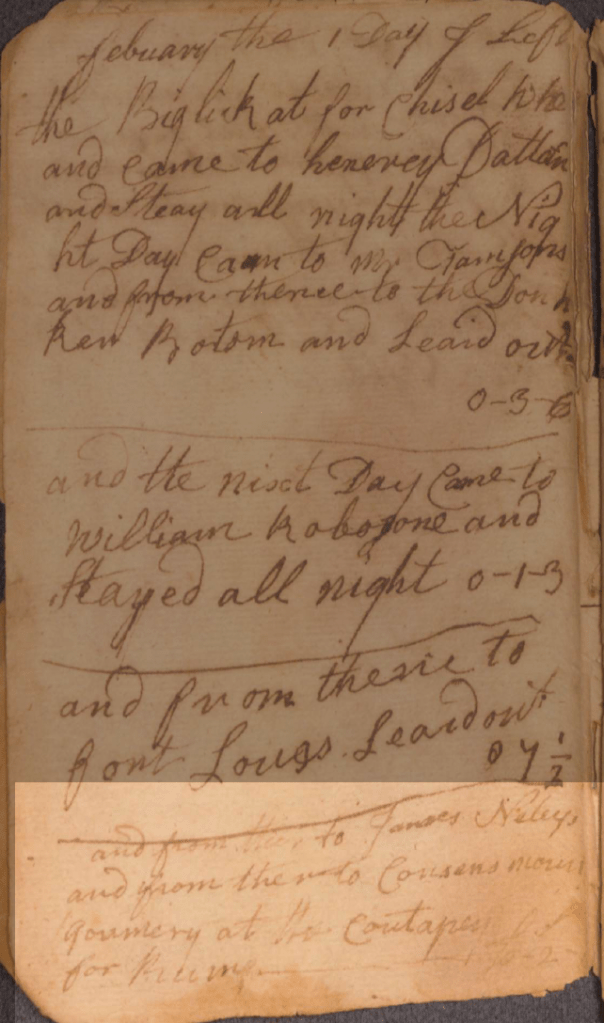
Alexander Noble’s travelogue says that he and his uncle William (who is not named) crossed the mountains to the waters of New River on 14 January 1763 and then went up the river on the 15th. On what appears to be the 4th or 5th February, they arrived at “cousens Montgomery” at the (Catawba? the word is hard to make out). I think he’s speaking here of the family of James Montgomery (abt. 1690-1756), who settled on Catawba Creek in Augusta (now Botetourt) County, Virginia, when this family left Lancaster County, Pennsylvania, in the mid-1740s. I’ll discuss that move in more detail later in this posting.
On 27 February, Alexander Noble and William Calhoun traveled from Buffalo Creek to “my frends the Montsgomerys.” This is likely the Buffalo Creek that runs through Botetourt and Rockbridge Counties, Virginia. On 3 March 1763, Alexander wrote: “Left Cataba or my frends the Mountgomerys at Cataba Creek.” According to Charles Edward Kemper, Alexander Noble’s parents John and Mary Calhoun Noble settled on Buffalo Creek in present-day Rockbridge County when they came to Virginia from Lancaster County, Pennsylvania, in 1745.[6]
On 18 March, Alexander wrote that he had come to Cousin Archibald Crockett’s (i.e., in the Waxhaws) and had stayed there till the 24th, the waters being high. He arrived back home in South Carolina 29 March.

So that’s the first trip recorded in Alexander’s journal, with Montgomery information highlighted. On 10 December 1770, Alexander wrote: “I set of[f] from home upon my (Juno? his horse?) for virgineay….” After crossing the Tyger River and Sugar Creek as he headed north and east through South Carolina, he went “over the mountains” on what appears to have been 23 December and “came to my Cousen John Mountgomery.”

On 2 January 1771, Alexander recorded: “Came to the old plantatio[n] & from thence to the cove to my cousin Samuels Mountgomery & from thence to Capt Croakets and Steayed Night athursday came to my Cousin Robert Mountgomerys to the Sarmon were Mr Commens preached.”[7] The “old plantation” was likely the land on Buffalo Creek in what was Augusta County when Alexander’s parents settled on it, and is today in Rockbridge County. Samuel and Robert Montgomery were other sons of the James Montgomery mentioned above. In 1770, Samuel had purchased part of Samuel Crockett’s Cove tract in Augusta County.[8]
On 4 January, Alexander wrote, “Came to my Cousin John & Williams at Cousen Williams Moungomerie the 6 Day at Sermoun.” On 7 January, Alexander set off for home from there and went over the mountains on the 8th, arriving at his house in the Long Cane settlement in South Carolina on the 18th. John and William Montgomery were two more sons of James Montgomery. John lived on a branch of Reed Creek in what would eventually become Wythe County.
Alexander wrote at a later point in his journal: “December the 20 Day of 1762 I set of to virginea and Did Not Return to the 29 Day of March in the year 1763.”
A notation later in the journal dated 5 January, evidently 1771, states “Left with my Cousen John Mountgomery William Ewens titels & Give my Cousen John 1 half & half a pistoal a Quarter Dollar and Neere a Dollar.” The “pistoal” to which he’s referring here is the Spanish gold coin called a pistole.
According to Mary Kegley, in 1782, Alexander Noble appointed John Montgomery his attorney to sell 556 acres of land belonging to Alexander to William Ewing.[9] I think, but do not know with certainty, that William Ewing was a relative of Jean/Jane Ewing, who married Alexander Noble’s uncle Ezekiel Calhoun. Margaret Ewing Fife concludes that Jean was a daughter of Patrick Ewing, who died after 15 March 1739, probably in Little Britain township in Lancaster County, Pennsylvania.[10] Patrick Ewing signed approval of the estate inventory of an Alexander Ewing in Cecil County, Maryland, with the inventory record stating beside Patrick’s name that he was kin to Alexander. Alexander was christened 18 January 1679/80 in Burt Congregation, County Donegal, Ireland, with the christening record stating that his father was Robert Ewing. Margaret Ewing Fife thinks that Alexander and Patrick were brothers and that Alexander was the father of the William Ewing to whom Alexander Noble sold land in what became Wythe County, Virginia.
To return to Alexander Noble’s journal: another notation states that on 5 January, again, evidently 1771, Alexander and James had (borrowed? — this entry is difficult to read) from Cousin John Montgomery 22 (Joas?), with Alexander receiving 11 and James 11. The journal goes on to speak of Alexander’s brother James, who is no doubt the James mentioned here.
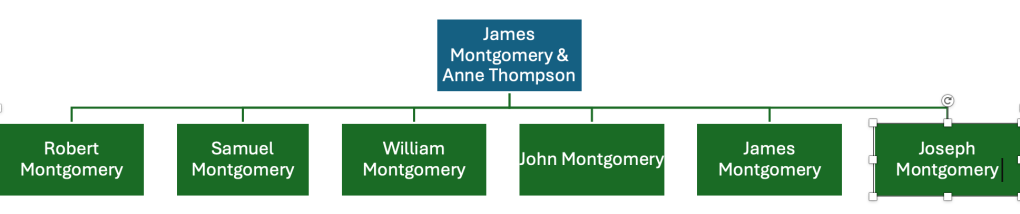
The journal of Alexander Noble definitely documents that Alexander was a cousin to the children of James Montgomery, who migrated from County Donegal, Ireland to Lancaster County, Pennsylvania, and finally to Augusta County, Virginia. It doesn’t, of course, specify how Alexander and the Montgomerys were cousins, but given the longstanding tradition in the family descending from Patrick and Catherine Colhoun that Catherine was a Montgomery, and given a statement that Patrick and Catherine’s grandson John C. Calhoun made in a 15 September 1846 letter referring to the same Montgomerys in Virginia as relatives of the Calhouns, I think it’s reasonable to conclude that James Montgomery and Catherine Colhoun were likely siblings.
About John C. Calhoun’s September 1846 letter: as I’ve noted in a previous posting and will discuss again in a moment, in a letter that John C. Calhoun sent to his brother-in-law and cousin John Ewing Colhoun, another grandson of Patrick and Catherine Colhoun on that date, John C. Calhoun states that members of a Montgomery family living in Wythe County, Virginia, on land on Reed Creek formerly belonging to the Calhouns (to John E. Colhoun’s father Ezekiel, in fact) were relatives of the Calhouns. This statement does not necessarily mean that the relationship ran through Catherine, wife of Patrick Colhoun. But given the longstanding tradition that Catherine was a Montgomery, I think it’s reasonable to conclude that this is the connection of which John C. Calhoun was speaking in that letter.
One final note about the trip Alexander Noble and William Calhoun made back to Virginia from South Carolina in December 1762: as a previous posting notes, Alexander married his first cousin Catherine Calhoun, daughter of Ezekiel Calhoun and Jean/Jane Ewing. As I’ve also previously noted, Ezekiel Calhoun’s will was probated 25 May 1762, and it’s thought that he died not long before that date after he had gone back from South Carolina to Virginia and was murdered and buried on his land on Reed Creek in what would become Wythe County. Prior to leaving on this trip, on 3 September 1759, Ezekiel had made his will in South Carolina.
If Alexander Noble and William Calhoun went to Virginia from South Carolina in late December 1762, they were following in the footsteps of William’s brother Ezekiel, who died in Virginia prior to 25 May 1762. Though the journal makes no reference to Alexander’s uncle Ezekiel, it’s tempting to think that he and his uncle William made this trip to visit relatives in Virginia in part due to the murder of Ezekiel Calhoun in Virginia, which seems to have happened in the early part of 1762.
Catherine Calhoun’s Tombstone
Another solid piece of information establishes both Catherine’s given name and her year of birth. This is a tombstone carved in 1785 by Andrew McComb, a miller and stone carver of the Lower Long Cane in what’s now McCormick County, South Carolina, and placed at the site at which she was buried following the Long Cane massacre of 1 February 1760, in which she was killed (see the photo at head of the posting).[11] Catherine’s tombstone, which is at the Long Cane massacre site three miles west of Troy in McCormick County, has an inscription which reads as follows:
Patk Calhoun Esq
In memory of Mrs. Cathrine Calhoun aged 76 years who with 22 others was here murdered by the Indians the first of Feb 1760
I say that the tombstone of Catherine Calhoun provides solid information about her because this tombstone was erected and carved by Andrew McComb at the behest of Catherine’s son Patrick Calhoun (1727-1796), who can be regarded, I think, as a reliable source of information about the year of his mother’s birth. In a 21 November 1847 letter Patrick’s son John C. Calhoun wrote to Charles H. Allen from Calhoun’s Fort Hill plantation, Calhoun stated,[12]
The battle was fought on the East side of Long Cane, near where the old road from Calhoun’s settlement to Charleston, called the Ridge Road, crossed it, at a place near to where Patterson’s bridge crosses it. A tombstone erected by my father to the memory of his mother, who was among the killed (an old woman of seventy-six years of age) marks the spot.
I have visited the Long Cane massacre site and photographed Catherine’s tombstone.
If we grant that Patrick Calhoun was a credible source for information about the birth year of his mother Catherine, then Catherine Montgomery was born in 1684. Since, as we’ve seen previously, Patrick’s son John C. Calhoun wrote on 13 September 1841 to Gilbert C. Rice, secretary of the Irish Emigrant Society of New York, that his father Patrick Calhoun was born in County Donegal, Ireland,[13] it also seems reasonable to connect Catherine to that Irish county from which she and Patrick Colhoun brought their family to America in 1733 – and where they were likely married and, in all likelihood, both born.
As we’ve also seen, the tombstone of Patrick Calhoun, son of Patrick and Catherine Montgomery Colhoun, in the Calhoun cemetery in Abbeville County, South Carolina, states that he was born in County Donegal, Ireland, and gives his date of birth as 11 June 1727.[14]
John Caldwell Calhoun’s 15 September 1846 Letter to John Ewing Colhoun
The 15 September 1846 letter of John C. Calhoun to John Ewing Colhoun that I mentioned above is another important piece of information as we look for evidence about Catherine’s probable Montgomery background. As I noted above, in that letter John C. Calhoun speaks to John E. Colhoun about their Montgomery relatives. But note that this letter connects the Calhouns to a specific group of Montgomery relatives, to Montgomerys living on Reed Creek in Wythe County, Virginia, in the 1840s, on Calhoun land that John E. Colhoun sold to them after his father Ezekiel Calhoun died. There’s some solid documentary information about the early history of this family in America tracing it from Lancaster County, Pennsylvania, to Augusta (later Wythe) County, Virginia, where the family settled in the mid-1740s, information that casts light on Catherine Montgomery Calhoun and her background if we accept that Catherine is likely a Montgomery and a close relative of these Montgomerys.
John C. Calhoun wrote the following to John E. Colhoun on 15 September 1846:[15]
At Wytheville, I remained two days to visit the ancient residence of our family on Reed Creek, a few miles from that place. They made a noble location of several miles up and down the Creek including 3000 acres of fertile low grounds and a large body of rich high lands. I saw no finer, or more beautiful country any where on my route. It is now in the possession of wealthy and respectible [sic] families, connected with us through the Montgomeries, who returned to the country after the termination of the old French war. They pointed out to me the place where my father resided, and also your grandfather and the rest of the brothers. We were entertained with unbounded Kindnes and hospitality….
Land Sales by Calhoun Family Members in South Carolina to Montgomerys in Virginia
In a previous posting, I discussed John Ewing Colhoun’s sale of his father Ezekiel Calhoun’s Reed Creek land in Virginia to Robert Montgomery on 5 September 1771.[16] John E. Colhoun was living then in the Long Cane settlement on what was Granville County, South Carolina, and Robert Montgomery was living in Botetourt County, Virginia, where Ezekiel’s Reed Creek tract was then located before it fell eventually into Wythe County. As the posting I’ve just linked explains and as I noted previously, Robert Montgomery (abt. 1717 – 1789/1790) was a son of James Montgomery (abt. 1690 – 1756), who was, Wythe County historian Mary B. Kegley thought, a brother of Catherine Montgomery Colhoun.[17] The linked posting has digital images of the original deed.
If Mary Kegley was correct about the connection of James Montgomery to Catherine Montgomery, a point I’ll discuss in more detail in a moment, then John E. Colhoun sold his father Ezekiel’s Reed Creek land in Virginia in 1771 to a first cousin of Ezekiel. The James Montgomery witnessing this 1771 deed was a brother of Robert and another son of the elder James.


Ezekiel Calhoun’s Reed Creek tract was not the only piece of Calhoun land that members of the Calhoun family sold to members of the Montgomery family after the Calhouns left Augusta County, Virginia, for South Carolina in 1755. On 17 October 1765, Patrick Calhoun, a son of Ezekiel’s brother James Calhoun, sold 610 acres on Reed Creek that had belonged to James Calhoun to Hugh Montgomery.[18] The deed states that Patrick was Jr. (his uncle Patrick, brother of James, was still living), and was of the Long Cane in Granville County, South Carolina. It does not specify where Hugh Montgomery was living (he was in Salisbury in Rowan County, North Carolina, by 1756), but says that Hugh was “late of the parish and county of augusta in the Colony of Virginia.” The deed states that the 610 acres Patrick Calhoun was selling Hugh Montgomery were on Reed Creek opposite land belonging to John Buchanan.[19]
Hugh Montgomery also bought 106 acres on Cripple Creek in Augusta County from John and Mary McFarland on 4 May 1763 (Augusta County, Virginia, Deed Bk. 11, pp. 328-9), which John McFarland had acquired from the estate of John Noble. John Noble’s estate records show that as of 16 January 1753, a note was due to the estate from John McFarland for the 106 acres of land (Augusta County, Virginia, Will Bk. 1, p. 480). Hugh Montgomery’s will, which he made in Rowan County, North Carolina, on 16 December 1779 (Rowan County, North Carolina, Will Bk. E, pp. 41-7), also bequeathed to his daughter Jane land on the New River in Virginia, noting that he had acquired this land from “the widow Noble’s son.” I haven’t yet found the deed for this land. I suspect that the son of Mary Calhoun Noble who sold the land to Hugh Montgomery was Alexander Noble.
In her Early Adventurers on the Western Waters, Mary B. Kegley proposes that Hugh Montgomery may have been another brother of Catherine Montgomery Colhoun, though she notes that his exact relationship to the other Montgomerys living in Wythe County – James with sons Robert, John, William, James, Joseph, and Samuel, the older sons born in County Donegal, Ireland – has not been confirmed.[20] She adds,
Family records state that he is the son of a Hugh Montgomery, of Scotland. If that is the case, he was the brother of James Montgomery, the father of Robert and John mentioned above, who would be his nephews.
Because Hugh seems to have been some years younger than James Montgomery and Catherine Colhoun, other researchers have proposed that he may have been their nephew and not their sibling. I’m not seeking at this point to sort out precisely how they’re related, but noting that members of the Calhoun family sold land to Hugh in Augusta County, Virginia, as they did to a son of James Montgomery.
James Montgomery of County Donegal, Ireland, Lancaster County, Pennsylvania, and Augusta County, Virginia
About the James Montgomery who was, Mary Kegley thinks, perhaps a brother of Hugh Montgomery and very likely a brother of Catherine Montgomery Colhoun, there’s some valuable and solid documentation. On 6 November 1797 in Wythe County, James’ son James made a deposition in which he stated that his family came to Augusta County, Virginia, when James’ brother John was about 21 years old. Some researchers think John was born around 1721 and others around 1725, so this would place the move of James Montgomery’s family from Lancaster County, Pennsylvania, to Augusta County, Virginia, in 1742 or 1746.[21] I myself think the 1746 date is more likely.
I have not been able (yet) to find a copy of the original deposition given by James Montgomery younger in Wythe County in November 1797. The deposition is abstracted and, it appears, perhaps transcribed in part, by Lyman Chalkley in his Chronicles of the Scotch-Irish Settlement in Virginia.[22] Chalkley says that the deposition is found in a book of court records in Augusta County entitled “Records,” and that this book is unpaginated. Chalkley transcribes James Montgomery’s deposition as follows:
James Montgomery, aged 68, deposes, in Wythe County, 6th November, 1797, that he lived with his father, James, in Lancaster County, Pennsylvania. His father sent deponent’s oldest brother, Robert, to Virginia to buy lands, and bought 654 acres on Catawba Creek, but one Clarke had bought part of the tract. Robert contracted as part payment to bring two uncommon large bells from Pennsylvania. Robert left his brother John on the land, returned to Pennsylvania, and then the father and family came. John was then about 21 years old.
Chalkley also abstracts a deposition given in Wythe County on 11 August 1795 by John Montgomery, which states that John was “an aged witness” and was a brother of Robert Montgomery, who bought land from Borden.[23] This is clearly the John Montgomery referred to as James Montgomery’s brother in James’ November 1797 deposition, so these two depositions link three brothers, Robert, John, and James to a James Montgomery who sent his sons Robert and John from Lancaster County, Pennsylvania, to Virginia in the early to mid-1740s to buy land in Augusta County. In addition, Chalkley states that on an unspecified date (it may have been November 1797, since this abstract follows his abstract of James Montgomery’s 6 November 1797 deposition), Joseph Montgomery deposed, stating that he was a brother of James. This adds another name to the list of the sons of James Montgomery elder.
On a page entitled “James Montgomery, Sr., of Catawba Creek” in the Early Settlers of Augusta County, Virginia, section of the Old Augusta Project at WeRelate, there’s additional information about these depositions citing “the court records of Wythe Co. Va.,” but with no specific source in Wythe County court records for this information – and I do not find it in the court order books of Wythe County.[24] This source states,
When researching the court records of Wythe Co. Va. it is found that James Montgomery Jr. and his brother, Joseph Montgomery, both gave depositions in the year of 1797. In their depositions they both told of their father and their families move from Lancaster Co. Pa to Augusta Co. Va. the year was given as 1742. They also said that their brother, Robert, purchased PART of the land from Borden Sr. and the other PART from another man. They said that their brother, Robert, returned to Lancaster Co. Pa. and left his brother, John, on the land. They said that their brother, John, raised a crop of corn on this land before Robert and the rest of the family got to the Virginia lands. Also to follow this up, Both James Jr. and his brother Joseph said that they stayed on this land until they removed to their Reed Creek lands.
The reference to Borden in the material above points to Robert and John Montgomery’s purchase of 654 acres from Benjamin Borden on Catawba Creek in Augusta (now Botetourt) County on 19 June 1746. On that date in Augusta County, Benjamin Borden and his mother Zeruiah, widow of Benjamin’s father Benjamin Borden, deeded this tract of land to James Montgomery, with the deed stating that James was residing in Augusta County.[25] On 27 May 1751, Benjamin Borden made another deed for this land to Robert Montgomery in Augusta County.[26] David Trimble notes, citing James Montgomery’s November 1797 deposition, that after buying this tract in June 1746 on behalf of his father James, Robert Montgomery then returned to Pennsylvania to bring back two large bells as partial payment for the land and to bring the rest of the Montgomery family to Virginia.[27]
The value of these depositions and land records is that they clearly document that the family of James Montgomery came from Lancaster County, Pennsylvania, to Augusta County, Virginia, in roughly the same time frame in which Catherine Colhoun moved with her children from Lancaster County to Augusta County, with “family traditions” cited by both Mary B. Kegley and David B. Trimble indicating that James Montgomery came to Pennsylvania from County Donegal, Ireland – where it can be documented that Patrick and Catherine Colhoun also lived before coming to Pennsylvania.
For her Montgomery sketches, as she speaks of the County Donegal background of the James Montgomery family, Kegley repeatedly cites David B. Trimble, who writes,[28]
James Montgomery, according to family tradition, was born about 1690 near Donegal, Ireland, and moved to America about 1733, perhaps at the same time as his sister Catherine and her husband, Patrick Calhoun. He was living in Lancaster County, Pennsylvania, probably at Chestnut Level, in 1746 when he sent his sons Robert and John to Virginia to buy land. On June 19, 1746, they acquired 654 acres on Catawba Creek in Augusta (now Botetourt) County, Virginia, from Benjamin Borden for £20; they then returned to Pennsylvania to bring back two large bells as partial payment for the land and to bring the remainder of the family to Virginia. The 654 acre tract was sold to Robert on May 28, 1751.
In a footnote to the preceding passage, David Trimble states, “The traditional relationship to the Calhouns is partially confirmed by the ‘Journal of Alexander Noble, 1762-3,’ University of South Carolina Library, Columbia, South Carolina.”
As she discusses the Calhoun family, Mary B. Kegley writes,[29]
The Calhoun family is said to have come from Donegal County, then part of Ulster and Northern Ireland, and believed to have migrated to America in 1733, settling in Lancaster County, Pennsylvania. The immigrants were Patrick Calhoun and his wife Catherine Montgomery (said to be the daughter of Hugh Montgomery of Scotland).
Lyman Draper’s Sketch of John Montgomery, Son of James Montgomery
I have not found a clear source for some of these family traditions cited by Mary B. Kegley and David B. Trimble as they discuss the background of the members of the Montgomery family that came to Augusta County, Virginia, in the mid-1740s. The tradition of an Irish origin for James Montgomery, and for his connection to Scotland, may be captured (though in a garbled way) in a sketch of James’ son John Montgomery (1721 or 1725 – 1805) written by Lyman Draper, apparently in the latter part of the 1800s.
New York-born Lyman Draper (1815-1891) was a librarian and historian who served as secretary for the State Historical Society of Wisconsin at Madison. He had a particular interest in the history of the Revolutionary period and the War of 1812, and in the early history of the trans-Allegheny region. Starting in 1838, he engaged in extensive correspondence with people who were early settlers of that region during the second half of the 18th century. He also traveled extensively gathering historical documents and interviewing those with information dating back to the Revolutionary period. He planned to write a series of biographies of early settlers of the region based on his interviews and correspondence with those settlers and their relatives, a project he never completed.
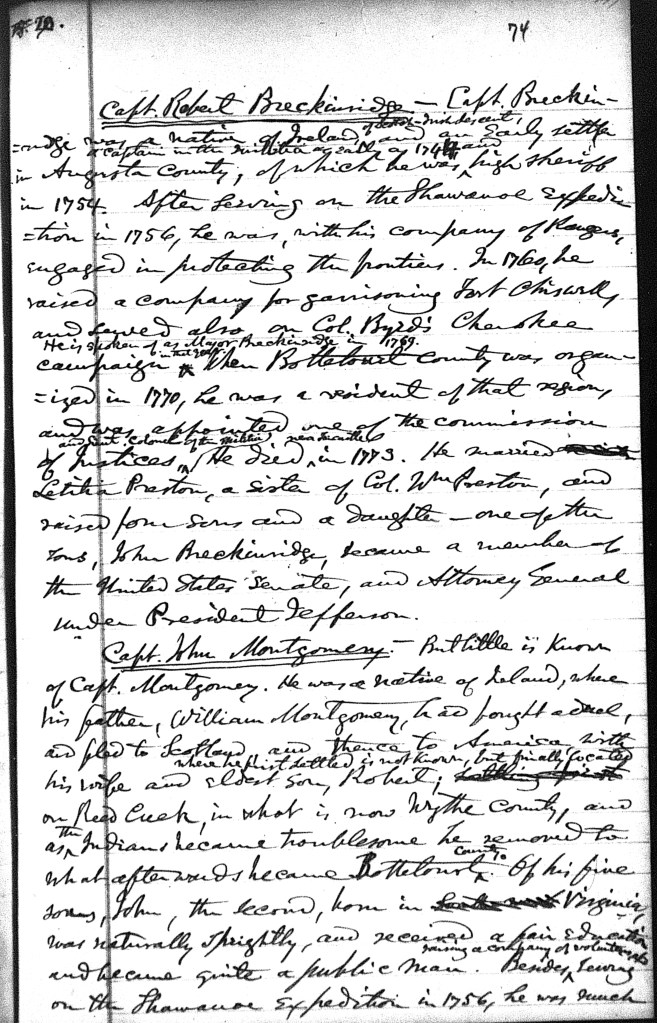

In a section of his voluminous manuscript collection now held by Wisconsin Historical Society entitled Frontier Wars Papers, 1754-1885, Draper wrote brief biographies of a number of people involved in the Sandy Creek expedition of 1756.[30] These biographies include one of John Montgomery. The biographical sketches are not dated. Draper wrote them as he gathered material with an eye to producing a new edition of Alexander Withers’ Chronicles of Border Warfare, which was originally published in 1831. Draper had not completed this project at the time of his death in 1891; it was completed by Reuben G. Thwaites in 1895, with a new publication of Withers’ book. The sketch of John Montgomery states,
Capt. John Montgomery – But little is known of Capt. Montgomery. He was a native of Ireland, where his father, William Montgomery, had fought a duel, and fled to Scotland, and thence to America with his wife and eldest son, Robert; where he first settled is not known, but finally located on Reed Creek, in what is now Wythe county, and as the Indians became troublesome he removed to what afterwards became Bottetourt [sic] county. Of his five sons, John, the second, born in Virginia, was naturally sprightly, and received a fair education and became quite a public man. Besides raising a company of volunteers, leaving on the Shawanee [sic] expedition in 1756, he was much engaged in protecting the frontiers. He was appointed one of the bench of Justices and captain of the militia, when Fincastle county was organized in 1773; and filled the position of Justice in the newly formed county of Montgomery, carved out of a portion of Fincastle, in 1777, and was high sheriff of that county in 1779. He also served as a member of the Virginia House of Burgesses in 1777. He was a man singularly positive in his opinions. His nephew of the same name, Col. John Montgomery, rendered good service under general George Rogers Clark, in the conquest of the Illinois country, and in the Nickojack campaign in 1794.
Because Draper corresponded and visited with people who lived during the Revolutionary period or were born not long after it, and because he traveled extensively in gathering material, it’s entirely possible he had visited members of the Montgomery family of Augusta (and later Wythe and Botetourt) County, Virginia, or with some of their descendants. Unfortunately, he does not state where he obtained his information that James Montgomery’s son John was born in Ireland (he also states that John was born in Virginia) or that his father, whom Draper erroneously names William, had engaged in a duel in Ireland then gone to Scotland before bringing his family to America. His biography may, though, be an indicator of family traditions dating back into the 19th century of an Irish origin for James Montgomery, and for some connection of the family to Scotland.
Draper’s biography of John Montgomery is repeatedly cited in accounts of the families of both James Montgomery and Catherine Colhoun which link James and Catherine to parents Hugh Montgomery and Jane Patrick, though few of these accounts seem to reflect any real familiarity with the actual text of the Draper biography. Possibly the source for the Hugh Montgomery-Jane Patrick information was initially Oral Montgomery.[31] This information is now widely circulated, though I’ve seen no documentation anywhere proving a link of either James Montgomery or Catherine Colhoun to those parents, and given that neither seems to have named a son Hugh (unless Hugh Montgomery of Salisbury, North Carolina, was James’ son), I must admit that I’m somewhat agnostic regarding this connection – but willing to be proven wrong.
[1] David B. Trimble, Montgomery and James of Southwest Virginia (Austin, Texas: Snug Harbor Productions, 1992), p. 101. See also “William Montgomery” in the Early Settlers of Old Augusta in the Old Augusta Project at WeRelate.
[2] Mary B. Kegley, Early Adventurers on the Western Waters, vol. 3, pt. 2 (Marceline, Missouri: Walsworth, 1995), pp. 472-3.
[3] On the Waxhaws as the home of the family of Andrew Pickens, who married Rebecca Calhoun, daughter of Ezekiel Calhoun and Jean/Jane Ewing, before Andrew moved to the Long Cane settlement, see this previous posting.
[4] See Find a Grave memorial page of John Crockett, Old Waxhaw Presbyterian Church cemetery, Riverside, Lancaster County, South Carolina, created by Mary Clyde Reid, maintained by Catoe4, with a tombstone photo by Mary Clyde Reid.
[5] Robert H. Montgomery, “Robert Crockett of the Great Calfpasture, Augusta County, Virginia,” Virginia Magazine of History and Biography 63,2 (April 1955), pp. 186-207.
[6] Charles Edward Kemper, Historical Notes from the Records of Augusta County, Virginia (Lancaster, Pennsylvania: Lancaster County Historical Society, 1921), p. 153, citing Augusta County, Virginia, Survey Bk. 1, p. 77.
[7] Mary Kegley notes that Mr Commens who was preaching at Robert Montgomery’s was Reverend Charles Cummings: Early Adventurers on the Western Waters, vol. 3, pt. 2, p. 473.
[8] Kegley, Early Adventurers on the Western Waters, p. 723.
[9] Kegley, Early Adventurers on the Western Waters, vol. 3, pt. 1, p. 426, citing Montgomery County, Virginia, Deed Bk. A, p. 256.
[10] Margaret Ewing Fife, Ewing in Early America, part 1 (Atlanta, 1995), pp. 141f.
[11] On Andrew McComb (1754-1819) as the carver of Catherine Calhoun’s tombstone in 1785, see Lester W. Ferguson, Abbeville County: Southern Lifestyles Lost in Time (Spartanburg: Reprint Co., 1993), p. 15; see also Brian Scott, The Long Cane Massacre (priv. publ., 2017), p. 35. On the Long Cane massacre site, see the page entitled “Long Cane Massacre Site, McCormick County” at the National Register of Historic Place’s South Carolina properties site; John C. Blythe Jr., “Long Cane Massacre Site,” at the National Register site; “Long Canes Massacre” at the Historical Marker Database site; “Long Cane Massacre” at the South Carolina Picture Project site; and “Long Cane Massacre” at Wikipedia.
[12] This letter is transcribed in John H. Logan, A History of the Upper Country of South Carolina, vol. 2 (Easley, South Carolina: Southern Historical Press, 1980), pp. 97-9. It is also transcribed in The Papers of John C. Calhoun, vol. 24: 1846-1847, ed. Clyde N. Wilson and Shirley Bright Cook (Columbia: University of South Carolina Press, 1998), p. 676; and in “Documents,” The Gulf States Historical Magazine 1 (1902-3), pp. 439-441.
[13] The Papers of John C. Calhoun, vol. 15: 1839-1841, ed. Clyde N. Wilson (Columbia: University of South Carolina Press, 1983), p. 774.
[14] See Find a Grave memorial page for Patrick Calhoun, Calhoun cemetery, Abbeville County, South Carolina, created by David Gillespie, with a tombstone photo by David Gillespie
[15] Correspondence of John C. Calhoun, vol. 2, part 1 (Washington, D.C.: Government Printing Office, 1900), pp. 706-7.
[16] Botetourt County, Virginia, Deed Bk. 1, pp. 302-4.
[17] Kegley, Early Adventurers on the Western Waters, vol. 3, pt. 2, pp. 722-6, citing David B. Trimble, Southwest Virginia Families (San Antonio, Texas, 1974), pp. 269-270; and Lewis Preston Summers, Annals of Southwestern Virginia, 1769-1800 (Abingdon, Virginia, 1929), p. 544.
[18] Augusta County, Virginia, Deed Bk. 14, pp. 2-6.
[19] James Calhoun’s patents for this land were issued 7 November 1752: Virginia Patent Bk. 31, pp. 265-6, 292-3.
[20] Kegley, Early Adventurers on the Western Waters, vol. 3, pt. 2, pp. 726-8.
[21] On the 1717 and 1725 dates for John Montgomery’s birth, see Kegley, Early Adventurers on the Western Waters, vol. 3, pt. 2, p. 723.
[22] Lyman Chalkley, Chronicles of the Scotch-Irish Settlement in Virginia, Extracted from the Original Court Records of Augusta County, 1745-1800, vol. 2 (Rosslyn, Virginia: Commonwealth, 1912-3), p. 274.
[23] Ibid., p. 273.
[24] “James Montgomery, Sr., of Catawba Creek,” in the Early Settlers of Augusta County, Virginia, section of the Old Augusta Project at WeRelate.
[25] Augusta County, Virginia, Deed Bk. 1, pp. 123-5. See David B. Trimble, Southwest Virginia Families (San Antonio, 1974), p. 269, citing this deed and James Montgomery’s November 1797 deposition.
[26] Augusta County, Virginia, Deed Bk. 3, pp. 270-3.
[27] Trimble, Southwest Virginia Families, p. 269.
[28] Ibid., and Kegley, Early Adventurers on the Western Waters, vol. 3, pt. 2, pp. 726-8.
[29] Kegley, Early Adventurers on the Western Waters, vol. 3, pt. 2, p. 594.
[30] Lyman Draper Collection, series U, Frontier Wars Papers, 1754-1885, vol. 21, originals held by Wisconsin Historical Society.
[31] Oral Montgomery, Montgomery Heritage, vol. 3 (San Antonio, 1987), pp. 3-7.
 BEGATS AND BEQUEATHALS
5 thoughts on “Catherine, Wife of Patrick Colhoun, Immigrant Ancestor of the South Carolina Long Cane Calhoun Family: Notes on Her Reputed Montgomery Ancestry”