According to a family history compiled by George’s grandson William Oscar Taylor in 1982, George and wife Mary Ann are buried in a Green family cemetery near Aurelle in Union County, Arkansas, where the couple lived after they settled in Union County in 1845.[2] I can find no mention of this cemetery in any histories of Union County, and I find no information about tombstone markers that might record George’s dates of birth and death. Aurelle is about 25 miles southeast of the Union County seat of El Dorado and about five miles north of Oakland in Union Parish, Louisiana, where George S. Green’s niece Emeline Keesee Wheelis lived and is buried, and where, as I’ll explain later, Mary Ann Clardy (Green) (Etheridge) is also buried.
Note that the 1850 federal census suggests a birth year of 1813 for George.[3] The census, which enumerates George and his family in Union County, Arkansas, states that he was born in South Carolina and was aged 37.
In previous postings, I’ve provided substantial information about George Sidney Green’s early life prior to his move with wife Mary Ann and their children from Saline to Union County, Arkansas, in 1845. If he was born in 1817, he was an infant when his parents moved from Pendleton District, South Carolina, to Tuscaloosa County, Alabama, in 1818. As the posting I’ve just linked says, according to William Oscar Taylor, George was a month old when his family moved from South Carolina to Alabama.[4] But as the linked posting notes, George’s parents John and Jane Kerr Green appear in Pendleton District records up to 28 October 1818 when Jane renounced her dower interest in the land John and Jane sold as they moved to Alabama. It seems to me very likely that the family left South Carolina soon after that October 1818 date.
As another posting notes, George S. Green is named as a son of John Green in John’s estate records, and his name consistently appears last in the list of John’s children in John’s estate records and the estate records of John’s wife Jane Kerr Green, both of which appear to be listing John and Jane’s children in order of birth. The final settlement of Jane’s estate, cited in the posting I’ve just linked, tells us that her son George had predeceased her when she died in Bibb County, Alabama, on 2 November 1855: the final settlement shows George’s children receiving his share of Jane’s estate. They’re named as Francis P. (Pickens) Green, John E. (Ewing) Green, Elias J. Green, Benjamin C. (Calhoun) Green, George W. (Washington) Green, Agnes J. (Jane) Green, and Sarah E. (Elizabeth) Green.
George S. Green Moves from Bibb County, Alabama, to Saline County, Arkansas, in 1838
As another previous posting indicates, George moved with his older brother Benjamin S. Green from Bibb County, Alabama, to Saline County, Arkansas, not long after George and Benjamin’s sister Jane Caroline Green and husband Thomas Keesee moved there from Tuscaloosa County, Alabama. James Lee Green places George and Benjamin’s move to Arkansas in or by 1838. Benjamin and wife Margaret sold their land in Bibb County on 10 July 1837 and at some point after that made their move to Arkansas, evidently with George accompanying them.[5] The two postings I’ve just linked provide detailed information about the migration of members of the Keesee family network from Tuscaloosa and Bibb Counties, Alabama, to Saline County, Arkansas, in the latter part of the 1830s, and a migration from the same area of Alabama that Reverend Joab Pratt led a few years later to the same part of Arkansas.
By 26 August 1839, George S. Green had begun to appear in Saline County court records: on that date, he was impaneled as a grand juror in Saline County’s circuit court.[6] George’s brother Benjamin also appears as a juror in these records, as do his father-in-law Benjamin Clardy, his brother-in-law Thomas Keesee (who was also also uncle of George’s wife Mary Ann Clardy), and Robert Calvert, who married Thomas Keesee’s sister Mary.
On 11 October 1839, George and his brother Benjamin both received certificates for several tracts of federal land in Saline County. Benjamin’s federal land purchases on that date are discussed in a previous posting. On this date, George had certificates for two tracts of 80 acres each, one in section 16, township 1 south, range 14 west, and another in section 31, township 1 north, range 14 west.[7] The land in section 16 was at the site of what is now the city of Bryant about 18 miles southwest of Little Rock. The land in section 31 was about eight miles northwest of the first tract, bordering on Pulaski County, of which Little Rock is the county seat.
George S. Green Marries Mary Ann Clardy, Daughter of Benjamin Clardy and Agnes Keesee

On 1 November 1839 in Saline County, George Sidney Green married Mary Ann Clardy, the daughter of Benjamin Clardy and Agnes Keesee.[8] Agnes was the daughter of Thomas Keesee Sr. and wife Mary, who is thought to have been née McKnight, and was the sister of Thomas Keesee Jr., who married George’s sister Jane Caroline Green.[9] The marriage was solemnized by Reverend William Wharton, the minister of the Cumberland Presbyterian church, Saline congregation, that Thomas Keesee Sr. founded along with his relatives soon after the Keesee kinship network migrated from Tuscaloosa County, Alabama, to Saline County, Arkansas. A previous posting provides information about William Wharton, noting that George’s brother Benjamin S. Green filed a verification on 2 January 1840 in Saline County that William Wharton was an ordained minister of the Cumberland Presbyterian church. The linked posting also indicates that Wharton, who came to Saline County from Bibb County, Alabama, along with the Keesee family, followed Thomas Keesee Jr.’s brother-in-law Robert Calvert from Saline County to Robertson County, Texas, where Wharton’s 18 July 1861 will named Robert Calvert as his executor and lifelong friend.
On the 1840 federal census, George S. Green is enumerated next to his wife’s grandfather Thomas Keesee Sr. in Owen township of Saline County.[10] As a previous posting notes, in 1840 Thomas Keesee Sr. was the largest slaveholder (and, with his son-in-law Robert Calvert, the largest landholder) in Saline County, holding thirty-six enslaved persons. The 1840 census shows George S. Green with four enslaved persons. I suspect that in this period soon after George had married Thomas Keesee’s granddaughter Mary Ann Clardy, George was farming with his wife’s grandfather. Owen township is in eastern Saline County on the Pulaski County, Arkansas. The city of Bryant, mentioned above, which is now considered a suburb of Little Rock and on whose site George held land, is in Owen township.
Saline County court minutes for 9 November 1840 show George Sidney Green being appointed overseer of a portion of the road leading from the county seat, Benton, by way of H.L. Fletcher’s and from there to the Pulaski County line.[11] Henry Lewis Fletcher (1787-1855) and wife Mary Lindsey were pioneer settlers of Saline County, arriving there from Tennessee in 1825.[12] Henry’s son Thomas Fletcher (1817-1900) played a prominent role in the growth of Little Rock as a city, and was a distinguished lawyer who held positions of honor and trust, twice serving as sheriff of Pulaski County as well as in the state legislature in 1885. In 1862 for a brief period he served as acting governor of Arkansas, and he was appointed U.S. Marshal for the Eastern District of Arkansas, serving in that position from 1885 until his death in 1900.[13] John Gould Fletcher, the first Southern poet to win the Pulitzer prize, was a son of Thomas Fletcher’s brother John Gould Fletcher Sr.
Saline County court records in 1841 show George S. Green continuing to serve on the county court in that year. On 22 February 1841 he was impaneled as a grand juror in in the county’s circuit court, and on 25 August 1841, he served on a jury in the circuit court case of Elias Hooper v. Jonathan Jones.[14]
On 5 September 1842, George purchased two more tracts of federal land in Saline County — 80 acres in section 31, township 1 north, range 14 west, and 98.12 acres in section 6, township 1 south, range 14 west.[15] On the land in section 31, see above. The land in section 6 was northeast of present-day Bryant with Little Hurricane Creek running through it.
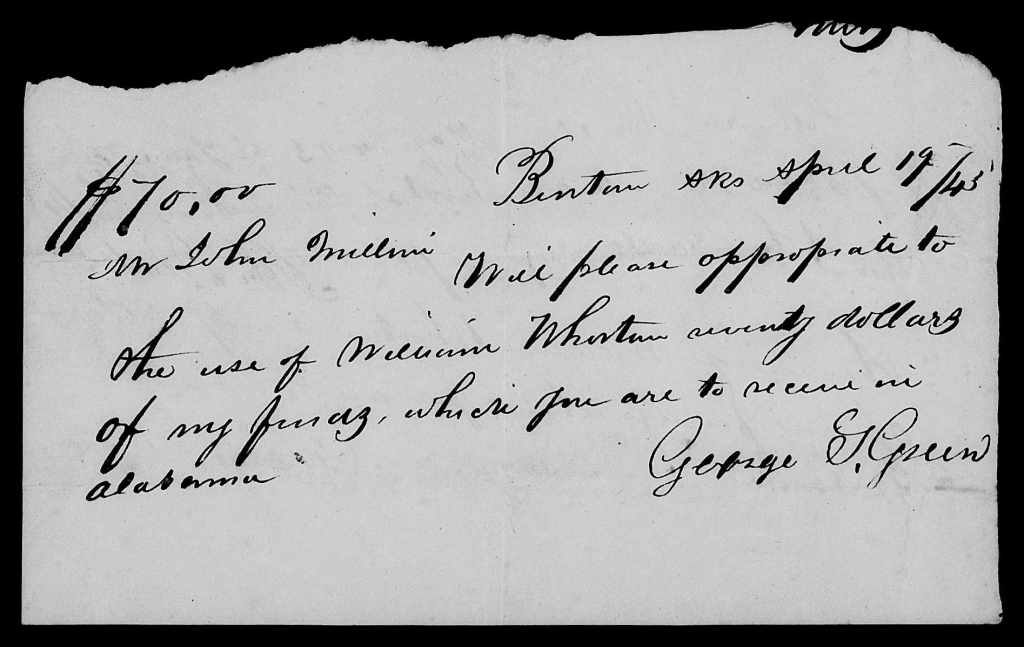
In 1843, George appears again in Saline County court records on 27 February 1843, when he was impaneled as a grant juror of the county’s Circuit Court.[16] Also in 1843, as a previous posting notes, a 19 April 1843 note from George to John (Millner?), which is found in John’s loose-papers estate file in Bibb County, Alabama, shows George writing John from Benton, Arkansas, asking that $70 of funds owing to him from his father’s estate be appropriated to the use of William Wharton, who is mentioned above. And a 10 July 1843 receipt in John E. Green’s estate file shows Berryman McDaniel receiving $200 from James H. Green for George S. Green of Saline County, Arkansas. Berryman McDaniel, who took part in the migration of the Keesee family network from Tuscaloosa and Bibb Counties, Alabama, to Saline County, Arkansas, is discussed in a previous posting.
On 11 November 1844, at Saline County court, the county clerk presented the bond of Ashley B. Bates for his position as county treasurer, with Thomas Keesee, George S. Green, and George Rutherford as his securities.[17]
The Green Family Moves to Union County, Arkansas, 1845
According to James Lee Green in a 1992 typescript entitled “The Greens of Bibb County, Alabama,” George Sidney Green moved his family from Saline to Union County, Arkansas, when Thomas Keesee Sr., grandfather of George’s wife Mary Ann, moved to that south Arkansas county from Saline County in 1845.[18] As a previous posting notes, George’s sister Jane Caroline and husband Thomas Keesee Jr. made the same move three years later in 1848. The linked posting explains that Thomas Keesee Sr. and Jr., who had established themselves as prosperous cotton planters in Saline County, had noted the fertility of land in south Arkansas when they migrated through that area to central Arkansas (Saline County) in 1837, and it was the prospect of growing cotton in Union County with the labor of enslaved people and shipping it to the New Orleans market that spurred their move to south Arkansas in the 1840s.
A 16 June 1845 receipt written by George S. Green and archived in the Bibb County, Alabama, estate file of his brother John E. Green confirms that George had moved to Union County by that date (see the image at the head of the posting). The receipt shows George writing from Union County, Arkansas, to acknowledge that his brother James H. Green had paid him $50 from John E. Green’s estate.
Saline County tax lists in 1846 provide further evidence that George had moved out of Saline County by that year: in 1846 the Saline tax lists show George S. Green as a non-resident taxpayer of Saline County.[19] The fact that George was paying taxes in Saline County in 1846 while he was no longer a resident of the county indicates that he had retained taxable property — land — in the county.
On 10 July 1848, George S. Green purchased more federal land in Saline County: 59+ acres in section 6, township 1 south, range 14 west.[20] The certificate for this land states that George was still living in Saline County, though the records I’ve just cited make clear that he had moved to Union County three years before he bought this Saline County land.
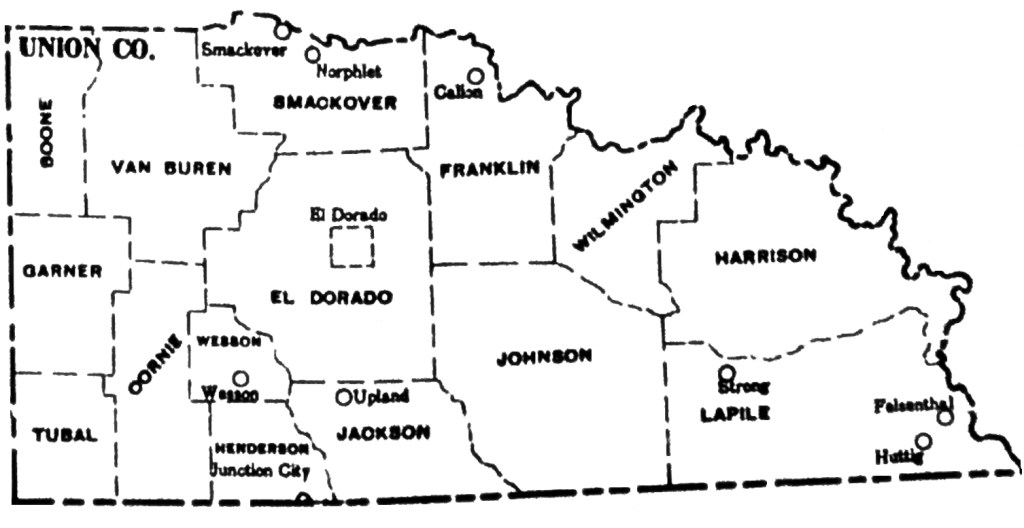
As I’ve noted above, the family of George Sidney Green was enumerated on the 1850 federal census in Union County, Arkansas.[21] The family is listed in Harrison township. Harrison is on the eastern side of the county bordering on Ashley County, with the Ouachita River as the border between the two counties. Harrison township is bordered on the west by Johnson township, in which George’s sister Jane Caroline and husband Thomas Keesee Jr. settled at Hillsboro when they moved to Union County in 1848. Thomas Keesee Sr., grandfather of George’s wife Mary and father of Thomas Keesee Jr., is living in Harrison township in 1850 two households away from the George S. Green household. The Greens are household 598 and the Keesees are household 596.
As I stated previously, this census shows George as aged 37 and born in South Carolina. He’s listed as a farmer with $1,500 real worth. Also enumerated in the household are George’s wife Mary A., 25, born in Alabama, and their children Francis P., 9, John E., 7, Elias D., 5, Benj. C., 3, George W., and George W., 2, with another farmer, John Allen, aged 18 and born in South Carolina, also in the household. All the children were born in Arkansas, and Francis, John, and Elias had attended school in the past year.
The 1850 federal slave schedule shows George S. Green holding three enslaved persons in Harrison township in Union County.[22] The same slave schedule shows Thomas Keesee Sr. with forty enslaved people in Harrison township.[23] As I state above, it appears to me that George S. Green farmed with his wife’s grandfather Thomas Keesee Sr. in Saline County, Arkansas, and when the Greens moved with Thomas Keesee Sr. to Union County in 1845, I think it’s likely that the same arrangement continued in Union County.
On 15 January 1853, George S. Green and wife Mary A. of Union County sold Nelson Wright of Saline County for $288 231.42 acres in Saline County in section 35, township 1 south, range 15 west.[24] George and Mary A. both signed with witnesses E.L. Coleman and E.M. Owen. Mary A. relinquished dower the same day and the deed was recorded 12 February.
George S. Green’s Death in Union County, 1853
In an ancestral chart for this family compiled in December 1992, James Lee Green states that George Sidney Green died 10 November 1853, but the chart has a note appended to it stating that the specific date of death is uncertain.[25] No source is cited for the date.
In his 1983 typescript entitled “John Ewen Green 1843-1930 and Descendants,” William Oscar Taylor provides information about the circumstances of George’s death. Taylor states that George had settled near Hillsboro in Union County, where he owned a large number of enslaved people and much of the land that came to be called Cane Creek in Union County.[26] At a later point in his typescript, Taylor says that George owned about 2,000 acres and a large number of enslaved persons near where the Aurelle post office was later established, and on his land, he had a gristmill, sawmill, and blacksmith shop. Following George’s death in 1853, the 1860 federal slave schedule shows John J. Etheridge, who married George’s widow Mary Ann Clardy (Green) in 1857, holding seven enslaved persons in Union County.[27] William Oscar Taylor also notes that George S. Green’s land in Union County adjoined the land of his wife’s grandfather Thomas Keesee Sr.
Cane Creek was a community in southwest Harrison township that is now defunct. A cemetery with the name of the former community (Cane Creek cemetery) is in this part of Union County, and George’s children John Ewing, George Washington, and Sarah Elizabeth are all buried there. Aurelle is some ten miles southeast of this cemetery.
Taylor says that when “Gid” Green (the nickname by which George was called) was aged 35, he was visiting a neighbor, Galby Simmons, and as he left to return home, he told Simmons that he was apprehensive about his mule. Simmons offered to lend George a horse, but George declined the offer. On his way home, his mule threw George against a tree, killing him. A biography of George’s grandson Benjamin Franklin Green, son of George Washington Green, in Henry E. Chambers’ History of Louisiana says that Benjamin’s grandfather George S. Green “lost his life while handling a vicious mule.”[28]
I have been unable to document the claim that George had such extensive landholdings or held large numbers of enslaved persons. As I note above, the 1850 slave schedule for Union County shows him with three enslaved persons in the county.
I think it’s likely that the neighbor whom George visited on the day of his death, Galby Simmons, was James Simmons (1814-1897), who married Sarah Ann Clardy, a sister of George S. Green’s wife Mary Ann Clardy. James Simmons was born in South Carolina, and moved to Union County, Arkansas, from Georgia in the mid-1840s. He lived at Hillsboro in Johnson township and is buried at Center Point cemetery at Urbana.[29] I have not seen any document giving James Simmons the middle name Galby, but since he named a son William Galba Simmons, I think it’s possible that James himself had that middle name. The son with this name was too young (born in 1841) to have been the neighbor who offered George S. Green a mule in 1853. William Galba Simmons was called Galby throughout his life.
George S. Green’s Estate Records
George had definitely died by 13 December 1853 when his widow Mary A. Green appealed for administration of his estate in Union County.[30] Mary Ann gave bond in the amount of $10,000 with her grandfather Thomas Keesee Sr. and with John Hill and was given letters of administration. On the Hill family network and its connection to the Keesee kinship network, see this previous posting.
On 10 October 1854, Mary Ann filed an inventory of George’s estate and it was recorded.[31] The inventory itself is not recorded in the county’s probate court records books.
At the same court session on 10 October 1854, two creditors — Enoch Jones and Ansel Kitchens — made claims against George’s estate for promissory notes he had made to them, and the court ordered that they be paid.[32] Jones claimed two debts for $80.40 each, one for $4.48 1/3, and one for $81.40. Kitchens made claims for unpaid notes in the amounts of $43.39½, $41.20, $141.70, and two notes for $80 each.
On 13 July 1857, Mary Ann filed her account for final settlement of George’s estate, with the court record mistakenly giving her name as Alsy A. Green.[33] The court ordered the final settlement continued until its next term. At the same court session, John J. Etheridge, whom Mary Ann had married in Union County on 22 February 1857, gave bond for $500 to assume the administration of the estate. His bondsmen were John M. Hicks and Allen J. Woodall.[34] Allen J. Woodall lived next to George S. Green’s family in 1850; George’s son John Ewing Green married Elizabeth J. Woodall, who was, if I’m not mistaken, Allen’s niece.
On 12 October 1857, Etheridge petitioned the court to sell livestock belonging to the estate: twenty-six head of cattle, twenty-four head of hogs, and a mule.[35] The court approved the petition, stipulating that Etheridge advertise the sale for twenty-six days.
On 14 October 1857, Mary Ann again presented her final settlement as the initial administratrix.[36] The court record states that the final amount held by Mary Ann as administratrix was $1,897.76, and instructed that this amount be placed in John J. Etheridge’s hands as the current administrator.
On 11 October 1858, John J. Etheridge presented to court a bill of sale for the personal effects of George’s estate.[37] This court record has no specifics about what items were sold and how much the sale netted the estate. On 2 November 1858, J.J. Etheridge presented an annual settlement of the estate and the court ordered that it be continued to the next session.[38] At the same court session, Etheridge petitioned the court for permission to hire out the enslaved persons of the estate, and the court gave an order for the labor of the enslaved persons to be sold at public auction.
Court minutes for 22 January 1859 state that Etheridge’s report on the estate’s annual settlement was being continued.[39] On 19 August 1859, Etheridge’s security Allen J. Woodall petitioned the court to be permitted to resign as security “for sundry reasons,” and the court ordered Etheridge to produce a new bondsman in Woodall’s place.[40] On 5 September 1859, Etheridge again gave bond, this time in the amount of $5,000, with Thomas Keesee Sr. (as previously) and Robert B. Sanders.[41]
On 24 November 1859, Etheridge presented another petition to court to hire out enslaved persons belonging to the estate, and the court gave permission for this action, with Etheridge being instructed to give twenty days’ notice before the sale of the enslaved persons’ labor occurred at George S. Green’s former residence in Union County on 2 January 1860.[42]
On 20 February 1860, Etheridge appeared in court and gave a new bond for the administration of the estate in the amount of $2,500 with Augustus Nolley and Henry Yarborough.[43] Possibly Thomas Keesee had resigned his role as bondsman for Etheridge due to growing infirmity: he would die 1 December 1861 at the age of eighty-three. Or possibly he had misgivings about Etheridge’s handling of the estate, a matter I’ll discuss in more detail later.
On 31 August 1860, Etheridge presented another annual settlement of the estate and the court ordered it to be continued.[44] On 20 November 1860, Etheridge presented an account current of the estate.[45] The account showed in Etheridge’s hands $2,524.12 belonging to the estate. A marginal note in the record book says that the account was recorded on 27 November 1860.
On 21 November 1861, Etheridge again petitioned for permission to hire out enslaved people belonging to the estate and received permission for this action.[46] On 24 February 1862, Etheridge filed an annual account and this was continued.[47] On 20 August 1862, at the continuation of the account, the court found that Etheridge had $1,843.24 belonging to the estate in his hands.[48]
Mary Ann Clardy (Green) (Etheridge)’s Death, 1862, and Estate Records
On 8 December 1862 Sidney T. Wheelis gave bond with H.B. Tucker and W.H. Frazer for administration of the estate of George S. Green, and on 16 December, he gave bond with Tucker and Frazer for administration of the estate of Mary A. Etheridge.[49] These records indicate to me that Mary Ann Clardy (Green) (Etheridge) had died by 8 December 1862, and, as I’ll show in a moment, Mary Ann’s husband John J. Etheridge had also died on 21 November 1862. On 19 December 1862, Sidney T. Wheelis petitioned to sell all personal property belonging to Mary A. Etheridge’s estate.[50]
As has been previously noted, Sidney Thompson Wheelis was the husband of George S. Green’s niece Emeline Virginia Keesee. Also noted in a previous posting was that Barnard Henry Tucker, who gave bond with Sidney T. Wheelis for this administration, was the husband of Emeline’s sister Eleanor.
On 25 May 1863, the appraisement of the estate of Mary A. Etheridge was filed and the court ordered it to be placed among the papers of her and George S. Green’s estate.[51] By this point, John J. Etheridge’s estate in Union County was also being probated.[52] On 26 May 1863, a bill of sale for the estate of both Mary Ann and an appraisal of the estate of John J. Etheridge were presented to court.[53]
From this point forward, I find no mention of the estates of George S. Green, his wife Mary Ann, or her second husband John J. Etheridge in Union County, Arkansas, probate records. As I noted at the outset of this posting, according to William Oscar Taylor, George and Mary Ann are buried in a Green family cemetery Aurelle in Union County, and, as I state above, I have not been able to find a record of this cemetery.[54] William O. Taylor also indicates that John J. Etheridge is buried in the same cemetery.

Mary Ann Clardy (Green) (Etheridge) is, however, buried in Spring Hill Baptist cemetery at Oakland in Union Parish, Louisiana, with a burial marker giving her name as Mary Ethridge.[55] As a previous posting notes, George Sidney Green’s niece Emeline Keesee Wheelis (who was also a first cousin of Mary Ann Clardy) and husband Sidney Thompson Wheelis are buried in the Spring Hill cemetery, as well. Mary Ann Clardy’s sister Mary Elizabeth Clardy and husband George West Murphy are also buried in the Spring Hill cemetery.
Notes About Mary Ann Clardy’s Second Husband John J. Etheridge

According to William Oscar Taylor, John J. Etheridge was the overseer on George S. Green’s farm when George died, and was aged nineteen at the time of George’s death.[56] The 1860 federal census shows him born in 1833 in Georgia.[57] Mary Ann was ten years Etheridge’s senior. As noted above, John and Mary Ann married 22 February 1857 in Union County, with Baptist minister Reverend J.P. Everett solemnizing the marriage and with the marriage record stating that John was aged 24 and Mary Ann was aged 34.[58] As the posting linked in the previous paragraph states, Springhill/Spring Hill Baptist church in Union Parish, Louisiana, in whose cemetery Mary Ann is buried, was founded by Reverend George Everett. Reverend John Pinckney Everett (1826-1891), who officiated at the marriage of Mary Ann and John, was George Everett’s son.
Taylor offers an unflattering portrait of John J. Etheridge that is evidently based on lore handed down in his family: he says that “John Etheridge proved to be a worthless husband — refusing to work — and soon ran through with all Mary had.”[59] Taylor states that Etheridge was killed at Vicksburg in a fracas with another man,[60] and trees for the Green family often state that Etheridge died 5 January 1863, the date on which Sidney T. Wheelis appealed for administration of Etheridge’s estate in Union County.[61]
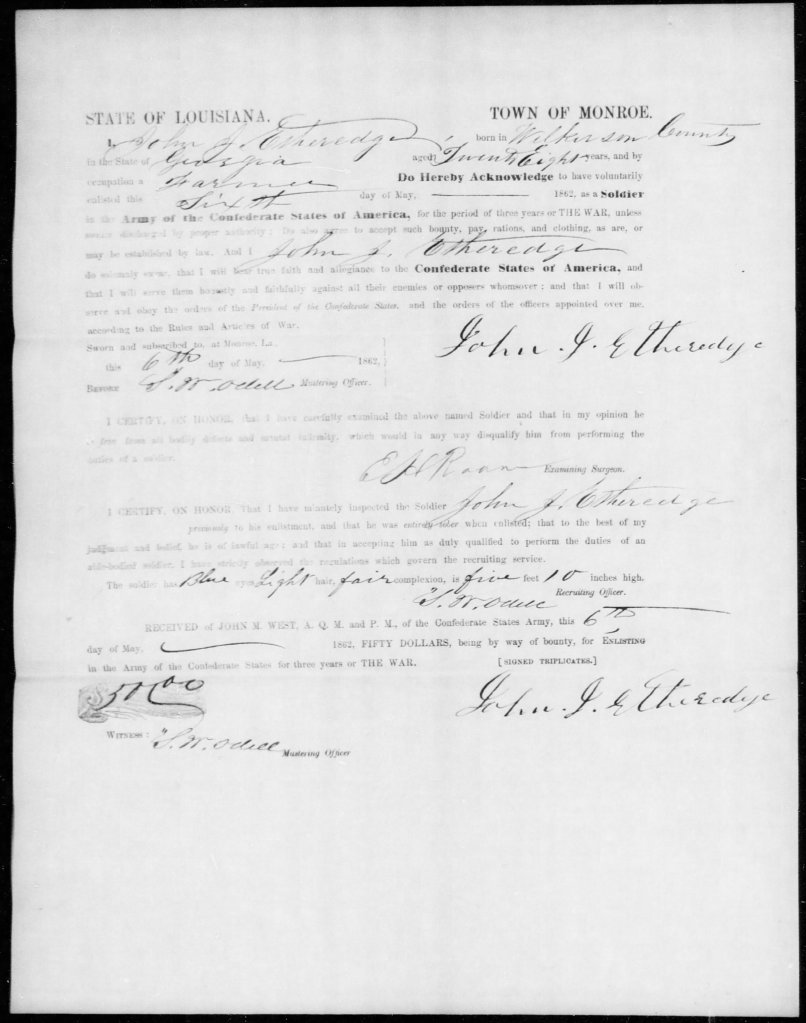

But John J. Etheridge’s Civil War service packet shows him dying of pneumonia in a hospital in Monroe, Louisiana, on 21 November 1862.[62] He enlisted at Monroe on 6 May 1862 in Company E of the Louisiana 31st Infantry Regiment (CSA) with his enlistment papers stating that he was a farmer, aged 28, born in Wilkinson County, Georgia, 5’10” in height, with blue eyes, light hair, and fair complexion.
According to Taylor, John and Mary Ann had three children, of whom only a son, William Murphy Etheridge, lived to maturity, spending his life in the Cane Creek community of Union County until in his latter years, he moved to Howard County. William Murphy Etheridge is buried in Antioch Baptist cemetery in Hempstead County, Arkansas.[63]
As I’ve noted above, Mary Ann’s birthdate, 6 March 1823, is recorded in her father’s family bible. Many family trees state that she was born in Pickens County, Alabama. Mary Ann’s father Benjamin Clardy was living in Tuscaloosa County, Alabama, in 1830. Many published trees for the family of George Sidney Green and Mary Ann Clardy also conflate Mary Ann with her sister Mary Elizabeth Clardy, who married George West Murphy, and assign Mary Elizabeth’s date of death — 10 January 1889, Oakland, Union Parish, Louisiana — to Mary Ann Clardy (Green) (Etheridge).
Brief Notes on the Clardy Family
Mary Ann Clardy’s father Benjamin Clardy was born 20 May 1797 in Pendleton District, South Carolina, and died 14 September 1875 in Hot Spring County, Arkansas. His tombstone marker in Francois cemetery at Gifford in Hot Spring County gives his date of death, stating that he was aged 78 years, 3 months, and 24 days when he died.[64] Benjamin married Agnes, daughter of Thomas and Mary (McKnight?) Keesee in Tuscaloosa County, Alabama, about 1822, and when the Keesee family moved from Tuscaloosa County to Saline County, Arkansas, in 1837, Benjamin and Agnes Keesee Clardy made the move along with her relatives.

As Carolyn Earle Billingsley notes, it’s possible the Clardy and Keesee families had known each other from the colonial period forward.[65] Both have traditions of Huguenot ancestry, and both lived in the same vicinity in Virginia before moving to South Carolina prior to 1790. Billingsley says that family tradition indicates that Benjamin Clardy worked for Thomas Keesee Sr. before marrying his daughter Agnes about 1822, and when the Keesee family moved to Tuscaloosa and Bibb Counties, Alabama, Benjamin Clardy bought federal land next to Thomas Keesee’s land, with both men buying their land on the same day.
After living in Saline County for some years, at some point in the 1840s, Benjamin and Agnes Keesee Clardy moved to Hot Spring County, which adjoins Saline on the southwest, and spent the rest of their lives there. Agnes is buried with Benjamin in Francois cemetery at Gifford. Billingsley notes that Benjamin Clardy donated land for Francois Baptist church at Gifford, in whose cemetery he and wife Agnes are buried.
Descendants of the Clardy family have told me the name is pronounced with the A sound of “rare” and “care,” rather than the A sound of “are” or “car.” This family also connects by marriage to my Batchelor family of Hot Spring County, who came to Hot Spring County in the fall of 1848 from Hardin County, Tennessee, and some of whom are also buried in Francois cemetery.
In a subsequent posting, I’ll share information about the children of George Sidney Green and Mary Ann Clardy.
[1] See, e.g., an ancestral chart compiled on 18 December 1992 by James Lee Green, which he sent to me in March 2000.
[2] William Oscar Taylor, “A Century of Edwin Taylor’s Descendants” (Melburne, Arkansas; 1982), a typescript of which William O. Taylor’s grandson Michael William Taylor sent me a copy in February 2003. William Oscar Taylor (1890-1996) graduated from Ouachita Baptist University in Arkadelphia, Arkansas, and then received a master’s degree in divinity from Southwestern Baptist Seminary in Fort Worth, Texas, in 1924. His grandson Michael William Taylor received a B.A. from University of North Carolina in 1969 and a Ph.D. from Harvard in archaeology in 1975. After having taught Greek at Harvard, he entered University of North Carolina Law School and then practiced law with his wife Susan Chandler Taylor, whom he met at law school. In 1982, Susan was assistant district attorney for the 20th judicial district of North Carolina and the Taylors were living in her hometown of Albemarle.
[3] 1850 federal census, Union County, Arkansas, p. 269A, Harrison township (dwelling/family 598; 10 December).
[4] See William Oscar Taylor, “John Ewen Green 1843-1930 and Descendants,” typescript (1983), a copy of which was sent to me in February 2003 by William O. Taylor’s grandson Michael W. Taylor.
[5] Bibb County, Alabama, Deed Bk. E, pp. 380-2.
[6] Saline County, Arkansas, Circuit Court Common Law Bk. A, p. 110. See also “Saline County Common Law Court (Jurors) 1837 – 1842,” abstracting information from Common Law Book A, at USGenweb site for Saline County.
[7] Arkansas Federal Patent Bk. 60, pp. 323-4, nos. 3535 and 3536.
[8] Saline County, Arkansas, Marriage Records Bk. A, p. 22.
[9] On the Clardy family and its Keesee connections, see Carolyn Earle Billingsley, Communities of Kinship: Antebellum Families and the Settlement of the Cotton Frontier (Athens: University of Georgia Press, 2004), pp. 135-7.
[10] 1840 federal census, Saline County, Arkansas, p. 213.
[11] Saline County, Arkansas, County Court Minutes Bk. 2, p. 151.
[12] See John Gould Fletcher, Arkansas (Chapel Hill: University of North Carolina Press, 1947), p. 368; and Dallas T. Herndon, Centennial History of Arkansas, vol. 3 (Chicago: S.J. Clarke, 1922), p. 853
[13] Herndon, Centennial History of Arkansas, vol. 2 (Chicago: S.J. Clarke, 1922), p. 276.
[14] Saline County, Arkansas, Circuit Court Common Law Bk. A, pp. 252, 282.
[15] Arkansas Federal Patent Bk. 70, pp. 434-5, nos. 3751 and 3752.
[16] Saline County, Arkansas, Circuit Court Common Law Bk. B, p. 25.
[17] Saline County, Arkansas, County Court Minutes Bk. 3, p. 204.
[18] James Lee Green, “The Greens of Bibb County, Alabama,” (typescript) (Columbia, South Carolina, 1992), p. 7.
[19] See the transcript of this tax list by Carolyn Earle Billingsley in Early Saline County, Arkansas, Records: Transcriptions of the 1840 Federal Census and 1846 Tax Book (Conway, Arkansas: Arkansas Research, 1987), p. 39.
[20] Arkansas Federal Patent Bk. 90, p. 342, no. 3537.
[21] See supra, n. 3.
[22] 1850 slave schedule, Union County, Arkansas, Harrison township, unpaginated.
[23] Ibid.
[24] Saline County, Arkansas, Deed Bk. D, pp. 188-9.
[25] See supra, n. 1.
[26] “John Ewen Green 1843-1930 and Descendants,” p. 1.
[27] 1860 federal slave schedule, Union County, Arkansas, p. 321B.
[28] Henry E. Chambers, A History of Louisiana, vol. 2 (Chicago: American Historical Society, 1925), p. 389.
[29] See Find a Grave memorial page of James Simmons, Center Point cemetery, Urbana, Union County, Arkansas, created by Lee.
[30] Union County, Arkansas, Probate Court Records Bk. E, pp. 196, 211.
[31] Ibid, p. 322.
[32] Ibid., pp. 325-7.
[33] Ibid., Bk. F, p. 57.
[34] Ibid., pp. 57-8. Etheridge’s bond is also recorded in Union County, Arkansas, Executors, Administrators, and Guardian Bonds Bk. E, pp. 73-4.
[35] Union County, Arkansas, Probate Court Records Bk. F, p. 78.
[36] Ibid., p. 82.
[37] Ibid., p. 200.
[38] Ibid., pp. 224-6.
[39] Ibid., p. 259.
[40] Ibid., p. 335.
[41] Ibid., p. 351.
[42] Ibid., p. 374.
[43] Ibid., p. 409. The bond is also recorded in Union County, Arkansas, Executors, Administrators, and Guardian Bonds Bk. E, pp. 189-190, which dates the bond 11 January 1860.
[44] Union County, Arkansas, Probate Court Records Bk. F-1, p. 485.
[45] Ibid., p. 500.
[46] Ibid., p. 641.
[47] Ibid., p. 667.
[48] Ibid., p. 695.
[49] Union County, Arkansas, Executors, Administrators, and Guardian Bonds Bk. E, pp. 287-8, 294-6. See also Union County, Arkansas, Probate Court Records Bk. F-1, pp. 729-730, recording this bond on 19 December 1862.
[50] Union County, Arkansas, Probate Court Records Bk. F-1, pp. 729-730.
[51] Ibid., p. 762.
[52] On 5 January 1863, Sidney Thompson Wheelis appealed for administration of John J. Etheridge’s estate, giving bond in the amount of $2,000 with securities Barnard Henry Tucker and Ezekiel A. Hammon: see Union County, Arkansas, Probate Records Bk. F, pp. 304-5. As noted supra, Wheelis was married to Emeline Virginia Keesee, a daughter of George S. Green’s sister Jane Caroline Green Keesee, and Tucker was married Emeline’s sister Eleanor. Ezekiel A. Hammon was the husband of Emeline and Eleanor’s sister Anastasia. See also Bk. F-1, p. 739, showing that on 19 May 1863, Wheelis petitioned to sell Etheridge’s property in Union County, and the following day, to be given administration of the estate (ibid., p. 748).
[53] Ibid., Bk. F-1, p. 769.
[54] Taylor, “A Century of Edwin Taylor’s Descendants,” p. 2.
[55] See Find a Grave memorial page of Mary Ethridge, Spring Hill cemetery, Oakland, Union Parish, Louisiana, created by Iris Meshell, with a tombstone photo by Iris Meshell. See also Harold and Lynda Phillips, “Springhill Cemetery,” at the Union Parish Genweb site.
[56] Taylor, “A Century of Edwin Taylor’s Descendants,” p. 2.
[57] 1860 federal census, Union County, Arkansas, Johnson township, Hillsboro post office (dwelling/family 104; 27 June). The census lists Etheridge with $5,000 real property and $8,275 personal property. The 1850 federal census shows John Etheredge living in the household of John McConly in Wilkinson County, Georgia, aged 16.
[58] Union County, Arkansas, Marriage Records Bk. B, p. 174.
[59] Taylor, “A Century of Edwin Taylor’s Descendants,” p. 2.
[60] Ibid.
[61] See supra, n. 51.
[62] NARA, Compiled Service Records of Confederate Soldiers Who Served in Organizations from the State of Louisiana, 1861-1865, RG 109, available digitally at Fold3.
[63] See Find a Grave memorial page for William Murphy Etheridge, Antioch Baptist cemetery, Hempstead County, Arkansas, created by Mr. & Mrs.
[64] See Find a Grave memorial page for Benjamin Clardy, Francois cemetery, Gifford, Hot Spring County, Arkansas, created by Pat Hall, maintained by Arkieologist, with a tombstone photos by Volunteer # 46577499 and Dennis Gibson.
[65] Billingsley, Communities of Kinship, p. 84.
 BEGATS AND BEQUEATHALS
One thought on “Children of John Green (1768-1837) and Jane Kerr (1768-1855): George Sidney Green (1817-1853)”