As a previous posting notes, James is enumerated as one of the younger males living in his father John Green’s household in Bibb County on the 1830 federal census.[2] As a previous posting states, according to James’s grandson John Morgan Green (1887-1969), after John Green and his son John built a house for the family in Bibb County from 1830-1834, into which the Green family moved in the spring of 1834, James and his brother John lived in the house with their widowed mother Jane following John Green’s death in 1837, and after John E. Green died in 1843, James and his family continued living there with Jane Kerr Green, who died in 1855. After this, James H. Green’s family continued to occupy the Green house as James farmed the family’s landholdings in Bibb County.[3] According to Rhoda Ellison and John Morgan Green, the last Green descendant to live in the house was James’s daughter Mary Caroline “Callie” Green, wife of John Rucker Caffee.[4]
As a previous posting indicates, when James’s father John Green died in Bibb County on 18 March 1837 and his estate was settled there, James H. Green appeared a number of times in his father’s estate records. When John Green’s personal estate was sold on 1 January 1838, James was a principal buyer of property along with his mother Jane and brother John E. Green.[5] As the posting I’ve just linked and others (here and here) note, the 1838 estate sale document and many other documents demonstrate that after John Green died, his sons John E. and James H. Green collaborated in farming together, pooling family lands and farming those lands as a large family farm operation with their mother Jane.
By 1850, the family had an extensive farming operation in Bibb County operated with the labor of enslaved people, with James H. Green heading the operation from the Green family house near Woodstock in Bibb County. According to John Morgan Green, during James’s tenure of the family landholdings, they grew eventually to 3,400 acres. This is a claim I haven’t been able to corroborate: as we’ll see in a moment, the 1860 federal agricultural schedule, which provides a snapshot of this farming operation at its peak, shows James with 400 acres of improved land and 1,500 acres unimproved. The estate records of James’s brother John E. Green explicitly state that when John died 3 March 1843 in Bibb County, James and John were farming collaboratively in a business partnership of which James became the head after John died.
As has been previously noted, the 1840 federal census shows the Green household in Bibb County with John E. Green as its head, and with a male aged 20-29 who is obviously James, as well as with their elderly mother Jane, aged 70-79, and 21 enslaved persons.[6] No other members are in the household in this year, since James had not yet married and John never married and all of their surviving siblings lived elsewhere.
James Marries Sarah Echols Randolph
On 30 January 1841, James H. Green obtained license to marry Sarah E. Randolph, and the couple were married the following day by Reverend Robert Oldham.[7] Family records state that Sarah’s middle name was Echols. According to Rhoda Ellison, James and Sarah married immediately after his parents moved into their newly built house in Bibb County in the spring of 1834, and the marriage took place in South Carolina.[8] Yet the marriage record in Bibb County clearly shows the couple marrying in that county in 1841.
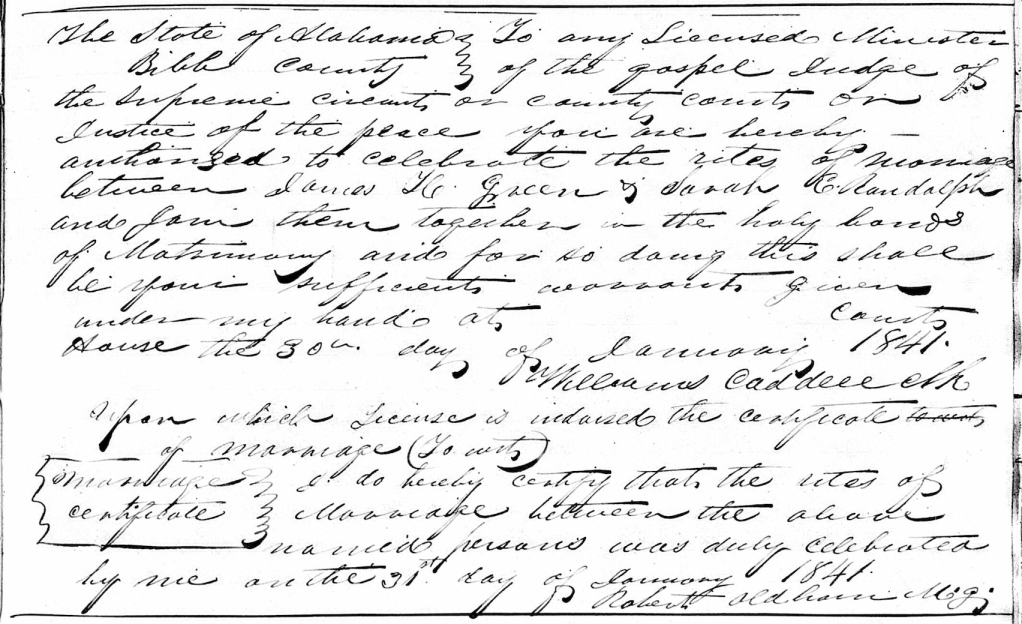
Sarah was born in November 1822 in Alabama, and died after 1900, probably in Bibb County. I have not been able to identify her parents. As I’ve noted previously, I think it’s likely that George B. Randolph, who is enumerated next to Sarah and husband James H. Green on the 1850 federal census and near them in 1860, is Sarah’s brother. George was born 19 September 1819 (in Alabama) and died 30 November 1891, according to his tombstone in Randolph cemetery at Woodstock in Bibb County.[9] On the 1880 federal census, both Sarah Randolph Green and George B. Randolph reported that their parents were born in Tennessee. In 1900, Sarah would say her father was born in Ohio and her mother in Tennessee. I think it’s likely that Sarah and George were orphaned young. I find no one with the Randolph surname listed on the 1840 federal census in Bibb County, so these two young Randolphs must have been living in that year in some other household than the household of a parent in that year, I think.
We’ve met the minister who married James H. Green and Sarah E. Randolph, Robert Oldham, in a previous posting. On 20 March 1843, he gave bond in Bibb County with James’s brother Joscelin for James’s administration of the estate of his brother John E. Green.[10] As the posting I’ve just linked also shows, Robert Oldham was one of the appraisers of John E. Green’s estate and was one of the commissioners appointed by Bibb County court to divide John E. Green’s land. Robert Oldham (1806-1869) was a Cumberland Presbyterian minister who came to Bibb County, as the Green family did, from Pendleton District, South Carolina.[11] Bibb County historian Rhoda Ellison says that Robert Oldham organized a number of Cumberland Presbyterian churches in Bibb County including Six Mile and Pleasant Hill churches.[12]
Robert Oldham was the son-in-law of James Hill (1776-1842), whom we’ve met in previous postings: on 24 April 1837, he gave bond with Joscelin B. Green for John E. Green’s administration of the estate of Joscelin and John E.’s father John Green; he was an appraiser of John Green’s estate, and, as this linked posting explains, he was married to Jane Calvert, a member of a Calvert family much connected to the Greens. Robert Oldham pastored the Pleasant Hill church near Centreville from its formation in 1841 up to 1851. As I’ve noted previously, the original thirty-three members of this church included members of the Green family, and its first elders included William Nichols and, according to Rhoda Ellision, a J.S. Green, who is, I suspect J.B. (Joscelin B.) Green, William Nichols’ son-in-law.
James Takes Over Green Family Farming Operation when Brother John Dies
As I’ve just stated, James H. Green gave bond in Bibb County on 20 March 1843 to administer the estate of his brother and business partner John Ewing Green. For further information about James’s appearance in John E. Green’s estate records and the farming operation the two brothers shared, see this previous posting.
As has been noted before, on 3 April 1844 James’s brother Joscelin sold him 79.95 acres of land in Tuscaloosa County.[13] As the posting I’ve just linked shows, Joscelin’s estate file documents various business dealings with his brother James, including a promissory note Joscelin made to James on 7 March 1846 for a debt of $50.00 to James H. Green.
On 1 September 1849, James H. Green had a certificate for 40 acres of federal land in Bibb County, the northwest ¼ southeast ¼ of section 23, township 21 south, range 6 west.[14] As this previous posting notes, it was in this section and township that James’s father John Green first entered federal land in Bibb County in September and December 1823, as did John’s sons Benjamin and Joscelin. This was the site of the Green family homeplace southeast of Woodstock, where John Green and son John E. Green built a house between 1830 and 1834.
According to James Lee Green, James H. Green bought more land in Bibb County on 2 October 1848.”[15] I cannot provide more specific information about this land purchase or others by James H. Green recorded in Bibb County deed books, since, at the time I’m composing this posting, the digital images of the index to Bibb County deed books and of many of the deed books formerly available at the FamilySearch site appear no longer to be available except if a researcher visits a branch of the Family History Library and accesses these files through computers linked to the library system..
On 1 April 1850, James had a certificate for another 40 acres of federal land in Bibb County.[16] This tract was the northwest ¼ northwest ¼ of section 26, township 21 south, range 6 west.
As noted above, the family of James H. Green is enumerated on the 1850 federal census in Bibb County.[17] As a previous posting notes, this census shows James’s mother Jane living with James and his family, aged 82. It gives James H. Green’s age as 44 and lists him as a farmer born in South Carolina with $3,000 real worth. Wife Sarah E. is 28 and born in Alabama, and also in the household are James and Sarah’s sons John Randolph and George Kerr Green, aged 6 and 4, along with a farmhand, William J. Tatum. As mentioned previously, living next to James’s family is the family of George B. Randolph who is, I suspect Sarah’s brother.
As the posting linked in the previous paragraph also notes, the 1850 federal slave schedule for Bibb County shows James holding twenty-nine enslaved persons.[18] Their ages range from 46 years to a year old. George B. Randolph appears again next to James H. Green on the 1850 federal slave schedule. The linked posting also discusses in detail the listing for James on the 1850 federal agricultural schedule for Bibb County.[19] As the linked posting states, this document shows James operating a sizable plantation, with three horses, seven mules, twelve milk cows, two working oxen, thirty other cattle, 45 sheep, and 50 swine, all valued at $1,150. The farm operation was producing two bushels of wheat a year, 1,500 bushels of corn, and 200 bushels of oats. There is no slot on the 1850 agricultural census in Bibb County for bales of cotton produced yearly.
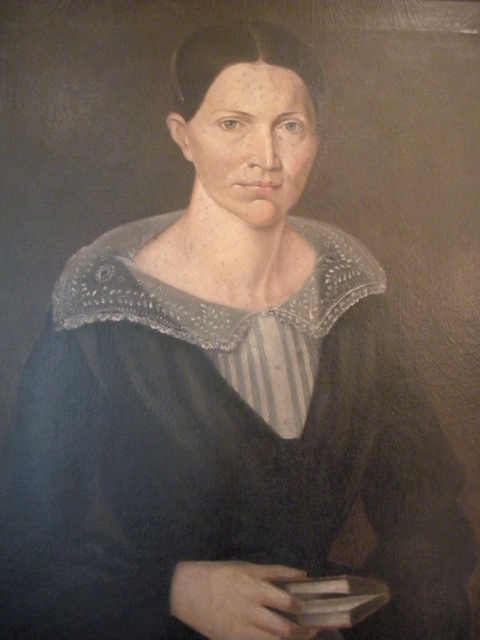
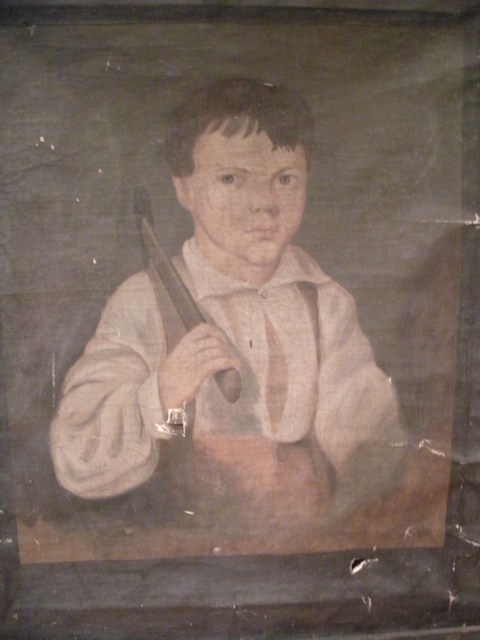
As a previous posting explains, at some point around 1850, oil portraits were made of Jane Kerr Green, James Hamilton Green, James’s wife Sarah Echols Randolph Green, and James and Sarah’s oldest son John Randolph Green. These portraits hung in the Green house until it was broken up following the death of Mary Caroline Green Caffee and its furnishings sold, and today are in the possession of a descendant in Virginia who has kindly sent me digital images of photographs he had made of each of these portraits. The digital image of the portrait of James is at the head of this posting. Above are the portraits of Sarah and her son John. The digital image of Jane’s portrait is at the posting linked at the start of this paragraph.
On 1 August 1854, James H. Green had a certificate for 160 acres of federal land in Bibb County.[20] This land had been awarded to Francis Ogden for service in the War of 1812, and Ogden sold or delivered the award to James H. Green. The tract was the east ½ northwest ¼ and east ½ southwest ¼ of section 22, township 21 south, range 6 west.
On 17 March 1856, James H. Green appealed for administration of the estate of his mother Jane Kerr Green, who died in Bibb County on 2 November 1855.[21] The posting I’ve just linked provides information and documentation about James’s administration of his mother’s estate, and his appearance in various estate records.
On 1 June 1858, James had a certificate for 281 acres of federal land in sections 22, 23, and 25, township 21 south, range 6 west in Bibb County.[22] This land purchase makes clear that in the period leading up to the Civil War, James was continuing to expand the already considerable landholdings and farming operation of the Green family in Bibb County.
Civil War and Final Years of James’s Life
As has been noted previously, James and his family were enumerated again on the 1860 federal census in Bibb County.[23] The census entry lists James as 52, born in South Carolina, a farmer with $7,000 real worth and $50,000 personal worth. Wife Sarah is 37 and was born in Alabama. In the household are children John, 16, George, 13, James, 9, Alice, 7, Samuel, 4, and Mary C., 8 months, and a laborer, Green Allen, 24, all born in Alabama. James appears on the 1860 federal slave schedule in Bibb County owning thirty-two enslaved persons.[24] Once again, George B. Randolph is enumerated next to him on this slave schedule. As a previous posting states and as is noted above, James H. Green is also listed on the 1860 agricultural schedule for Bibb County with 400 acres of improved land and 1,500 acres unimproved.[25] His farm is valued at $7,000. This document shows that he had ginned 47 bales of cotton, 400 pounds each, in the past year, and had produced 100 bushels of wheat, 50 bushels of oats, 2,500 bushels of corn, and 150 pounds of wool. His livestock, valued at $3,200, included 4 horses, 11 mules, 12 milk cows, 2 oxen, 30 other cattle, 40 sheep, and 100 hogs.
A previous posting provides a digital image and transcript of a letter James’s nephew William Nichols Green, son of Joscelin B. Green, sent to his uncle James in Bibb County from William’s CSA military camp near Fredericksburg, Virginia. The letter mentions James’s son John Randolph Green, who was serving in the “Tuscaloosa Rifles” company of the 50th Alabama Infantry when William wrote his letter to his uncle James.

Rhoda Ellison notes that, as the war continued, planters in Bibb County holding enslaved persons found themselves compelled by the Confederate government to furnish the labor of their enslaved people to work details under the authority of the CSA government.[26] Those subject to this conscription included James H. Green, who received a letter dated 17 November 1864 from L.E. Starr, the local CSA impressment agent, which is transcribed in Ellison’s book, requiring him to furnish one of his enslaved men as a hand to work on behalf of the Confederate army.
On the 1870 federal census, the family of James H. Green appears in the Kingdom beat of Bibb County at Scottsville post office.[27] This census gives James’s age as 64 and states that he was a farmer born in South Carolina with $2,500 real worth and $1,000 personal worth. The reason for the sharp decrease of James’s personal worth from 1860 to 1870 is, of course, that this worth had depended heavily on his ownership of enslaved people who had been freed between 1860 and 1870. The census shows James’s wife Sarah as 48, born in Alabama. In their household are James and Sarah’s children James, 19, Alice, 17, and Caroline, 11. Living next door is James and Sarah’s son John, 20, with his wife Ella, 21. John had married Ellen Matina Caffee 7 June 1869.

In an article he published on 22 March 1900 in the Centreville Press newspaper, Professor W.P. Wallace recounts how Kingdom beat, the beat comprising the northwestern corner of Bibb County bordering on Tuscaloosa County, in which the Green family lived, got that name.[28] As he states, James Hill, who represented Bibb County in the Alabama senate several terms and who is said to have ruled his beat like a kingdom, had such influence in this section of the county that the beat came to be called Kingdom beat due to James Hill’s control of it.
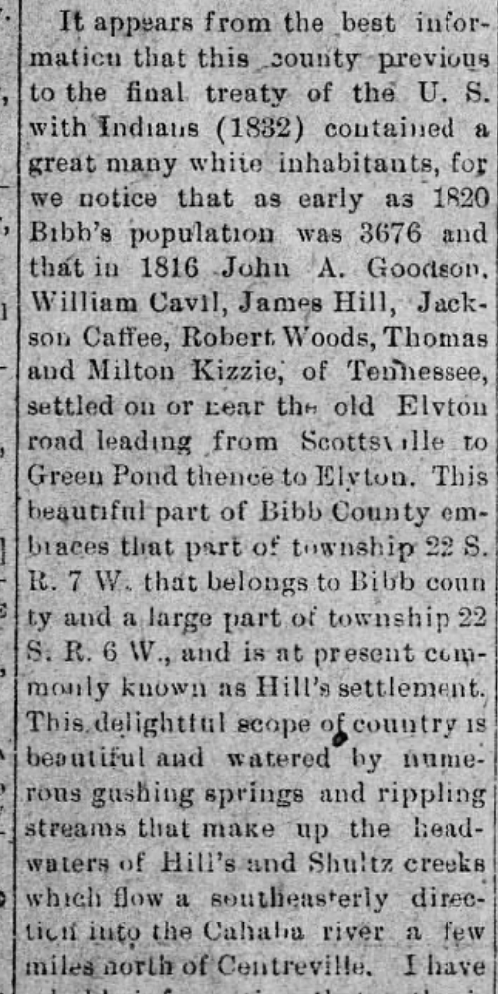

In an article he had published in the same newspaper on 29 June 1899, Wallace notes that the part of township 22 south, range 7 west, and a good bit of township 22 south, range 6 west, in which James Hill settled (and in which the Greens also lived), was long known as Hill’s settlement.[29] Wallace says that in 1816, James Hill, Jackson Caffee, Robert Woods, and Thomas and Milton Keesee (Wallace spells the name Kizzie) along with others settled this part of Bibb County along the old Elyton Road running from Scottsville to Green Pond and on to Elyton. Wallace characterizes Thomas “Kizzie” as “a man of considerable wealth and a great hunter.”
James Hill and his tie to the Calvert family connected to the Greens are discussed above. Robert W. Woods, a son of the Robert Woods named by W.P. Wallace, married John and Jane Kerr Green’s daughter Mary Calhoun Green. Mary’s sister Jane Caroline Green married Thomas Keesee, a son of the Thomas Keesee about whom W.P. Wallace wrote. And, as a previous posting indicates, the Caffee/Calfee family of the Kingdom beat section of Bibb County was also intermarried with the Green family. Two of James H. Green’s children, John Randolph and Mary Caroline Green, married Caffee siblings.
An article entitled “The History of Woodstock, Alabama” in Centreville Press on 11 June 1936 states that when Dr. J.U. Ray Sr. began building the town of Woodstock in Bibb County in the early 1870s, he gave J.H. Green and G.B. Randolph each a lot in the new town.[30] This source states that Randolph built a substantial building on his lot in which he maintained a store that he later rented to B.F. Glass of Six Mile, who conducted a general merchandise business there under the name B.F. Glass & Son.
James H. Green died in Bibb County in July 1879, according to the 1880 federal mortality schedule.[31] This source gives the cause of death as apoplexy (i.e., a stroke) and states that James was 69 years old and born in South Carolina of South Carolina-born parents. For my reasons for thinking that James’s age is incorrect in this document, see supra.
I have not found burial information for James and his wife Sarah. Sarah was still living in 1900 when she was enumerated in Kingdom beat in Bibb County, with the census reporting that she was born in November 1822 in Alabama.[32] Living with her were her widowed daughter Mary C. Caffee and her son John R. and wife Ellen with their son James R. Two households away were Sarah’s son James and his wife and children. This census entry makes clear that Sarah had continued to live in the old Green house in Bibb County, which would pass to her daughter Mary Caroline Caffee at Sarah’s death.
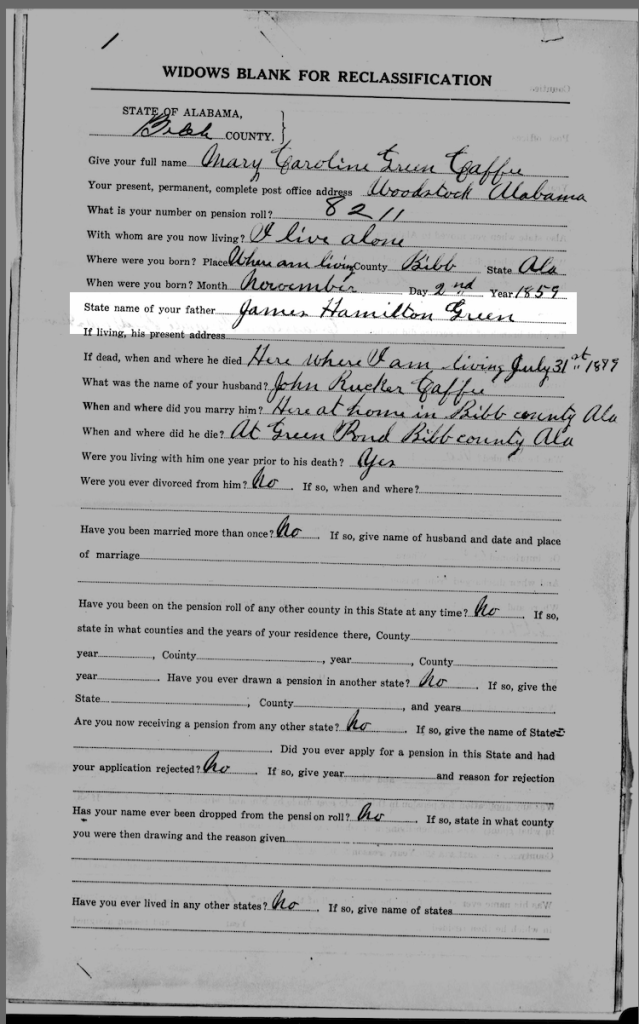
James H. Green’s full name — James Hamilton Green — is stated in the application James’s daughter Mary Caroline made in Bibb County on 4 December 1929 for a pension for the Confederate service of her husband John Rucker Caffee.[33] Mary Caroline supplied the information for the application.
[1] 1850 federal census, Bibb County, Alabama, W.C. [West of Cahaba] River, p. 31A (dwelling/family 396, 30 October); 1860 federal census, Bibb County, Alabama, W.C. River, p. 689 (dwelling 281/family 274, 7 July); 1870 federal census, Bibb County, Alabama, Kingdom Beat, Scottsville post office, p. 220 (dwelling/family 92, 29 August); 1880 federal mortality schedule, Bibb County, Alabama, p. 57.
[2] 1830 federal census, Bibb County, Alabama, p. 150.
[3] John Morgan Green, “A History of the House” (unpublished manuscript, no date), in possession of Anne Clouse, Woodstock, Alabama, June 2000. Rhoda Ellison, Bibb County, Alabama, The First Hundred Years 1818-1918 (Tuscaloosa: University of Alabama Press, 1984) p. 85, cites this manuscript, noting that it was in possession of E.D. Clouse, Woodstock, Alabama, who bought the house and farm in 1946. James Lee Green, “The Greens of Bibb County, Alabama” (typescript) (Columbia, South Carolina, 1992), also cites John Morgan Green’s history of the Green house.
[4] Ellison, Bibb County, Alabama, The First Hundred Years, p. 49; John Morgan Green, “A History of the House.”
[5] Bibb County, Alabama, Administrators Records Bk. E, pp. 1-3; and Probate Minutes Bk. A, pp. 195-7.
[6] 1840 federal census, Bibb County, Alabama, p. 107.
[7] Bibb County, Alabama, Marriage Records Bk. D, p. 188.
[8] Ellison, Bibb County, Alabama, The First Hundred Years, p. 49.
[9] See Find a Grave memorial page of George B. Randolph Sr., Randolph family cemetery, Woodstock, Bibb County, Alabama, created by Bobby and Judy Laney Liles, with a tombstone photo by Cheryl Dodson.
[10] Bibb County, Alabama, Administrators Records Bk. E, 334; and Bibb County, Alabama, Probate Minutes Bk. C, pp. 125-6. The original bond is in Bibb County, Alabama, loose-papers estate file of John E. Green, available digitally at FamilySearch.
[11] See “Oldham, Reverend Robert,” at Jan Oldham’s Oldham Family History site; and Find a Grave memorial page of Rev. Robert Oldham, Hill-Oldham cemetery, Bibb County, Alabama, created by Kathy.
[12] Ellison, Bibb County, Alabama, The First Hundred Years, pp. 69-70.
[13] Bibb County, Alabama, Deed Bk. E, p. 404.
[14] Alabama State Volume Patent Bk. 2710, p. 289, #24990.
[15] James Lee Green, “The Greens of Bibb County, Alabama.”
[16] Alabama State Volume Patent Bk. 2720, p. 51, # 25258.
[17] See supra, n. 1.
[18] 1850 federal slave schedule, Bibb County, Alabama, W.C. River, p. 331.
[19] 1850 federal agricultural schedule, Bibb County, Alabama, W.C. River, p. 217.
[20] Military Warrants Patent Bk. 803, p. 446, #23138.
[21] Bibb County, Alabama, Probate Minutes Bk. F, p. 147.
[22] Alabama State Volume Patent Bk. 2810, p. 392, #30897.
[23] See supra, n. 1.
[24] 1860 federal slave schedule, Bibb County, Alabama, p. 197B.
[25] 1860 federal agricultural schedule, Bibb County, Alabama, p. 23.
[26] Ellison, Bibb County, Alabama, The First Hundred Years, pp. 133-4.
[27] See supra, n. 1.
[28] W.P. Wallace, “Antiquities of Bibb,” Centreville Press (22 March 1900), p. 4, col. 4.
[29] W.P. Wallace, “The First White Settlers of Bibb County,” Centreville Press (29 June 1899), p. 1, col. 1-2.
[30] “The History of Woodstock, Alabama,” Centreville Press (11 June 1936), p. 9, col. 3-4.
[31] See supra, n. 1.
[32] 1900 federal census, Bibb County, Alabama, Kingdom beat, p. 24B (dwelling 465/family 477, 16 June).
[33] Alabama Department of Archives and History, Confederate Pension Applications, 1880-1940, application of Mary Caroline Green Caffee, Bibb County.
 BEGATS AND BEQUEATHALS
2 thoughts on “Children of John Green (1768-1837) and Jane Kerr (1768-1855): James Hamilton Green (abt. 1806 – 1879)”