As a previous posting states, on 19 November 1817 in Pendleton District, South Carolina, Joscelin witnessed, along with his father John Green, Charles Gates’ sale of two tracts of land west of the Keowee River to George W. Liddell.[2] The deed record in Pendleton District shows that on 8 August 1825, John Green and his son Joscelin gave oath to prove the deed in Tuscaloosa County, Alabama. Note that, unless he had recently turned eighteen, Joscelin would have been only seventeen years of age at the time he witnessed this deed, if the 1850 census is correct about his age.
Tuscaloosa County, Alabama, Years
On 26 September 1821 in Tuscaloosa County, Alabama, Joscelin entered two tracts of 80 acres of federal land in sections 22 and 23 of township 21, range 6 west, in Bibb County, Alabama.[3] The certificates for these tracts, which indicate that they were the west ½ of northeast ¼ and east ½ of southeast ¼ of sections 22 and 23, were issued on 2 June 1823, and state that Joscelin was living in Tuscaloosa County when they were issued.[4] As a previous posting notes, on the same day, Joscelin’s father John Green and brother Benjamin S. Green entered land in Bibb County at the federal land office in Tuscaloosa County. According to Bibb County historian Rhoda C. Ellison, these federal land entries by John Green and his sons were the first purchases of federal land in Bibb County made at the Tuscaloosa land office.[5]

The posting I’ve just linked in the preceding paragraph includes digital images of Bibb County plat maps from Gregory Boyd’s Family Maps of Bibb County, Alabama (Norman, Oklahoma: Arphax, 2007) which show the location of Joscelin’s two tracts in Bibb County just south and east of Woodstock, where John Green and a number of his sons acquired pieces of land and where John built a house between 1830 and 1834. As the linked posting also states, when John Green’s son John Ewing Green petitioned in February 1838 for a partition of the real property of his deceased father, listing six tracts of land owned by John Green, one of these tracts was land that Joscelin has purchased from the federal land office.[6]
On 7 December 1825 in Tuscaloosa County, Joscelin B. Green married Elizabeth Nichols, daughter of William Nichols.[7] I find much confusion about William Nichols in various published and online family trees, and am by no means an expert on the genealogy of the Nichols family. I have, however, tried to sort out the confusion to the extent that I can be sure I have Elizabeth attached to the right William Nichols.
The William Nichols who was Elizabeth’s father was born in South Carolina in 1790 and died in Bibb County in January 1850, according to the federal mortality census of that year.[8] The mortality record states that he was clerk of Bibb County court when he died. The initial administrator of William Nichols’ estate was his son Joscelin Green Nichols, who gave bond for $1,600 with Joscelin B. Green and Robert Parker in Bibb County on 22 January 1850 for administration of his father’s estate.[9] Joscelin G. Nichols apparently then relinquished administration and on 4 November 1850, he gave bond with Felix Shropsher in the amount of $1,500 for Joscelin B. Green’s administration of William Nichols’ estate.[10] Joscelin G. Nichols appears to have died not long after this. After Joscelin B. Green died about 30 March 1853, Joscelin’s son William Nichols Green took over the administration of William Nichols’ estate. An estate account that William N. Green filed in Bibb County on 13 June 1853 states that the administration had passed from Joscelin G. Nichols to Joscelin B. Green to William N. Green.[11]
William Nichols’ heirs are named in a 21 December 1850 petition that Joscelin B. Green made to Bibb County court to sell William Nichols’ real estate.[12] The petition names Nichols’ heirs as Elizabeth, wife of Joscelin B. Green, Willis W., William, Martha, wife of Bird Owens, Susan, wife of Drury Allen, Joscelin G., Williams M., all of age, as well as Sarah Jane, Julius, and Susan, who were minors. The petition also states that the widow Jane (who was mother of the minor children) had relinquished her dower interest in the land.
On 13 October 1831 in Bibb County, William Nichols married Jane Maguire — the surname appears as Majure or Mafure in one transcription after another, but appears to my eye to be Maguire in the original marriage record.[13] Jane was not the mother of William Nichols’ daughter Elizabeth Nichols Green, who was born about 1811 in South Carolina. Following William Nichols’ death in January 1850, Jane appears as a widow heading her household in Bibb County, with her age given as 50 and with her children by William Nichols in her household — Joscelin G., William N., Sarah G., and Julius.[14] Jane and her family are three households from the family of Joscelin B. and Elizabeth Green on the same census page.
According to Rhoda Ellison, William Nichols was one of the first elders of Pleasant Hill Cumberland Presbyterian church in Bibb County, along with a J.S. Green whom I cannot identify — is this actually Joscelin B. Green, with the middle initial mistranscribed?[15] Ellison says that a William Green, who was, I think, Joscelin B. Green’s son William Nichols Green, was one of the church trustees who planned its first sanctuary along with Felix Shropsher, whose name appears below. The Pleasant Hill church seems to have been founded in 1841 and was near the Bibb County seat in Centreville. Joscelin B. Green’s loose-papers estate file in Bibb County, which I’ll discuss later, has a receipt dated 9 January 1854 from Wesley Chapel Methodist church for $1.00 that Joscelin had paid at an unspecified date as his subscription to the church. Wesley Chapel was, as far as I can determine, also near Centreville. This receipt doesn’t necessarily mean, of course, the Joscelin belonged to the Wesley Chapel church — only that he gave money to support it.
Numerous family trees identify the William Nichols who was father of Elizabeth Nichols Green with a William Nichols who married Barbara Hair about 1808 in South Carolina. But this couple cannot be the parents of Elizabeth Nichols Green, if the information about the death date of this William Nichols on his Find a Grave memorial page is correct.[16] The memorial page states that this William Nichols was born 12 May 1765 in Newberry County, South Carolina, and died 8 September 1856 in Perry County, Alabama. This couple appear on the 1850 census in Perry County, whereas, as I’ve just stated, William Nichols of Bibb County died in January 1850 leaving wife Jane to be listed as his widow on the 1850 federal census in that county.
The 1830 federal census shows William Nichols in Tuscaloosa County with only two white family members, a male aged 50-59 and a male 20-29.[17] The older male is clearly William, though his age is a decade older than it should be. There are no female household members: William Nichols’ previous wife had died prior to 1830. There are also twelve enslaved persons in the household.
By 1840, William Nichols had moved to Bibb County, where he’s found on the federal census with a household containing a male 50-59, a male 15-19, two males 10-14, a male under 5, a female 40-49, a female 15-19, and a female 5-9.[18] Note that William Nichols now has a wife — Jane Maguire, whom he married in 1831. The household also has four enslaved persons. Enumerated next to William is his son Willis M. Nichols.
As I’ve stated previously, I think that Joscelin B. Green, wife Elizabeth, and their children born prior to 1830 (a daughter Susan and son William) are enumerated on the 1830 federal census in the household of Joscelin’s father John Green in Bibb County.[19] If I’m correct in concluding this, then it should also be noted that Joscelin and his family may be enumerated as well in Tuscaloosa County — so that the family would have been enumerated twice on this census, if I’m correct.[20] The family of J.B. Green in Tuscaloosa County has a male aged 20-29 and a female 15-19. But it also has younger family members that cannot be children of Joscelin and Elizabeth — in addition to one male and three females under 5, there are a male and female 5-9, and a male 10-14. It’s possible that Joscelin and Elizabeth had children in addition to the four who appear as their children in various records — Susan M., William Nichols, Frances Jane, and Eliza Candace — and that those additional children died young. But note that the younger members of this household aged over five years would have been born prior to the marriage of Joscelin B. Green and Elizabeth Nichols in December 1825. Given Elizabeth’s birth year of 1811 (as reported on the 1850, 1860, and 1880 censuses), she cannot have been having children prior to around 1825, in any case; Joscelin and Elizabeth’s first child, Susan, was born in 1828 when Elizabeth was 17 years old. I do think this Tuscaloosa County household is the household of Joscelin B. and Elizabeth Green in 1830. But I think some of the younger people in the household are not their children.
The 1830 federal census also shows Joscelin holding eight enslaved persons in Tuscaloosa County. As we’ll see later, a number of records show Joscelin living in Tuscaloosa County prior to 1850, and holding enslaved persons in both Tuscaloosa and Bibb Counties. He held land in both counties and seems to have maintained a residence in Tuscaloosa County while farming with his father and brothers in Bibb County as well. In 1830, the federal census in Tuscaloosa County also shows J.B. Green three households removed from a James Nichols, who is next to a William Nichols, both likely brothers of Joscelyn’s wife Elizabeth, and listed on the same page as Thomas Keesee, who married Joscelin’s sister Jane Caroline Green.
On 24 April 1837, Joscelin B. Green gave bond with James Hill Sr. in the amount of $30,000 for his brother John E. Green’s administration of their father John Green’s estate.[21] This previous posting notes a number of references to Joscelin B. Green in John Green’s estate records. As another previous posting states,
It’s clear from John Green’s estate records and other records that his widow Jane continued the operation of John’s plantation with her sons James H. Green, John Ewing Green, and Joscelin B. Green pooling their land as well as the land Jane acquired from John Green’s estate to keep the plantation viable and to expand it over a number of years.
On 20 September 1839, Joscelin bought from the federal land office at Tuscaloosa 40+ acres of land in Tuscaloosa County, the northeast ¼ of northwest ¼ of section 33, township 20, range 5 west.[22] The certificate for this federal land identifies Joselin (as the name is spelled here) B. Green as of Tuscaloosa County.
The 1840 federal census shows Jocelin [sic] B. Green and his family living in Tuscaloosa County.[23] The household members are a male 30-39, a male 10-14, a male under 5, and a female 30-39, two females 10-14, and two females 5-9. There are also eight enslaved persons. The names on this census are arranged alphabetically, so it doesn’t help us determine neighbors of those who appear on the census.
3 September 1841, Joscelin B. Green of Tuscaloosa County mortgaged his land in Bibb County to Anthony Stoutenborough of Dallas County to secure a debt of $3,240.[24] Joscelin signed the mortgage with B.L. Defreese and C.H. Collier witnessing. On 4 September Joscelin affirmed the mortgage and it was recorded 13 October. A marginal note by A. Stoutenborough dated 14 April 1854 says that the debt was satisfied in full. The receipt for this payment from Joscelin’s estate is in his loose-papers estate file, which I’ll discuss later.

According to Rhoda C. Ellison, Anthony Stoutenborough (1802-1863) was living in Bibb County’s seat, Centreville, by 1826 and erected one of the first stores there.[25] He bought a number of lots in the town and also built a two-story grocery-saloon and the first hotel, called Tonteen, in Centreville. Ellison says that Stoutenborough also built “what was then considered a lavish residence” (in the 1840s, apparently) at the corner of Walnut and Cedar Streets in Centreville. Stoutenborough was a New Jersey native and is buried in Dallas County.[26] Stoutenborough Hall, a house built for Anthony Stoutenborough about 1850 near Shepardville in Dallas County, is on the Alabama Register of Landmarks and Heritage and has been restored.[27]
Bibb County, Alabama, Years
On 3 April 1844, for $700 Joscelin sold his brother James H. Green 79.95 acres in section 23, township 21 in Tuscaloosa County.[28] The deed states that both Joscelin and James lived in Bibb County and is filed in that county. Joscelin signed with his brother-in-law William Nichols Jr. as witness and Nichols, who was clerk of circuit court, proved the deed on 19 June 1844.
I suspect there’s more information to be found about Joscelin in Tuscaloosa County deed records. They are unfortunately not available digitally at FamilySearch, and I’ve been unable to search them for references to Joscelin B. Green.

On 25 May 1844, Joscelin sold Ninian Tannehill of Tuscaloosa County for $300 242 acres in section 23, township 20 in Tuscaloosa County.[29] The deed was filed in Bibb County and states that Joscelin was living in that county. Joscelin acknowledged the deed on 25 May 1844 and it was recorded that day. In 1836, Ninian Tannehill (1796-1875) bought the ironworks that Daniel Hillman and Abner McGehee had started on Roupes Creek in Tuscaloosa County, and the ironworks then bore the Tannehill name and are now preserved at Tannehill Historical State Park in Tuscaloosa County, to which the graves of Joscelin’s parents and several siblings were moved from the Green family cemetery in Bibb County.[30]
As noted previously, Joscelin and his family are on the federal census in Bibb County in 1850.[31] The census, which spells Joscelin’s name as Joselin, states that he’s aged 50, a farmer with $2,500 real worth, born in South Carolina. Wife Elizabeth is 39 and also born in South Carolina. In the household are children William, 21, Jane F., 20, and Eliza C., 17, all born in Alabama. Note that Joscelin was living on the west side of the Cahaba in 1850, while other members of his family lived on the east side of the Cahaba south and east of Woodstock in Bibb County. A number of hints suggest to me that Joscelin’s family lived near the county seat, Centreville, which was founded on the west bank of the river. As also stated previously, three households away from Joscelin and his family on the 1850 census is the household of Elizabeth Nichols Green’s stepmother Jane Maguire Nichols.
The 1850 slave schedule for Bibb County shows Joscelin holding seven enslaved persons, a female aged 65, a male aged 40, a female aged 27, a male aged 20, a male aged 18, a female aged 14, and a male aged 12.[32] These enslaved persons will appear by name in Joscelin’s estate records, which I’ll discuss in a moment, though the estate documents do not match the names to ages in a way that allows one to determine the ages of each enslaved person named in the estate records.
On 15 February 1853, as administrator of the estate of William Nichols and following an order of Bibb County probate court at Centreville on 3 February, Joscelin B. Green sold to Cullen Lee for $258.20 land of William Nichols in Tuscaloosa County.[33] Joscelin reported this land sale to Bibb Court on 16 February and the deed was made to Lee on the 18th. Joscelin signed with Felix Shropsher and William N. Green as witnesses. Felix Shropsher affirmed the deed on 22 February and it was recorded that day.
On 12 March 1853, as successor of Joscelin G. Nichols as administrator de bonis non for the estate of William Nichols, Joscelin B. Green sold Felix Shropsher 80 acres belonging to William Nichols in Bibb County.[34] Joscelin signed with William N. Green and Candace E. Green witnessing. William N. Green affirmed the deed on 16 April 1853 and it was recorded the same day.
Joscelin’s Death
Joscelin B. Green died in 1853 in Bibb County. A number of items in the extensive loose-papers estate file held for him in Bibb County suggest that he died between 25-28 March 1853. In the estate file there is an account of Dr. J.W. (James Wilson) Crawford (1822-1883) for his visits to the Green household beginning in January 1853. The account shows him coming to the family a number of times in March 1853 to provide care for Joscelin. His last visit to Joscelin was on 24 March, when the account says that Dr. Crawford went to the house both in the day and at night, which suggests that Joscelin was close to death on the 24th. From that point forward, Dr. Crawford’s account says that he continued treating family members and enslaved persons belonging to the family, but Joscelin himself is no longer mentioned.
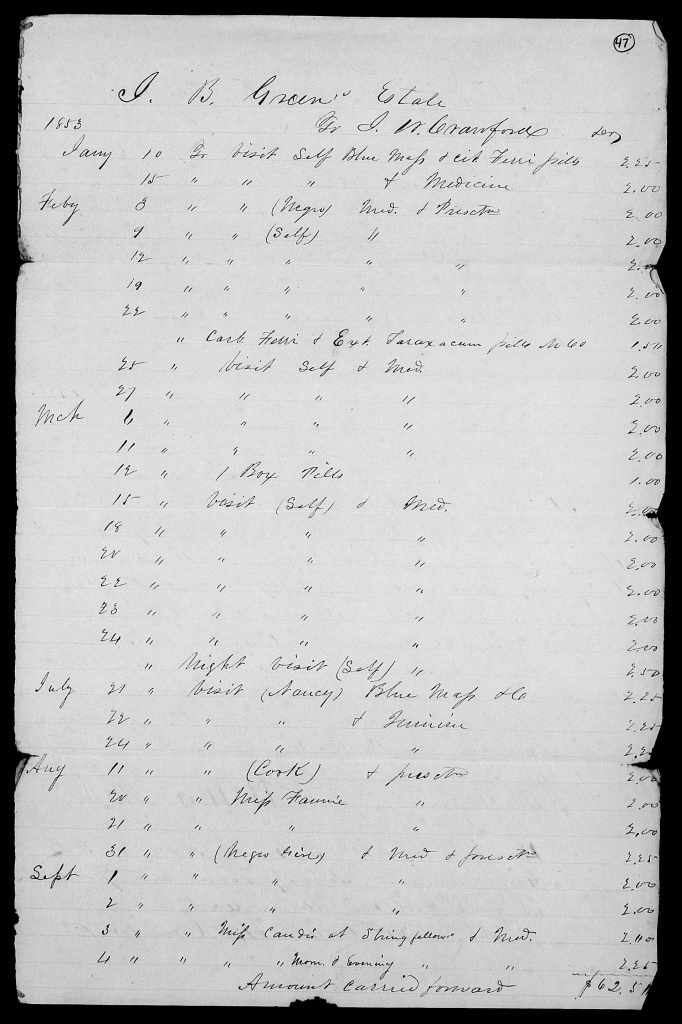
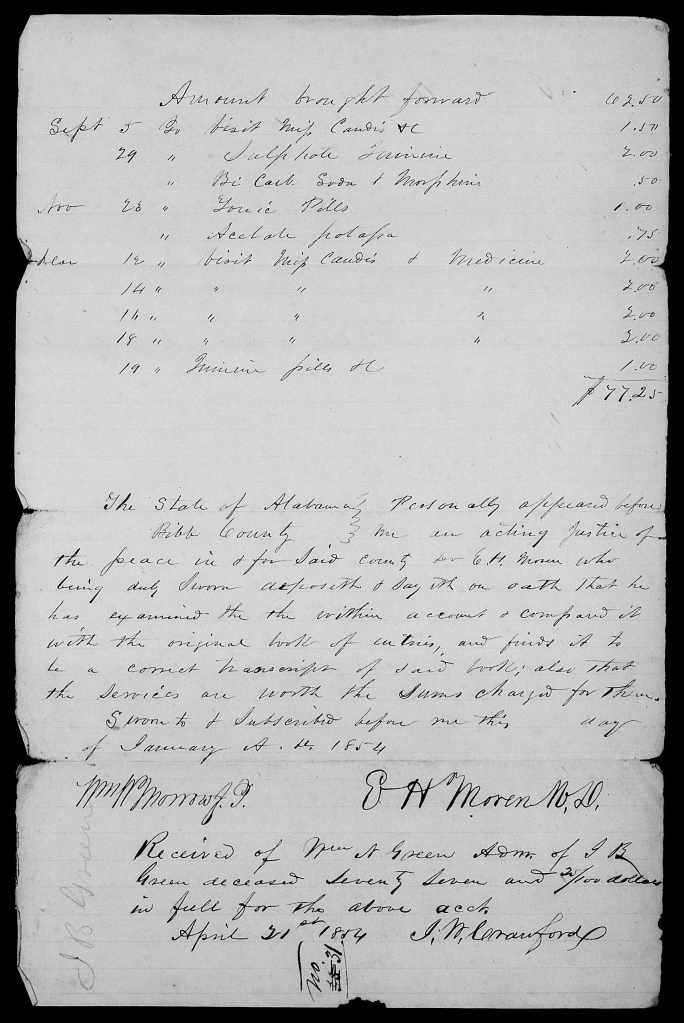
Also in the estate records is an account of James M. Williams, who appears on the 1850 federal census in Bibb County listed as a physician. It says that he visited Joscelin on 22 and 25 March to give medicine to him and to blister him — e.g., to apply something to blister the skin in hopes of ameliorating a fever or infection. So Joscelin apparently lived to the 25th of March, and the family may have been so desperate to see him treated in his extreme illness that they called in a second practitioner to blister him on that date.
Then there’s a store account from Butler and Butler for 1852-3. It states that on 28th March, a daughter of Joscelin bought 16½ yards of black calico. Then it moves to 13 April and notes that the account is now for the estate of J.B. Green, meaning he had died. The entry for black calico on the 28th suggests to me Joscelin had just died and his family had begun buying material for mourning clothes and to lay out Joscelin’s body in his coffin.
On 31 March 1853, the account of Bernhard and Davidson shows that the family purchased two black bonnets and 3½ yards of black calico (see the digital image at the head of the posting). The next day on 1 April, they bought two black lace mantillas, black crepe, and black satin and gloves. These purchases suggest to me that Joscelin died between the 25th of March, when James M. Williams came to blister him, and the 28th of March, when one of his daughters first bought black calico. The estate file does have a receipt for $15.00 paid to John W. Hayes for making a fine coffin, but the 2 July 1853 receipt does not state when this item was requested.
Joscelin’s Estate Records
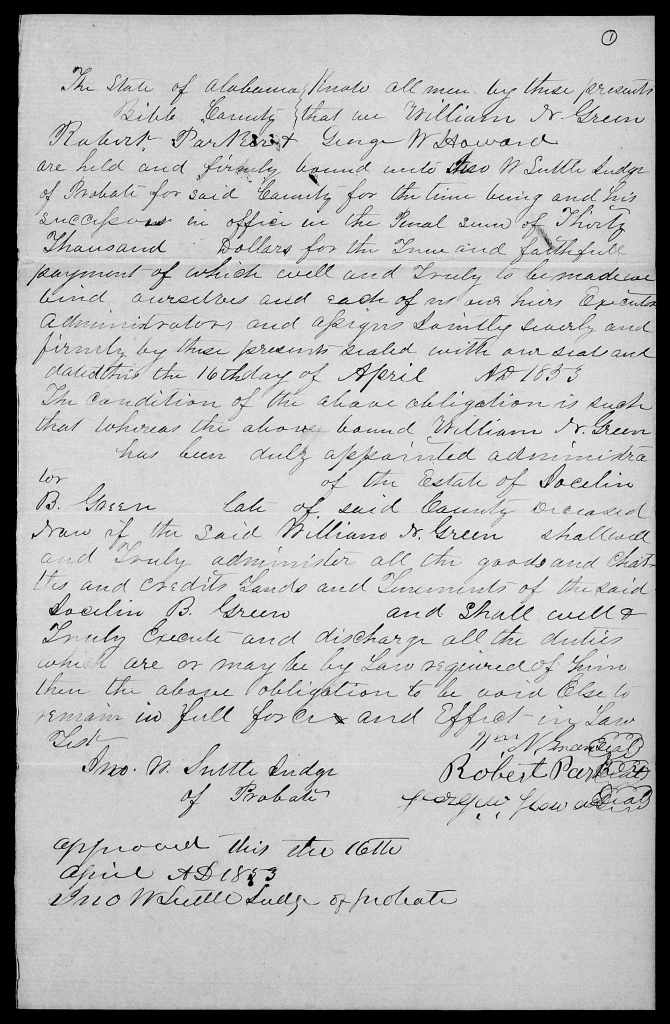
On 16 April 1853, William N. Green appealed for administration of the estate of Joscelin B. Green in Bibb County.[35] Probate minutes state that the widow Elizabeth relinquished her right to administer, and, since Joscelin had been dead over 15 days and had left no will, William N. gave bond for $30,000 with Robert Parker and Samuel Frazier for administration and was granted it. The original bond is in Joscelin’s loose-papers estate file held by Bibb County.[36]
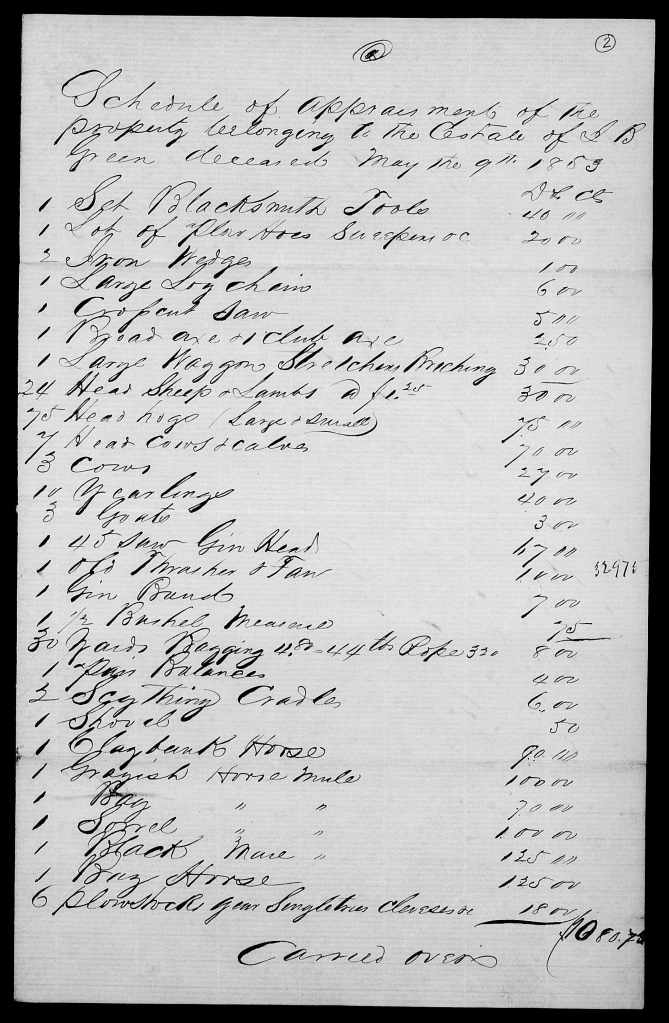
At the same court session, Adam James, Felix Shropsher, and George W. Howard were ordered to appraise the estate. William N. Green returned the inventory to court on 9 May 1853, with a notation that it was made by the three men ordered to do the appraisal.[37] The inventory shows Joscelin’s personal estate valued at $9,082.75. It lists thirteen enslaved persons, whose names are given as Demos (a man), Jack (a man), Henry (a boy), Humphrey (a boy), Albert (a boy), Nancy (a woman), Harriet (a girl), Jason (a boy), Jinny (a woman), Cresia/Cresy (a woman) with her child, Daniel (a boy), and Margaret (a girl). The original inventory is in the estate file.

On 19 November 1853, Elizabeth Green with Susan M. Stringfellow, William N. Green, Frances J. Green, and Candis (the spelling given here) E. Green sold to Samuel W. Davidson, all of Bibb County, for $2,500 tracts of land in Bibb County belonging to Joscelin’s estate.[38] The deed says that the sellers were acting on behalf of Joscelin’s estate. It’s signed by all parties with W.D. Caddell and John Lang as witnesses. Willis D. Caddell proved the deed on 22 November and it was recorded the same day.
On 12 December 1853, William N. Green petitioned the court for permission to sell the personal property belonging to Joscelin’s estate and the petition was granted, with the stipulation that the enslaved persons belonging to the estate were not to be included in the sale.[39] William’s original petition is in the estate file.
In the estate file is a document dated 15 December 1853 showing Elizabeth relinquishing administration of the estate (again) to her son William. A document in the estate file filed on the same day notes that William did not know that he ought not to claim administration in April, and he was reappointed administrator of 15 December. My reading of these documents, which are not in the probate or administrators records books, is that some question may have been raised, prior to the sale of Joscelin’s property, about William’s legal right to proceed as administrator, and these documents were filed to verify that he was the bona fide administrator.
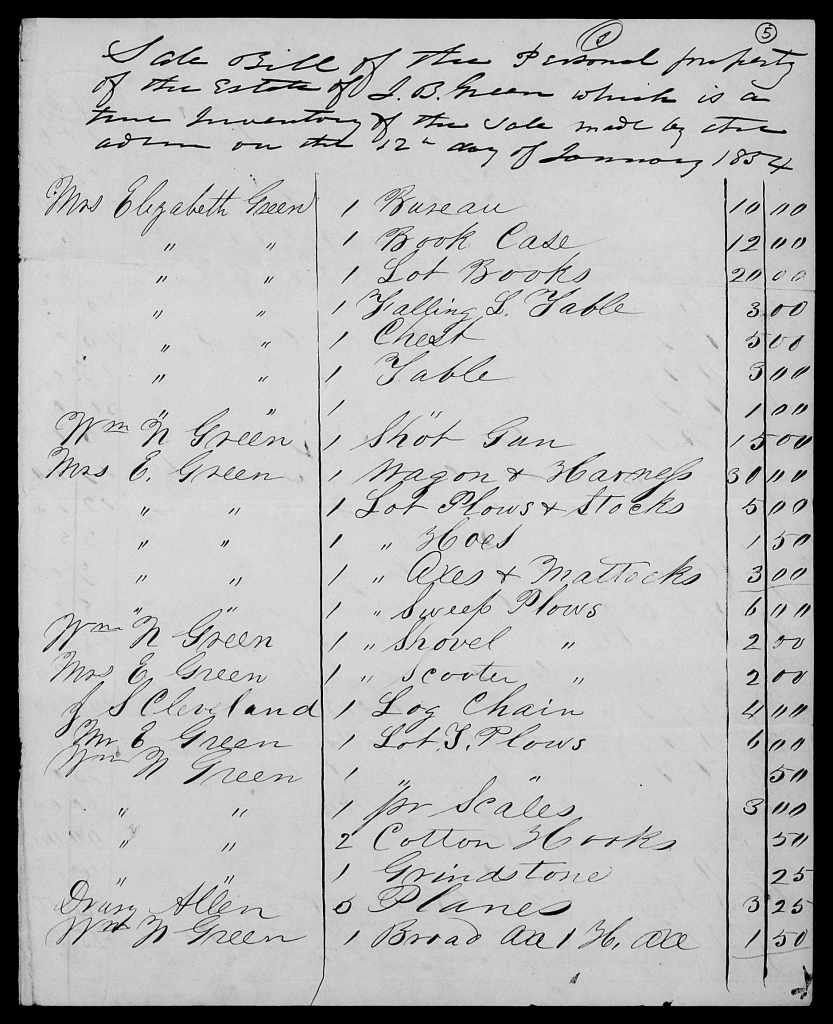
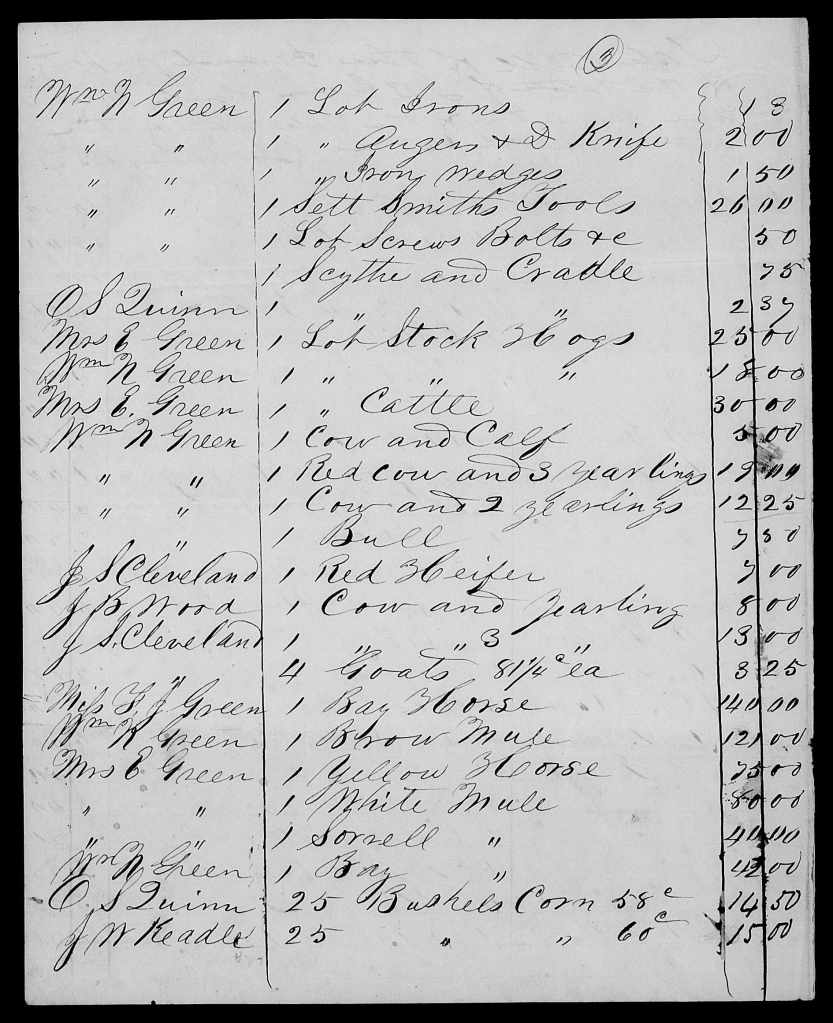
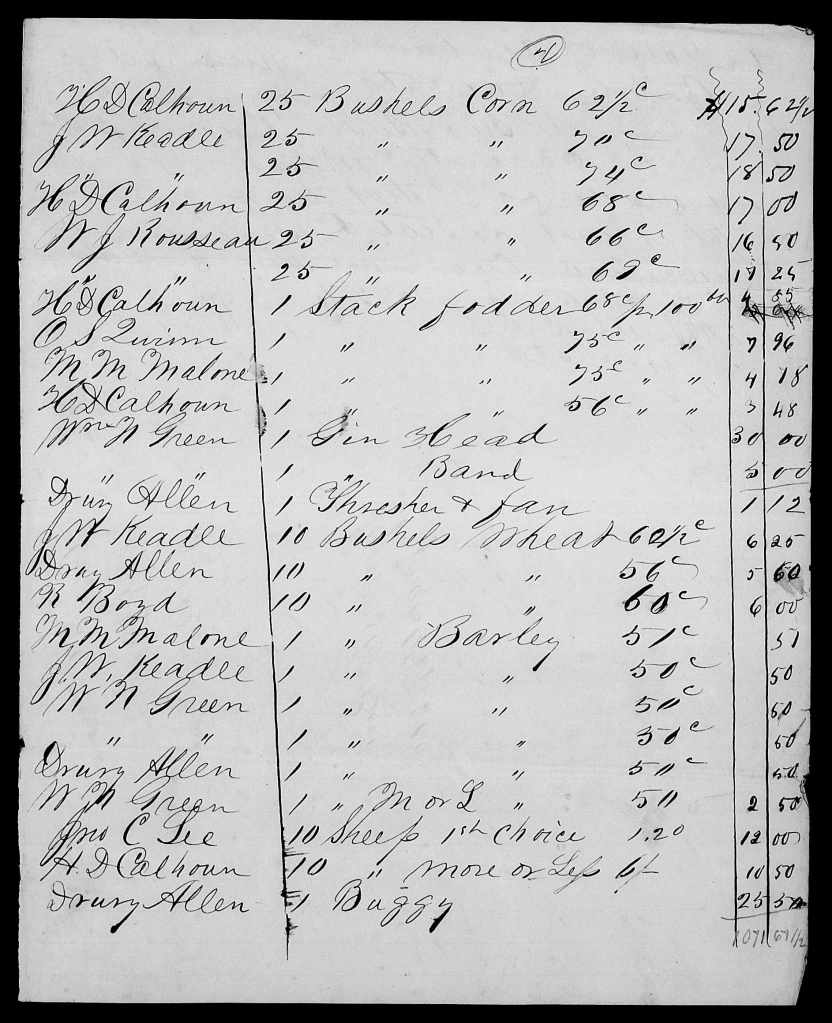
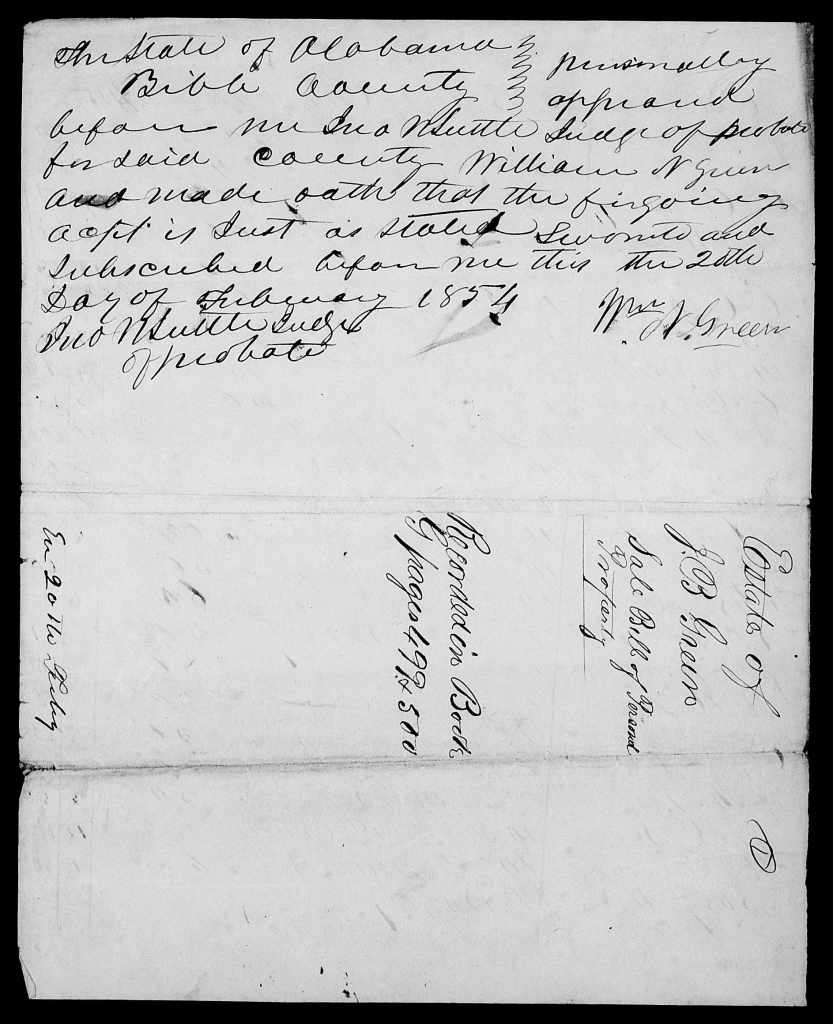
The sale of Joscelin’s personal property was held 12 January 1854 and returned to court by William N. Green on 20 February 1854.[40] It shows Joscelin’s widow Elizabeth and son William as the primary buyers, with Elizabeth buying most of the household goods, and William and Elizabeth together buying most of the farm equipment and livestock. Joscelin’s unmarried daughter Frances Jane Green bought a bay horse that was, I’d think, likely her riding horse. Also buying at the estate sale was Drury Allen, brother-in-law of Elizabeth Nichols Green, the husband of Elizabeth’s sister Susan. The personal estate sold for $1,076.67½.


The enslaved persons belonging to the estate were divided on 20 January 1855 by Jonathan Newton Smith, Robert Hill, and Henry F. Fancher. Jonathan N. Smith would marry Joscelin’s daughter Frances Jane later in 1855, on 27 November. The widow Elizabeth received Cresia/Creasy, Sandy, and Albert, Candace received Harriet, Frances received Daniel, Nancy, and Jack, Susan received Henry and Jason, and William received Demas/Demos, Jinny/Jenny and Margaret. Sandy appears to be Cresia’s unnamed child listed in the estate inventory. The original division document is in Jonathan’s loose-papers estate file and is signed by each heir. On 12 March 1855, William N. Green returned the division of the enslaved persons belonging to the estate to court.[41]
In Joscelin’s estate file is a 6 March 1856 account compiled by William N. Green listing the heirs of the estate and the distributive shares each received. This account shows a net amount of $3,877.37. With all debts paid, $1,255.96 remained to be distributed among the five heirs. The heirs are listed here as Elizabeth, the widow, of Bibb County, Susan M., wife of Joseph D. Neely of Shelby County, Alabama, William N. Green of Bibb County, Frances J., wife of Jonathan N. Smith of Bibb County, and Candace Green of Bibb County.
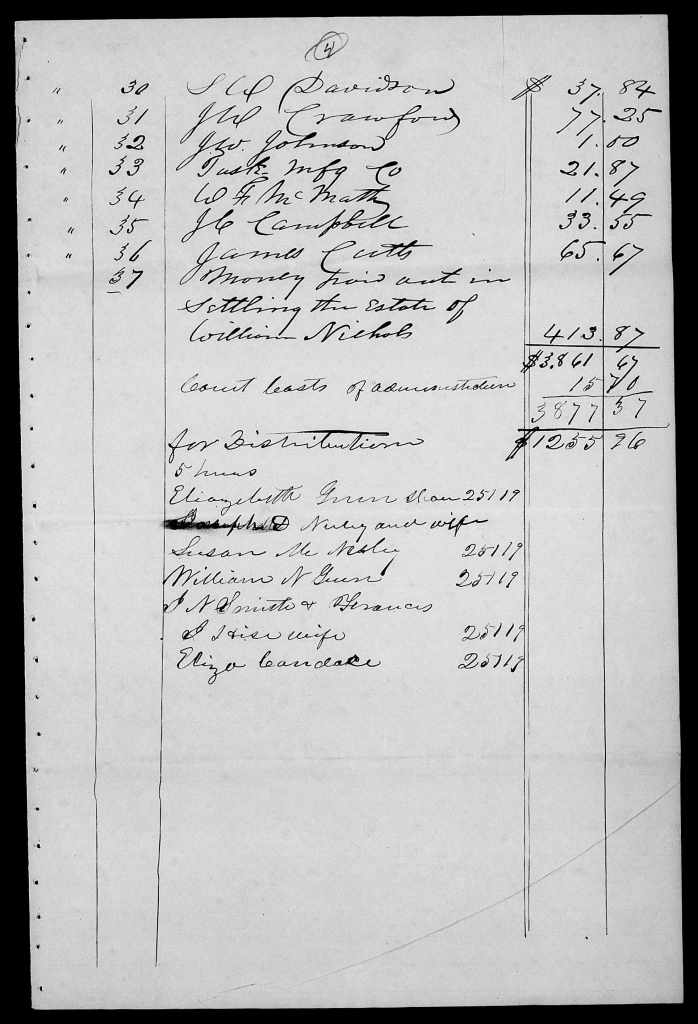

On 10 March 1856, William N. Green filed his vouchers for allowance and appealed for final settlement of the estate.[42] The court set the final settlement for the second Monday in April. The final settlement was made on 14 April 1856.[43] Each of the five heirs received $251.19. William was then discharged of his duties as administrator.
The loose-papers estate file contains quite a few interesting store accounts. The account of (Edward Henry) Bernhard and (Samuel W.) Davidson (31 March – 31 May 1853) showing the family’s purchase of mourning clothes on 31 March and 1 April 1853 has previously been cited. The estate file also has an 1852 account of Bernhard and Davidson listing purchases of spices, pepper, cambric, combs, pins, an umbrella, shoes, etc. Also discussed previously was the account of Dr. James Wilson Crawford for visits to the Green household commencing in January 1853, with his last visit to Joscelin on 24 March 1853, when he made a day and a night visit. The account runs from January to September 1853 and mentions visits also to provide care and medicine for Joscelin’s daughter Candace and to enslaved persons, some of whom are named and others not. Dr. J.W. Crawford evidently also maintained a druggist business with one Wilson, since the estate file contains a receipt by druggists Wilson and Crawford for a payment made by the estate. In addition to these accounts, also noted previously was the account for Dr. James M. Williams for visiting Joscelin on 22 and 25 March to dispense medicine and to blister him. Finally, also discussed previously was an 1852 store account from Butler and Butler which states that on 28 March 1853, a daughter of Joscelin bought 16½ yards of black calico.
In addition to these accounts, there’s an 1851-2 account with blacksmith J.C. Campbell; an 1852 store account for goods purchased from Charles Sanford, submitted 6 May 1853; an 1852-3 store account with J.S. Kennedy for items including tobacco, sugar, salt, crackers, and fish; an 1852-3 account with J.J. Tucker for brandy, wine, mackerel, crackers, raisins, etc.; an 1851-2 account with Sanders and Potts for leather goods and leather work such as shoes and boots; an 1852 account of W.L. McMath for visits to prescribe medicine to Candace; an 1852 account with a merchant whose name is difficult to read — it’s something like Tusk Manfy and Co. — for cloth, patterns, a bonnet for Mrs. Stringfellow (Joscelin’s daughter Susan), coffee and so on; an 1852 account with Bernhard and Campbell for items including cards of pins, linen, calico, a fan, a box of soda, envelopes and paper, a pair of balances, ribbon, buttons, a bonnet, brass tacks, silk, brandy, plates, a bowl, gilt paper, ladies shoes, a walking cane, and a pitcher; and an 1851 account with A.K. Calhoun & Bros. for lumber.
Among the receipts found in the estate file is, as noted previously, one made by John W. Hayes on 2 July 1853 acknowledging payment of $15.00 for his making of a fine coffin and case. Another receipt dated 9 January 1854 from Wesley Chapel church for $1.00 paid by Joscelin as his subscription to the church has also been discussed. A receipt signed by R.T. (Robert Thomas) Meriwether (a Tuscaloosa arrorney)J shows him paid $28.50 for tutoring Miss Candace Green for 9¼ months in 1852 and buying an English grammar for her.

The estate file also contains a number of promissory notes signed by Joscelin B. Green. A note dated 1 January 1840 and signed by Joscelin and his brother James Hamilton Green shows the Green brothers promising to repay A. Stoutenborough $1,166.40 by 1 January 1846. On 3 September 1841, Joscelin made another note to Stoutenborough for $1,080 which was to be repaid on or before 1 January 1844.
Another promissory note signed by Joscelin on 7 March 1846 shows him acknowledging a debt of $50.00 to his brother James H. Green. A 4 April 1850 note shows Joscelin indebting himself in the amount of $50.00 to James Cutz, with a promise to repay the debt by 1 March the following year. On 15 December 1852 at Centreville, Joscelin, his son William, and Felix Shropsher signed a promissory note to pay Charles P. Findley, administrator of the estate of John C. Campbell, $42.87.
The index to Bibb County estate records lists some estate records that appear to be for Joscelin’s estate, which are not available digitally at FamilySearch. These are in Administrators Records Bk. H, pp. 91-2 and 391-2.
Concluding Remarks
I have not found a burial record for Joscelin or his wife Elizabeth. I assume that they are both buried in Bibb County. If they were buried in the family cemetery near Woodstock, then their graves appear not to have been among those moved to Tannehill Historical State Park. As I’ve stated previously, it appears to me that after this family moved from Tuscaloosa County to Bibb County between 1840 and 1850, they settled west of the Cahaba River near, I think, Centreville, while Joscelin’s other family members lived east of the river near Woodstock. Joscelin and Elizabeth are perhaps buried in that part of Bibb County, and I suspect that Elizabeth’s father William Nichols, for whom I have also not found a burial record, lived in and is buried in that part of Bibb County, too.

Elizabeth Nichols Green died 21 March 1887 at the home of her granddaughter Sarah Smith Whitfield at Brierfield in Bibb County — see the digital image of her death notice in Bibb Blade above. Elizabeth outlived all of her children.
Elizabeth appears on the federal census in 1860 in the household of John Frank and Margaret McKinley Stout at Six Mile in Bibb County.[44] I’m assuming that the Elizabeth Green enumerated in this household is Elizabeth Nichols Green, since her age (48) and birthplace (South Carolina) match the age and birthplace of Joscelin’s widow Elizabeth. In addition, two households away on this census Joscelin and Elizabeth’s daughter Candace (E.C. Green) is living in the household of Elizabeth (Casel?) and her infant daughter Cinderella (dwelling 614/family 607). This census shows Elizabeth Green with $500 personal worth and $4,040 real worth, and Candace with $3,000 personal worth.
Also living at Six Mile in 1860 was Joscelin and Elizabeth’s son William Nichols Green, who is listed on the federal census as a merchant with $300 personal worth and $13,000 real worth. William was living alone. If Elizabeth Nichols Green had a family connection to John Frank Stout or Margaret McKinley Stout, I’m not aware of it.
As a previous posting notes, the final settlement of the estate of Jane Kerr Green in Bibb County made by her son James Hamilton Green on 23 November 1857 states that her heirs who received a share of the estate included the children of Joscelin B. Green, who are named as Susan M., wife of Joseph D. Neely, Frances J., wife of Jonathan N. Smith, William N. Green, and Eliza C. Green.[45]
In another previous posting, I note that John Green and Jane Kerr’s daughter Elizabeth and son Joscelin both had the middle initial B., and this makes me wonder if, back a generation earlier in the Green family line, there was a forebear whose surname began with the letter B. If so, I have been unable to figure out what that B. stands for. I have also not found any information to indicate why John and Jane named one of their sons Joscelin. This is possibly a variant spelling of the surname Joslin, but if so, I’ve found no documentation showing a connection of these Greens to a family of that surname.
In my next posting, I’ll discuss the children of Joscelin and Elizabeth Nichols Green.
[1] 1850 federal census, Bibb County, Alabama, W.C. (West Cahaba) River, p. 2B (dwelling/family 23; 19 September).
[2] Pendleton District, South Carolina, Deed Bk. S, p. 64.
[3] U.S. Bureau of Land Management Tract Bk. 2B (Tuscaloosa County), p. 198.
[4] Alabama State Volume Patent Bk. 650, pp. 262-3, #747-8.
[5] Rhoda Ellison, Bibb County, Alabama, The First Hundred Years 1818-1918 (Tuscaloosa: University of Alabama Press, 1984), p. 32.
[6] Bibb County, Alabama, Orphans Court Minutes Bk. A, pp. 190-1.
[7] Tuscaloosa County, Alabama, Marriage Bk C. p. 44.
[8] 1850 federal mortality census, Bibb County, Alabama. p. 23.
[9] Bibb County, Alabama, Orphans Court Records Bk. A, p. 475.
[10] Ibid., pp. 543-4. On 29 November 1850, Joscelin B. Green reported to Bibb court that William Nichols’ estate was insolvent: Ibid., Bk. B, pp. 303-4. The court declared the estate insolvent on 15 January 1851: Bk. B, p. 324. An order for estate settlement was given on 10 March 1851: Bk. B, pp. 351-2.
[11] Bibb County, Alabama, Administrators Records Bk. G, pp. 369-370. See also pp. 678-9, showing Bibb County sheriff Jackson Gardner reporting to court on 14 August 1854 as administrator of Joscelin Green Nichols that Joscelin G. Nichols’ estate was insolvent.
[12] Bibb County, Alabama, Orphans Court Records Bk B, pp. 314-5. On 14 February 1853, Joscelin reported the land sale to court: Bibb County, Alabama, Orphans Court (Probate Minutes), Bk. E, p. 104. On 7 March 1853, Joscelin reported to court that Felix Shropsher was purchaser of 80 acres of the Bibb County land and title had been made to him: Ibid., p. 117. The deed is recorded in Bibb County, Alabama, Deed Bk. G, pp. 508-9: see infra, n. 31.
[13] Bibb County, Alabama, Marriage Bk. 1829-1834, p. 166.
[14] 1850 federal census, Bibb County, Alabama, W.C. (West Cahaba) River, p. 2B (dwelling/family 20; 19 September).
[15] Ellison, Bibb County, Alabama, The First Hundred Years 1818-1918, p. 70.
[16] Find a Grave memorial page of William “Buck” Nichols, Mount Pleasant Free Will Baptist cemetery, Perry County, Alabama, created by Larry Boyd, maintained by Sherry Moore Anderson, with tombstone photos by Sherry Moore Anderson, Larry Boyd, and Terry Moon.
[17] 1830 federal census, Tuscaloosa County, Alabama, p. 345.
[18] 1840 federal census, Bibb County, Alabama, p. 106.
[19] 1830 federal census, Bibb County, Alabama, p. 150.
[20] 1830 federal census, Tuscaloosa County, Alabama, p. 334.
[21] Bibb County, Alabama, Probate Minutes Bk. A, pp. 149-150.
[22] Alabama State Volume Patent Bk. 2580, p. 360, #18644.
[23] 1840 federal census, Tuscaloosa County, Alabama, p. 208.
[24] Bibb County, Alabama, Deed Bk. E, pp. 56-8.
[25] Ellison, Bibb County, Alabama, The First Hundred Years 1818-1918, pp. 46-7.
[26] See Find a Grave memorial page of Anthony Stoutenborough, Center Ridge cemetery, Dallas County, Alabama, created by Jeffrey Read, with tombstone photos by Jeffrey Read and Larry Bell. This source states that Stoutenborough was son of Captain John Stoutenborough and Catherine Holmes and married Jane Jones Crocheron.
[27] See “List of Plantations in Alabama,” Wikipedia; “Facade of the Stoutenborough House, on the east side of Alabama Highway 41 in Shepardville, Alabama,” photo by Duane Phillips in the Alabama Photographs and Pictures Collection at website of Alabama Department of Archives and History; and “Elm Bluff Stoutenborough Hall,” photo by Jeffrey Read at Wikimedia Commons.
[28] Bibb County, Alabama, Deed Bk. E, p. 404.
[29] Ibid., p. 402.
[30] See “Tannehill Ironworks,” Encyclopedia of Alabama, online with sponsorship of Alabama Humanities Alliance and Auburn University.
[31] See supra, n. 1.
[32] 1850 federal slave schedule, Bibb County, Alabama, unpaginated (18 September).
[33] Bibb County, Alabama, Deed Bk. G, pp. 467-8.
[34] Ibid, pp. 508-9.
[35] Bibb County, Alabama, Orphans Court (Probate Minutes) Bk. E, pp. 131-2; and Bibb County, Alabama, Administrators Records Bk. G, pp. 317-9.
[36] Bibb County, Alabama, loose-papers estate file box 7, folder 27, available digitally at FamilySearch.
[37] Bibb County, Alabama, Orphans Court (Probate Minutes) Bk. E, p. 144; and Bibb County, Alabama, Administrators Records Bk. G, pp. 330-2.
[38] Bibb County, Alabama, Deed Bk. G, pp. 603-4.
[39] Bibb County, Alabama, Orphans Court (Probate Minutes) Bk. E, pp. 243-4.
[40] Bibb County, Alabama, Orphans Court (Probate Minutes) Bk. E, p. 299; and Bibb County Administrators Records Bk. G, pp. 499-500.
[41] Bibb County, Alabama, Orphans Court (Probate Minutes) Bk. E, p. 500.
[42] Ibid., Bk. F, p. 112-3.
[43] Ibid., pp. 144-5.
[44] 1850 federal census, Bibb County, Alabama, East Side Cahaba River, Six Mile post office, p. 737 (dwelling 616/family 609; 25 July).
[45] Bibb County, Alabama, Probate Minutes Bk. F, pp. 411-3.
 BEGATS AND BEQUEATHALS

3 thoughts on “Children of John Green (1768-1837) and Jane Kerr (1768-1855): Joscelin B. Green (1800-1853)”