Mary’s tombstone reads,
Sacred to the memory of Mary C. wife of R.W. Woods and daughter of John & Jane Green who was born December 16th 1797 and departed this life November 27th 1827. Age 29 years 11 months & 11 days.
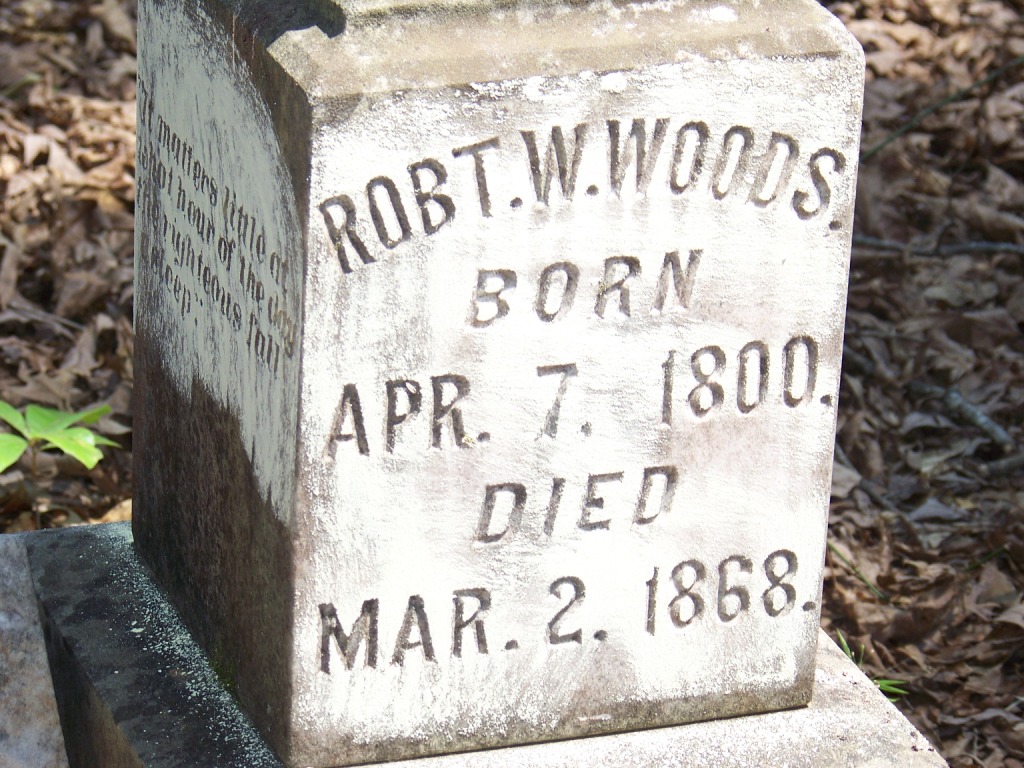
Mary Calhoun Green married Robert Wilson Woods, son of Robert and Elizabeth Woods of Pendleton District, South Carolina. Robert’s tombstone in Six Mile Presbyterian cemetery at Six Mile in Bibb County, Alabama, gives his dates of birth and death as 7 April 1800 and 2 March 1868.[2]
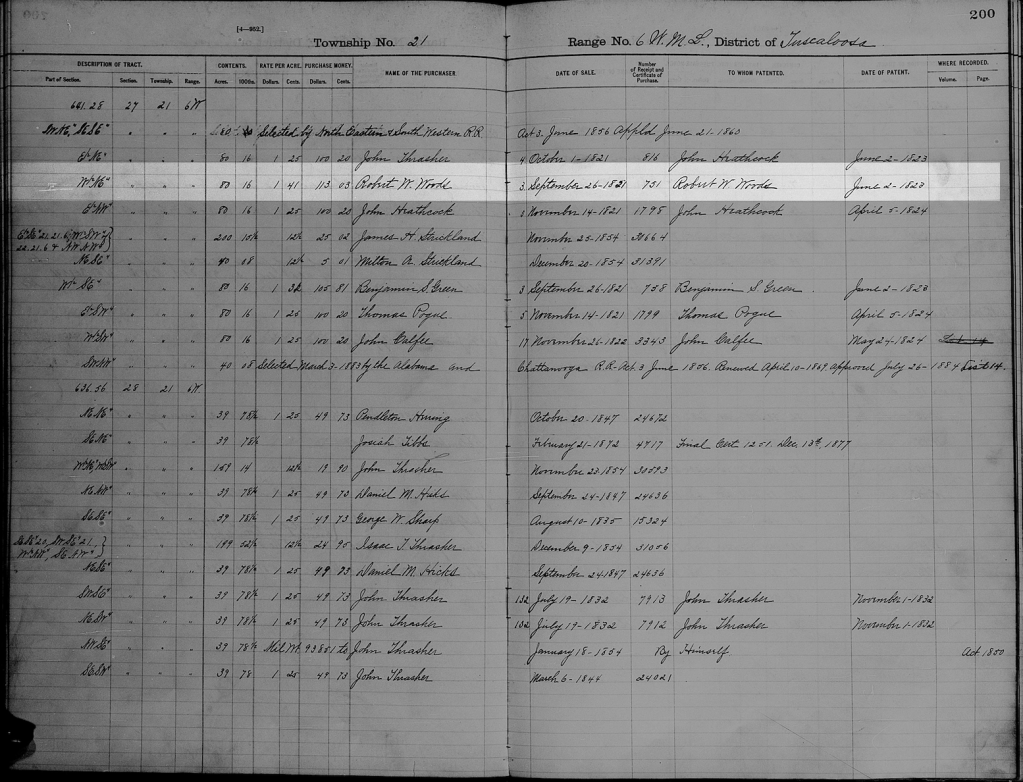
I have not found a marriage record for Robert and Mary. Their oldest child, a daughter Elizabeth, was born in or about 1823. Though the couple could possibly have married in Pendleton District, South Carolina, before their families came to Alabama, I think it’s likely that Robert W. Woods and Mary C. Green married about 1822, likely in Tuscaloosa County, Alabama, where Robert W. Woods purchased land in Bibb County on 26 September 1821.[3] The land was 80 acres, the west ½ northeast ¼ of section 27, township 21, range 6 west. The land was patented to Robert on 2 June 1823. The tract book recording this land purchase shows Robert’s brother-in-law Benjamin S. Green purchasing 80 acres in the same section, township, and range on the same day that Robert W. Woods bought his land. As the posting I’ve just linked states, on the same day, 26 September 1821, at the federal land office in Tuscaloosa, Robert W. Woods’ father-in-law John Green and brother-in-law Joscelin B. Green also purchased land in Bibb County. The patents issued to these purchasers state that they were all living in Tuscaloosa County at the time they bought land in Bibb County in 1821.
On 2 June 1823, Robert W. Woods received certificates for two tracts in Bibb County, one 80 acres and one slightly less than 80 acres. The land certificate of neither certificate precisely matches the information recorded about Robert’s 1821 land purchase recorded in the BLM Tract Bk. 2B, which I cited above. The two tracts are in township 21, range 6 west, as with the land described above, but one is in section 14 of that township and the other in section 15.[4] Robert had a certificate for another 80 acres in section 14, township 21, range 6 west in Bibb County on 22 April 1824.[5]
As Mary Calhoun Green’s tombstone inscription transcribed above states, she died (in Bibb County) on 27 November 1827 at the young age of 29 years, 11 months, and 11 days. As previous postings note, the children of Mary C. Green and Robert W. Woods are named in the Bibb County estate records of their grandfather John Green and grandmother Jane Kerr Green.[6] The estate records (and other records) show that Robert and wife Mary had three children: Elizabeth W. (born in or about 1823); Jane Rebecca (born 1 August 1825); and James L. (born in or about 1827).

On 28 August 1828 in Bibb County, Robert Wilson Woods married Nancy Jack Wallace, daughter of John Wallace and Margaret Thompson.[7] John Wallace was a Revolutionary soldier who filed an application for a pension for his service during the Revolution in Bibb County on 14 August 1832.[8] His affidavit states that he was a Ranger in North Carolina under Captain Roger Topps in troops commanded by General Charles McDowell. He served at Kings Mountain. He was born 22 December 1757/1758 in the western North Carolina. He lived in Sullivan County, North Carolina (later Tennessee), during his period of service, then moved to Blount County, Tennessee, and lived there for 25 years before moving to Bibb County. John is buried in Six Mile Presbyterian cemetery in Bibb County, in which Robert Wilson Woods and wife Nancy J. Wallace Woods are also buried.[9]
Robert Wilson Woods had a second family by wife Nancy, who raised his three children by Mary Calhoun Green. Three years following Mary’s death, the 1830 federal census enumerates Robert’s family in Bibb County with a household comprised of one male under 5, one male 20-30, and one male 30-40, and with two females under 5, one female 5-10, and one female 30-40.[10] Also in the household is an enslaved female aged 10-24 year. As a previous posting notes, this census shows Robert living next to his previous wife Mary’s father John Green. The linked posting also has images of plat maps showing where Robert’s tracts of land discussed previously in sections 14, 15, and 27 of township 21, range 6 west, were located, and where John Green and his sons Benjamin S., James H., John E., and Joscelin B. Green held land in Bibb County, all of these tracts being close to Robert W. Woods’ land.
On the 1830 census, the older male and female in Robert’s household are, of course, Robert and wife Nancy. I am not sure who the male aged 20-30 is. The male aged under 5, one of the females aged under 5, and the females aged 5-10 are Robert’s children by wife Mary — Elizabeth (aged about 7), Jane Rebecca (aged 5), and James L. (aged about 3). The other female aged under 5 is Robert and Nancy’s first child, their daughter Mary Margaret (born 1829).
As the posting I linked above also states, the Woods family was intermarried with the family of John Calfee, a pioneer settler of Bibb County who lived near the Green and Woods families and is discussed in this linked posting. Robert W. Woods’ sister Elizabeth married Evan Adair Calfee, a son of John Calfee, and Robert’s brother John Alexander Woods married Evan A. Calfee’s sister Mary. On the 1830 census, John Calfee and his son Evan, are enumerated two houses before Benjamin S. Green, who is next to Robert W. Woods.
When Robert Wilson Woods died in Bibb County on 2 March 1868, his estate documents named his three children by Mary Calhoun Green as well as his children by Nancy Jack Wallace. A list of Robert’s heirs that his son and administrator Felix Grundy Woods presented to Bibb County court on 10 November 1871 states that Robert and Mary’s daughter Elizabeth W. Woods was living in Bibb County on that date and was non compos mentis.[11] It states that Robert and Mary’s daughter Rebecca Jane had predeceased her father and her children Robert Wallace, James Wallace, Monroe Wallace, and Henry Wallace were living with their father John Pulaski Wallace in Bibb County.
The list of Robert Wilson Woods’ heirs states, too, that James L. Woods, his son by Mary Calhoun Green, had predeceased his father and had children Oscar living in Bibb County, and Edward, Robert, and William living in Bienville Parish, Louisiana.
I haven’t done a great deal of work to trace Robert Wilson Woods’ children by Nancy Jack Wallace. The records I’ve cited from Robert’s estate documents in Bibb County contain good information about them, as does Rita Wallace’s well-documented Arkansas Connections, Genealogy of the Wallace-Foster Family, which I cited previously.[12]
Children of Mary Calhoun Green and Robert Wilson Woods
The children of Mary Calhoun Green and Robert Wilson Woods were as follows:
a. Elizabeth W. Woods was born about 1823 in either Tuscaloosa or Bibb County, and died after 1870 in Bibb County. The 1850 federal census suggests that she was born in 1824, the 1860 federal census has her born in 1823, and the 1870 federal census shows her born in 1825.[13] This census is the last on which I find Elizabeth. In 1850 and 1860, she is enumerated in the household of her father Robert W. Woods and second wife Nancy in Bibb County, and in 1870, she’s with her widowed stepmother Nancy in Bibb County. Elizabeth did not marry, and is buried in Six Mile Presbyterian cemetery in Bibb County with her father and stepmother, with a marker that has only her name.
b. Jane Rebecca Woods is said to have been born 1 August 1825 in Bibb County and died 17 May 1857 in Bibb County.[14] On 7 September 1848 in Bibb County, she married John Pulaski Wallace.[15] I have tried, without success, to figure out how (or whether) John Pulaski Wallace fits into the kinship network of Wallaces in Bibb County. The 1850 and 1860 federal censuses in Bibb County place his birth in 1821, but the 1870 federal census has him born in 1802, quite a difference from the testimony of the previous two federal censuses.[16] He bought federal land in Bibb County on 1 July 1848 close to land patented by Matthew Wallace, a known son of John Wallace and Margaret Thompson and a brother of Nancy Jack Wallace, second wife of Robert Wilson Woods.[17] If John Pulaski Wallace was born in 1802, then he, too, could have been a brother of Nancy.
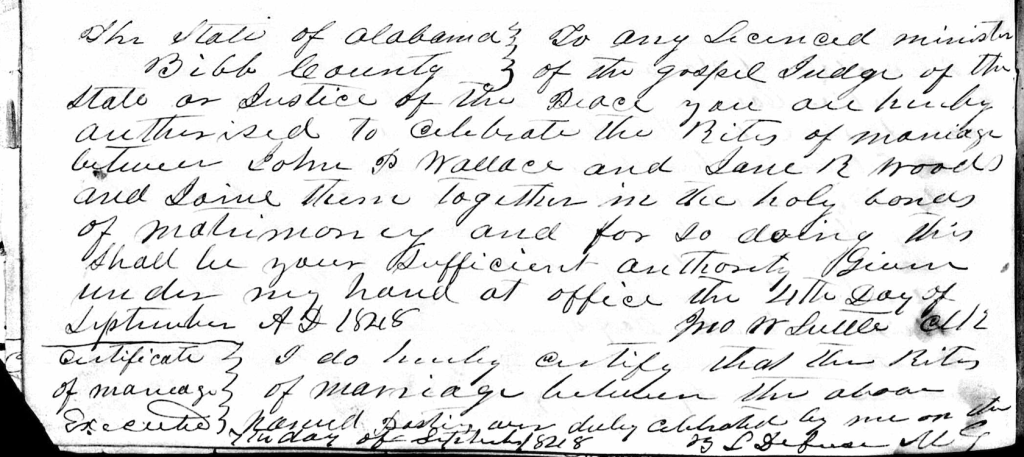
Unfortunately, the John Pulaski Wallace who married Jane Rebecca Woods in September 1848 in Bibb County has been thoroughly mixed up by various researchers with a Pulaski Wallace who married Durana Pratt in Bibb County on 22 October 1841. These are two different men, both with the name Pulaski, though John Pulaski usually went by John P. Wallace. If John Pulaski was born in 1821 as the 1850 and 1860 federal censuses report, then he was close in age to Pulaski Wallace with wife Durana Pratt. Pulaski and Durana Pratt Wallace are buried in the Pratt-Wallace cemetery at Centreville in Bibb County with John’s tombstone stating that he was born 20 February 1821 and died 1 April 1900 in Bibb County.
Both John Pulaski Wallace and Pulaski Wallace appear on the 1850 federal census in Bibb County, John P. with wife Jane Rebecca Woods and Pulaski with wife Durana.[18] Both are aged 29. Both men appear again on the federal census in Bibb County in 1860, John P. with wife Mary W. Owen on 29 October 1857 following Jane Rebecca Woods’ death on 17 May 1857, and Pulaski Wallace with wife Durana.[19] John Pulaski is aged 39 and Pulaski is aged 37, and they have separate sets of children; John Pulaski has his four sons by Jane Rebecca Woods and a son Thomas born to wife Mary.
I don’t find Pulaski Wallace on the 1870 federal census in Bibb County. John Pulaski Wallace is on the 1870 census in Bibb County with wife Mary and his children by Jane Rebecca Woods, plus the children he has now had by Mary.[20] In 1880, Mary appears as a widow at Six Mile in Bibb County on the federal census, so John Pulaski Wallace died between 1870 and 1880.[21] I have not found a burial record for him. In 1880, Mary had living with her John Pulaski’s youngest son by Jane Rebecca Woods, Henry Lafayette Wallace. Between 1870 and 1880, John Pulaski and Jane Rebecca’s oldest son Robert D. Wallace moved to Arkansas and spent the rest of his life there in Pulaski County. I do not find John Pulaski and Jane Rebecca’s sons James and Monroe on the 1880 federal census. Great confusion is created by the fact that Pulaski Wallace and Durana Pratt also had sons James and Monroe, and their son Julius or James Monroe, who married Eliza J. Williams, has been confused with John Pulaski and Jane Rebecca’s son Monroe G. Wallace.
The children of Jane Rebecca Woods and John Pulaski Wallace were Robert D. Wallace (3 September 1849 – 18 January 1932, married Margaret Josephine Holt); James Wallace (abt. 1851 – after 1870); Monroe G. Wallace (about 1853 – after 1870); and Henry Lafayette Wallace (15 April 1855 – 23 February 1935, married Candace Green Fancher).
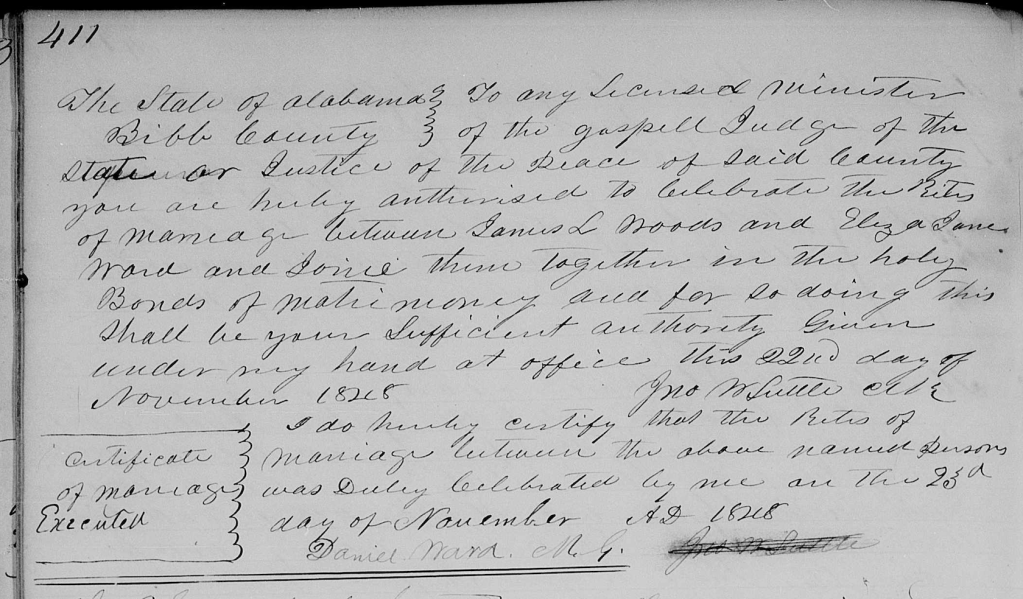
c. James L. Woods was born about 1827 in Bibb County, Alabama. This date of birth is indicated by the 1850 federal census, which is the only federal census on which I find James enumerated.[22] On 23 November 1848 in Bibb County, he married Eliza Jane Ward, daughter of Rev. Daniel Ward and Rebecca Cobb.[23] In October 1849, Eliza Jane gave birth to their son Oscar and then died before 15 December 1853, when James remarried to Mary Ann Lowery, daughter of Joel Lowery and Mary Abigail Pratt.[24] Between 1854 and 1858, when James and Mary Ann’s sons Edward and William were born in Alabama and Louisiana respectively, the family moved to Bienville Parish, Louisiana, where James had died before 2 March 1868 when his father Robert Wilson Woods died in Bibb County, Alabama, with Robert’s estate records saying, as noted above, that his son James had predeceased him and that James’ heirs (except for son Oscar) were in Bienville Parish, Louisiana. The 1870 federal census shows Mary Ann heading her household at Brush Valley in Bienville Parish, widowed, with her three sons in the household.[25] By 1880, Mary Ann had disappeared from the federal census and had apparently died.
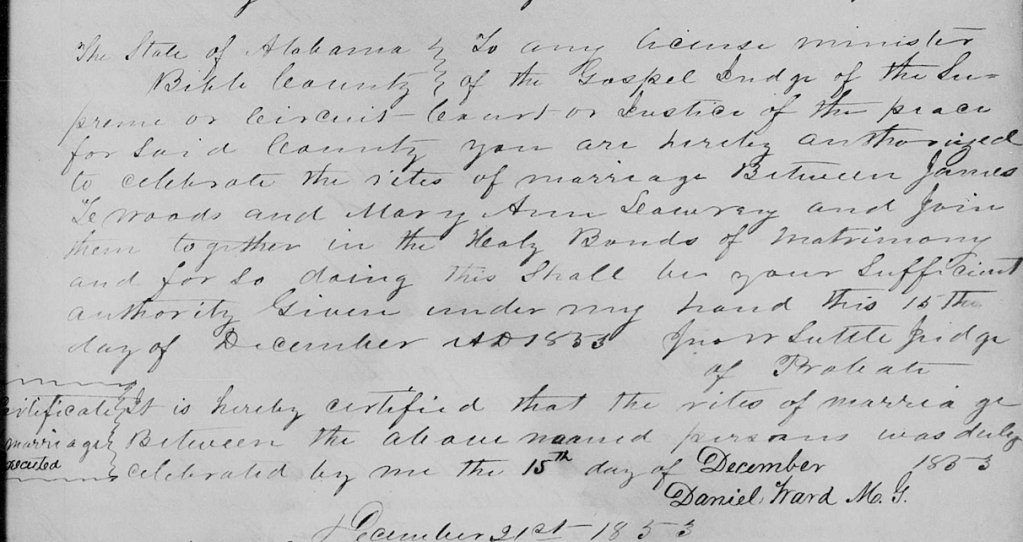
James L. Woods, son of Robert Wilson Woods and Mary Calhoun Green, is not a James Lowell Woods who married Mary Emily Fisher in Avoyelles Parish, Louisiana, and who died in that parish in 1862 — though Ancestry hints want to conflate these two different men named James L. Woods.
Oscar M. Woods, son of James L. Woods and Eliza Jane Ward, was born in December 1849 in Bibb County and died 1 December 1887. On 30 June 1870 in Bienville Parish, Louisiana, he married Elizabeth Roden, daughter of Joshua Emory Roden and Sarah Frances Franks. Oscar is buried in Liberty Hill cemetery in Bienville Parish.
Edward Lowery Woods, son of James L. Woods and Mary Ann Lowery, was born 31 October 1854 in Bibb County and died 25 September 1918 in Bienville Parish. On 22 November 1883 in Bienville Parish, he married Margaret V. Caldwell, daughter of William Marshall Caldwell and Caroline M. Walden. Edward L. Woods and wife Margaret are buried in Liberty Hill cemetery in Bienville Parish.
William W. Woods, son of James L. Woods and Mary Ann Lowery, was born 23 November 1858 in Bienville Parish and died 9 January 1873 in Bienville Parish. He is buried in Taylor cemetery at Liberty Hill in Bienville Parish.
Robert J.N. Woods, son of James L. Woods and Mary Ann Lowery, was born 5 December 1860 in Bienville Parish, Louisiana, and died 7 January 1873, two days prior to his brother William. Robert is buried in Taylor cemetery at Liberty Hill in Bienville Parish.
Letters of Felix Grundy Woods to Bibb Blade about Liberty Hill, Louisiana
The family of James L. Woods and Mary Ann Lowery was joined in Bienville Parish by two of James’s half-brothers, sons of Robert Wilson Woods by wife Nancy Jack Wallace: these were Felix Grundy and John H. Woods, both of whom are buried in Liberty Hill cemetery in Bienville Parish. Felix and his brother John acquired federal land just south of Liberty Hill and Brush Creek near members of the Fancher and Wallace families who had also come from Bibb County to bienville Parish. Liberty Hill is some twenty miles south of the Bienville Parish seat, Arcadia, and is about five miles north of Brush Valley, which is where the 1870 federal census shows Mary Ann Lowery Woods living with her sons after James L. Woods had died. In her history of the formative years of Bibb County, Alabama, Rhoda C. Ellison notes that members of “the Woods clan of Six Mile” settled at Liberty Hill in Bienville Parish about 1870, and that F.G. (Felix Grundy) Woods wrote letters from there to the Bibb Blade in the 1880s encouraging other Bibb County families to move there, due to the affordable cost of good land.[26]
On 16 November 1880, the Bibb Blade reported,[27]
Mr. Grundy Wood with his family left our neighborhood last week for Liberty Hill, La. We wish him health and prosperity in his new home.
On 9 December, the Bibb Blade carried an interesting letter by K. dated 30 November 1880 and written from Arcadia in Bienville Parish, noting that the Blade had told its readers that Mr. Grundy Wood had left Alabama and was settling near Liberty Hill in Bienville Parish.[28] K. notes that “the tide of emigration seems to be ‘setting in’ to this section, and describes the conditions that Felix Grundy Wood would find in his part of Bienville Parish, from cost of land ($1.50 to $3.00 an acre) to availability of schools (“limited school facilities”).
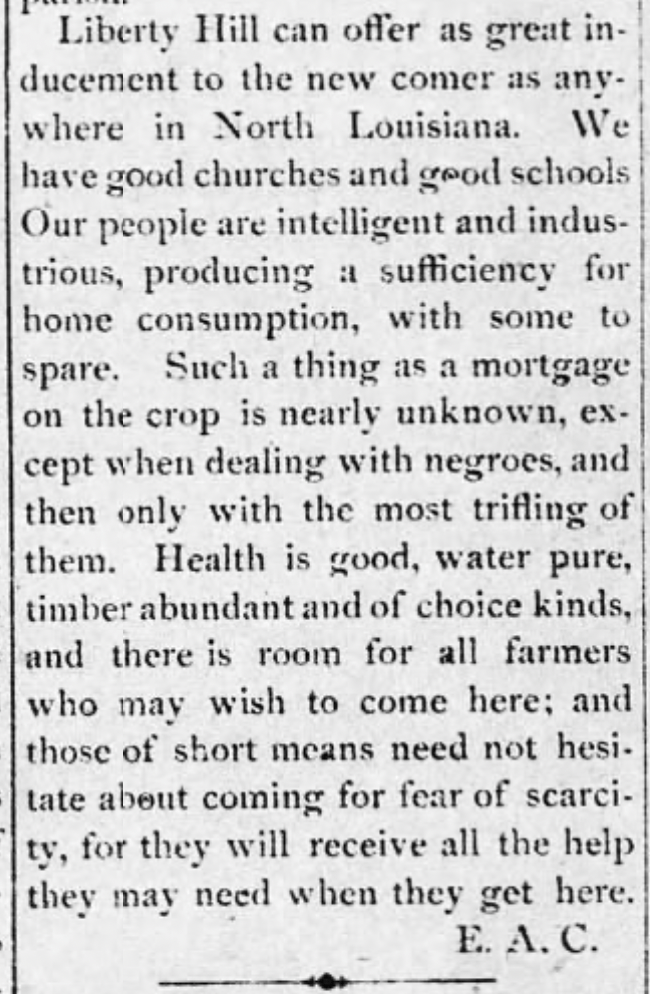
K.’s letter needled another correspondent, E.A.C., who wrote Bibb Blade on 19 February 1881, with the Blade publishing the letter on 10 March.[29] E.A.C. says that lands at Liberty Hill were good, “generally sandy loam with clay subsoil, and as good as there is in the parish.” E.A.C. took K. to be implying in his letter that conditions in Bienville Parish were primitive, and in response, he noted that there was a steamboat landing forty miles from Liberty Hill (not fifty miles, as K. had stated), and that there was tri-weekly mail and “people are liberally supplied with papers, books, etc.” A mile from Liberty Hill was Del Rio school house, with forty pupils, and Liberty Hill had its own school house with as many pupils. The letter quotes Felix Grundy Woods’ brother John H. Woods to say that where he lived at Liberty Hill, people were so thickly settled that he could clearly hear the dinner horn of twenty families. The letter concludes with a statement that several families of Alabamians lived at Liberty Hill and they joined him in stating that their advantages were as good as, if not better than, those of settlers of any other section of Bienville Parish. The final section of the letter is a paean to Liberty Hill — see the excerpt above.
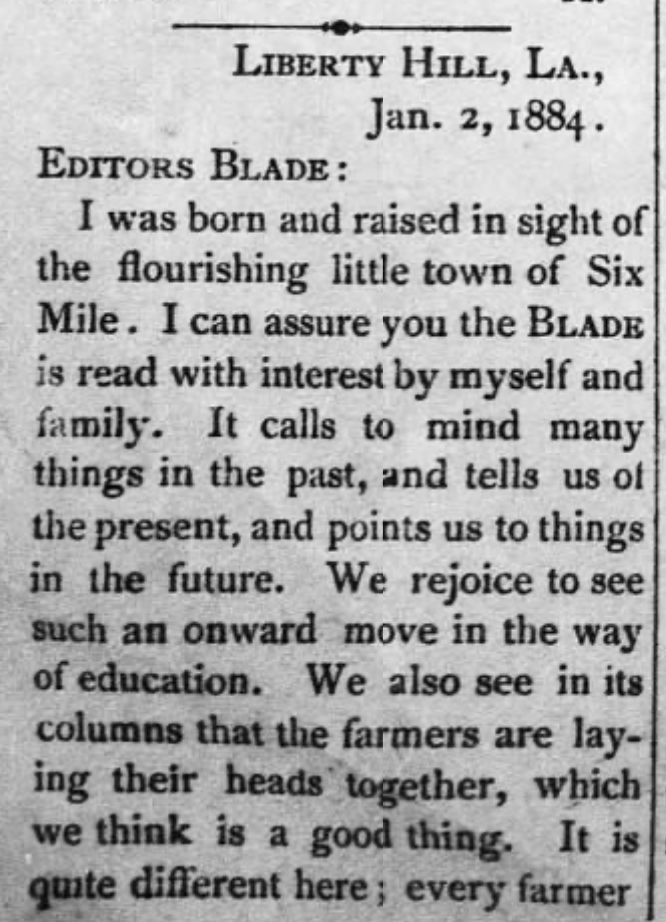
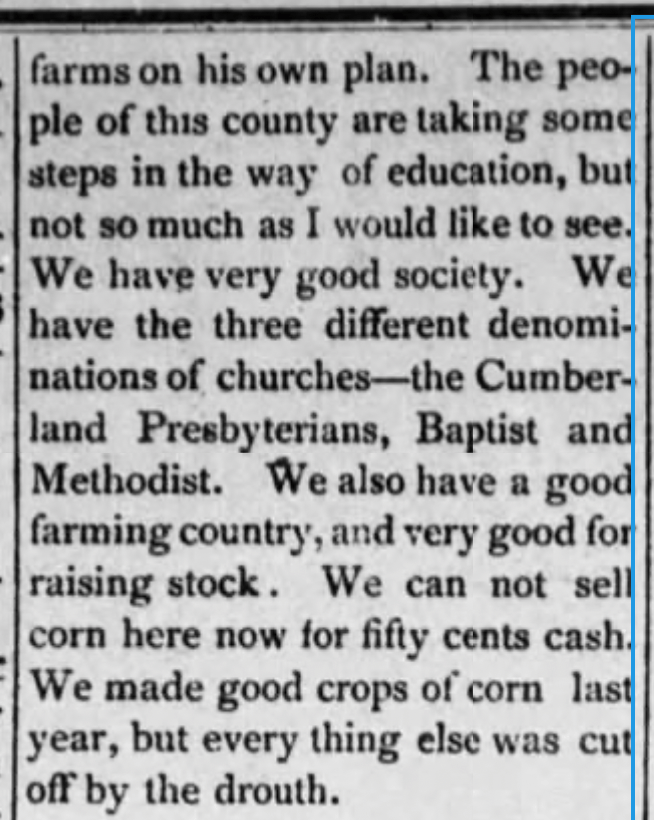
On 2 January 1884, Felix G. Woods wrote the first of several letters from Liberty Hill to the Bibb Blade.[30] The Blade published the letter on 16 January. It notes that Felix G. Woods was born and raised “in sight of the flourishing little town of Six Mile. The letter states that those living at Liberty Hill had “very good society” with Cumberland Presbyterian, Baptist, and Methodist churches, and good farming country that was especially well-suited to raising stock.
On 8 February 1884, Felix G. Woods again wrote the Bibb Blade, with the letter published 20 February.[31] This letter states that Liberty Hill was a “flourishing little town” with four purveyors of dry goods, one drug store, and “I am sorry to say one retail grocery.” Though it had previously been a challenge to bring goods to market, this situation had improved due to the arrival of the railroad running from Monroe to Arcadia, the latter being not many miles from Liberty Hill. The same issue of the Blade that published this letter noted that Felix G. Woods had sent names of six new subscribers to the paper from his community, and that surely Bibb Countians could do equally well to support their paper.
The 25 March 1885 Bibb Blade carried another letter by Felix G. Woods written from Liberty Hill on 14 March.[32] This letter states that every member of his family read each issue of the Blade with great interest “for the simple reason that it is like a letter from old Bibb.” This letter states that growing conditions at Liberty Hill were good for oats, corn, cotton, potatoes, molasses (i.e., sorghum), and watermelons, but not for wheat. Cotton was planted on old land around corn. The letter states that the country was “very good country for a poor man,” because land was cheap, houses readily available, and water plentiful.
On 5 September 1886, Felix G. Woods again wrote the Bibb Blade, with the Blade publishing the letter on 16 September.[33] The letter reports that the corn crop was good but oats and cotton sorry. Farmers were increasingly growing field peas for stock. Felix G. Woods reported that he had planted a bushel of field peas on old land last year and harvested twelve bushels in return. He notes that there was little emigration from the area since land was cheap, water good, and timber plentiful. As to churches, most local residents were Baptists, but “there is a vast difference between the Baptist here and in Alabama.” In Louisiana, one scarcely ever heard a Baptist shout or speak of who had just been converted at a Baptist meeting. Finally, residents of Liberty Hill were hoping that a proposed railroad from Hope, Arkansas, to Alexandria, Louisiana, would run through their area.
The hope for a railroad materialized, since on his next letter to Bibb Blade written on 5 March 1887 and published on 17 March, Felix stated that “Louisiana is on a boom, as there is now a railroad survey running through our parish.”[34] One result of the announced railroad was that farmers in Liberty Hill were planting more cotton since they could now more easily market it. The letter also responds to a taunting letter the Blade had published by a Bibb County resident who called himself “the Peddler” and who had taken offense at Woods’ praise of his new home in Louisiana. The Peddler would not dream of leaving Bibb County — had never been out of it, in fact — and put little stock in what Felix G. Woods had to say about Louisiana. Felix replied in kind.
And so it went, with Felix sending letters to Bibb Blade expressing his satisfaction with his new home in Liberty Hill while maintaining ties to Bibb County and sending news of family members and other former Bibb Countians back home. On 28 January 1888, he wrote the Blade, which published the letter on 16 February), addressing presumed questions of those wondering if they might remove to Liberty Hill: is there good society there? Yes, Felix responded, noting that the community had Methodist, Baptist, Primitive Baptist, and Cumberland Presbyterian churches. What about high schools? Yes, there were three in Bienville Parish, two of them chartered colleges. How about land — was it affordable? Yes, Felix replied, and available at various prices. And was whiskey sold there? Indeed, but only in two wards of Bienville Parish. And then this:
Some marriagable [sic] young man or widower may ask, is there any pretty girls, old maids or widows there? Answer. some as nice as you ever saw, and if you are the right sort of a man, if you will come over you can be fixed up.
All this, and the parish had three newspapers and Felix knew of only one murder within thirteen miles of his home in the past seven years. So would new immigrants to Liberty Hill be welcome? Indeed so, “if they are of the right stripe….”
One final footnote: I noted previously that Mary Ann Lowery, second wife of James L. Woods, was the daughter of Joel Lowery and Mary Abigail Pratt. Given the move that James L. Woods and wife Mary Ann Lowery made west from Bibb County to Bienville Parish, Louisiana, it’s worth noting that Mary Ann’s mother Mary Abigail Pratt was a sister of Joab Pratt, who has been discussed here because of the migration of families he led from Bibb and Tuscaloosa Counties in the fall of 1841 to central Arkansas. There had, in other words, been out-migration of Bibb County families to places like Arkansas and Louisiana for some time prior to the move James L. Woods and wife Mary Ann Lowery made to Bienville Parish in northwest Louisiana, with several waves of such migration in the late 1830s and early 1840s that had involved James’ uncles Benjamin S. and George Sidney Green and his aunts Elizabeth Green Thompson and Jane Caroline Green Keesee. Arcadia, the seat of Bienville Parish, is just sixty miles south of El Dorado, the seat of Union County, Arkansas, where James’ uncle George Sidney Green settled after spending a number of years in Saline County in central Arkansas.
[1] See Find a Grave memorial page of Mary Calhoun Green, Tannehill Historical State Park, Tuscaloosa County, Alabama, created by Kathy, with tombstone photos by wdlindsy and J R MORRIS-AKA-FRANK DOCKERY. The grave is marked with the original tombstone dating from the time of Mary’s burial and a more recent flat marker that has the same information given on the original tombstone.
[2] See Find a Grave memorial page of Robert W. Woods, Six Mile Presbyterian cemetery, Six Mile, Bibb County, Alabama, created by Lauren Baty, with tombstone photos by Laurel Baty.
[3] U.S. Bureau of Land Management Tract Bk. 2B (Tuscaloosa County), p. 200. See also Marilyn Davis Barefield, Old Tuskaloosa Land Office Records and Military Warrants 1821-1855 (Easley, South Carolina; Southern Historical Press, 1984), p. 5; Rhoda Ellison, Bibb County, Alabama, The First Hundred Years 1818-1918 (Tuscaloosa: University of Alabama Press, 1984), p. 32; and James Lee Green, “The Greens of Bibb County, Alabama” (typescript) (Columbia, South Carolina, 1992), p. 2.
[4] Alabama Patent Bk. 65, pp. 278-9, certificates #763-4.
[5] Ibid., Bk. 68, p. 331, certificate #2388.
[6] Bibb County, Alabama, Probate Minutes Bk. A, pp. 195-7, pp. 286-9; Bibb County, Alabama, Administrators Records Bk. E, pp. 87-90; Probate Minutes Bk. F, pp. 411-3.
[7] Bibb County, Alabama, Marriage Licenses Bk. 1820-1828, p. 4.
[8] NARA, Case Files of Pension and Bounty-Land Warrant Applications Based on Revolutionary War Service, compiled ca. 1800 – ca. 1912, documenting the period ca. 1775 – ca. 1900, RG 15, file of John Wallace, North Carolina #S32572.
[9] See Find a Grave memorial page of John B. Wallace, Six Mile Presbyterian cemetery, Six Mile, Bibb County, Alabama, created by Tina Brown, with marker photos by Tina Brown and David Michael Martin Jr. Extensive documentation of John Wallace’s life is at Rita Wallace’s Arkansas Connections, Genealogy of the Wallace-Foster Family(online).
[10] 1830 federal census, Bibb County, Alabama, p. 150.
[11] Bibb County, Alabama, Administrators Records Bk. J, p. 486. See also Bibb County, Alabama, Probate Minutes Book K, pp. 326-7.
[12] See supra, n. 9.
[13] 1850 federal census, Bibb County, Alabama, E.C. (East Cahaba) River, p. 78B (dwelling/family 1060; 18 December); 1860 federal census, Bibb County, Alabama, East Side Cahaba River, Six Mile post office, p. 792 (dwelling 994/family 977; 2 August); 1870 federal census, Bibb County, Alabama, Six Mile, Brierfield post office, p. 283B (dwelling/family 104; 27 June).
[14] I have not found a source for these dates of birth and death. They were sent to me in January 2003 by Ouida Starr Woodson, an historian and researcher living in Wilcox County, Alabama, who wrote Within the Bend: Stories of Wilcox County, 3 vols. (Camden, Alabama, 1988, 1991). Ouida S. Woodson was a founding member of the Wilcox County Historical Society.
[15] Bibb County, Alabama, Marriage Licenses Bk. 1837-1850, p. 401.
[16] 1850 federal census, Bibb County, Alabama, E.C. (East Cahaba) River, p. 75B (dwelling/family 1015; 13 December); 1860 federal census, Bibb County, Alabama, East Side Cahaba River, Six Mile post office, p. 740 (dwelling 633/family 625; 25 July); 1870 federal census, Bibb County, Alabama, Scottsville post office, p. 265 (dwelling/family 3; 2 August).
[17] Alabama State Patent Bk. 2690, p. 415, certificate #24103.
[18] See supra, n. 16 and 1850 federal census, Bibb County, Alabama, E.C. (East Cahaba) River, p. 78B (dwelling/family 1059; 18 December).
[19] See supra, n. 16 and 1860 federal census, Bibb County, Alabama, East Side Cahaba River, Six Mile post office, p. 737 (dwelling 610/family 603; 25July).
[20] See supra, n. 16.
[21] 1880 federal census, Bibb County, Alabama, Six Mile post office, p. 300B (dwelling/family 27; 4 June).
[22] 1850 federal census, Bibb County, Alabama, E.C. (East Cahaba) River, p. 78B (dwelling/family 1061; 18 December).
[23] Bibb County, Alabama, Marriage Licenses Bk. 1837-1850, p. 411.
[24] Ibid., Bk. 1850-1858, p. 84.
[25] 1870 federal census, Bienville Parish, Louisiana, Brush Valley post office, p. 115B (dwelling/family 155; August — no day stated).
[26] Rhoda C. Ellison, Bibb County, Alabama: The First Hundred Years, 1818-1918 (Tuscaloosa: University of Alabama Press, 1984, pp. 157-8.
[27] “Local Items,” Bibb Blade (18 November 1880), p. 3, col. 4.
[28] “Letter from Louisiana,” Bibb Blade (9 December 1880), p. 3, col. 4.
[29] “Letter from Louisiana,” Bibb Blade (10 March 1881), p. 1, col. 5.
[30] [Letter from Felix G. Woods], Bibb Blade (16 January 1884), p. 2, col. 1-2.
[31] “Extract from a Louisiana Letter,” Bibb Blade (20 February 1884), p. 2, col. 3.
[32] [Letter from Felix G. Woods], Bibb Blade (25 March 1885), p. 2, col. 2-3.
[33] “Louisiana Letter,” Bibb Blade (16 September 1886), p. 1, col. 3.
[34] “Another Louisiana Letter,” Bibb Blade (17 March 1887), p. 1, col. 5.
 BEGATS AND BEQUEATHALS