Pendleton District, South Carolina, and Bibb County, Alabama, Records, 1816-1837
As a previous posting indicates, on 27 January 1816 in Pendleton District, South Carolina, Benjamin S. Green witnessed a deed of land on Six Mile Creek, waters of the Keowee, by Benjamin Lawrence to John Hudson, both of Pendleton District.[2] Benjamin’s father John Green was the justice of the peace before whom Benjamin proved this deed on the same day. The posting I’ve just linked contains information about Benjamin Lawrence, who was John Green’s neighbor on the Keowee River in Pendleton District.
As another previous posting has stated, after Benjamin’s parents John Green and Jane Kerr sold their land in Pendleton District in 1818 and moved to Alabama, Benjamin made the move to Alabama along with his parents, and on 26 September 1821 at the federal land office in Tuscaloosa, Benjamin entered land in contiguous Bibb County, with his father John and brother Joscelin B. Green also entering federal land in Bibb County the same day.[3] The 80 acres (and a slight bit more) of land that Benjamin entered were the west ½ southeast ¼ of section 27, township 21, range 6 west, and the certificate for the land was recorded on 2 June 1823, with a certificate for two tracts of 80+ acres recorded at the same time for John Green.[4] As the linked posting also notes, when John Green’s son John Ewing Green, as administrator of John Green’s estate, petitioned for a partition of John Green’s land in Bibb County on 6 February 1838 and listed six tracts of land belonging to John Green’s estate, this tract purchased by Benjamin S. Green in June 1823 was included in the listing of John Green’s land.[5]
The posting linked in the preceding paragraph also shows that on 14 April 1824, Benjamin had a certificate for another 81+ acres in Bibb County, the west ½ northeast ¼ of section 34, township 21, range 6 west, with the certificate being issued jointly to Benjamin S. Greene (the spelling that appears on the certificate) and John Calfee.[6] The linked posting discusses John Calfee and his family’s numerous connections to the Green family in Bibb County. I have found no record indicating why Benjamin was purchasing land jointly with John Calfee.
Benjamin and his family appear on the 1830 federal census in Bibb County.[7] The household is comprised of one male -5, one male 5-10, one male 10-15, and one male 30-40, as well as one female -5 and 1 female 30-40. Also in the household are two enslaved females aged 10-24 and 36-45. This census indicates that by 1815-1820 and possibly in South Carolina before he moved to Alabama, Benjamin had married a wife in his same age bracket (born 1790-1800), whose name, we find in a 10 July 1837 deed I’ll discuss in a moment, was Margaret M.
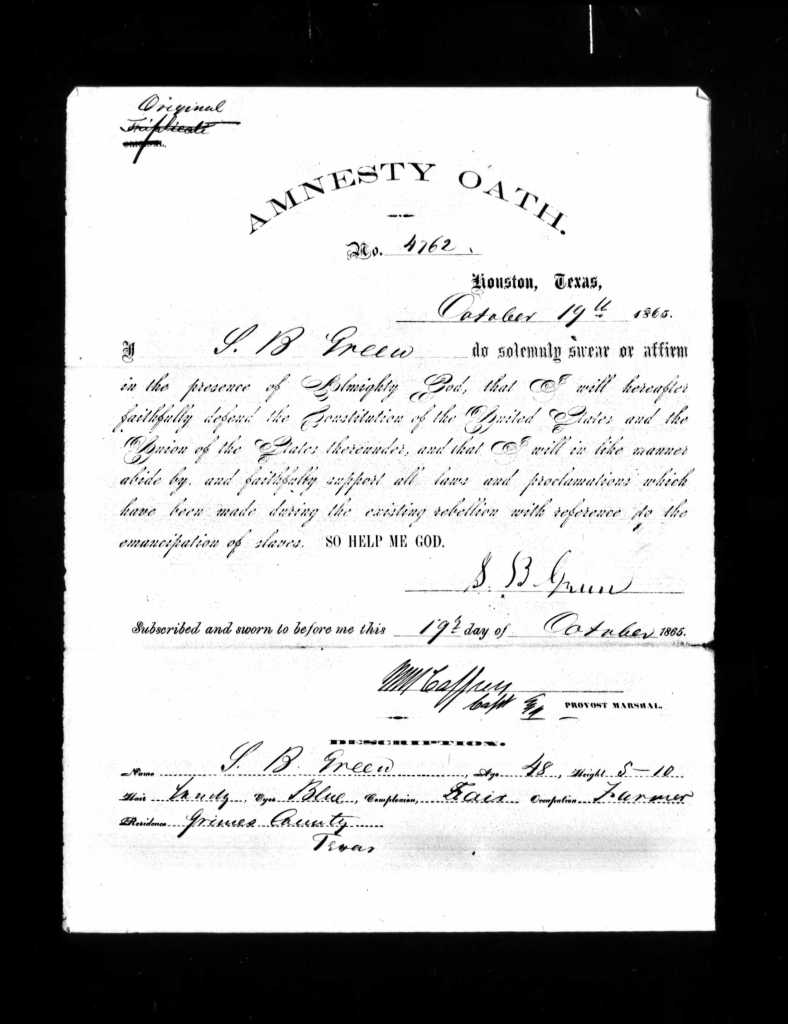
The older male and female in Benjamin’s household in Bibb County in 1830 are Benjamin and wife Margaret. The male aged 10-15 is his oldest son Benjamin S. Green, whose birth year as implied by the 1850, 1860, and 1880 federal censuses ranges from 1822 to 1827. In an application Benjamin Jr. filed in Houston, Texas, on 17 October 1865 for a presidential pardon for his Confederate service, he gave his age was 48.[8] This would give Benjamin S. Green’s son Benjamin S. Jr. a birth year of 1817; I suspect this is his correct year of birth. The 1850 federal census gives Benjamin Jr. an Alabama birthplace, but in 1860 and 1880, he stated on the federal census that he was born in South Carolina. I think it’s likely that Benjamin S. Green married Margaret in South Carolina, probably in Pendleton District and probably around 1815-6, and that he came to Alabama married and with a wife and first-born son.
The other children in Benjamin’s household in 1830 were his sons Thomas L. (born 1820), John W. (born 1826), and Lucinda Caroline (born 1824 or March 1826).
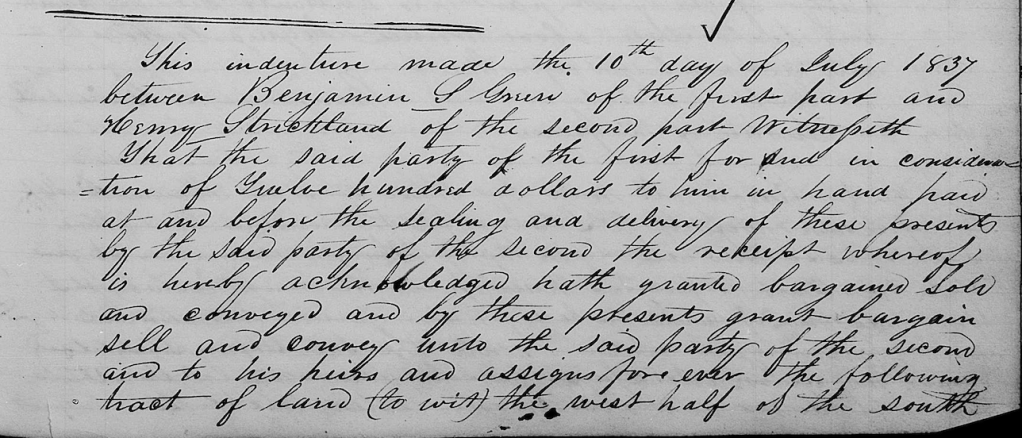
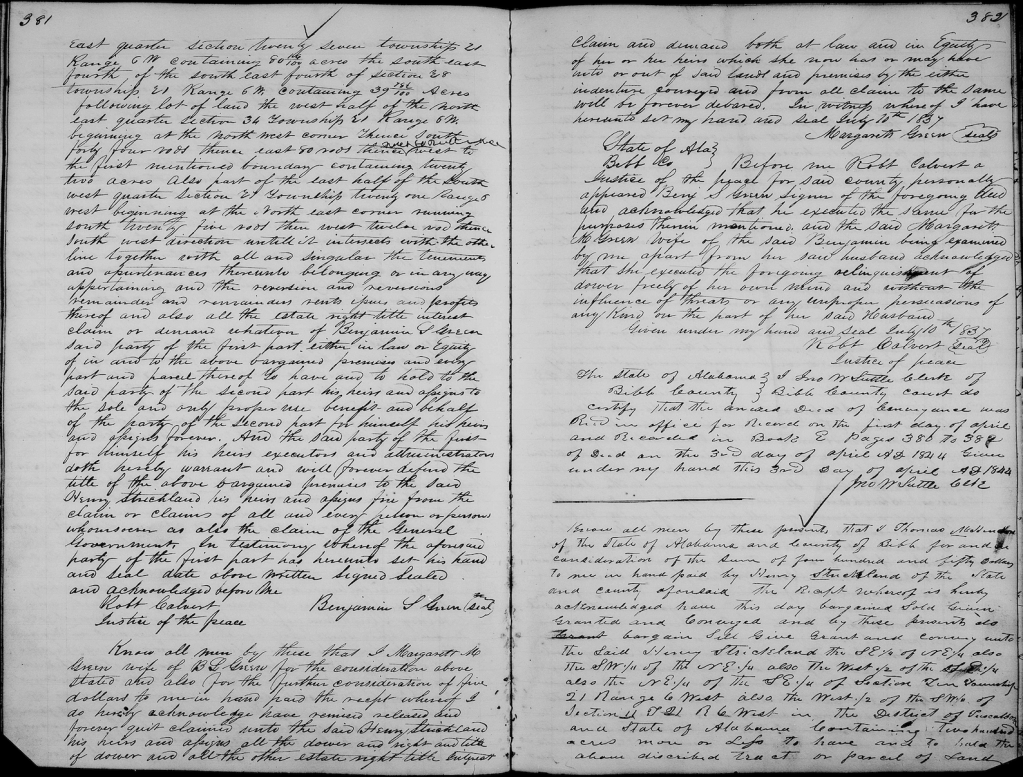
On 10 July 1837 in Bibb County, Benjamin and wife Margaret M. sold to Henry Strickland for $1,200 four tracts of land in Bibb County, 142 acres plus a piece of land with tenements and appurtenances whose acreage is not given and which appears to have been their homeplace (Bibb County, Alabama, Deed Bk. E, pp. 380-2). This appears to have been all of their landholdings in Bibb County: Benjamin and Margaret were selling out to move to Arkansas.
Benjamin signed as Benjamin S. Green with Robert Calvert, j.p., witnessing. On the same day, Benjamin’s wife Margaret M. Green quitclaimed her interest in the land to Strickland for $5, signing as Margaret Green with Robert Calvert witnessing her relinquishment of dower interest. The deed was recorded 4 April 1844. Note the appearance of Robert Calvert in this deed: I’ll discuss him in more detail in a moment.
Saline County, Arkansas, Records, 1837-1848
According to James Lee Green, Benjamin S. Green and his brother George Sidney Green moved together in 1838 from Bibb County, Alabama, to Saline County, Arkansas, their sister Jane Caroline having settled there with husband Thomas Keesee in 1837.[9] Goodspeed’s Biographical and Historical Memoirs of Pulaski, Jefferson, Lonoke, Faulkner, Grant, Saline, Perry, Garland and Hot Spring Counties, Arkansas reports that in the summer of 1837, 100 families settled in Saline township in Saline County in a colony led by Thomas Keese, Robert Calvert, Berryman McDaniel, George Cobb, John Green, Joab Pratt, Nathan Pumphrey, and Jacob Leach.[10] As I’ll note in a moment, this account seems to conflate two migrations from Bibb and surrounding Alabama counties to Saline County, Arkansas, one in 1837 and one in 1841.
The Thomas Keesse named above was Thomas Keesee Sr. (1778-1861), whose son Thomas Keesee Jr. (1804-1879) married Jane Caroline Green, daughter of John Green and Jane Kerr; the younger couple accompanied Thomas Jr.’s father to Arkansas in 1837. Robert Calvert (1802-1867) was a son-in-law of Thomas Keesee Sr. He married Thomas’s daughter Mary Keesee. Thomas Keesee Sr.’s daughter Agnes married Benjamin Clardy, whose daughter Mary Ann married George Sidney Green, son of John Green and Jane Kerr, in Saline County on 1 November 1839.
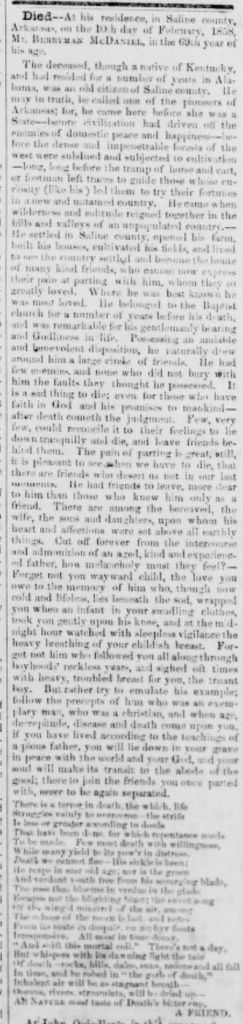
We’ve met Berryman McDaniel in a previous posting. As the posting I’ve just linked shows, Berryman McDaniel was appointed by Bibb County, Alabama, court on 6 February 1838 as one of several men charged with conducting the division of the real property of John Green.[11] On 15 June 1838 when the real estate division was reported to Bibb County court, Berryman McDaniel was among those signing the document.[12] So if Berryman McDaniel moved from Bibb County to Arkansas in 1837, he then returned to Bibb County for a period of time before settling permanently in Bibb County. Berryman McDaniel is buried in Philadelphia Baptist cemetery at Prattsville in Grant County, the county contiguous to Saline on the south, along with his daughter Louisa and her husband Nathan Pumphrey, who is mentioned in the list of settlers above who came from Bibb County, Alabama, to Saline County, Arkansas, in the summer of 1837.[13] The McDaniel and Pumphrey families had belonged to Mount Moriah Baptist church in Bibb County before settling in Arkansas.
I’m not sure who the John Green listed by Goodspeed’s history as part of the group moving in 1837 from Bibb to Saline County might be. John Green Sr., father of Benjamin S. and George Sidney Green, had died in Bibb County in 1837, so this cannot be that John Green. John’s son John Ewing Green definitely remained in Bibb County, dying there on 3 March 1843. I suspect Goodspeed has gotten names garbled: it was two sons of John Green — Benjamin S. and George Sidney — and one of John Green’s daughters, Jane Caroline with husband Thomas Keesee Jr. — who moved with the group of other settlers from Bibb County, Alabama, to Saline County, Arkansas.

According to historian Carolyn Earle Billingsley, who was a descendant of the Keesee family, Robert Calvert and his brother-in-law Milton Keesee actually came to Saline County in 1836, and they then appear on the 1837 Saline County tax list.[14] Billingsley states that the bulk of Robert Calvert and Milton Keesee’s kinship community then relocated from Alabama to Arkansas in 1837, with another wave following from Tuscaloosa and Bibb Counties in 1841.[15]
Milton Keesee (1799-1860), was a son of Thomas Keesee Sr. married Robert Calvert’s sister Mary Calvert, and, as I’ve noted above, Robert Calvert (1802-1867) married Milton Keesee’s sister Mary. Keesee. Billingsley writes,[16]
In Tuscaloosa County on 28 August 1823, Calvert, aged twenty-one, married Mary ‘Polly’ Keesee, age fifteen. In a classic example of sibling exchange, Robert’s sister Mary had married Calvert’s wife’s brother Milton Keesee earlier that same year.
Billingsley states,[17]
When [Robert] Calvert was a boy, his parents moved to the Tuscaloosa and Bibb Counties area in Alabama, probably drawn by the potential for cotton cultivation in the fertile lands in the Black Warrior River valley just as his future father-in-law, Thomas Keesee Sr., had been. Cotton prices were high after the War of 1812 and motivated many planters like the Calverts and Keesees into the newly opened territory of Alabama.
Billingsley sketches the likely motivation of the Calvert-Keesee kinship network, including Green family members, to move from Alabama to Arkansas in the late 1830s: land was cheap in the new state of Arkansas and had not yet been depleted by exhaustive agriculture; and the price of cotton had been declining, leading to a depression in Alabama that became nationwide by 1839.[18] She adds, “The very fact that the Keesee kinship group all migrated west at the same time speaks to the coordinated nature of the decision to move.”[19]
Billingsley writes,[20]
The Calverts and Keesees were part of a much larger migration to Arkansas and westward in general during this time period. In 1836, the year members of the kinship group began their relocation, public land sales in Arkansas and in the United States were at their highest point ever, with 1 million and 20 million acres, respectively, moving from the public to the private domain. Despite this land boom, in 1840, only one third of all taxpayers in Arkansas owned land – and the Calvert-Keesee kinship group were members of this minority.
By 1840, Robert Calvert and his father-in-law Thomas Keesee Sr. were the two largest landholders in Saline County.[21] Milton Keesee did not remain in Saline County, but moved on to Washington County, Texas, where he died 10 March 1860. As we’ll see in a moment, Benjamin S. Green would make the same move from Saline County, Arkansas, to Washington-Austin County, Texas, between 1848-1850.
In her history of Bibb County’s early days, historian Rhoda Ellison transcribes a letter that John Ewing Green wrote on 18 April 1840 from McMaths in Tuscaloosa County, Alabama, to his brother Benjamin in Benton, Saline County, Arkansas, speaking of the economic hardships in Alabama that were spurring relocation to central Arkansas and, soon, to Texas.[22] John E. Green tells his brother,
Dr. Brother … I am sorry I cannot write you a more flattering account of your bisness than I can doe at this time I believe Henry Strickland will not be able to pay you anything this Spring he has promised … but I find his onley chance is to borrow the money and that is a bad won for he is now in the Bank and I know of no one that has got money to lend. . . .
Times is harder here I expect than you have any Idea of. Common property fetches nothing when sold there was 500 acres of Houstons land sold the first Monday in March for $80, and that is about a fare average of such property at this time Our cotton netted us 5% cents. from 51/2 cents is what the people has generally got for cotton and we had to give it almost all for baling and roops. baling was 45 cents and roops 20 and there is so many that is not able to pay off these bank debts that it is almost impossible to make a note that will [not?] be discounted…. the only chance I see is for people to live on their own resources and not make any debt that they can help.
Ellison comments:
[O]ne result of the economic depression following in the wake of bank trouble, both state and national, was the westward migration of a number of Bibb families. Only one generation after settling in Alabama, many had not yet put down roots that would hold them, especially after they became insolvent, and so they moved west for a fresh start, often leaving their land to be fought over by creditors and tax collectors. Salina County, Arkansas (admitted as a state in 1836), was one of these emigrants’ favorite destinations. In the fall of 1841, a wagon train organized by Reverend Joab Pratt from among the financially stricken families in his several Baptist congregations headed in that direction. They made their way to the middle of Louisiana and then pushed north, passing a point in Union Parish just below the Arkansas line still known as Alabama Landing, on their way north to Salina [sic] County. Today, markers at the cemetery of the Philadelphia Baptist Church, which they founded when they settled there, are said to bear the Bibb County names of Mayfield, Pumphrey, McDaniel, Pratt and Cobb, and the community nearby is called Prattsville.
According to Robert Crowson, Joab Pratt was a Baptist minister ordained at Enon Baptist church in Bibb County, whose ministerial circuit included Mount Moriah and Haysop churches in Bibb County and Gilgal in Tuscaloosa County.[23]
Benjamin S. Green begins appearing in Saline County records by 29 August 1839, when he was a juror in Saline County’s circuit court in the trial of Job Harrall for the murder of Henry Boykin.[24] Benjamin was a juror again at the September 1839 term of the court in the trial of state of Arkansas v. L. V. Willingham, Benjamin S. Green was a juror.[25]
Benjamin began acquiring land in Saline County on 11 October 1839, when he had certificates from the federal land office in Little Rock for two tracts in Saline County.[26] One was for 80 acres in Saline County, the southeast ¼ southwest ¼ of section 13, township 1 south, range 15 west The other was for 155 acres in Saline County, the northeast ¼ of section 23, township 1 south, range 15 west. The certificates for both tracts identify Benjamin as a resident of Saline County. These tracts were north of the old stagecoach road heading from Little Rock in the direction of Hot Springs, just west of Salem and southeast of Congo, north of the county seat, Benton.[27] Thomas Keesee bought federal land near them.
On 2 January 1840 in Saline County, Benjamin S. Green verified that William Wharton of Saline County was an ordained minister of the Cumberland Presbyterian church.[28] Carolyn Earle Billingsley points out that Thomas Keesee Sr., who came to Saline County as a ruling elder of the Cumberland Presbyterian church, founded, along with his relatives, a new Cumberland Presbyterian church in Saline County.[29] She states, “Many of the kinship group attended church together at Saline Congregation, a Cumberland Presbyterian church where William Wharton was the minister. In fact, the church was on Elder Robert Calvert’s land, and presbytery meetings were occasionally held at his house.”[30]
Billingsley cites Goodspeed’s Biographical and Historical Memoirs of Pulaski, Jefferson, Lonoke, Faulkner, Grant, Saline, Perry, Garland and Hot Spring Counties, Arkansas, which states that Saline Congregation was organized in 1838 with William Harland as its first pastor and with ruling elders Robert Calvert, Thomas Keesee Jr., and Gideon Keesee.[31] Billingsley thinks that William Harland was actually William Wharton, and Goodspeed has garbled his name — and I agree.
Billingsley notes that William Wharton (1813-1862) came to Saline County from Bibb County, Alabama, along with the Keesees and Calverts and then ended up with Robert Calvert in Robertson County, Texas, with Wharton’s will stating that his lifelong friend Robert Calvert was his executor.[32] Note the Cumberland Presbyterian link to Benjamin S. Green: as we’ve seen previously, James Thompson, husband of Benjamin’s older sister Elizabeth B. Green, helped found a Cumberland Presbyterian church, White Spring, in Ouachita County, Arkansas, and may have been an elder of that church.
On 7 January 1840, Saline County court appointed Benjamin Green overseer of the second division of the road from Collegeville to Hot Spring County.[33]
Benjamin is on the 1840 federal census in Saline County with a household comprised of one male 10-15 (John W.), one male 15-20 (Thomas), one male 20-30 (Benjamin S. Jr.), and one male 40-50 (Benjamin S. Sr.).[34] Also in the household is one female 10-15 (Lucinda Caroline).
The absence of a wife for Benjamin on this census long led me to think that his wife Margaret M. died between 1830 and 1840, and that he married a second wife in Saline County, whose name appears as Lucinda on the 1850 federal census (see infra), and who was born in Arkansas. I have now concluded that because M.M. Green is buried in the Green family cemetery in Waller County, Texas, along with Benjamin and their children, Benjamin had only that one wife, Margaret, and she had not died by 1840, but went to Texas with her family and died there.
The 1840 federal census shows Benjamin S. Green holding no enslaved persons, though in 1830 he is listed on the census with two enslaved females. As we’ll see in a moment, by 1850, he had acquired five enslaved persons, whom he either bought after moving to Texas or brought from Arkansas to Texas with him.
Benjamin is in Saline township on the 1840 federal census. This township is in the middle of Saline County and contains the county seat of Benton.[35]
On 24 August 1840, Benjamin S. Green was impaneled as a grand juror in Saline County’s circuit court, along with his brother George’s father-in-law Benjamin Clardy and Robert Calvert’s brother William.[36] On 9 November 1840, Saline County court records show B.S. Green over-taxed for the year 1840 with his local taxes being deducted by 84¢ and his county taxes by $1.68.[37]
26 August 1841, Benjamin was a juror in the trial of John K. Hudson v. Charles Caldwell.[38] At Saline County court on 3 January 1842, Gideon Keesee was appointed overseer of the portion of the Collegeville road to Hot Spring County running past Benjamin Green’s farm by the way of James Barnes to the north fork of the Saline River.[39] Gideon was a son of Thomas Keesee Sr., and a brother of Thomas Jr. who married Benjamin’s sister Jane Caroline Green.
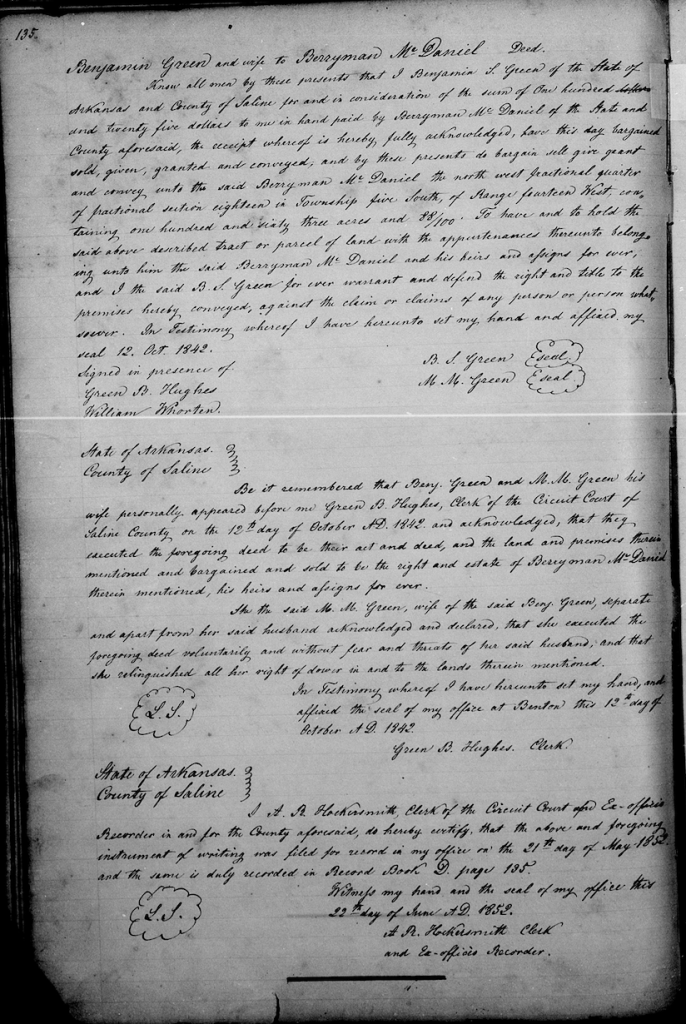
On 12 October 1842, for $100, Benjamin S. Green and wife M.M. Green of Saline County sold to Berryman McDaniel of the same 163.88 acres in section 18, township 5 south, range 14 west in Saline County.[40] Both Benjamin and M.M. signed with Green B. Hughes and William Wharton witnessing. On the same day, Benjamin and M.M. affirmed the deed and M.M. relinquished dower. The deed was recorded 21 May 1852. Berryman McDaniel and William Wharton are both discussed above.
On 3 January 1844, Saline County court appointed Thomas Carroll overseer of a section of a road running from Benjamin Green’s farm to the north fork of the Saline River.[41]
On 10 July 1848, Benjamin purchased two more pieces of land from the federal land office in Little Rock, with the certificates for the land stating that he was a resident of Saline County.[42] The first tract was 231.54 acres in Saline County, the southeast ¼ east ½ southwest ¼ of section 14, township 1 south, range 15 west. The second was 77.12 acres in Saline County, the southwest ¼ northeast ¼ of the same coordinates.
Washington, Austin, and Grimes County, Texas, Records, 1850-1863
At some point between that date and 22 November 1850, when he and his family appear on the federal census in Washington County, Texas, Benjamin moved his family to Texas. I find no records in Saline County showing him disposing of his landholdings there as he went to Texas. The 1850 federal census shows Benjamin in Washington County, Texas, as a farmer aged 50 with $3,000 real value, born in North Carolina.[43] His wife Lucinda is 42, born in Arkansas. In their household are children Lucinda, 18, S.B., 28 (a male), Thomas, 26, and George, 24, all born in Arkansas. This census listing clearly has garbled information. Benjamin was not born in 1800, and was not born in North Carolina. His wife’s name appears as Margaret M. or M.M. in the few other records we have of her. His last child is John W. in all other records, not George. And his children were born in Alabama, or, in the case of his son Benjamin Jr., probably in South Carolina — not in Arkansas.
B.S. Green is also listed on the 1850 slave schedule in Washington County, Texas, holding five enslaved persons.[44]
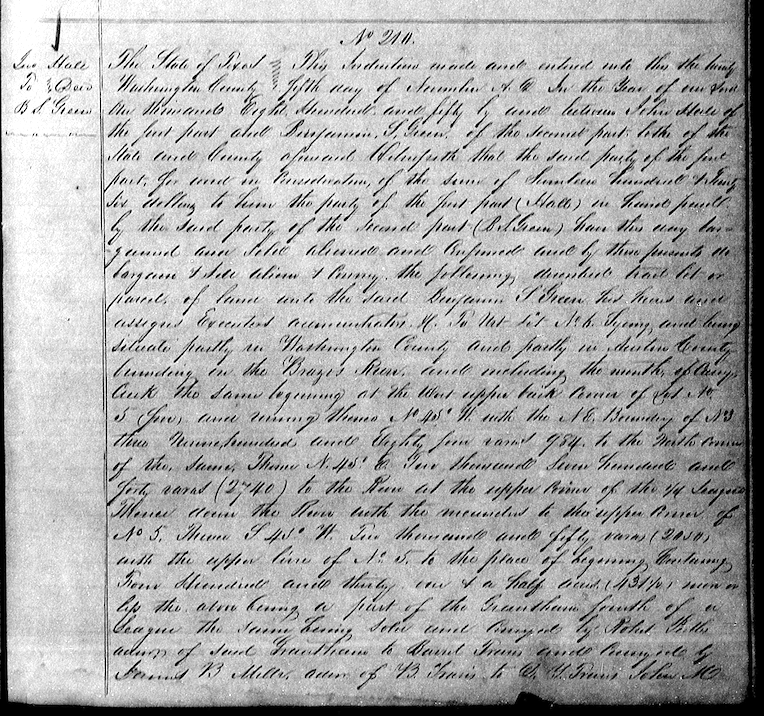

On 25 November 1850, John Hall sold Benjamin S. Green for $1,776 a tract of land, on the Brazos River, being lot 6 in Washington County, Texas.[45] The witnesses to this deed were Hugh Calvert and Benjamin’s son Thomas L. Green. Though the deed was made in Washington County, it was filed in Austin County, which borders Washington on the south. The deed states that John Hall and Benjamin S. Green both lived in Washington County, but the land Hall was selling Green on the Brazos was partly in Washington County and partly in Austin County. The land was 431½ acres and was part of the Grantham fourth of a league sold by Robert Little or Pirtle (the name is hard to read), administrator of Grantham, to Barrett Travis and conveyed by Samuel B. Miller, administrator of Travis, to W.Y. Travis, John Shipman, and J.H. (H.—?), who then sold it to John Hall.
Washington and Austin Counties are in southeast Texas not far west of Houston. Grimes County, where Benjamin died in 1860, is contiguous to Washington on the east. Waller, where his family cemetery is located and where his children lived, was formed from the southern part of Grimes in 1873 and borders both Washington and Austin on the east.
On 18 December 1850 at Bellville in Austin County, Benjamin’s son Thomas L. Green proved the deed and it was recorded 23 December. The Hugh Calvert who witnessed this deed along with Thomas L. Green was Hugh Hudson Calvert (1805-1883), son of Jesse and Jane Wardlaw Calvert, and is said to have been born in Abbeville County, South Carolina.[46] I do not know precisely how Hugh Calvert was related to Robert Calvert, but have no doubt the two were related and that this explains how Hugh Calvert came to be a witness to a deed of land to Benjamin S. Green when Benjamin arrived in Texas.
Carolyn Earle Billingsley notes that in 1850, Robert Calvert also left Saline County, Arkansas, to settle on the Brazos River, following his brother-in-law Milton Keesee:[47]
Shortly after the 1850 census was taken, Robert Calvert, along with his extended family and slaves, relocated to the rich Brazos River bottoms of Robertson County, Texas, following his brother-in-law Milton Keesee, who had once again blazed the trail into new territory for the family after remaining in Union County, Arkansas, for only a few years. Calvert’s new plantation was also just up the Brazos River from his brother-in-law William Keesee’s residence in Washington County, Texas.
As she notes, William Keesee had gone to Washington County in 1837, and may have influenced other family members to move to that part of Texas and settle on the rich land along the Brazos River. She also notes that Calvert’s minister William Wharton accompanied Robert Calvert in his move to Texas.[48]
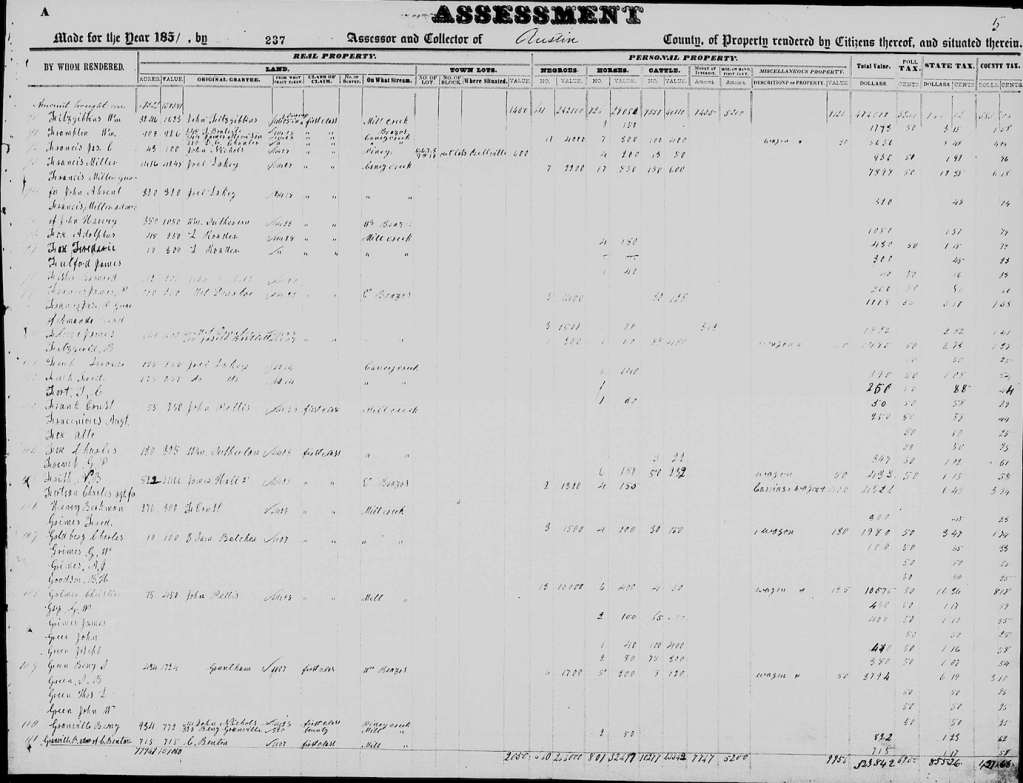

Benjamin S. Green appears on the tax list in Austin County, Texas, in 1851 taxed for 434 acres of first-class land from a Grantham grant on the west side of the Brazos valued at $1,724, 6 enslaved persons valued at $1,700, 5 horses, 8 cows and other property, all valued at $3,794.[49] His sons S.B., Thomas L., and John W. appear on the tax list beside him with no property, an indicator that they were farming along with their father.
In 1852, Benjamin is again on the tax list in Austin County, taxed for 431 acres from a Grantham grant on the west of the Brazos valued at $1,724, 8 enslaved persons valued at $3,400, 5 horses, and 26 cows, with a total value of $5,684.[50] In 1853, Benjamin is taxed in Austin County for 430 acres valued at $1,720 from an M.F. Grantham grant west side of the Brazos, 8 enslaved persons valued at $2,400, 5 horses, 34 cows, all valued at $4,570.[51] In 1852 and 1853, Benjamin’s three sons are again listed next to him on the tax list with no property of their own.
In 1854, Benjamin is taxed in Austin County for the same 430 acres valued at $1720, 7 enslaved persons valued at $2,000, 7 horses, 36 cows, all valued at $4,450, with his sons listed beside him.[52] In 1856, Benjamin continues on the Austin County tax list taxed for his 430 acres valued at $1,720, with 7 enslaved persons valued at $2,500, 9 horses, and 46 cows, with a total value of $5,290.[53] His three sons are once again listed beside him.
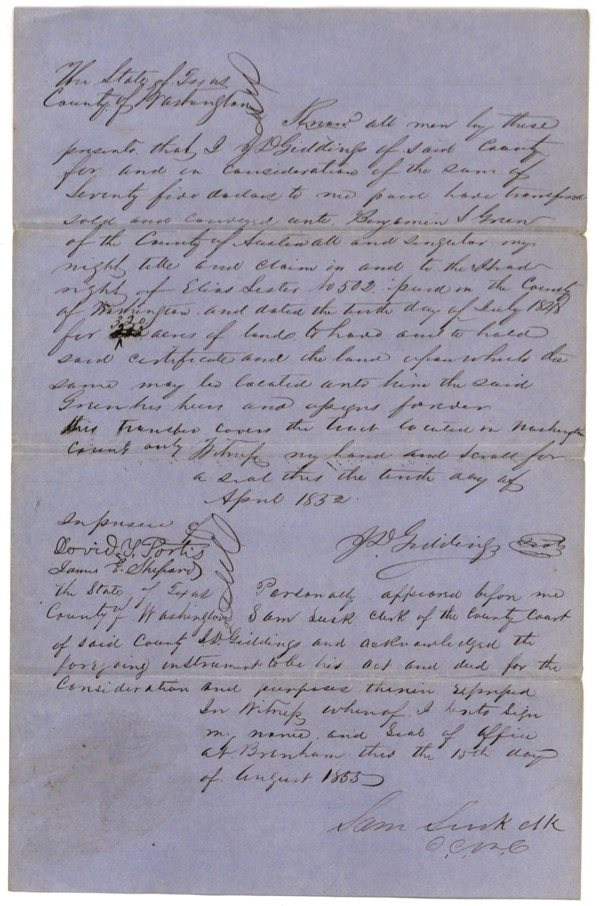
On 20 August 1855, Elias Lester assigned to Benjamin S. Green 212 acres in Washington County, Texas.[54] This land was on Gibbs Creek in southeastern Washington County, and was third-class land.[55] Lester had a headright grant for the land on 30 December 1839. A survey for the land on 18 August 1852 says that it was eight miles east of Brenham and about three miles west of the Brazos. Lester assigned the land 12 July 1848 to J.D. Giddings. On 10 April 1852 Giddings assigned the land for $75 to Benjamin S. Green of Austin County.
The last tax listing I find for Benjamin is the 1859 Grimes County tax list, on which he appears as the “agent” for L.C. Green, his daughter Lucinda Caroline.[56] Benjamin’s sons are again listed along with him, though the tax list gets Thomas’s initials wrong. The only family member listed holding taxable property is Lucinda, who is shown with five enslaved persons valued at $2,200, 2 horses, and 64 cattle, all valued at $3,140. No land is listed for Lucinda.
I take this tax listing to mean that by this point, the family had relocated or were relocating to Grimes (later Waller) County, and for some reason, a decision had been made to place the family’s property in Lucinda’s name. As we’ll see in a moment, by January 1863, Lucinda bought land in Grimes County on which she and her brothers lived, all unmarried, to the end of their lives and on which they are buried with their father, mother, and uncle Samuel K. Green in what’s now Waller County.
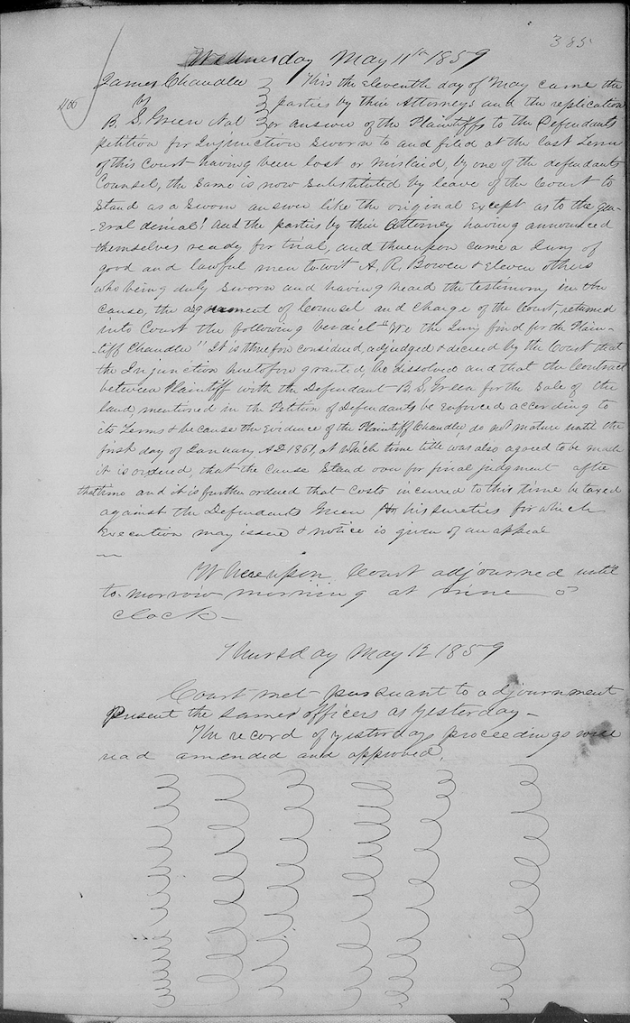
On 11 May 1859, Walker County Texas court minutes state that in the case of James Chandler v. B.S. Green, regarding a contract B.S. Green had made with Chandler to sell land, the jury had found for the plaintiff.[57] The information about the case in court minutes is sketchy. I take it to mean that Benjamin had contracted to sell Chandler his land, probably in Austin and Washington Counties, and had then reneged on the contract or not given Chandler title for the land. After the jury found in Chandler’s favor, the court issued an order for a final judgment to be made.

Benjamin then died in Grimes County in April 1860, as noted at the head of this posting. On 25 March 1861 in Grimes County, his son Thomas L. Green appealed for administration of his father’s estate and this was granted, with Thomas giving bond with J.J. Jackson and N.W. Bush in the amount of $3,000.[58] Thomas filed a statement that there was no property to inventory and the court ordered that no formal inventory need be made, pending the outcome of a lawsuit in Walker County. The court ruled that Thomas did not need to make any further showing in the estate until the lawsuit in Walker County had been resolved. I find no further information about either Benjamin’s estate or the Walker County lawsuit, which may have become null and void with Benjamin’s death in April 1860.
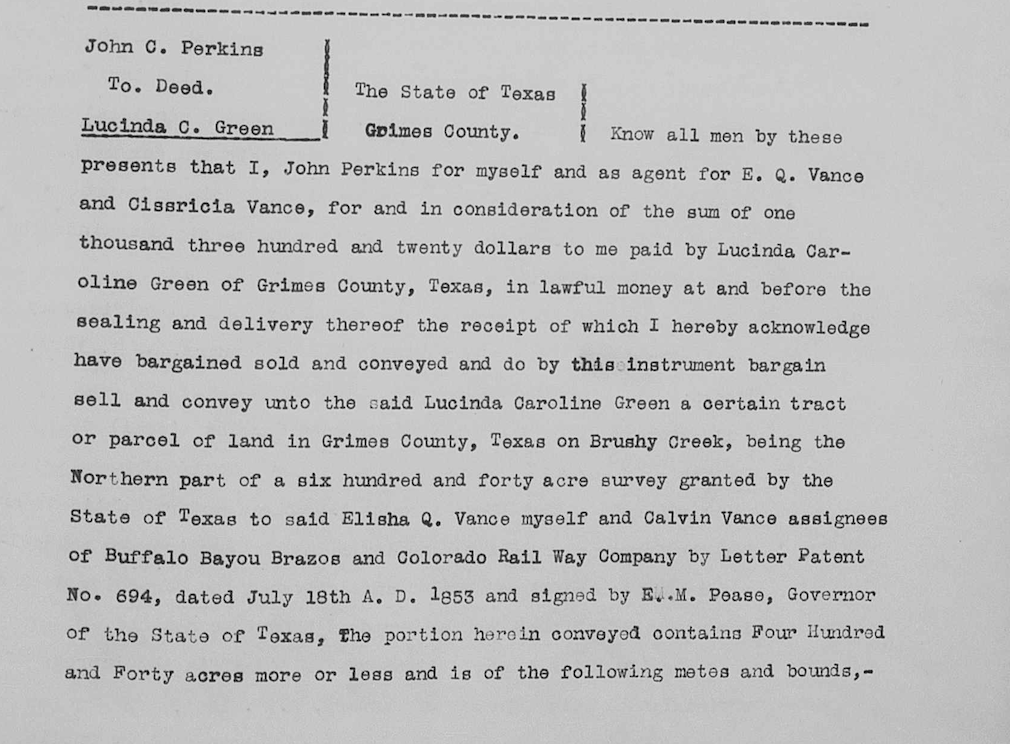
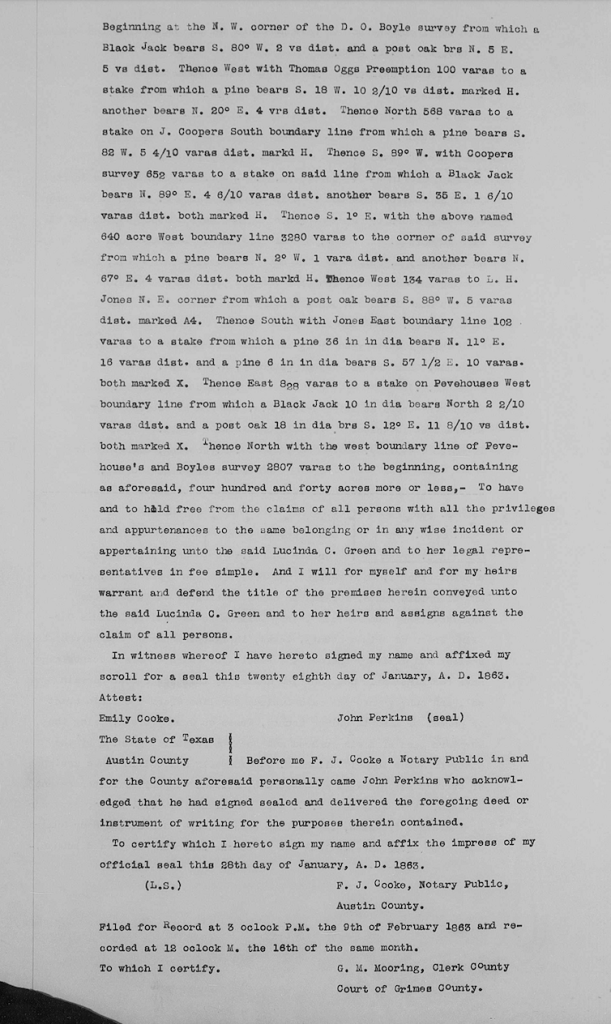
On 28 January 1863, Lucinda Caroline Green bought 440 acres on Brushy Creek in Grimes County from John C. Perkins, acting for himself and as an agent for E.Q. Vance and Cissricia Vance.[59] She paid $1,320 for the land. It was out of a survey granted by Texas to Perkins, Elisha Q. Vance, and Calvin Vance. Emily Cooke witnessed. F.J. Cooke acknowledged the deed on the day it was made and it was filed for record on 9 February. I suspect that the Greens were living on this tract at the time of Benjamin’s death, but had not yet purchased the land, and I would think that the money Lucinda used to buy the land likely came from her father’s estate. Lucinda was a single woman of 37 or 39 at the time she bought the land, an unusual thing for a single woman to do in this time and place. Because tax documents show her and her brothers living on and farming the land up to the end of their lives, it’s clear to me that she purchased the land on behalf of herself and her brothers, though why a decision had been made, evidently prior to Benjamin S. Green’s death, to vest family land in Lucinda’s name is a mystery to me.
Benjamin, his children, and his wife M.M. are all buried in a family cemetery at Hegar about halfway between Magnolia and Hempstead, Texas, in Waller County.[60] This previous posting provides information about the location of the cemetery, in which Benjamin’s brother Samuel is also buried.
The cemetery has a single marker for Benjamin, wife M.M., and his children, with only their initials inscribed on the marker — B.S., M.M., S.B., T.L., J.W., and L.C. This marker, in obelisk style, is identical to the one for Samuel Kerr Green, whose marker also has only the name S.K. Green inscribed on it.
The 1860 federal census appears to indicate that Benjamin’s wife Margaret M. died between 1850 and 1860.[61] The census shows a household headed by S.P. Green (male), aged 35, born in South Carolina, and with other household members J.W., 30, T.L., 33, both males, and Lucinda C., 26, all born in Alabama. Lucinda has $4,000 personal property. J.W. is listed with $1520 real property and $25 personal property. These are obviously Benjamin S. Green’s children, though Benjamin Jr.’s initials are incorrect and I suspect that he was several years older. This census listing confirms that the family’s financial holdings had been placed in Lucinda’s hands by this date.
The bulk of the wealth from Benjamin S. Green’s estate that was in Lucinda’s hands in 1860 was vested in enslaved persons. The 1860 slave schedule for Grimes County shows Lucinda holding five enslaved people — males aged 24, 12, 10, and 8, and a female aged 7.[62]
As I note in a previous posting, I think that Benjamin S. Green, as the second son of John Green and Jane Kerr, was likely named for his grandfather Benjamin Green. John and Jane’s first son Samuel Kerr had been named for his grandfather Samuel Kerr. It was common, though not an absolute pattern, in many Southern families at this period to name the first two sons for the couple’s fathers, and the first two daughters for the couple’s mothers. John and Jane named their first two daughters Elizabeth B. and Mary Calhoun Green. We know for certain that Jane’s mother was Mary Calhoun Kerr, and I think we may well suppose that Elizabeth was the name of John Green’s mother — and that their first two sons and first two daughters were named for grandparents.
In my next posting, I’ll share what I know of Benjamin S. Green’s children Benjamin S. Jr., Thomas L., John W., and Lucinda Caroline Green.
[1] 1860 federal mortality schedule, Grimes County, Texas, p. 5, #31.
[2] Pendleton District, South Carolina, Deed Bk. M, p. 474.
[3] See Marilyn Davis Barefield, Old Tuskaloosa Land Office Records and Military Warrants 1821-1855 (Easley, South Carolina; Southern Historical Press, 1984), p. 5; Rhoda Ellison, Bibb County, Alabama, The First Hundred Years 1818-1918 (Tuscaloosa: University of Alabama Press, 1984), p. 32; and James Lee Green, “The Greens of Bibb County, Alabama” (typescript) (Columbia, South Carolina, 1992), p. 2.
[4] Alabama Patent Bk. 65, p. 273, #758.
[5] Bibb County, Alabama, Probate Minutes Bk. A, pp. 195-7.
[6] Alabama Patent Bk. 67, p. 461, #2050.
[7] 1830 federal census, Bibb County, Alabama, p. 150.
[8] NARA, US, Case Files of Applications from Former Confederates for Presidential Pardons (“Amnesty Papers”), 1865-1867, RG 94, available digitally at Fold3.
[9] James Lee Green, “The Greens of Bibb County, Alabama,” typescript (Columbia, South Carolina, 1992), pp. 3-5.
[10] Goodspeed’s Biographical and Historical Memoirs of Pulaski, Jefferson, Lonoke, Faulkner, Grant, Saline, Perry, Garland and Hot Spring Counties, Arkansas: Comprising a Condensed History of the State, etc. (Chicago: Goodspeed, 1889), p. 234.
[11] Bibb County, Alabama, Probate Minutes Bk. A, pp. 195-7.
[12] Bibb County, Alabama, Administrators Records Bk. E, pp. 28-9.
[13] Berryman McDaniel’s obituary is in Little Rock’s True-Democrat, 20 April 1858: “Died,” True-Democrat [Little Rock, Arkansas] (20 April 1858), p. 3, col. 6. The obituary states that he had died at his residence in Saline County on 10 April 1858, aged 69. He was born in Kentucky, lived in Alabama a number of years, and was “an old citizen of Saline county.”
[14] Carolyn Earle Billingsley, Communities of Kinship: Antebellum Families and the Settlement of the Cotton Frontier (Athens: University of Georgia Press, 2004), p. 111. See also p. 97. On Carolyn Earle Billingsley, see William D. Lindsey, “Carolyn Earle Billingsley (1948–2018),” Encyclopedia of Arkansas (online).
[15] Billingsley, Communities of Kinship, p. 111.
[16] Ibid., p. 107. Biographical information about Robert Calvert is also found in John Henry Brown, The Indian Wars and Pioneers of Texas (Austin: L.E. Daniell, 1880), pp. 638-9. Engraved portrait of Robert Calvert following p. 638. See also Marlo B. Krueger, “Mary Calvert and Her Three Husbands, Including Dr. Peter H. Smith,” The Saline 30,1 (spring 2015), pp. 40-8.
[17] Billingsley, Communities of Kinship, pp. 106-7.
[18] Ibid., p. 109.
[19] Ibid.
[20] Ibid., p. 110.
[21] Krueger, “Mary Calvert and Her Three Husbands, Including Dr. Peter H. Smith,” p. 40.
[22] Rhoda Ellison, Bibb County, Alabama: The First Hundred Years, 1818-1918 (Tuscaloosa: University of Alabama Press, 1984), p. 95. See also Green, “The Greens of Bibb County, Alabama,” p. 7.
[23] Robert Crowson, “From Alabama to Arkansas: An 1841 Journal,” Bibb Eagle (February 1978).
[24] Saline County, Arkansas, Circuit Court Common Law Bk. A, p. 151.
[25] See “Saline County Common Law Court (Jurors) 1837 – 1842,” abstracting information from Common Law Book A, at USGenweb site for Saline County.
[26] Arkansas Patent Bk. 60, p. 263, certificate #3456, and p. 294, certificate #3494.
[27] Gregory A. Boyd, Family Maps of Saline County, Arkansas (Norman, Oklahoma: Arphax, 2005), pp. 168-173.
[28] I think this record is in a Saline County ministers’ docket, but do not have a more precise citation and am unsure where I found the record. I do not find it in minutes of Saline County’s county or circuit court.
[29] Billingsley, Communities of Kinship, p. 7.
[30] Ibid., p. 63.
[31] Ibid., p. 82, citing Goodspeed’s Biographical and Historical Memoirs of Pulaski, Jefferson, Lonoke, Faulkner, Grant, Saline, Perry, Garland and Hot Spring Counties, Arkansas, p. 240.
[32] Billingsley, Communities of Kinship, p. 82. Kristy D. Ford transcribes Wharton’s will and offers valuable biographical information about him in “Information about William Henry Wharton,” at her A Journey into the Past site.
[33] Saline County, Arkansas, County Court Minutes Bk. 2, p. 94.
[34] 1840 federal census, Saline County, Arkansas, p. 211.
[35] See “Saline County townships map, 1930” at the Arkansas Archives’ Digital Heritage collection, reproducing an image from the 1930 Bureau of the Census’ Arkansas Minor Civil Divisions.
[36] Saline County, Arkansas, Circuit Court Common Law Bk. A, p. 212.
[37] Saline County, Arkansas, County Court Minutes Bk. 2, p. 123.
[38] Saline County Circuit Court Common Law Bk. A, p. 285.
[39] Saline County, Arkansas, County Court Minutes Bk. 2, p. 152.
[40] Saline County, Arkansas, Deed Bk. D, p. 135.
[41] Saline County, Arkansas, County Court Minutes Bk. 3, p. 193.
[42] Arkansas Patent Bk. 90, pp. 335-6, certificates #3449 and #3450.
[43] 1850 federal census, Washington County, Texas, p. 308 (dwelling/family 378, 22 November).
[44] 1850 federal slave schedule, Washington County, Texas, p. 641.
[45] Austin County, Texas, Deed Bk. D-E, pp. 250-1. Matthew F. Grantham received a quarter league of land in Austin County on 7 December 1832, patent #2038, vol. 6, p. 59.
[46] See Margaret Watson, Greenwood County Sketches: Old Roads and Early Families (Greenwood, South Carolina: Attic, 1970), pp. 182-3.
[47] Billingsley, Communities of Kinship, p. 120.
[48] Ibid., p. 121.
[49] Austin County, Texas, 1851 tax list, p. 237, #109.
[50] Ibid., 1852, p. 261, #139.
[51] Ibid., 1853, p. 286.
[52] Ibid., 1854, p. 313.
[53] Ibid., 1856, p. 374.
[54] Texas General Land Office, file 36, abstract 153, patent 1192, patent vol. 10, certificate 502, online at the website of Texas GLO.
[55] Gregory A. Boyd, Texas Land Survey Maps for Washington County (Norman, Oklahoma: Arphax, 2009), pp. 27, 102.
[56] Grimes County, Texas, 1859 tax list, p. 13.
[57] Walker County, Texas, Civil Court Minutes Bk. C, p. 385.
[58] Grimes County, Texas, Probate Minutes Bk. 3A, pp. 736-7.
[59] Grimes County, Texas, Deed Bk. D2, pp. 411-412.
[60] See Find a Grave memorial page of Benjamin S. Green, Hegar, Waller County, Texas, created by A. Nobody, maintained by Annette Stone-Kerr, with a tombstone photo by A. Nobody.
[61] 1860 federal census, Grimes County, Texas, western division, Plantersville post office, p. 257B (dwelling 506/family 497, 29 July).
[62] 1860 federal slave schedule, Grimes County, Texas, p. 52.
 BEGATS AND BEQUEATHALS
2 thoughts on “Children of John Green (1768-1837) and Jane Kerr (1768-1855): Benjamin S. Green”