Initial Settling in Tuscaloosa County, Alabama
As the last posting states, at the time John and Jane made their move to Alabama, Jane’s first cousins Andrew and Joseph, sons of Andrew Pickens and Rebecca Calhoun — were also making preparations with their nephew Ezekiel Pickens to move from Pendleton District to Alabama. The previous posting cites a 23 August 1819 letter that Andrew Pickens sent his cousin Captain William Noble of Abbeville, South Carolina, which states that Andrew was returning to South Carolina from “the Alabama” and was writing his cousin from Monticello, Jasper County, Georgia; the letter states that Andrew had left Joseph in Alabama, and Joseph was heading to Tuscaloosa.[1]
The previous posting also cites historian Carolyn Earle Billingsley, whose Keesee ancestors were intermarried with this Green family, and who notes that after the native peoples living in what became Alabama were forced to cede their lands between 1814-1816, settlers of European descent seeking fertile new land on which to grow cotton as the cotton market was booming began pouring into Alabama, with Tuscaloosa County a prime draw for settlers, since the city of Tuscaloosa, which became the state’s capital in 1826, sits at the head of the Black Warrior River, a major transportation route connecting to the Alabama-Tombigbee Rivers and the cotton market of Mobile.[2]

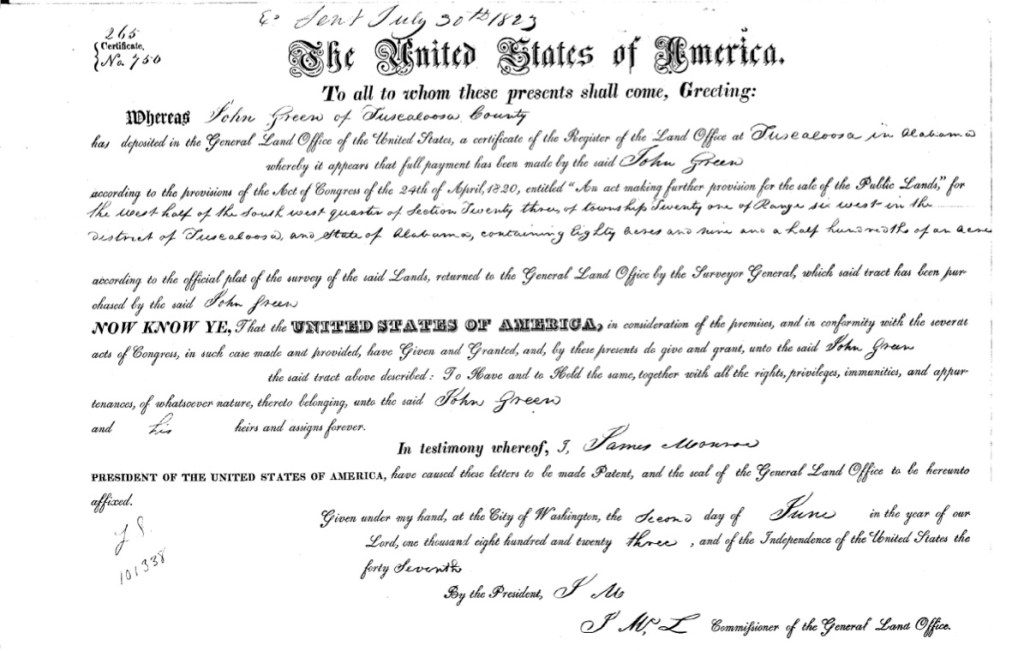
On 26 September and 3 December 1821 at the federal land office in Tuscaloosa, John Green entered a number of tracts of land in Bibb County, Alabama, in township 21 section 23 (also in sections 22 and 27).[3] Each tract was a slight bit more than 80 acres. On 26 September 1821, John’s sons Benjamin and Joscelin B. had also entered federal tracts in Bibb County, Benjamin one and Joscelin two. Certificates for the land were issued to John and his sons on 2 June 1823, with each stating that John, Benjamin, and Joscelin B. Green were living in Tuscaloosa County at the time the certificates were issued.[4] The two tracts for which John Green had certificates on 2 June 1823 were the west ½ southwest ¼ of township 21 south and the east ½ southwest ¼ of the same township, both in section 23, range 6 west. Benjamin’s tract was in the same township and section, as was one of Joscelin’s. Another of Joscelin’s was in township 21 south but in section 22. According to Rhoda Ellison in her history of Bibb County’s formative years, the entries John Green and sons Benjamin and Joscelin made in Bibb County on 26 September 1821 were the first claims for federal land in Bibb County made at the Tuscaloosa federal land office. [5]

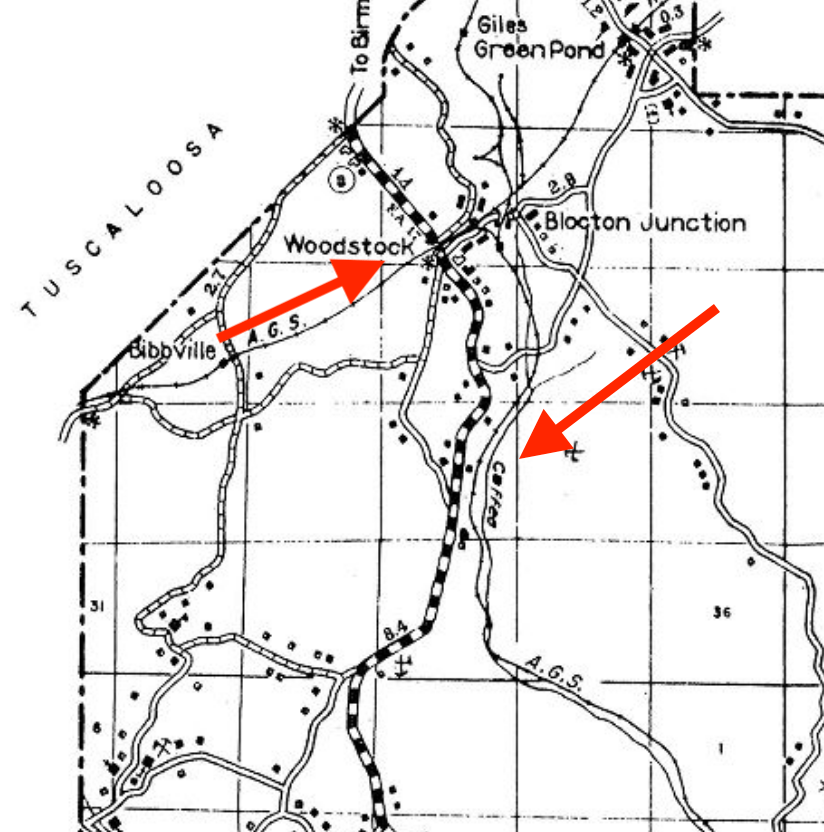
The federal land to which John Green got title in June 1823 was just southeast of the current community of Woodstock in Bibb County, with Caffee Creek running through it.[6] Following John Green’s death in Bibb County on 18 March 1837, his son John Ewing Green petitioned in February 1838 for a partition of John’s real property, listing six tracts of land, each somewhat more than 80 acres.[7] The two tracts for which John had certificates in June 1823 are listed, as well as the tract bought by Benjamin and one of Joscelin’s tracts — so his sons evidently transferred some of their land to him after purchasing it at the federal land office, or he bought it from Benjamin and Joscelin.
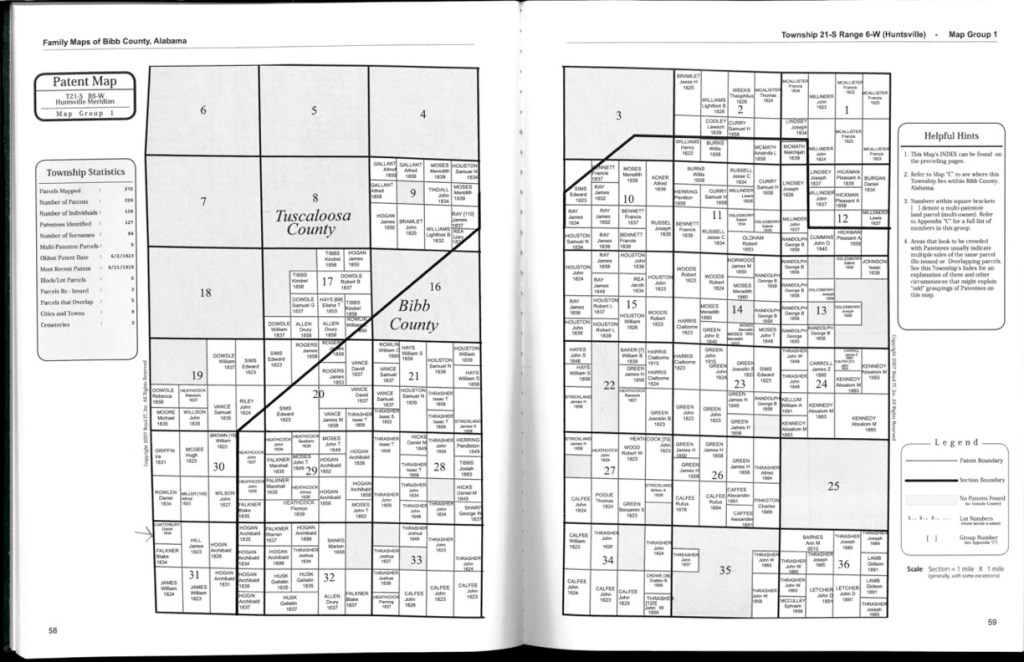
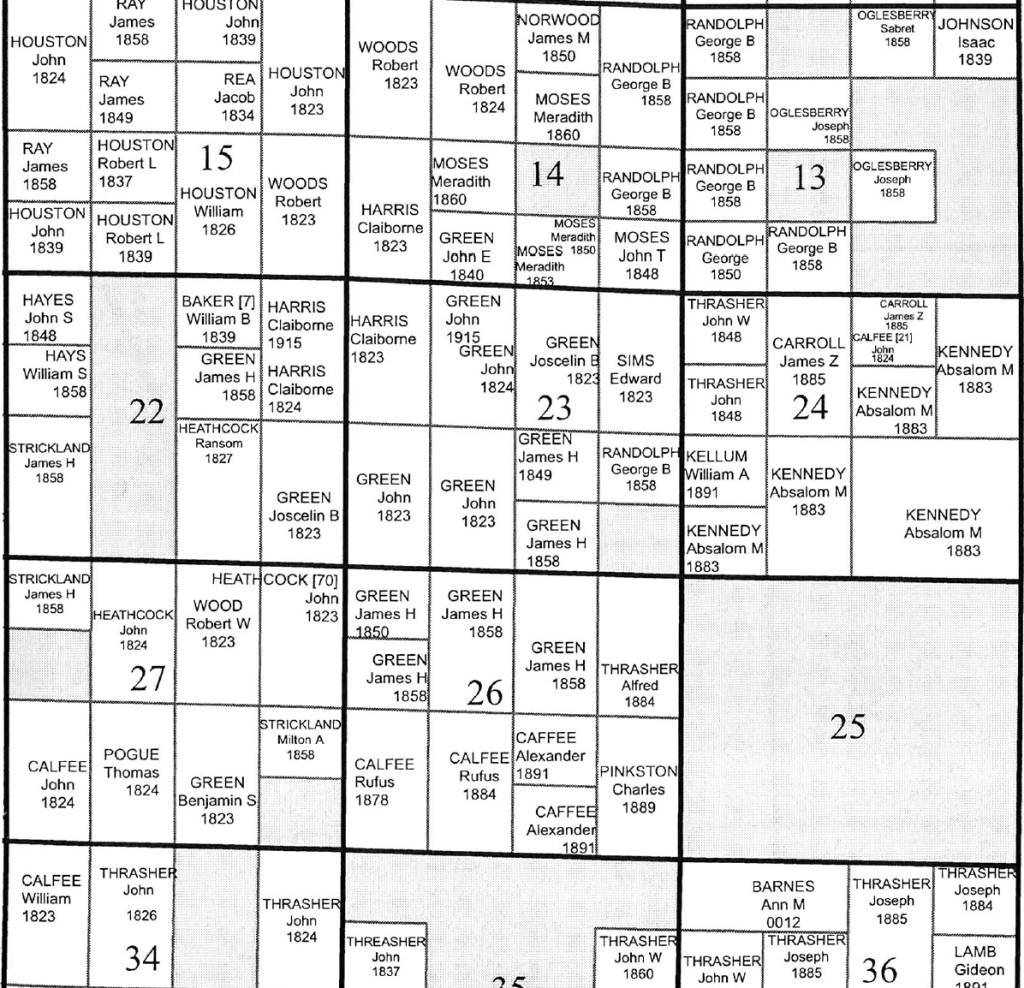
A series of Bibb County maps in Gregory Boyd’s Family Maps of Bibb County, Alabama (Norman, Oklahoma: Arphax, 2007) provide a good snapshot of exactly where in Bibb County John Green’s land and the land of his sons was located, and where John lived. The first set of maps above (pp. 58-9) show the northwest corner of the county in which John Green lived. Note that the tracts that John Green purchasted initially were in section 23, and this is where he built his house. In the snapshot of a section of the larger map showing section 23, note the other tracts belonging to his son James, with a tract belonging to his son John E. Green in contiguous section 14, and note the tracts belonging to James in contiguous section 26 with a tract belonging to John’s son Benjamin in section 27. Finally, note the tracts around this area belonging to John’s son-in-law Robert W. Woods, and the land belonging to the Calfee and Randolph families who appear in records of John’s family.


The next two sets of maps locate John Green’s homeplace in relation to Woodstock, Bibb County waterways and roads, and other county features such as Caffee cemetery. Note Caffee Creek running into section 23 where John built his house, and the Old Stagecoach Road on which the house was sited also running through this section.
On 12 April 1824, John Green had a certificate from the federal land office in Tuscaloosa County for another tract of 80+ acres in Bibb County, the east ½ northwest ¼ of township 21 south, section 23, range 6 west.[8] This certificate, too, states that John was living in Tuscaloosa County at the time it was issued. Two days after this on 14 April, John Green’s son Benjamin had a certificate for another 81+ acres in township 21, section 34, in Bibb County. This certificate was issued jointly to Benjamin S. Greene (the spelling that appears on the certificate) and John Calfee.[9]
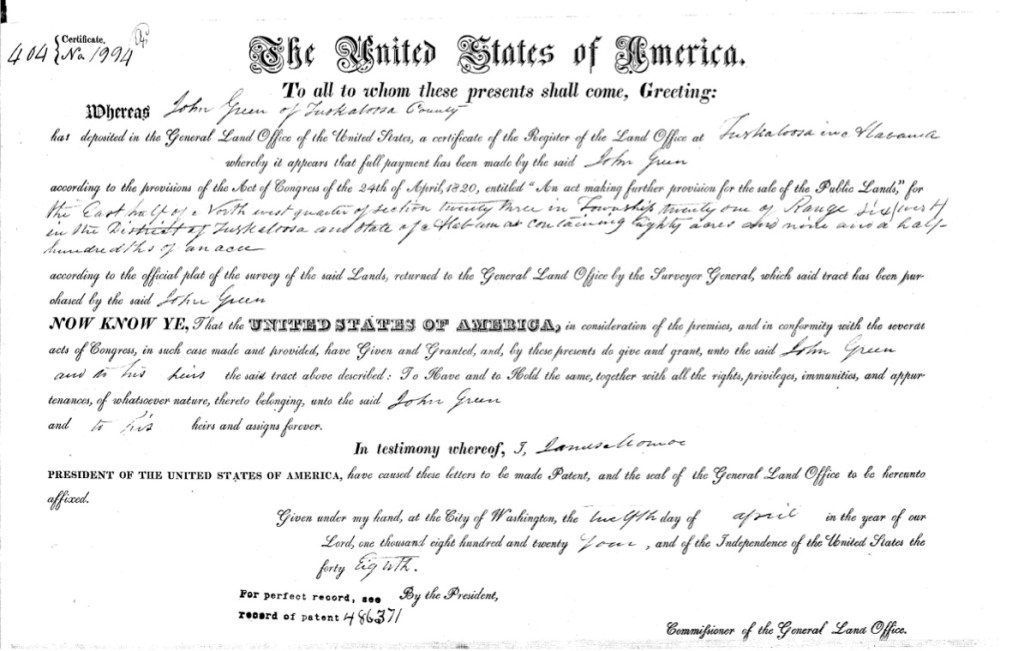
John Calfee (abt. 1775 – 1844) was the progenitor of this family in Bibb County.[10] This is the family for which Caffee Creek, mentioned previously, which ran through the tracts for which John Green had certificates in June 1823, is named. The surname is spelled as both Calfee and Caffee in various records. John Calfee is a member of a Calfee family I’ve discussed previously, since it connected to my Whitlock ancestral line that I sketched in detail in a series of postings in the past. John’s parents were William Calfee (1743-1801) and Mary Wilson; John’s brother James (1795-1858) married Hannah Whitlock (1795 – 1860/1870), daughter of Charles Whitlock and Mary Davies of Wythe County, Virginia. James and Hannah and their family are discussed in detail at the posting I’ve just linked.
I’m not sure why Benjamin S. Green was purchasing federal land in Bibb County in April 1824 in conjunction with John Calfee. The Calfee and Green family do connect by a number of marriages. Mary Calhoun Green (1797-1827), a daughter of John Green and Jane Kerr, married Robert Wilson Woods (1800-1868), a son of Robert and Elizabeth Woods. Elizabeth’s surname is said to have been Goff, but I haven’t seen records proving that. Two of the children of John Calfee, a daughter Mary and a son Evan Adair Calfee, also married children of Robert and Elizabeth Woods. And as we’ll see in a moment, the last Green family member owning and living in the house John Green built on his land in the first half of the 1840s was John’s granddaughter Mary Caroline Green, who married John Calfee’s grandson John Rucker Caffee.
Move to Bibb County, Alabama, After 1824
It appears that after John Green acquired more Bibb County land in April 1824 and prior to 1830, he moved his family to Bibb County, where the family then settled and lived on the three tracts he had purchased near Woodstock, farming, in addition to that land, a tract acquired by John’s son Benjamin and one bought by his son Joscelin. The 1830 federal census lists John Green in Bibb County with a household comprised of two males -5, one male 10-15, one male 15-20, two males 20-30, one male 60-70, one female -5, one female 20-30, and one female 60-70.[11] The older male and female are, of course, John Green and wife Jane, who were both 62 years old in 1830. The two males 20-30 are their sons John Ewing and Joscelin B. Green, and the males 15-20 and 10-15 are James Hamilton and George Sidney Green. The female 20-30 is, I think, Joscelin’s wife Elizabeth Nichols Green (born about 1811), whom Joscelin married in Tuscaloosa County on 7 December 1825. The children under five are children of Joscelin and Elizabeth.
Also in the household of John Green are the following enslaved persons: two males -10, two males 20-26, three females -10, and three females 20-26. As the previous posting notes, I have not found documents in Pendleton District, South Carolina, showing John Green owning enslaved persons there. The 1810 federal census for that district shows John with no enslaved persons. The enslaved persons in his household in 1830 were acquired, I think, following his move to Alabama. (Note: there is no 1820 federal census for Alabama.)
The 1830 federal census shows John Green’s son-in-law Robert W. Woods (husband of Mary Calhoun Green) enumerated directly prior to John, and immediately before Robert W. Woods is listed John Green’s son Benjamin S. Green, who seems to have married between 1814-1820. I have found no record of Benjamin’s wife’s name or of his marriage. It’s possible he had married in Pendleton District, South Carolina, before moving to Alabama with his parents in 1818. This was a first wife. He would marry at least once more and possibly twice after leaving Bibb County for Saline County, Arkansas, in the late 1830s and then moving to Texas by 1850. Two houses before Benjamin S. Green on the 1830 federal census in Bibb County are found John Calfee and his son Evan, whose wife Elizabeth W. Woods was a sister of Robert Wilson Woods, husband of Mary Calhoun Green.
Building the Green House, 1830-1834
According to John Morgan Green (1887-1969), whose father James William Green (1851-1920) was a son of John Green’s son James Hamilton Green, in the spring of 1830, John Green and his son John Ewing Green began building a house in Bibb County into which John Green moved his family in the spring of 1834. Following the death of John Green, John Morgan Green’s grandfather James Hamilton Green lived in the Green house with James’s mother Jane Kerr Green and with James’s brother John E. Green, who died unmarried on 3 March 1843, and the family of James Hamilton Green continued to occupy the house following Jane’s death in 1855. John Morgan Green recounts the history of the Green house in an unpublished and undated manuscript, a copy of which was sent to me in June 2000 by Anne Clouse, whose husband Ellis Davis Clouse bought the Green house and farm in 1946.[12]
According to John Morgan Green, the house is made of hand-sawn or hand-hewn lumber, with broad heart-pine floors of tongue and groove design. It had a 20-foot square kitchen connecting on the northwest corner of the house. John Morgan Green states that prior to the Civil War, the plantation on which the house was built consisted of 3,400 acres. If that’s correct, then the acreage left by John Green, which amounted to something around 480 acres according to his estate records, was augmented by land acquired by his sons John E. and James H., who appears on the 1860 federal agricultural census with 400 acres of improved land and 1,500 acres of unimproved land.
John Morgan Green writes,[13]
The place required numerous slaves and mules to work it. The old slave cabins were located about a hundred feet north of the dwelling house, and the white…overseer house was located about one hundred feet north of the present well on the southeast side of the house. Across the present highway was a large mule lot, cotton gin, sorghum mill, and a few other smaller buildings. There were a number of large white oak trees scattered around the house place…. There was a large back yard which contained several small outbuildings such as smoke house, chicken house, weaver’s house, potato storage, etc., also fruit trees — figs, plums, pomegranates, and two large grape arbors.
John Morgan Green notes that the primary crop of the plantation was cotton, and that the only two urban areas in traveling distance from the plantation — and presumably the point at which cotton was marketed — were Tuscaloosa and Selma. The stagecoach ran from Memphis to Mobile past the plantation site, he also indicates. I think that the plantation as John Morgan Green describes it is the arrangement that postdated John Green, the plantation as it was managed and developed by John’s widow Jane and her sons John E. and James H. Green, who pooled their landholdings to create a large farming operation, and who had acquired a considerable number of enslaved persons prior to the Civil War.

In her history of Bibb County’s formative years, Rhoda Ellison offers a photo of the Green house, noting that the house was among commodious houses built in northern Bibb County during the 1830s. Ellison notes that the house is on a country road near Woodstock not far from Alabama highway 5, and looks down impressively from a slight eminence above a quiet yard framed by ancient oak trees and surrounded by green pastures.[14] Rhoda Ellison notes that the Green house was known as the Halfway House, since as she states, “On the Elyton road. the [stagecoach] change, usually considered necessaary every fifteen miles, is said to have occurred regularly near Woodstock at the old Green house, called Halfway House.”
James Lee Green also notes that the Green house was known as the Halfway House, since it was at a stop on the Elyton-Selma road at which travelers changed their horses. He indicates that the Green house was occupied by members of the Green family until 1939.[15] According to Rhoda Ellison, the last Green descendant to live in the house was Mary Green Caffee.[16] John Morgan Green notes that James Hamilton Green’s “baby girl” Callie (Mary Caroline Green) inherited the Green house and lived in it all her life, after which members of the Hamilton family owned the house, selling its furniture and equipment and then the house itself.[17] James Lee Green indicates that the house and what remained of the land was sold to E.D. Clouse in 1946.[18] Mary Caroline Green (1859-1939) married John Rucker Caffee (abt. 1847 – 1889), son of Richmond C. Caffee and Cynthia L. Moses. Mary Caroline’s brother John Randolph Green married John Rucker Caffee’s sister Ellen Matina Caffee. Richmond Caffee was a son of John Calfee, the progenitor of the Bibb County Calfee/Caffee family who is discussed above.
I visited the Green house in December 2006 and took photos of it. The photo at the head of the posting is one I took at that time. As the photograph shows, the house is in what’s called the “plantation plain” style which I discussed in a posting about the plan of a similar but smaller house that John Green’s son Samuel Kerr Green had built in Natchitoches Parish, Louisiana, in 1835. As the linked posting states, Frederick Doveton Nichols coined the term “plantation plain” and it was then adapted to refer to “the typical two-story, one-room-deep, plain plantation house, with a one-story porch and a shed roof across the front.”[19]

On 21 February 1831 in Bibb County, John Green bought from John Hathcock for $300 80+ acres, the east ½ northwest ¼ of township 21, section 27, range 6 west.[20] John Hathcock signed the deed by mark with witnesses Robert Calvert and Evan Calfee. John Hathcock’s wife Mary relinquished her dower rights in the land on the day the deed was made, and the two witnesses acknowledged the deed the same day. It was recorded 16 Apr 1831.
As stated previously, Evan Calfee was the son of John Calfee. Robert Calvert was the husband of Mary Keesee, daughter of Thomas Keesee and Mary (thought to have been née McKnight), whose son Thomas Keesee married John Green’s daughter Jane Caroline Green. Thomas and Mary Keesee also had a daughter Agnes Keesee who married Benjamin Clardy, and their daughter Mary Ann Clardy married John Green’s son George Sidney Green.
John Green’s Death and Estate Documents, 1837-9
As a previous posting notes, John Green’s tombstone states that he died 18 March 1837. John died at home in Bibb County. On 24 April 1837, John’s son John E. Green applied for and was granted estate administration.[21] James Hill Sr. and John E. Green’s brother Joscelin B. Green gave bond with John E. Green in the amount of $30,000 for the estate administration.[22] At the same court session, the court appointed James Hill Sr., John Calfee Sr., and Robert Calvert to inventory and appraise the personal estate of John Green.[23]
I’ve discussed John Green’s neighbor John Calfee and Robert Calvert previously. James Hill was married to Robert Calvert’s aunt Jane Calvert, a sister to William Calvert (wife Lucy Rogers), who was Robert Calvert’s father. As I noted previously, Robert Calvert married Mary Keesee, daughter of Thomas Keesee (1778-1861) and wife Mary, whose son Thomas Keesee (1804-1879) married John Green’s daughter Jane Caroline Green and whose daughter Agnes Keesee and husband Benjamin Clardy were parents of Mary Ann Clardy, who married John Green’s son George Sidney Green. These family connections are studied extensively in Carolyn Earle Billingsley’s book Communities of Kinship, which focuses its study of the migration of families in the antebellum South to the cotton frontier on the Keesee family, who were Billingsley’s ancestors.[24]


On 19 May 1837, John Calfee, James Hill, and Robert Calvert filed their inventory and appraisement of the estate.[25] The very helpful transcript of the inventory in the digital image above appears in James Lee Green’s typescript “Greens of Bibb County, Alabama.”[26] The penned-in emendations and additions are mine. The appraisers evaluated John Green’s personal estate at $8,816.06¼ in total. On 5 June 1837, John E. Green returned the inventory and appraisement to court and it was recorded.[27]
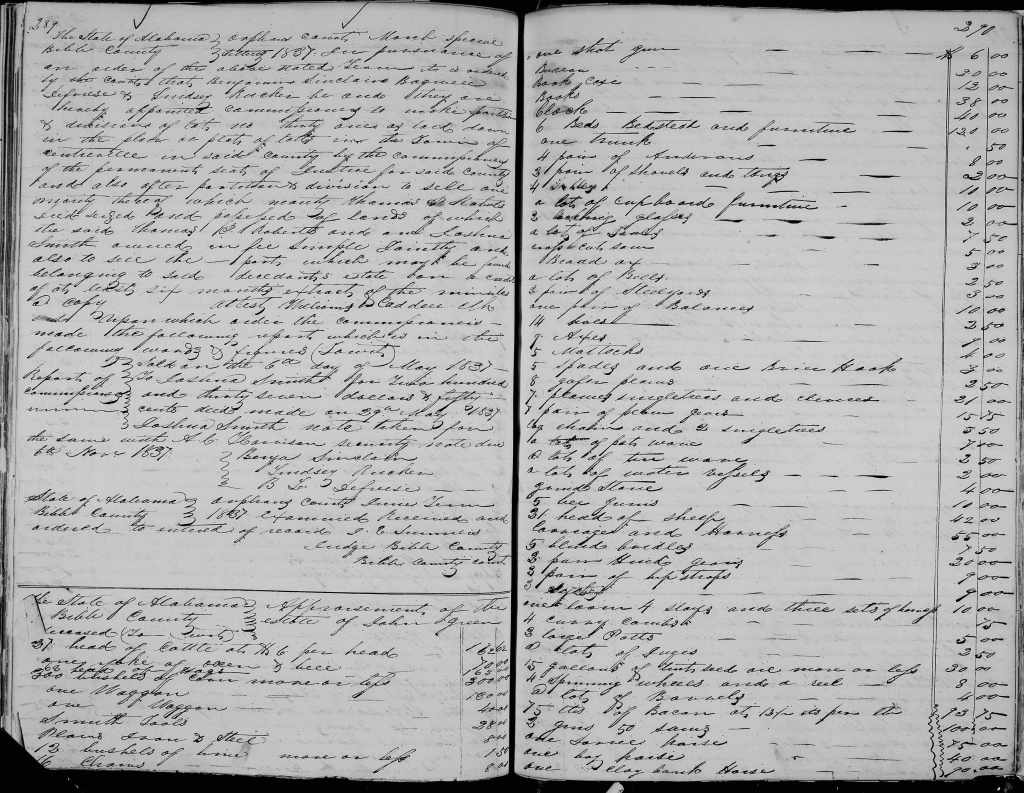
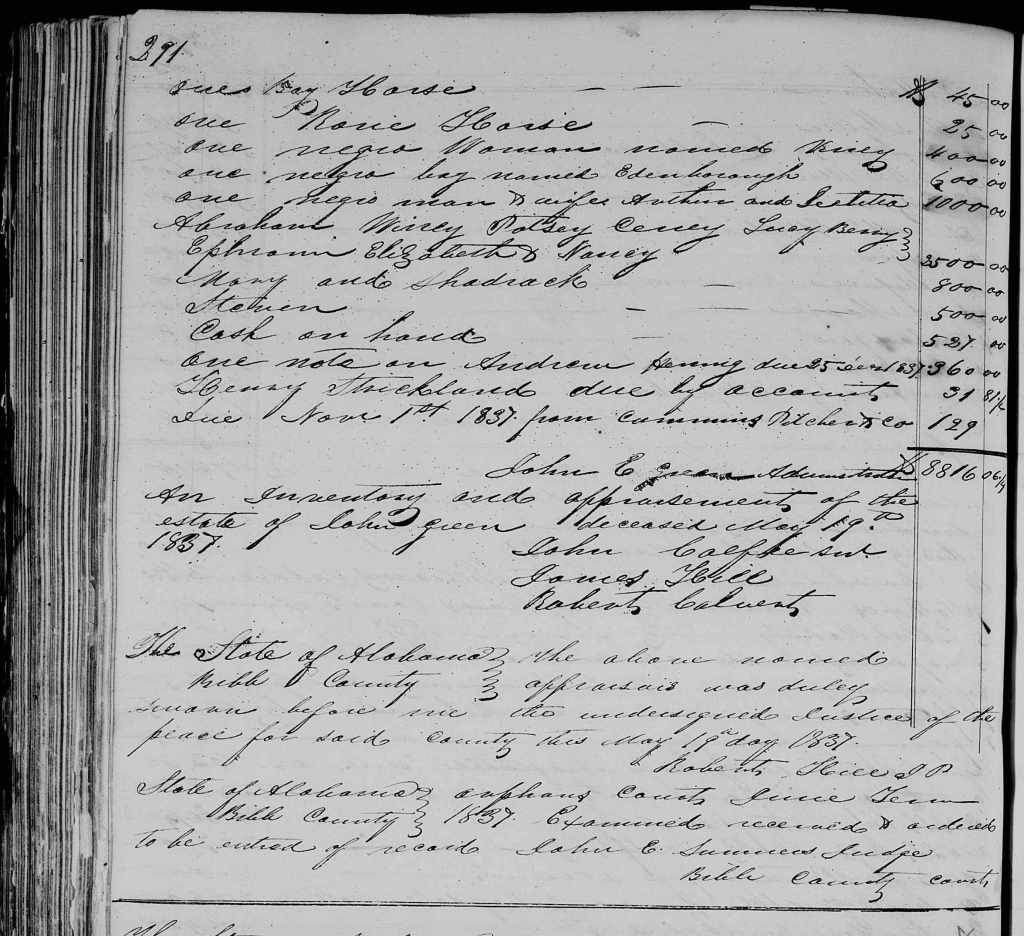
The inventory included sixteen enslaved persons who are named. in some cases being named in family groups: Viney; Edenborough; Arthur and Letitia; Abraham, Winney, Patsey, Ceney (called Sina when the estate sale was held), Lucy, Bessy (?), Ephraim, Elizabeth, and Nancy; Mary and Shadrack; and Steven. From the estate sale account, we learn that Abraham and Winney were husband wife and Patsy, Sina, Lucy, Bessy (?), Ephraim, Elizabeth, and Nancy were their children. Arthur and Letitia were also evidently a married couple, and Mary and Shadrack appear either to be husband and wife or Shadrack was perhaps Mary’s son. The name of Abraham and Winney’s child transcribed as Bessy by James Lee Green in his transcription of the estate inventory appears to be something like Kned in the sale account, but appears to be Bessy in the inventory and sale account of John E. Green when he died in Bibb County in March 1843.[28] John’s estate records show him owning a number of the enslaved persons named above, and shows his brother James buying these enslaved persons: Edinborough, Viny, Patsy, Abram, Winny, Sina, Lucy, Bessy, Nancy, and Ephraim.


On 13 November 1837, the court issued an order for John E. Green to sell the personal property of the estate.[29] The sale of the personal property was held on 1 January 1838 with John E. Green as administrator reporting the sale account to court on 6 February 1838.[30] The widow Jane was the primary buyer of property, buying, in addition to household furniture and kitchen items, a bay horse and carriage, the following enslaved persons: Abraham (called Abram in the sale account) and Winney and their children Patsey, Sina, Lucy, Kned?, Ephraim, Elizabeth, and Nancy. The enslaved person whose name James L. Green transcribes as Bessy in the estate inventory appears with a name that looks like Kned in the sale account. The account notes that Abram and Winney are husband and wife and the persons listed with them are their children.
Jane’s son James H. Green purchased Mary and Shadrack, as well as farm equipment and smith’s tools, twenty-seven hogs, nine pigs and a yoke of two oxen. Since we know from other documents that James and his wife and children lived in the house John Green and son John E. Green had built between 1830-4, these items, along with the items Jane Kerr Green purchased, kept the household and farm operation intact, and perhaps kept two families of enslaved persons (who would have provided labor on the farm) together as well.
John E. Green, who was also living unmarried at home when his father died (and as noted previously, he died unmarried), bought the enslaved persons Viney and Edenborough (Edinborough here), a horse, twenty head of sheep and twenty-four head of cattle, farm tools and household furniture. His purchase, too, would have assured that the household and farm operation remained relatively intact after John Green’s death.
John and Jane Kerr Green’s oldest son Samuel K. Green, who was living in Natchitoches Parish, Louisiana, when his father died, shows up in the sale account as purchaser of the enslaved woman Letitia. Letitia’s husband Arthur was purchased by James McMath.
Other buyers at the estate sale included non-family members: John Johnson, Joshua Thrasher, Hiram Cooly, James Hill, Benjamin Oswald, John Moses, Sam Friday, Moses (Moring?), Stephen, James, and Andrew Herring, John Hathcock, and a Jonathan whose surname I cannot make out. Also buying at the sale were John and Jane Kerr Green’s son-in-law Robert Wilson Woods, whose wife Mary Calhoun Green had died 27 November 1827, and Robert’s brother John Alexander Woods, whose wife Mary was a daughter of John Calfee. Note that the Herring surname often appears in Bibb County records as Herrin and may have been commonly spelled that way.
The only crop mentioned in the inventory and sale account is corn. This leads me to conclude that John Green had not shifted in a major way to growing cotton after he moved from South Carolina to Alabama, but maintained a more diversified farm operation. The shift to cotton growing seems to have occurred following his death, when his sons James and John E. Green managed the plantation. It’s clear from the estate file of John E. Green that by the time of his death in March 1843, the focus of the plantation had shifted strongly to cotton-growing following the death of John Green in 1837.
The sale netted $9,397.68¾. Also appended to the sale account is a sketch of the tracts of land belonging to the heirs and the tract allotted to Jane as her dower portion. This report on lands was filed at March court. The heirs inherited two tracts both 80.09½ acres each and a tract 160.19 acres. These are described as follows: southwest ¼ and the east ½ of the northwest (no fraction given) of township 21, section 23, range 6 west, and the east ½ of the northwest ¼ of same coordinates. Jane’s portion was a tract of 160.32 acres, the west ½ northeast ¼ of township 21, section 27, range 6 west and the east ½ of the north ¼ of same coordinates. The land division was drawn up and reported to court by Robert Hill, John Thrasher, B. McDaniel, Andrew Herring, and J.W. Thrasher.
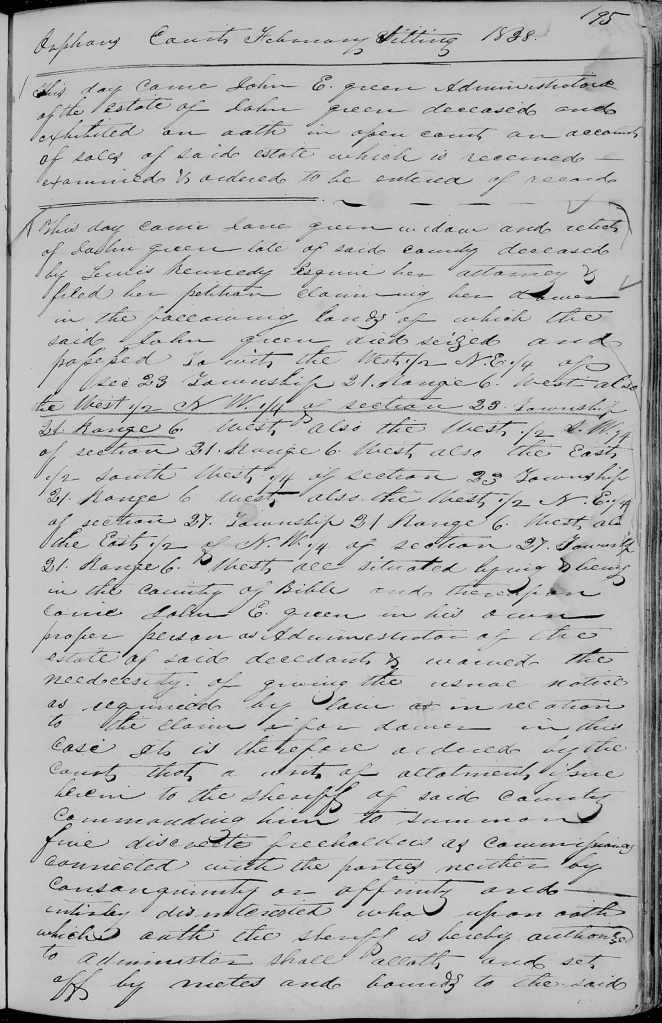
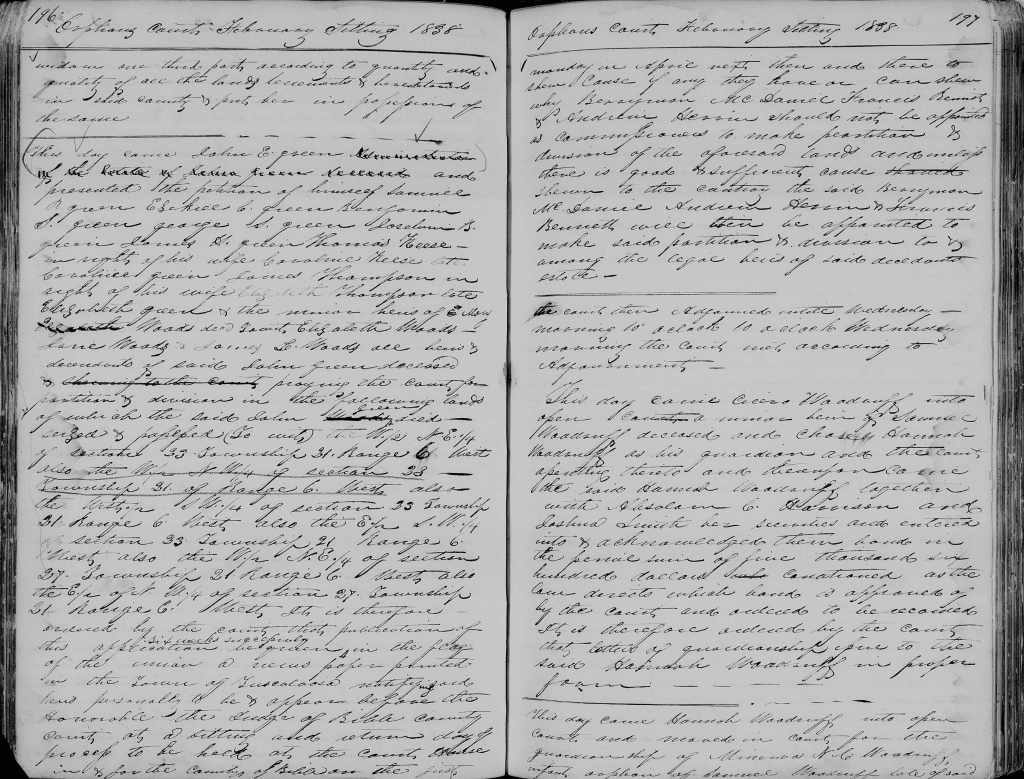
As John E. Green returned the sale account to court on 6 February 1838, Jane had appeared in court with her attorney Louis Kennedy and filed her petition for dower interest in the lands of the estate. At the same court session, John E. Green had petitioned for partition of the real estate naming the estate’s heirs and the tracts of land: John E., Samuel K., Ezekiel C., Benjamin S., George S., Joscelin B., James H., Caroline (m. Thomas Keese), Elizabeth (m. James Thompson), and the heirs of Mary Woods, deceased (Elizabeth, James L., and Jane Woods). The petition describes the land as follows:
• west ½ northeast ¼ of township 21, section 23, range 6 west
• northwest ½ of the northwest ¼ of same coordinates
• west ½ southwest ¼ of same coordinates
• east ½ southwest ¼ same coordinates
• west ½ northeast ¼ of township 21, section 27, range 6 west
• east ½ northwest ¼ of same coordinates.
Of these six tracts, the first is the land for which Joscelin B. Green had a certificate on 2 June 1823, the third and fourth are tracts John Green purchased on the same day (2 June 1823), and the fifth is the tract that Benjamin S. Green purchased on that date.[31] It appears Joscelin and Benjamin had given or sold their tracts bought in June 1823 to their father. The sixth tract is the land John Green bought from John Hathcock on 21 February 1831.[32] The mystery piece of land in the estate of John Green is the second tract listed above. This tract of 80.09 acres had been sold on 2 June 1823 at the Tuscaloosa federal land office to Claiborne Harris.[33] It appears to me that John Green must have swapped the 80+ acres he bought from the federal land office in the same township, section, and range on 12 April 1824 with Claiborne Harris for a matching piece of land in those coordinates, the west ½ of the northwest ¼ instead of the east ½ of the northwest ¼ that John purchased in April 1824.
At the same 6 February 1838 court session at which Jane petitioned for her dower allotment of land and the tracts belonging to John Green’s estate were listed, the court appointed Berryman McDaniel, Francis Bennett, and Andrew Herring as commissioners to handle the sale of real estate.[34]
On 5 March 1838, Edward Lee, Esq. and county sheriff, reported to court that he had allotted Jane her dower portion of the estate.[35] On 2 April 1838, the court ordered that the application for division and partition of real estate be continued to the first Monday in May next.[36] On 4 April 1838, the Tuscaloosa newspaper the Democratic Gazette and Flag of the Union carried a notice stating that Berryman McDaniel, Francis Bennett, and Andrew Herring were dividing the lands belonging to John Green of Bibb County. The notice again names John’s heirs.[37]
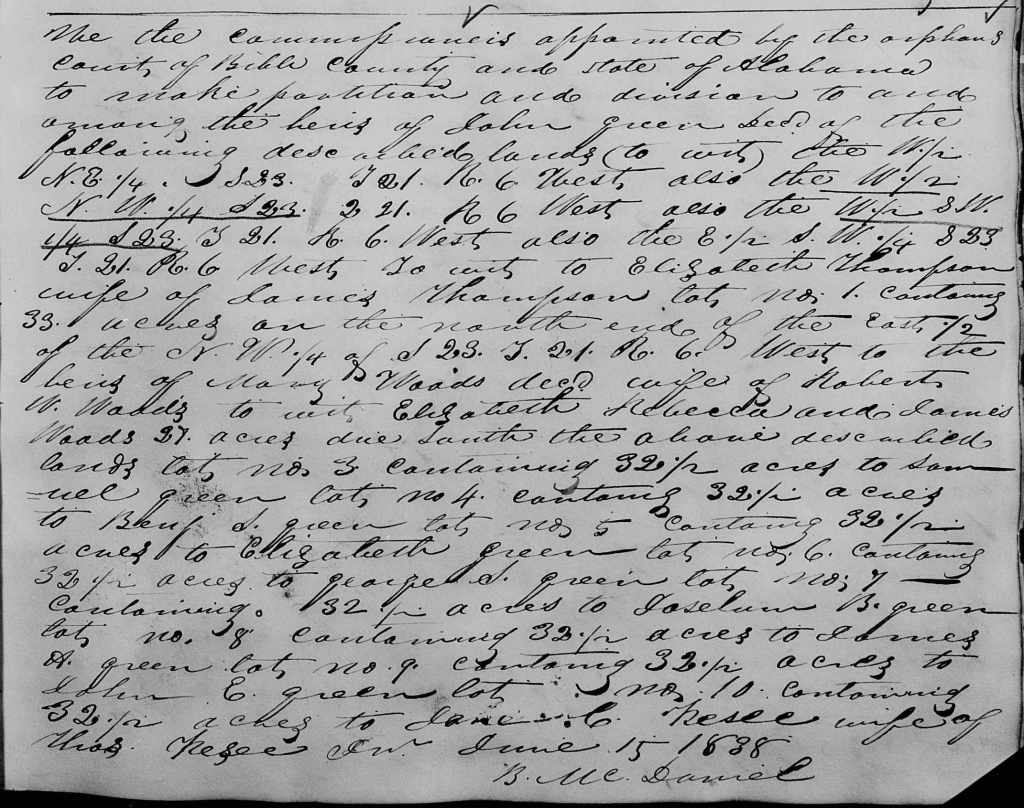

On 7 May 1838, the court issued an order to McDaniel, Herring, and Bennett to proceed with the partition and division of the land.[38] On 4 June 1838, the land commissioners were given leave to make their report to court the first Monday in July.[39] The commissioners then divided the land and apportioned it among the heirs on 15 June 1838, with Berryman McDaniel, Andrew Herring, and Francis Bennett signing the report.[40] The land partition report again names the heirs and shows what piece of land each received. The commissioners’ report was filed with a report by Robert Hill, j.p., certifying that the undersigned commissioners had been duly certified to make the land division and had followed the court’s instruction in doing so.
On 2 July 1838, as estate administrator, John E. Green returned to court the report that the commissioners handling the estate’s real property had compiled in June.[41] On 5 November 1838, the court ordered John E. Green to present his final account of the estate on the first Monday in April next.[42]
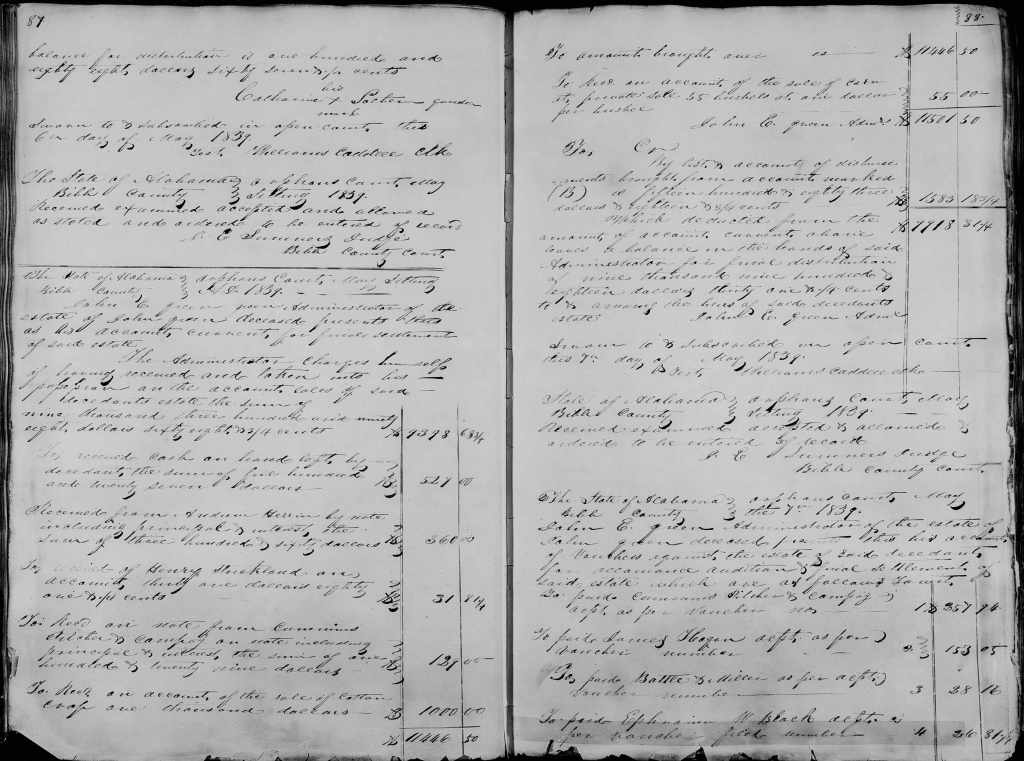

John E. Green presented his final account to court on 7 May 1839.[43] The account shows the estate with a net amount of $11,809.50, of which $1,583.18¾ had been expended, leaving a final amount of $9,918.31¼ to be distributed among the heirs Jane Green, widow; Samuel K. Green; Elizabeth, wife of James Thompson; Benjamin S. Green; Ezekiel C. Green; Elizabeth W., Jane R., and James L. Woods, children of Mary C., wife of Robert W. Woods; J. (Joscelin) B. Green; John E. Green; James H. Green; Jane C., wife of Thomas Keesee; and George S. Green. Jane’s share of the estate was $1,983.66, and each other heir received $793.46, with the children of Mary C. Green Woods splitting that amount.
As a previous posting notes, John Green, his wife Jane, and their children Mary Calhoun Green Woods and Lucinda and John Ewing Green were buried in a family cemetery on their land a mile southeast of Woodstock, Alabama, and their graves were moved at a later point to Tannehill Historical State Park in Tuscaloosa County, about five miles northwest of their original burial site.
I have not found information about the church background of the Green family. I think it’s likely the John and Jane Kerr Green were Presbyterians, as were Jane’s Kerr and Calhoun forebears, and that they raised their children as Presbyterians. John and Jane’s son George Sidney Green was married to Mary Ann Clardy on 1 November 1839 in Saline County, Arkansas, by a Presbyterian minister, and John and Jane’s daughter Jane Caroline and husband Thomas Keesee were also Presbyterians and belonged to Shiloh Presbyterian church at Ovila in Ellis County, Texas, in whose cemetery both are buried.
If John Green and Jane Kerr attended a church in Bibb County, I think it’s likely that they went to Bethany Presbyterian church at Green Pond not far from where they lived. This church was founded in 1827 and is called Green Pond Presbyterian church today. According to Rhoda Ellison, the area in which Bethany Presbyterian church is located was a prosperous corner of northwestern Bibb County that was given the name Kingdom Beat due to its prosperity and due to the political influence of James William Green, son of James Hamilton Green, in that part of Bibb County.[44] Green Pond is approximately two miles northeast of Woodstock and a mile south of the Tuscaloosa County line.
[1] This letter is in the Andrew Pickens papers at the South Caroliniana library of University of South Carolina.
[2] Carolyn Earle Billingsley, “Antebellum Planters: Communities of Kinship on the Cotton Frontier,” East Texas Historical Journal 39,2 (fall 1997), pp. 58-74.
[3] See Marilyn Davis Barefield, Old Tuskaloosa Land Office Records and Military Warrants 1821-1855 (Easley, South Carolina; Southern Historical Press, 1984), p. 5; Rhoda Ellison, Bibb County, Alabama, The First Hundred Years 1818-1918 (Tuscaloosa: University of Alabama Press, 1984), p. 32; and James Lee Green, “The Greens of Bibb County, Alabama” (typescript) (Columbia, South Carolina, 1992), p. 2.
[4] Alabama State Patent Bk. 65, p. 264, #749 and p. 265, #750, for John Green’s two tracts of 80+ acres each in township 21, section 23; ibid., p. 273, #758 for Benjamin S. Green’s 80+ acres in township 21, section 27; and ibid., pp. 262-3, #747-8 for Joscelin’s two tracts of 80+ acres each in township 21, sections 22 and 23.
[5] Ellison, Bibb County, Alabama, The First Hundred Years, p. 32.
[6] See Green, “Greens of Bibb County,” p. 2.
[7] Bibb County, Alabama, Orphans Court Minutes Bk. A, pp. 190-1.
[8] Alabama State Patent Bk. 67, p. 404, #1994.
[9] Ibid., p. 461, #2050. The certificate states that it was issued to Calfee and Green as joint tenants.
[10] John Calfee is buried in the Caffee family cemetery at West Blocton in Bibb County: see Find a Grave memorial page of John Columbus Calfee Sr., created by W.D. Hosey, with tombstone photos by Mary Falwell Henderson and Cyndi Nash. The tombstone marking John Calfee’s grave appears to be one placed there years after his burial.
[11] 1830 federal census, Bibb County, Alabama, p. 150.
[12] John Morgan Green, “A History of the House” (unpublished manuscript, no date), in possession of Anne Clouse, Woodstock, Alabama, June 2000. Ellison, Bibb County, Alabama, The First Hundred Years, p. 85, cites this manuscript, noting that it was in possession of E.D. Clouse, Woodstock, Alabama, who bought the house and farm in 1946. Green, “Greens of Bibb County,” also cites John Morgan Green’s history of the Green house.
[13] John Morgan Green wrote his manuscript without attention to punctuation and capitalization, and his orthography left something to be desired. I have taken the liberty of transcribing this passage with corrected spelling and with punctuation and capitalization added.
[14] Ellison, Bibb County, Alabama, The First Hundred Years, pp. 48-9.
[15] Green, “Greens of Bibb County,” p. 3.
[16] Ellison, Bibb County, Alabama, The First Hundred Years, p. 49.
[17] John Morgan Green, “A History of the House.”
[18] Green, “Greens of Bibb County,” p. 11.
[19] John Linley, The Georgia Catalog, Historic American Buildings Survey: A Guide to the Architecture of the State (Athens: Univ. of Georgia Press, 1982), p. 22.
[20] Bibb County, Alabama, Deed Bk. A, pp. 136-7.
[21] Bibb County, Alabama, Probate Minutes Bk. A, pp. 149-150.
[22] Ibid., and see Bibb County, Alabama, Administrators Records Bk. D, p. 279, with a copy of the bond.
[23] Bibb County, Alabama, Probate Minutes Bk. A, pp. 149-150.
[24] Carolyn Earle Billingsley, Communities of Kinship: Antebellum Families and the Settlement of the Cotton Frontier (Athens: Univ. of Georgia Press, 2004).
[25] Bibb County, Alabama, Administrators Records Bk. D, pp. 289-291.
[26] Green, “Greens of Bibb County,” pp. 3-5.
[27] Bibb County, Alabama, Probate Minutes Bk. A, p. 154.
[28] See the loose-papers estate file of John E. Green held by Bibb County, available digitally at FamilySearch.
[29] Bibb County, Alabama, Probate Minutes Bk. A, p. 173.
[30] Bibb County, Alabama, Administrators Records Bk. E, pp. 1-3; and Probate Minutes Bk. A, pp. 195-7. The Administrators Records account states that the sale account was filed in March after having been submitted to court in February.
[31] See supra, n. 4.
[32] See supra, n. 20.
[33] Alabama State Patent Bk. 65, p. 261.
[34] Bibb County, Alabama, Probate Minutes Bk. A, pp. 195-7.
[35] Ibid., p. 201.
[36] Ibid., p. 210.
[37] See Pauline Jones Gandrud, Marriage, Death, and Legal Notices from Early Alabama Newspapers 1819-1893 (Easley, South Carolina: Southern Historical Press, 1981), p. 160; and Gandrud, Alabama Records, vol. 5, p. 58.
[38] Bibb County, Alabama, Probate Minutes Bk. A, pp. 211-2.
[39] Ibid., p. 213.
[40] Bibb County, Alabama, Administrators Records Bk. E, pp. 28-9.
[41] Bibb County, Alabama, Probate Minutes Bk. A, p. 222.
[42] Ibid., p. 240.
[43] Ibid., pp. 286-9; and Bibb County, Alabama, Administrators Records Bk. E, pp. 87-90.
[44] Ellison, Bibb County, Alabama, The First Hundred Years, p. 68; Ellison, Place Names of Bibb County, Alabama (Brierfield, Alabama: Cahaba Trace Commission, 1993), p. 75.
 BEGATS AND BEQUEATHALS
6 thoughts on “John Green (1768-1837): Bibb County, Alabama, Records, 1823-1839”