Two men named John Green are listed in 1800 in Pendleton District. Neither has a household matching that of John Green with wife Jane Kerr. One of these John Greens, who is in John Moore’s militia district, has a household comprised of a male under 10, a male 26-45, and a female 16-25.[1] The other John Green, enumerated in John Brown’s militia district, has a household with a male under 10, a male 16-25, and a female 16-25.[2] Listed not far from this John Green are a Henry and Abednego Green who can clearly be placed in the Green family who came to Pendleton District from Baltimore County, Maryland, a family I mentioned in the previous posting. It’s clear to me that this John Green belongs to that family.
In 1800, both John Green and wife Jane Kerr were aged 32, and they had five children, three sons and two daughters: Samuel Kerr (born 1790); Elizabeth B. (born abt. 1792-1794); Benjamin S. (born 1794); Ezekiel Calhoun (born 1795); and Mary Calhoun (born 1797). A son Joscelin B. would be born in or near 1800.
In his study of Jane Kerr Green’s uncle John Ewing Colhoun entitled Our Honoured Relation, James Lee Green suggests that John and Jane Green had gone down to the lowcountry prior to 1800 along with Jane’s sister Ruth and husband William Oliver, and that these families are a John Green and William Oliver listed on the same census page in the Waccamaw District of Georgetown County, South Carolina, in 1800.[3] The census listing for John Green’s household shows a male and a female 26-45, a female 10-15, and ten enslaved persons. William Oliver’s household contains younger people whose ages and gender match those of John and Jane’s other children born prior to 1800. James Lee Green notes that these younger family members are not in the Oliver household on the 1810 federal census. He proposes that because Jane was pregnant with son Joscelin at the time the 1800 census was taken, the Olivers were caring for her children other than daughter Elizabeth.
As the last posting indicates, there was definitely much back-and-forth movement between the upcountry and lowcountry within a number of interrelated families of Abbeville-Pendleton Districts, South Carolina, who also had ties to the South Carolina lowcountry, including the family of Jane’s uncle John Ewing Colhoun, who owned a number of plantations and much land in the lowcountry from his marriage to Floride Bonneau but also spent time living on their Keowee Heights plantation in Pendleton District. Jane Kerr Green and Ruth Kerr Oliver had a brother John Kerr who was living in Charleston by 1784, where he owned a hatter’s business as he also engaged in land speculation in Abbeville and Pendleton Districts with business partners William Matlack and Jacob Morris. John had gone down to Charleston from Abbeville District and appears at times to have lived on his land in Pendleton District.
So it’s certainly possible for families living primarily in the upcountry to have appeared on censuses in the lowcountry as they sojourned there temporarily. But as Green researcher Marcia McClure has pointed out to me (I’m citing an email from her dated 19 April 2011), in the will that Jane, John, and Ruth’s mother Mary Calhoun Kerr made in Abbeville District on 21 January 1805, Mary names her daughter Ruth as Ruth Kerr, indicating that Ruth did not marry until after January 1805.[4] The same will names Mary’s daughters Jane (married John Green) and Catherine (married Hugh Macklin) by their married surnames. In addition, as Marcia McClure notes, federal censuses from 1850 to 1880 assign William Oliver a birth year of 1789, and the 1850 federal census shows Ruth Kerr born in 1779, so in 1800, William Oliver would have been aged only eleven.
I agree with Marcia McClure that the William Oliver enumerated on the 1800 federal census in Georgetown County cannot be the man who married Ruth Kerr, and I think it’s very doubtful that the John Green found on the same 1800 census page as the William Oliver in Georgetown County is John Green with wife Jane Kerr. I can’t account for the absence of John Green (wife Jane Kerr) from the 1800 federal census, but am strongly inclined to think he was in Pendleton District at the time the census was taken, since, on 11 March 1800, he witnessed a deed of Jane’s uncle John Ewing Colhoun to John Simpson of 50 acres on the west side of Twelve Mile River in Pendleton, the northeast end of the plantation on which John E. Colhoun resided, bounded by William Gilham, John Simpson, and John Ewing Colhoun.[5] The other witness to this deed was a J.C. Kerr who may, I think, have been John Ewing Colhoun’s nephew John Kerr, son of Samuel Kerr and Mary Calhoun. John Green proved this deed on the day it was made and it was recorded on 4 April, with a plat drawn 18 September.
John Simpson (1768-1825) was part of the Calhoun-Pickens family kinship network: he married Ann Pickens, daughter of Andrew Pickens and Rebecca Calhoun, Ann being a first cousin of Mary Calhoun Kerr, mother of John Green’s wife Jane Kerr.
After John Ewing Colhoun made his will on 20 May 1802, he added a codicil on 21 October 1802 making his nephew Ezekiel Pickens an executor in addition to previously named executors, and this codicil was witnessed by John Simpson Jr., Benjamin Green Jr., and Robert Anderson. A 7 December 1803 account of notes for property sold by the estate of John Ewing Colhoun archived in his papers in the Southern Historical Collection at Wilson Library, University of North Carolina at Chapel Hill, shows a note by John Green and John Simpson for $33.75 due for unspecified property they purchased jointly at the estate sale. The list of notes due the estate was kept by Andrew Pickens, John Ewing Colhoun’s brother-in-law, husband of John’s sister Rebecca Calhoun and the General Andrew Pickens named as one of John E. Colhoun’s executors.
The 11 March 1800 deed of John E. Colhoun to John Simpson indicates that John E. Colhoun was living at his Keowee Heights plantation in Pendleton District when he deeded this land. John E. Colhoun died at Keowee Heights on 26 October 1802, with the Charleston Times stating on 9 November 1802,[6]
Died at his seat in Pendleton district on the 26th ult. in the 53d year of his age, John Ewing Colhoun, esq. Senator from this state in the Congress of the United States.
John E. Colhoun was buried at Keowee Heights in a family cemetery on the plantation. Jane Kerr Green’s mother Mary Calhoun Kerr, sister of John Ewing Colhoun, outlived her younger brother John by a number of years. When Mary Kerr made her will in Abbeville District on 21 January 1805, she made her son-in-law John Green an executor of the will along with Andrew Norris and George Bowie.[7] As the previous posting states, Andrew Pickens Norris was a half-brother of John E. Colhoun and Mary Calhoun Kerr, a son of their mother Jean/Jane Ewing and her second husband Robert Norris. George Bowie (1772-1864) was the husband of Mary Calhoun Kerr’s niece Margaret Pickens, a daughter of Mary’s sister Rebecca, wife of Andrew Pickens.
Mary Calhoun Kerr died in Abbeville District between 21 January 1805, when she wrote her will, and 11 February 1805, when the court issued an order for her estate to be appraised. When the estate sale was held on 23 February, John Green was a buyer. In addition to naming Jane Green as one of her daughters, Mary Kerr also stipulated in her will that her youngest unmarried daughter Ruth was to hold all the land Mary had gotten by dower through her marriage to Samuel Kerr, on which Mary was residing up to the point of Ruth’s marriage, and when Ruth had married, the value of the land was then to be divided between Ruth and her sisters Catherine Macklin (McLain in the will) and Jane Kerr.
An Abbeville County equity case that appears to date from 16 May 1822 shows family contention over some of Mary’s estate left to her daughter Ruth.[8] The will had bequeathed to Ruth, in addition to her possession of Mary’s land up to her marriage, Mary’s black cardinal silk gown and jewelry and enslaved persons named George and Nancy. William P. Martin filed suit against Ruth’s husband William Oliver and Catherine Kerr’s husband Hugh Macklin (McLin in the case file), alleging that he had bought from Oliver and Macklin on 2 July 1816 70 acres of land along with a stone house and other valuable buildings, all from Mary Calhoun Kerr’s estate, but they had not given him title to this property.
Also at issue in this lawsuit was, it appears, Ruth Kerr Oliver’s right of ownership to the enslaved persons George and Nancy. A 28 May 1805 deed made by Ruth’s aunt Floride Bonneau Colhoun, widow of John Ewing Colhoun suggests that John E. Colhoun actually owned Nancy. With this deed, Floride Bonneau Colhoun deeded Nancy for love and affection to her niece Ruth Kerr, stating that this enslaved woman was in Ruth’s possession.[9] Floride’s deed states that if Ruth should die without issue, Nancy was to go to Floride’s nieces Jane Green and Catherine Mecklin. Floride Bonneau Colhoun was living in St. John’s Parish in Berkeley County, South Carolina, when she made this deed, which was witnessed by Ezekiel Pickens, who proved it on 13 August 1805. It was recorded on 19 August. As the previous posting states, a 10 May 1805 Pendleton District deed shows Ezekiel Pickens acting with Henry de Saussure on behalf of the estate of John E. Colhoun. Ezekiel Pickens (1768-1813) was a son of Andrew Pickens and Rebecca Calhoun. He married Floride Bonneau’s sister Elizabeth Bonneau. I think that in acting in these transactions as John E. Colhoun’s executor along with de Saussure, Ezekiel was acting on behalf of his father Andrew Pickens, who had been named one of Colhoun’s executors.
Documents in the 1822 Abbeville County equity case Thomas P. Martin vs. William Oliver et al. case also name John Green and wife Jane Kerr, who were by this time in Alabama, having moved there in 1818.
On 16 September 1805, as William Hays deeded 320 acres on Six Mile Creek of the Keowee in Pendleton District to Benjamin Armstrong, the deed noted that the land had been surveyed for John Green on 1 January 1793, and that it was part of a grant of 838 acres to John Green from Governor William Moultrie.[10] The deed was witnessed by John Green and his son Samuel K. Green. John Green proved the deed on 7 March 1806, and it was recorded 28 March. I have not been able to find a deed from John Green to William Hays for this land. I note that when Griffin Brown sold Christopher Vickery 198 acres on Little River in Pendleton District on 7 March 1800, William Hayes [sic] was a witness to the land sale along with B. Green Jr., who is, I think, the Benjamin Green who was probably John Green’s brother and tutor to the children of John E. Colhoun.[11]

Six Mile Creek is named consistently as a landmark in the Pendleton District land records of John Green with wife Jane Kerr. Because of changes made to waterways in Pickens and Oconee Counties to create Lakes Issaqueena and Hartwell, it is difficult to figure out on contemporary maps exactly where Six Mile Creek joined the Enoree River at the time John Green lived in that vicinity. As Jerry Alexander noted in an article entitled “Historic Keowee Plantation” from an unidentified and undated newspaper found in the Mary Stevenson Collection at Clemson Univesity Library’s Special Collection and Archives (“Keowee, Home of John Ewing Colhoun and Graveyard,” box 15, folder 42, mss 353), the confluence of the Keowee and Twelve Mile Rivers, the site of John E. Colhoun’s Keowee Heights planatation, is difficult to locate today because those streams no longer exist after they were formed into Lake Hartwell.
As best as I can deduce, Six Mile Creek originally met the Enoree near where Pickens and Oconee Counties meet, just north of what is today Clemson, in the Clemson Experimental Forest area on which John E. Colhoun’s Keowee Heights plantation and family cemetery and the land owned by John Green’s neighbor Benjamin Lawrence are both located, as the last posting notes.

On 30 September 1807, John Green had a survey for 409 acres on the southwest side of the Keowee bordering Little River.[12] All of his other tracts on the Keowee were on the east side of the river, and this land seems to have been at a distance from the other tracts John owned on the Keowee around Six Mile Creek. I suspect John acquired this land with an eye to speculating with and not farming it, since he sold it to Ezekiel Pickens on 27 October 1809, as will be discussed below. The surveyor of these 409 acres was Thomas Garvin, whose son Greenberry Stanford Garvin married Mary Calhoun Oliver, a daughter of Jane Kerr Green’s sister Ruth, on 23 September 1836.
On 16 February 1808, Joseph Eaton sold John Green, both of Pendleton District, for $440 175 acres on both sides of Six Mile Creek, waters of the Keowee.[13] The land had been surveyed for James Beaty on 4 December 1787. The tract bordered land of Robert Anderson on the southeast and Robert Beaty on the northwest. Archibald McCoy and John’s son Samuel K. Green witnessed this deed, and Samuel proved it on 26 April 1808, the day on which the deed was recorded.

As the previous posting states, a 20 June 1808 plat for Benjamin Lawrence shows the 297 acres surveyed for Lawrence on 4 March 1808 bordering both John Green and John’s wife Jane’s uncle John E. Colhoun.[14] As the linked posting also notes, John Green’s survey for 838 acres on the Keowee on 1 January 1793 states that Benjamin Lawrence’s land bordered John’s on the north, a point reiterated in this June 1808 plat for Lawrence. As the linked posting further indicates, both Benjamin Lawrence’s land, on which he is buried, and John E. Colhoun’s (on which he is also buried) are today in Clemson University’s Experimental Forest north of Clemson. The map above, a screenshot of a Google map, shows where both Benjamin Lawrence and John E. Colhoun lived, John closer to what is today Clemson, with his Keowee Heights house on what’s today Doyle Bottom Road near Lake Issaqueena and an historic marker for the house located near the intersection of Old Six Mile Road and Six Mile Highway, now South Carolina highway 133, overlooking what is now Lake Hartwell.[15] Benjamin Lawrence lived some miles northwest from John E. Colhoun just above where the Keowee and Lake Issaqueena now join. John Green’s land was between these two men, south of Benjamin Lawrence and north of John E. Colhoun. It’s possible John’s land is now underwater: as Jim Melvin notes, Lake Issaqueena was formed from a valley that had “previously been part of the sloping bottomlands of Six Mile Creek.”[16]

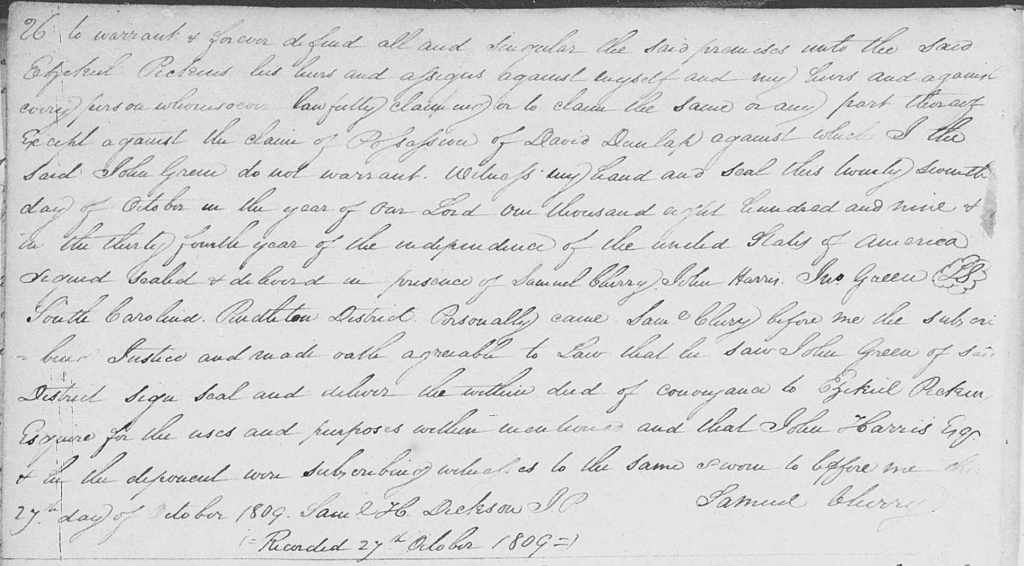
On 27 October 1809, John Green sold to Ezekiel Pickens, both of Pendleton, for $100 the 409 acres he had had surveyed on Little River, waters of the Keowee, on 30 September 1807.[17] The deed states that the grant for this land was made to John by the state on 5 October 1807. Samuel Cherry and John Harris witnessed the deed, and Cherry proved it on the day the deed was made and it was recorded on the same day. As has been previously noted, Ezekiel Pickens was a first cousin of John’s wife Jane Green, a son of Andrew Pickens and Rebecca Calhoun, a sister to Jane’s mother Mary Calhoun Kerr. I find no listing for this grant in the index to South Carolina grants.
1810-1818
Five men named John Green are enumerated on the 1810 federal census in Pendleton District, South Carolina. Of these, only one household appears to match (roughly) the configuration of the family of John Green and Jane Kerr.[18] This household has a male aged 45+ and a female aged 26-44 (John and Jane were both 42 in 1810), three males -10, one male 10-15, two males 16-25, two females -10, one female 10-15, and one female 16-25. By 1810, John Green and Jane Kerr had six sons (aged 20, 15-17, 15, 10, 7, and 4) and four daughters (aged 15-17, 13, 9, and 2). Living near John Green’s family on this census are John Hudson and Charles Gates, both of whom had deeds witnessed by John Green’s sons in the period 1810-1818, as I’ll discuss in a moment.
Note that the 1810 federal census shows John Green holding no enslaved people. I have not found documents indicating that he owned enslaved people in Pendleton District. I think he either operated his farming operation with his own labor and that of his sons, and possibly some hired workers, or he was offered the labor of enslaved persons belonging to his wife’s uncles John E. Colhoun and Andrew Pickens, the former having died prior to 1810. By the time John died in Bibb County, Alabama, in 1837, as we’ll see later, he had acquired sixteen enslaved persons. Those appear to have been bought in Alabama and not brought from South Carolina when the Greens moved to Alabama.
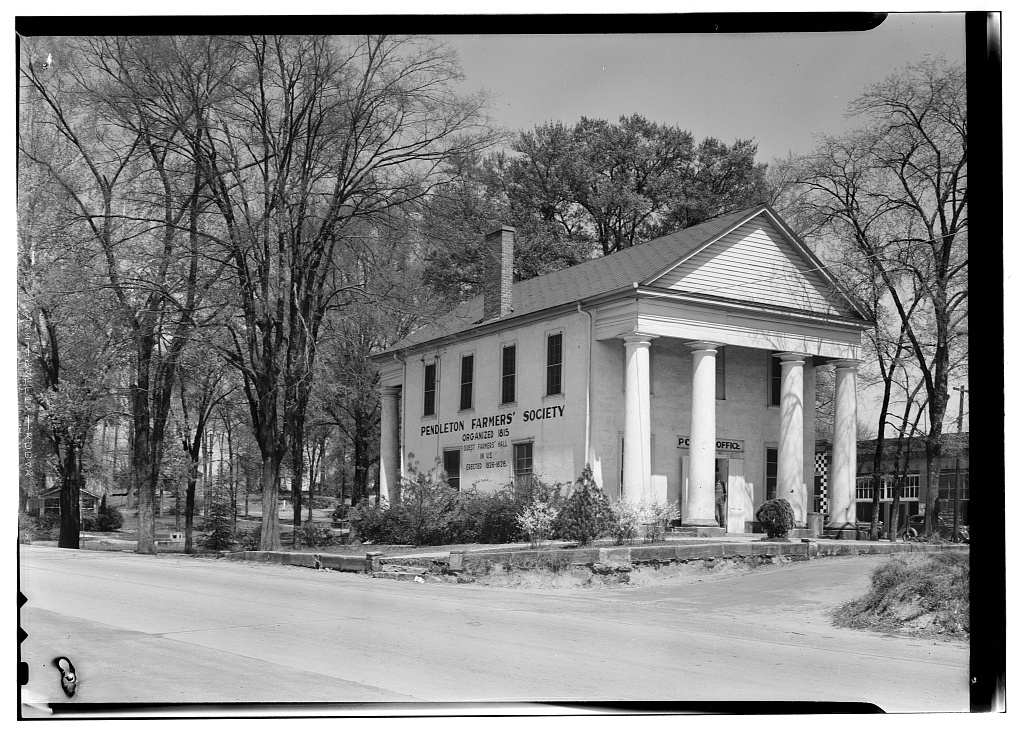
In 1815, the Pendleton Farmers’ Society was organized in the town of Pendleton, with John Green among its first members.[19] In discussing the inauguration of this society in his history of old Pendleton, R.W. Simpson states that other founding members included Andrew Pickens, John E. Calhoun [sic], and Patrick Norris. Jane Kerr Green’s uncle Andrew Pickens was still living in 1817, but her uncle John E. Colhoun had died in 1802, so the John E. Colhoun who was an inaugurating member of the society was the son (1791-1847) of the older John E. Colhoun, who had the same name. It’s also possible that the Andrew Pickens who was among the founders of the Pendleton Farmers’ Society was Andrew (1779-1838), son of Andrew Pickens and Rebecca Calhoun. If so, he moved to Alabama around the same time John Green did. Patrick Calhoun Norris (1793-1840) was a half-brother of Jane Green’s mother Mary Calhoun Kerr, who married a Calhoun cousin, Rachel Calhoun, daughter of William Calhoun and Agnes Long.
On 27 January 1816, when John Green’s son Benjamin S. Green witnessed a deed of land on Six Mile Creek, waters of the Keowee, by Benjamin Lawrence to John Hudson, both of Pendleton District, Benjamin’s father John Green was the justice of the peace before whom Benjamin proved the deed on the same day.[20] Joseph Miller was the other witness to this deed.
On 19 November 1817, John Green and his son Joscelin witnessed the sale by Charles Gates to George W. Liddell of two tracts of land west of the Keowee in Pendleton District.[21] John and son Joscelin gave oath to prove this deed on 8 August 1825 in Tuscaloosa County, Alabama.

On 4 May 1818, for $1,000, John Green and wife Jane sold to Thomas Gates their home plantation of 1,345 acres on the east side of Keowee, where Six Mile Creek joined the Keowee (see the digital image at the head of the posting).[22] The deed has a plat of the tract showing Six Mile Creek running through the land into the Keowee. The deed notes that the land descended from several surveys: one for 500 acres to John Green, 17 January 1799; one for 334 acres to James Beaty, 2March 1789; one for 838 acres to John Green, 6 May 1793; and one for 148 acres to Robert Anderson, 2 February 1789. John Green signed the deed with C. Gaillard and Jonathan Montgomery witnessing. Charles Gaillard proved the deed on the day it was made and it was recorded the same day. Jane renounced her dower rights in the land before court clerk John T. Lewis on 28 October 1818 and the dower renunciation was recorded on that day. It states that the land John and Jane were selling bordered Benjamin Lawrence, Joseph Reid, and William Oliver (husband of Jane’s sister Ruth). As the last posting notes, a May 1805 deed by Henry William de Saussure and Ezekiel Pickens, acting as executors of John E. Colhoun, to William Floyd states that Joseph Reid and John E. Colhoun had adjoining pieces of land. Reid’s 5 August 1820 will in Pendleton District states that one of two tracts constituting the 650 acres on which he lived on the east side of the Keowee had originally been granted to John E. Colhoun.[23]
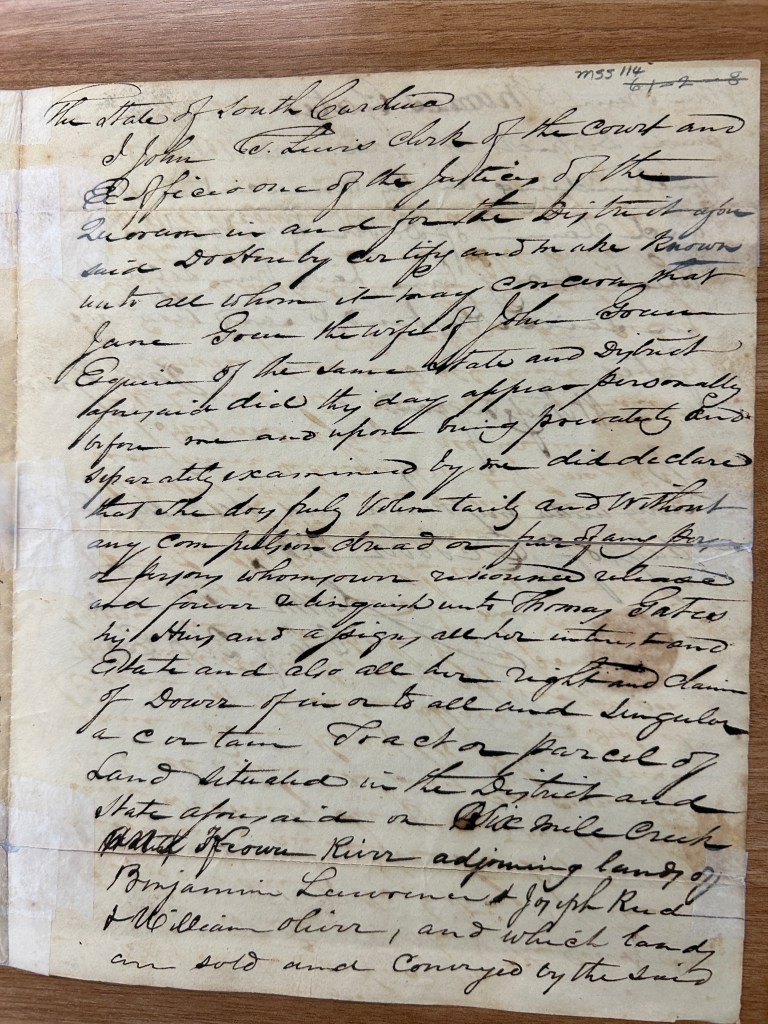
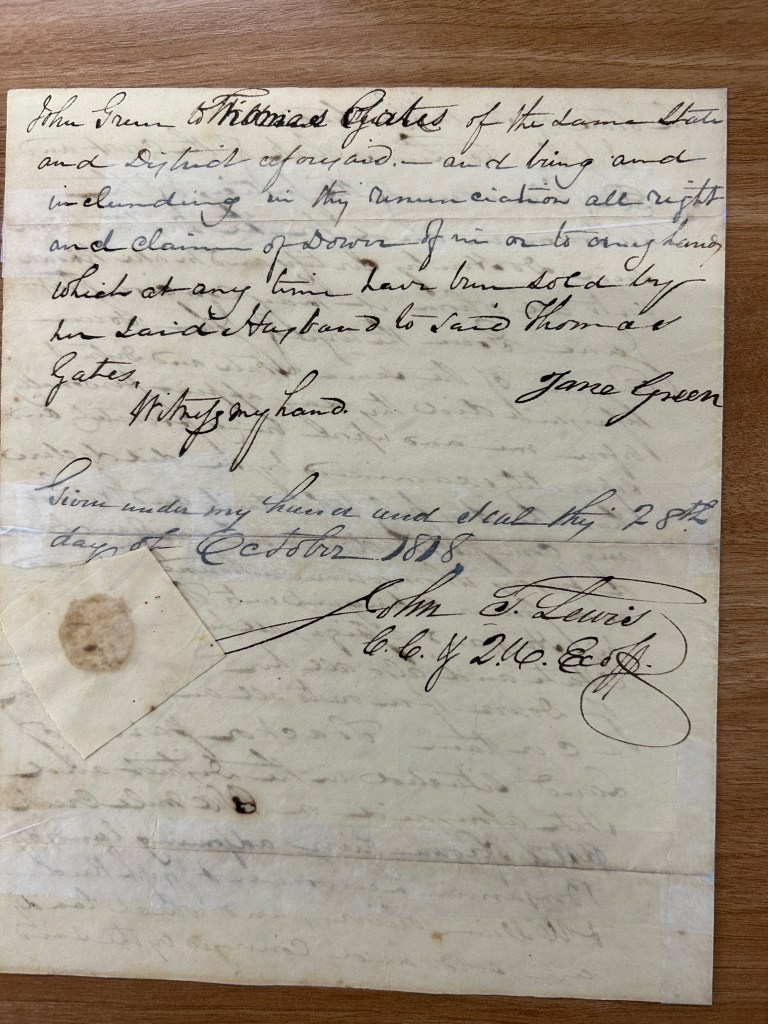
Jane Kerr Green’s original renunciation of dower document has survived and is now found in the “Lawrence Family Papers” at Clemson University’s Special Collections and Archives (box 1, mss 114). As noted above, John and Jane Green sold their land to Thomas Gates in 1818 as they moved to Alabama. On 14 December 1819, Gates sold some of the Green land to James and Elisha Lawrence, sons of the Greens’ neighbor Benjamin Lawrence, the land he had bought from John and Jane Green. The original plat for John Green’s 838 acres on the Keowee and Jane’s renunciation of dower passed from John and Jane to Thomas Gates as they sold their land to him, and from Gates to Lawrence, whose descendants saved these documents. In addition, Thomas Gates’ 14 December 1819 deed to James and Elisha Lawrence is preserved in the “Lawrence Family Papers” at Clemson’s archives. For a digital image of Gates’ deed to the Lawrence brothers, see this subsequent posting.
It seems clear to me that with this sale of their homeplace and its land in South Carolina, John and Jane Kerr Green were selling out to move their family to Alabama. The couple had eleven children at this point, with that last born in 1817 and no more to follow, and with ages ranging from 28 to less than a year old: Samuel Kerr, Elizabeth B., Benjamin S., Ezekiel Calhoun, Mary Calhoun, Joscelin B., Lucinda, John Ewing, James Hamilton, Jane Caroline, and George Sidney. Of these children, the only one who appears to have married by 1818 was Benjamin, and about that fact, I am not certain. I have not found the name of his first wife. As I’ve stated previously, a number of records suggest to me that Samuel K. and Ezekiel C. did not accompany their parents and siblings to Alabama, but went to Tennessee (Samuel) and Kentucky (Ezekiel) at the time the rest of their family left South Carolina for Alabama.
With native peoples who had been living in what became Alabama Territory in 1817 and then the state of Alabama in 1819 having been forced to cede their lands, settlers of European descent eager to acquire fertile new land began pouring into Alabama at this time. This land rush from the older states of the southeast was spurred by farmers’ and planters’ frustration due to depletion of their land after years of over-cropping with tobacco, and, later, cotton. As historian Carolyn Earle Billingsley notes,[24]
The Creeks and the Choctaws had been forced to cede lands in this area between 1814 and 1816, the Territory of Alabama had been created in 1817, and both Tuscaloosa and Bibb counties had been created in 1818. Tuscaloosa sat at the head of the Black Warrior River, a major transportation route from upper Alabama to the Alabama-Tombigbee rivers, which drained into Mobile Bay on the Gulf of Mexico. Tuscaloosa became a principal market for cotton, since it could then be transported by steamboat via the river. Cotton prices were extremely high after the War of 1812, reaching their peak about 1819.
With its virgin lands and the price of cotton high, Alabama was a promising site for settlers from the old southeast eager to profit from lucrative new farms and plantations. In 1817, Pendleton District had suffered from crop failures with resulting famine, affecting some families severely. In his history of the process of westward migration of planters from the old southeast, James David Miller cites correspondence of John C. Calhoun to his brother-in-law (and cousin) James Edward Calhoun, son of John Ewing Colhoun, when James Edward returned in 1820 from naval duty in China to Norfolk, Virginia.[25] John C. Calhoun wrote to James Edward Calhoun to tell him that in his absence, many relatives including Colonel Andrew Pickens and his brother Joseph and nephew Ezekiel had left Pendleton District for Alabama. Miller notes that after his move to Alabama, Andrew Pickens (who had been governor of South Carolina before removing to Alabama) remained in close touch with his Calhoun kin in South Carolina.[26]

As has been previously noted, Andrew Pickens (1779-1838), son of Andrew Pickens and Rebecca Calhoun, was a first cousin of John Green’s wife Jane Kerr. Following the removal of his parents in 1805 from their Hopewell house (built in 1785) on the Keowee in Pendleton District to their Tamassee plantation in what became Oconee County, Andrew and his brother Ezekiel were given the Hopewell house and Andrew lived in it up to his removal to Alabama. It appears that Andrew and Joseph Pickens moved to Alabama around the very same time that John and Jane Kerr Green did. A 23 August 1819 letter of Andrew Pickens to his cousin Captain William Noble of Abbeville archived in the Andrew Pickens papers at the South Caroliniana library of University of South Carolina indicates that Andrew was in Monticello, Jasper County, Georgia, at that time returning from “the Alabama” where he had left Joseph, who was intending to go to Tuscaloosa. A 21 April 1819 letter of John Ewing Colhoun’s widow Floride Bonneau Colhoun to her son James Edward Calhoun has Floride telling her son,[27]
I am most mortified that you did not write to Colonel Pickens, do write to him, and enclose it to me, he left Pendleton for the Alabama a week before John E. got up and expects to return in about two months.
Bless his heart, James Edward seems often to have mortified his mama Floride. But that’s a story for another posting down the road….
In a manuscript composed in 1983, Green descendant William Oscar Taylor states that John and Jane Kerr Green moved their family to Alabama when their son George Sidney Green was a month old. George Sidney was born 2 August 1817.[28] Since Jane’s dower renunciation for the land sold in Pendleton District on 4 May 1818 took place on 28 October 1818 in Pendleton District, I think the family left South Carolina at some point after 28 October 1818. If Jane filed the renunciation of dower as a last step before the family departed, then they may well have moved at the end of October or in early November 1818. Fall, when the weather was pleasant and usually not seriously inclement and crops had been harvested, was the preferred time for Southern families to relocate in this period.
Note that John and Jane headed to Tuscaloosa County, contiguous to Bibb County where they settled, when they left South Carolina, and that the 23 August 1819 letter of Jane’s cousin Andrew Pickens to their cousin William Noble mentioned above states that Andrew had left his brother Joseph in Alabama, intending to head to Tuscaloosa. In my next posting, I’ll pick up the story of John Green and his family after they have arrived in Alabama.[29]
[1] 1800 federal census, Pendleton District, South Carolina, p. 161, no. 852.
[2] Ibid., p. 104, no. 37.
[3] James Lee Green, Our Honoured Relation (Greenville, South Carolina: Southern Historical Press, 2009), p. 321, n. 394, citing the 1800 federal census, Waccamaw District, Georgetown County, South Carolina, p. 72.
[4] Abbeville District, South Carolina, Will Bk. 1, p. 304; and Abbeville District, South Carolina, estate files box 52, packet 1231.
[5] Pendleton District, South Carolina, Deed Bk. E, pp. 212-4.
[6] As cited, A.S. Salley, “The Calhoun Family of South Carolina,” South Carolina Historical Magazine 7,2 (April 1906), p. 155. The same death notice appeared in the Alexandria [Virginia] Advertiser and Commercial Intelligencer (25 November 1802), p. 3, col. 2.
[7] See supra, n. 4.
[8] Abbeville County, South Carolina, Equity Court case files box 58, packet 3245, Thomas P. Martin vs. William Oliver et al.
[9] According to an abstract by James Wooley, the deed is in a Pickens County estate packet for Floride Bonneau Colhoun: see Wooley, A Collection of Upper South Carolina Genealogical and Family Records, vol. 3 (Easley, South Carolina, Southern Historical Press, 1982), p. 46, citing a Pickens County estate packet, #70.
[10] Pendleton District, South Carolina, Deed Bk. H, pp. 342-3.
[11] Ibid., Deed Bk. G, p. 81.
[12] South Carolina Plat Bk. 41, p. 166.
[13] Pendleton District, South Carolina, Deed Bk. I, p. 202.
[14] South Carolina Plat Bk. 41, p. 314.
[15] See “Keowee / John Ewing Colhoun,” at the Historic Marker Database website, with notes submitted in December 2011 by Brian Scott.
[16] Jim Melvin, “When Paths Converge,” Clemson World (spring 2017), online at the website of Clemson World.
[17] Pendleton District, South Carolina, Deed Bk. K, p. 25.
[18] 1810 federal census, Pendleton District, South Carolina, p. 152.
[19] R.W. Simpson, History of Old Pendleton District, with a Genealogy of the Leading Families of the District (Anderson, South Carolina: Oulla, 1913), p. 23. See also Pendleton District Historical and Recreational Commission, Pendleton Historic District: A Survey (Pendleton, South Carolina: Pendleton District Historical and Recreational Committee, 1973), p. 26, which offers a photo of the society’s building built between 1826-8; and see “Pendleton Farmers’ Society Membership Roll,” in the Mary Stephenson Collection of Clemson University Library’s Special Collections and Archives (box 21, folder 5, mss 353), which shows John Green as a member of the society in 1815.
[20] Pendleton District, South Carolina, Deed Bk. M, p. 474.
[21] Ibid., Bk. S, p. 64.
[22] Ibid., Bk. O, pp. 136-8, 234-5. The deed is also recorded in Bk. M, pp. 593f.
[23] Pendleton District, South Carolina, Will Bk. 1, pp. 1-3.
[24] Carolyn Earle Billingsley, “Antebellum Planters: Communities of Kinship on the Cotton Frontier,” East Texas Historical Journal 39,2 (fall 1997), pp. 58-74.
[25] James David Miller, South by Southwest: Planter Emigration and Identity in the South and Southwest (Charlottesville: University of Virginia, 2002), p. 18, citing Meriwether, Papers of John C. Calhoun, vol. 5, p. 96.
[26] Miller, South by Southwest, p. 153, n. 1.
[27] The letter is in the James Edward Calhoun papers at the South Caroliniana library of the University of South Carolina in Columbia.
[28] William Oscar Taylor, “John Ewen Green 1843-1930 and Descendants,” typescript (1983). Michael W. Taylor of Albemarle, North Carolina, kindly sent me a copy of this typescript in February 2003.
[29] Some records for men named John Green in Pendleton District in the period 1810-8 that may or may not pertain to the John Green with wife Jane Kerr: on 4 May 1810, a John Green applied to be guardian of Simeon and Elizabeth Webb in Pendleton, Simeon being 8 and Elizabeth 7 (Pendleton District, South Carolina, Probate Bk. C, p. 182; on 18 June 1814, a John Green inventoried the estate of Joseph Smith in Pendleton District (Pendleton District, South Carolina, estate files box 19, packet 661); on 26 October 1818, John Green sold to William Duckworth land on Big Creek from the William Honey tract (Pendleton District, South Carolina, Deed Bk. O, p. 231). This last record is almost certainly not a record of John Green with wife Jane Kerr.
 BEGATS AND BEQUEATHALS
8 thoughts on “John Green (1768-1837): Pendleton District, South Carolina Records, 1800-1818”