James Whitlock (1762-1804)
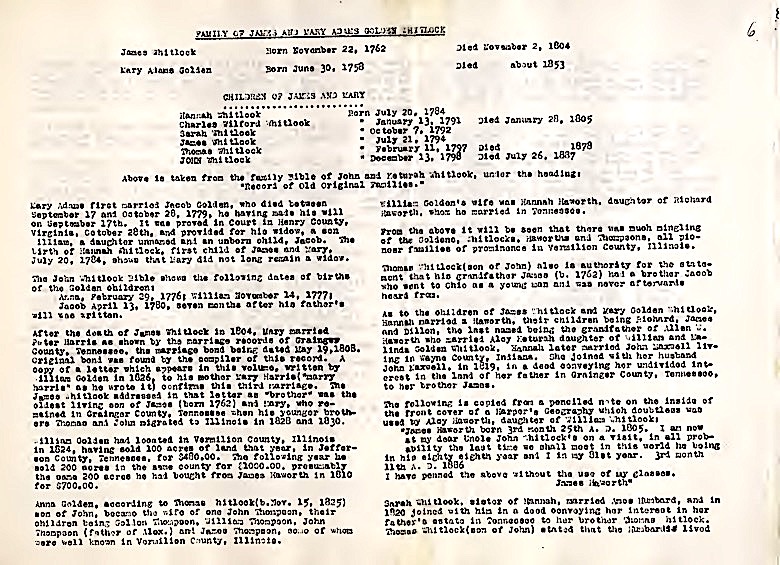
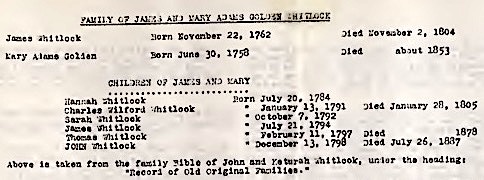
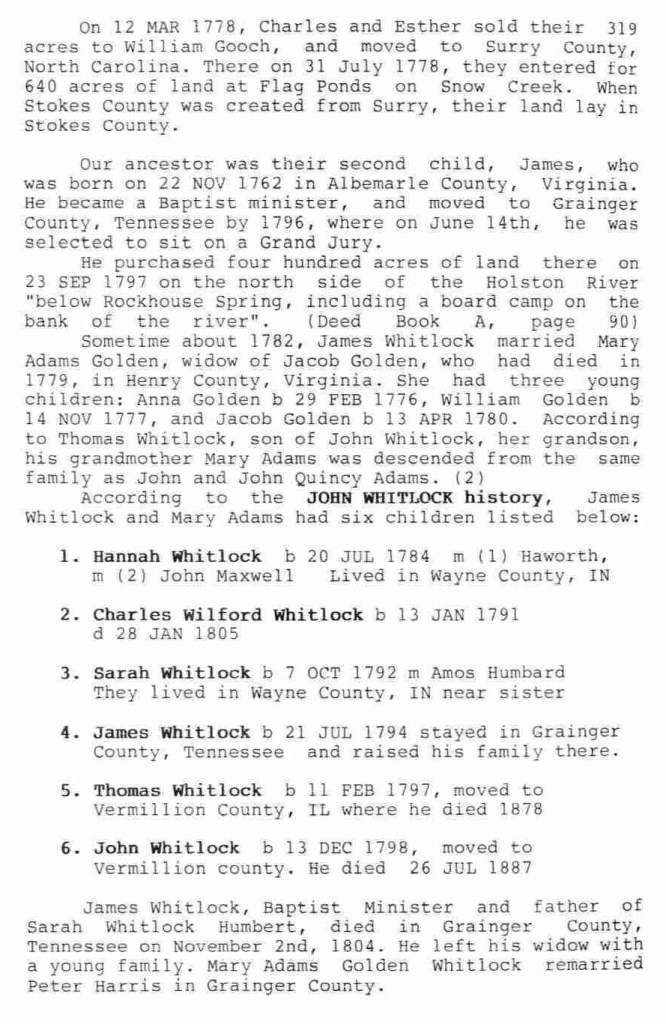
4. James Whitlock, son of Charles and Esther Whitlock, was born 22 November 1762 in Albemarle County, Virginia, and died 2 November 1804 in Grainger County, Tennessee. According to Richard E. Whitlock, a grandson of James’s son John Whitlock (1798-1887), these dates of birth and death are written in a bible that belonged to John Whitlock and his wife Keturah Quine.[1] In a book he published in 1940 about the family of John and Keturah, Richard Whitlock states that when John and Keturah moved in 1830 from Grainger County, Tennessee, to Vermillion County, Illinois, Keturah brought along a small family bible in which were written dates of birth, death, and marriage of family members.[2] I am assuming that this is the family bible in which James Whitlock’s dates of birth and death and his wife Mary’s date of birth were recorded. His book does not have further information about the bible and its whereabouts in 1940, nor have I seen that information elsewhere.

Note a problem here: if the birthdate of William Whitlock, brother of James Whitlock, was 4 June 1762, as William’s tombstone appears to indicate, then either that birthdate or the date of birth given for James Whitlock in John and Keturah Whitlock’s bible cannot be correct. Two brothers cannot have been born in June and November of the same year.
Numerous published family trees for James Whitlock and wife Mary Adams (Golden) state that James was born in Charlotte County, Virginia, or “Charlotte, Albemarle County, Virginia.” There is no Charlotte in Albemarle County, though there’s a Charlottesville; and the information that James Whitlock was born in Charlotte County is incorrect. As we’ve seen, Charles and Esther Whitlock, parents of the James Whitlock I’m discussing here, can confidently be placed in Albemarle County from 1760 (and possibly 1759: see the linked posting) to 1778.
According to Richard E. Whitlock, the bible of John and Keturah Whitlock states that James Whitlock’s wife Mary Adams (Golden) was born 30 June 1758.[3] Mary was the widow of Jacob Golden at the time James Whitlock married her. Jacob died testate in Henry County, Virginia, with a will dated 17 September 1779 and probated 28 October 1779.[4] To my knowledge, no one has found a marriage record for James Whitlock and Mary Adams (Golden); the marriage would have occurred following Jacob Golden’s death sometime before 28 October 1779 and the birth of James and Mary’s first child, Hannah Whitlock, on 20 July 1784.[5]
As the previous posting notes, the Shelton family who lived next to the family of Charles Whitlock in Stokes County, North Carolina, and into which Charles’s son William married, came to Surry (later Stokes) County, North Carolina, from Henry County, Virginia, and lived in a part of Henry County that became Patrick County in 1791. Patrick borders Stokes on the north, and, as we’ll see in a moment, James’s brother Thomas Whitlock settled there after marrying his wife Margaret Bryson. It seems likely that James Whitlock and Mary Adams (Golden) married either in Henry County, Virginia, or Surry (later Stokes) County, North Carolina.
After marrying, James Whitlock and wife Mary settled in Stokes County. As we’ve seen in a preceding posting, James was taxed for 200 acres in 1790 in Captain Beasley’s district in Stokes County near his father Charles Whitlock, and it appears that these 200 acres were land that Charles had shared with his son James from the 640-acre tract on Snow Creek that Charles had claimed in 1778. As the linked posting also states, the 1790 federal census enumerates James on the same page in Stokes County on which his father Charles is listed.[6]
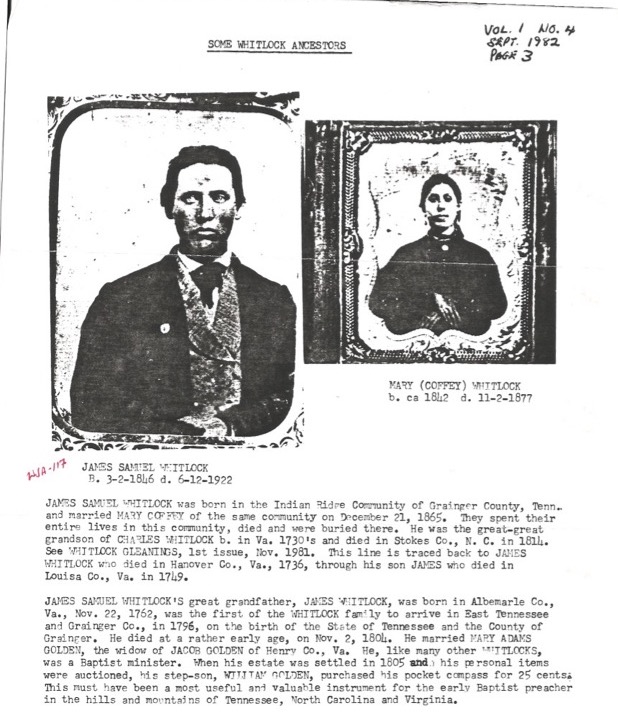
From 1792 through 1795, James was taxed again in Captain Beasley’s district with 200 acres, and after 1795, he disappears from Stokes County tax lists, evidently having moved to Tennessee. According to Thomas Edward Roach, James Whitlock moved his family to Tennessee by 1796 and he was “the first of the Whitlock family to arrive in East Tennessee.”[7] As the previous posting indicates, James’s brother Alexander also went to east Tennessee, arriving there by 1796 when he appears on the tax list in Sullivan County. By 1799, James Whitlock shows up on the tax list of Grainger County. Grainger is west of Sullivan, with Hawkins County lying between the two counties. Grainger was created in 1796 from Knox and Hawkins Counties.
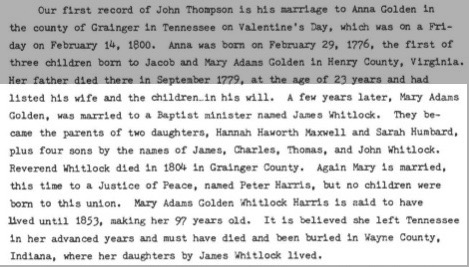
Multiple published accounts of this family including Richard E. Whitlock’s John Whitlock and Keturah Quine Whitlock state that James Whitlock was a Baptist minister.[8] Virginia Biddle Thode suggests that James was already a Baptist minister at the time he married Mary Adams.[9]
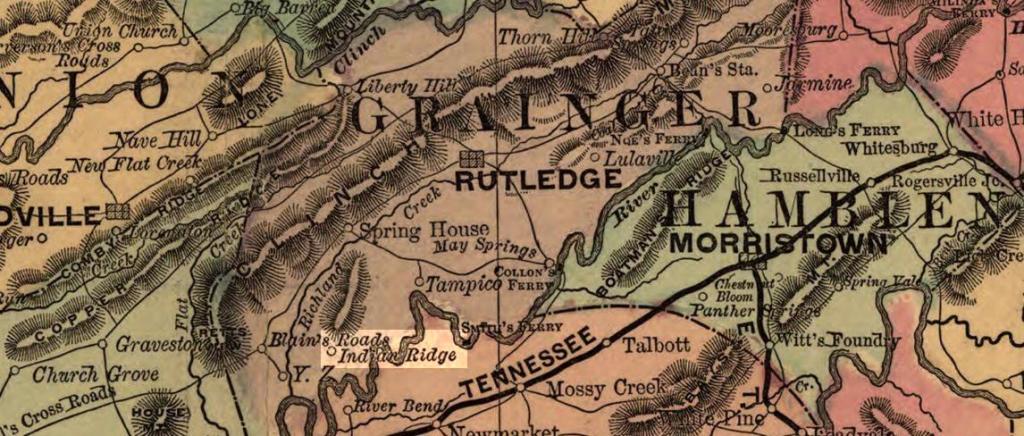
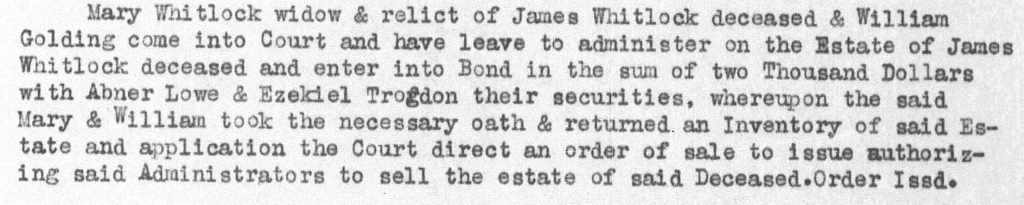
After moving to Grainger County, Tennessee, the Whitlock family settled on the north side of the Holston River at Indian Ridge near the Grainger-Jefferson County border.[10] This is where James Whitlock died on 2 November 1804, aged just short of 42 years. On the third Monday in November, his widow Mary appealed to Grainger County court for administration of James’s estate, giving bond with her son William Golden (court minutes give his surname as Golding) with Abner Lowe and William Trogdon as securities.[11] At this court session, Mary was made administrator. She filed an estate inventory on the same day and an order for sale of James’s estate was granted. As a previous posting notes, the 24 March 1811 Stokes County, North Carolina, will of James’s father Charles Whitlock states that Charles’s son James had predeceased him and leaves a bequest to James’s heirs without naming them: “Vizt to the heirs of my son James Whitlock desd five pounds.”[12]
Following James Whitlock’s death, his widow Mary remarried to Peter Harris, and according to Virginia Biddle Thode, she is believed to have left Tennessee in her late years and to have gone to Wayne County, Indiana, where her daughters by James Whitlock lived.[13] She’s thought to have died there in 1853. Richard E. Whitlock states that Peter Harris gave bond in Grainger County on 8 May 1808 for his marriage to Mary Adams (Golden) (Whitlock).[14]
Note that James Whitlock was likely named for Charles Whitlock’s father James Whitlock.
Thomas Whitlock (1766-1841)
5. Thomas Whitlock, son of Charles and Esther Whitlock, was born in 1766 in Albemarle County, Virginia. His obituary in the Lynchburg Virginian on 22 November 1841 states that he had died 26 October 1841 at his residence in Patrick County, Virginia, aged seventy-five years.[15] This places his birth in 1766. His parents were living in Albemarle County at that point in time.
As Chris Crookston notes, both Charles Whitlock and a James Whitlock who married Sylvia Jones and who moved from Lunenburg County, Virginia, to Rowan County, North Carolina, by 1768, and whose children appear in records of Surry County, North Carolina, named sons Thomas, John, and James.[16] Both also named daughters Agnes, and as Peter Whitlock notes, James Whitlock with wife Sylvia Jones may well be the James Whitlock who is listed as a son and heir of James Whitlock (married Agnes Christmas) in the 20 November 1757 Louisa County, Virginia, settlement of James Whitlock’s estate.[17] That is, Charles Whitlock and James Whitlock of Rowan County, North Carolina, may have been brothers.
As Chris Crookston and Peter Whitlock, citing notes of Bobby and Mandane Ennis indicate, there has been confusion regarding the sons of James and Sylvia Jones Whitlock named Thomas, John, and James, and the sons of the same name belonging to Charles and Esther Whitlock.[18] The confusion is compounded by the fact that members of both families are found in Surry County records at the same time. Charles’s son Thomas has been confused with James’s son Thomas, who married 1) Catherine Steelman and 2) Mary Ponsonbay.
The Thomas Whitlock who was son of Charles and Esther Whitlock married Margaret, daughter of John and Margaret Bryson of Surry County, who is said to have been born 11 May 1765 in Orange County, Virginia. This family and its Whitlock connections have been discussed in previous postings which note that Margaret had a brother James whose son Abner Bryson married Nancy Whitlock, a daughter of Thomas Whitlock and Hannah Phillips. Another child of James Bryson, his daughter Susannah, married James Hanna, whose brother William Hannah married a daughter of Thomas Whitlock and Hannah Phillips whose name is not known but was, I suspect, probably Agnes.
I have not found a record of when and where Thomas Whitlock married Margaret Bryson. Their first daughter Nancy was born in or about 1799 in Virginia, so the marriage likely took place around 1798.
Thomas was living in Surry County along with other members of Charles Whitlock’s family on 4 January 1788 when he witnessed a deed by James Meredith Sr. to William Martin for land on Crooked Creek in Surry.[19] As Chris Crookston notes, the land Meredith was selling Martin in 1788 fell into the far northeastern corner of Stokes County the following year, where the family of Charles Whitlock lived.[20] As Crookston also notes, William Martin is found on the federal census in Stokes County in 1790 on the same page as Charles Whitlock. This allows us to distinguish the Thomas Whitlock witnessing this 1788 deed from the Thomas who was son of James Whitlock and Sylvia Jones and who lived on Dutchman Creek in Surry County quite a distance south and west from where Charles Whitlock’s family lived on Snow Creek in Stokes County.
As a previous posting has noted, Thomas, son of Charles, is on the 1791 tax list in Captain Beasley’s district in Stokes County, where his father lived, taxed with no land and one poll, and he is taxed again in 1792-3 next to his father and again with no land and one poll. In 1794-6, Thomas is not on the Stokes County tax list, having moved to Patrick County, Virginia, where he was appointed 2nd lieutenant of a militia unit on 29 April 1794 and commissioned for that duty on 30 October 1794.[21] On 29 April 1796, Thomas Whitlock qualified as a justice of the peace in Patrick County and served in that capacity until 1816.[22]
As a previous posting indicates, Thomas Whitlock, son of Charles, testified in Wythe County on 7 April 1803 in the Whitlock vs. Whitlock trial about the disposition of land Thomas Whitlock elder (with wife Hannah Phillips) had promised to give his son Charles, who was killed in an accident in Wythe County in April 1796.[23] Charles’s widow had laid claim to this land on behalf of her daughters Agnes and Hannah. In his affidavit, Thomas Whitlock younger testified that he was with the family of his uncle Thomas Whitlock at the time Charles died in April 1796.
On 8 September 1804, Thomas’s father-in-law John Bryson made his will in Surry County, North Carolina, naming Margaret Whitlock as John’s daughter, and Thomas Whitlock an executor of John’s estate along with his sons James and John Bryson.[24] An account of the sale of John Bryson’s estate held in Surry County on 12 January and 4 March 1808 found in a loose-papers estate file for John Bryson held by the North Carolina archives shows Thomas Whitlock as a buyer at the estate sale.
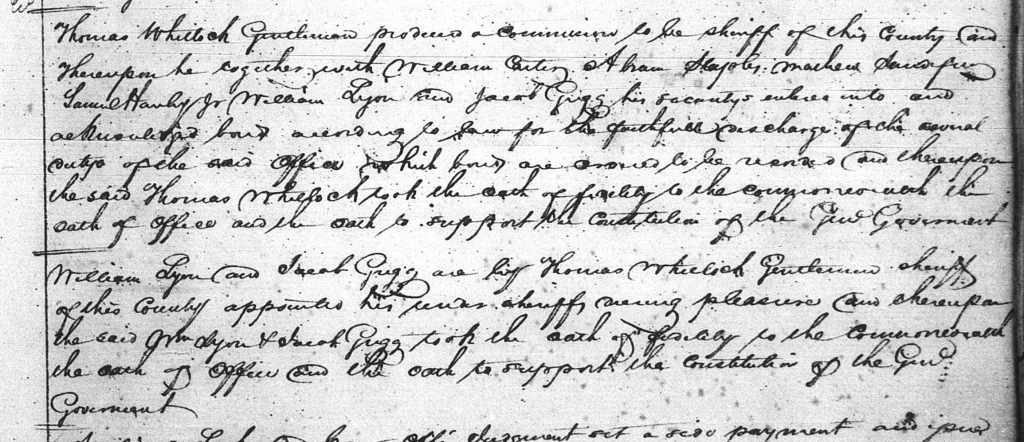
On 15 August 1817, Thomas Whitlock was commissioned sheriff of Patrick County, giving bond on that date with William Carter, Abram Staples, Matthew Sandifur, Samuel Hanby Jr., William Lyon, and Jacob Grigg, and taking an oath of fidelity to the Commonwealth.[25] Thomas served as the county sheriff from 1817-9.[26]
I have not seen information about when Margaret Bryson Whitlock died. She’s not mentioned in Thomas’s 14 July 1841 will in Patrick County, so she evidently predeceased him. The 1830 federal census shows both a male and a female in the 60-69 age range living in Thomas’s household in Patrick County.[27] But in 1840, the federal census shows a male 70-79 in Thomas’s household, but no female in that age range.[28] The oldest female in the household is aged 40-49. As we’ll see in a moment, Thomas’s July 1841 will makes a stipulation that his daughter Nancy Bray is to be permitted to live in his dwelling house during her lifetime, with her brothers John and Martin inheriting Thomas’s land. I think that Nancy had been widowed by 1840 and was living with her father and her children when the census was taken in that year.
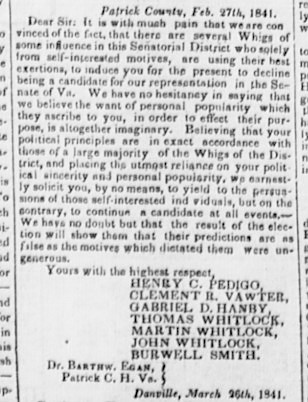
The Richmond Whig on 8 April 1841 published a letter written on 27 February 1841 to Dr. Bartholomew Egan of Patrick courthouse.[29] The letter was written jointly by Henry C. Pedigo, Clement R. Vawter, Gabriel D. Hanby, Thomas Whitlock and his sons Martin and John, and Burwell Smith. It states that some Whigs in the local senatorial district were seeking to discourage Egan from running for office as a Whig candidate, but in the view of the signatories, he was well-situated to represent the district as an outstanding candidate. This letter is followed by a response from Egan thanking the letter writers and styling Thomas Whitlock as Thomas Whitlock Esq.
Bartholomew Egan (1795-1891), an Irish native, was a graduate of Trinity College in Dublin whom Thomas Jefferson brought to Virginia as a professor at University of Virginia. He maintained a classical school in Albemarle County and then in Henry County before moving to Mount Lebanon in Bienville Parish, Louisiana, where he was president of Mount Lebanon College and founded the North Louisiana Medical Society.
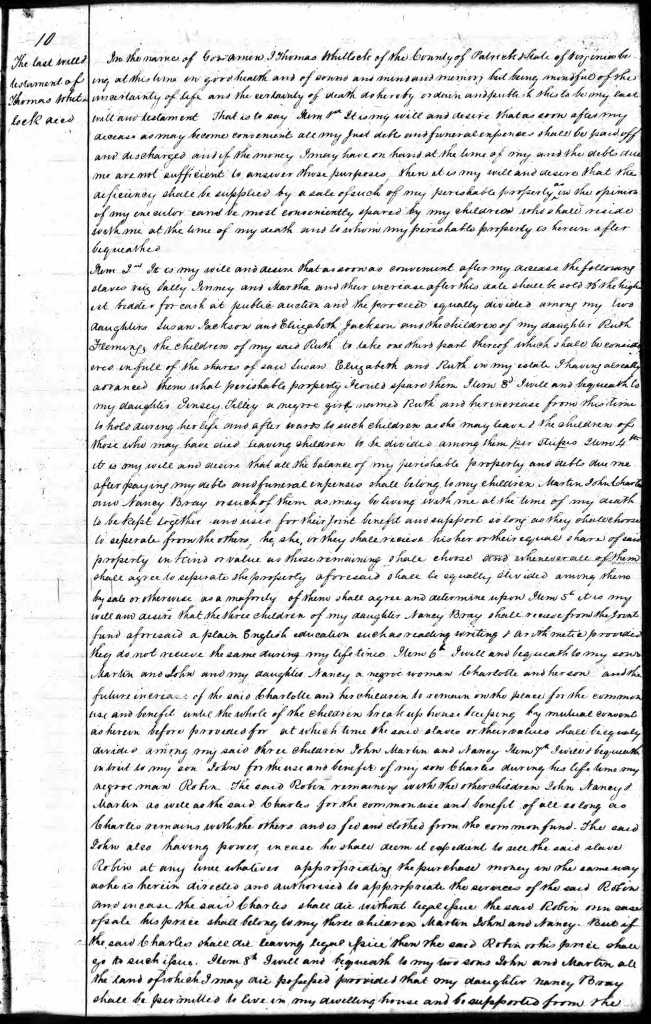
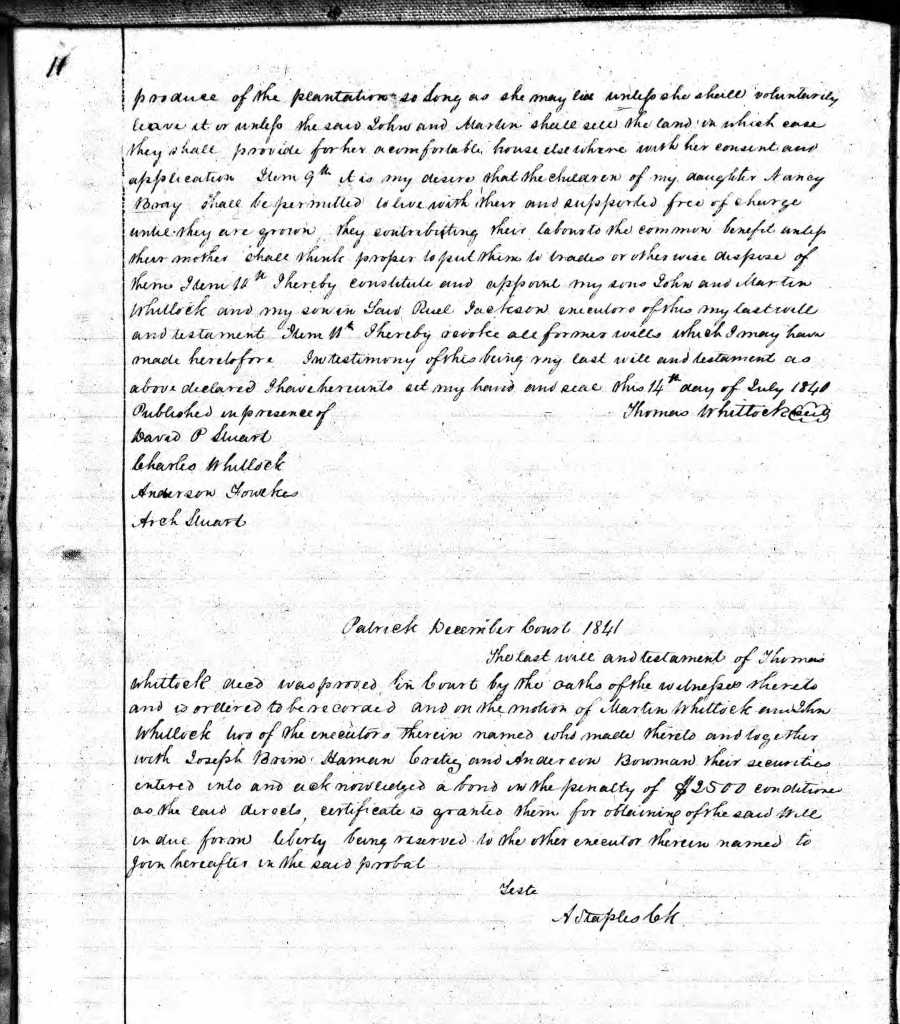
On 14 July 1841 in Patrick County, Thomas Whitlock made his will.[30] The will states that Thomas was of Patrick County. It stipulates that enslaved women Sally, Jenny, and Martha were to be sold at public auction and the money gained from that sale divided between Thomas’s daughters Susan and Elizabeth Jackson and the children of his daughter Ruth Fleming. This was to be the full share of his estate these three daughters were to have, Thomas already having advanced to each what perishable property he could spare.
To his daughter Jinsey Tilley, Thomas bequeathed an enslaved woman Ruth and her increase, to be divided among Jinsey’s children and their children. The balance of his perishable property once his expenses and debts had been paid was to go to Thomas’s children Martin, John, Charles, and Nancy Bray, “or such of them as may be living with me at the time of my death, to be kept together and used for their joint benefit and support.” Those who chose to separate from the other siblings were to receive their proportionate share.
Thomas specified that the three children of his daughter Nancy Bray were to receive “from the joint fund aforesaid a plain English education, such as reading, writing, and arithmetic, provided they do not receive the same during my life time.” To Martin, John, and Nancy, Thomas left an enslaved woman Charlotte, with her future increase to be shared by the three children of Thomas jointly.
To his son Charles, Thomas bequeathed an enslaved man Robin to be held in trust by Charles’s brother John, who was given the right to decide to sell Robin at any point he might choose to do so. John and Martin were left all of Thomas’s land with the stipulation that their sister Nancy Bray was to live in Thomas’s dwelling house during her lifetime, with her children also permitted to live there and to work for the common benefit of the siblings at home, unless Nancy chose to put them into trades or otherwise dispose of them.
John and Martin Whitlock were named executors along with their brother-in-law Ruel Jackson. Thomas Whitlock signed and sealed the will with witnesses David P. Stuart, Charles Whitlock, Anderson Fowkes, and Arch(ibald) Stuart. I think the Charles Whitlock witnessing the will was Thomas’s son Charles, who was given a bequest in trust and therefore, as an heir not receiving a direct legacy, qualified to witness the will. The witnesses proved the will at December court in Patrick County and John and Martin gave bond for execution with securities Joseph Bram, Harman (Cratiz?), and Anderson Bowman.
As noted previously, the Lynchburg Virginian published an obituary of Thomas Whitlock on 22 November 1841, stating that he had died at his Patrick County residence on 26 October 1841 (see the image at the head of this posting).[31] The obituary notes Thomas’s years of service as a justice of the peace, and states that he was held in esteem by his fellow citizens. It also states that he was not a member of any church, an important piece of information, since researchers have persistently stated that Thomas was a minister of the gospel. They are basing that conclusion, I think, on the fact that he appears in Patrick County records on numerous occasions as an official marrying couples — but he was officiating at these marriages as a J.P. and not an M.G.

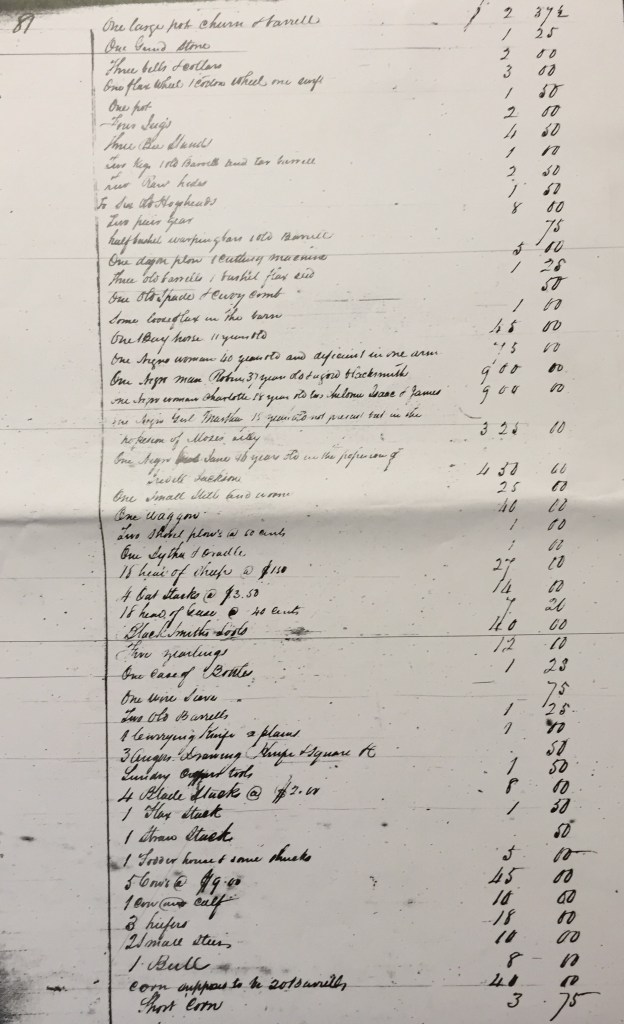

An estate inventory done on 10 January 1842 by Martin Cloud, Fowkes Smith, and A.G. Lewis provides more information about some of the enslaved persons mentioned in the will.[32] Robin was aged 37 and was a blacksmith; Charlotte was aged 18 and had children Isaac and James; Martha was aged 15 and was in the possession of Moses Tilley, husband of Thomas’s daughter Jincey; Jane (Jenny) was in possession of Iredell Jackson, husband of Thomas’s daughter Elizabeth; and one enslaved person is not named, but is described as a woman aged 40 with a deficient arm. I think the last enslaved person is Sally, who is mentioned with Jenny and Martha in the will.
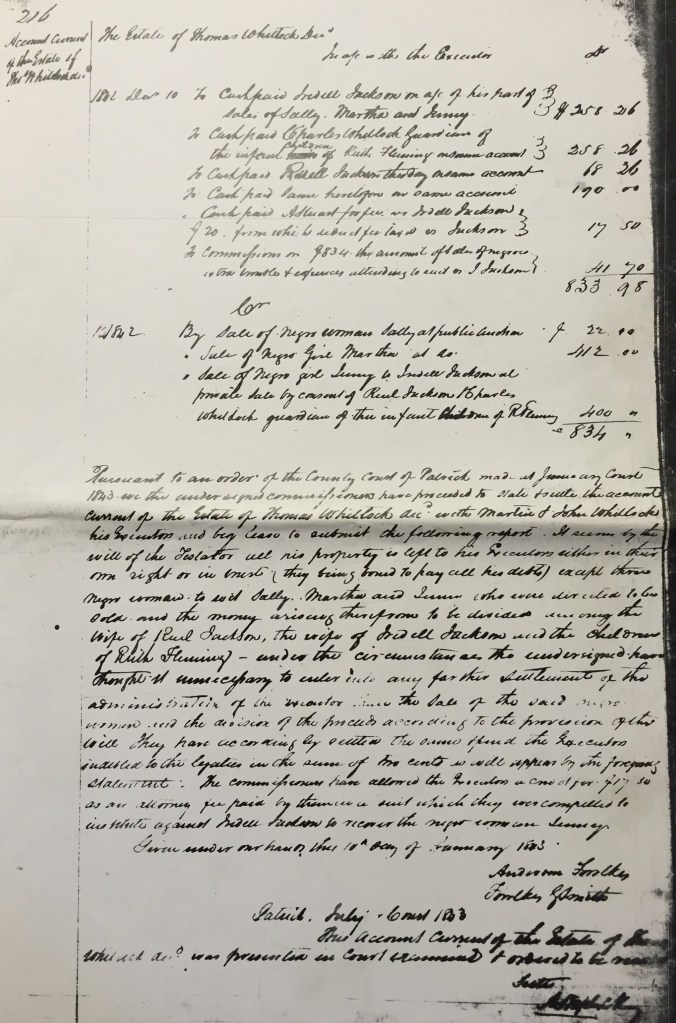
An estate account dated 1842 with no day or month states that Sally and Martha had been sold at public auction and Jenny was sold in a private sale to Iredell Jackson, with Ruel Jackson (husband of Thomas’s daughter Susanna) and Charles Whitlock, as guardian of Ruth Fleming’s children, consenting to this sale.[33] The fact that Sally was sold for $22, while Martha was sold for $400 and Jenny for $412, confirms, I think that Sarah is the enslaved woman aged 40 with a deficient arm who is not named in the estate inventory.
At May court 1847, Arch Stuart, Martin Cloud, and James D. Cloud filed an inventory and appraisement of the estate of Thomas Whitlock belonging to his son Charles.[34] This states that an order was given by Patrick County court on 3 December 1846 for the estate of Thomas Whitlock belonging to his son Charles and in the hands of Charles’s brother John to be appraised. The inventory document repeats the stipulation of Thomas’s will that Martin, John, Charles, and Nancy Bray were to share Thomas’s estate as long as they remained together, and the enslaved man Robin was to be held in trust by John for Charles’s benefit and sold at John’s decision, if John chose to do that.
The inventory states that the siblings had remained together, except for Charles, who had been sent to the Western Lunatic Asylum or Hospital, and word had been received by his siblings that he had now been cured and they expected him home at any time. Robin remained in possession of the family with John as trustee, and was valued at $400.
There is likely more information to be found about Thomas Whitlock in records of Surry County, North Carolina, and Patrick County, Virginia, than I have reported here. I have not done an exhaustive search for records about him in the records of those two counties.
As I noted previously, it seems to me that Charles and Esther Whitlock named their son Thomas after Charles’s brother of that name, who appears to have had particularly close ties to his brother Charles and Charles’s family. Charles’s brother Thomas was likely named for his maternal grandfather Thomas Christmas, father of Agnes Christmas Whitlock.
Mary Whitlock Pruett (abt. 1774? – bef. 1820)
6. My information about Mary Whitlock, the daughter of Charles and Esther Whitlock named in Charles’s will as Mary Pruett, is sketchy. The 1800 federal census shows the family of William Pruett living in Stokes County next to Mary’s brother Charles Whitlock.[35] This census places Mary and her husband William in the 26-44 age range, with birth years falling between 1756 – 1774. In 1800, William’s family has four children under 10 years of age in the household, and that suggests to me that he and wife Mary would likely have been born closer to 1774 than to 1756. Unfortunately, I cannot locate William on the 1810 federal census, and by 1820, when I do find him again on the federal census in Stokes County, which has him aged 45+, there is not an older female in the household.[36] Mary seems to have died by 1820. So I have no federal census other than the 1800 census on which to estimate her year of birth. I’m inclined to think that she was born between her brother Thomas, who was born in 1766, and Charles, who was born in 1774.
According to Richard A. Prewitt, William Pruett was born about 1773 and was the son of Willis Pruitt or Pruett, who was born in Lunenburg County, Virginia, about 1749.[37] On 18 May 1789, William’s brother Micajah Pruett had a grant for 100 acres on Snow Creek in Stokes County, where the Whitlock family lived.[38] The land was assigned to him by Henry Baker. Micajah made an affidavit at Pikeville in Blount County, Tennessee, on 4 May 1840, as he applied for a Revolutionary pension.[39] His affidavit states that he was born in 1765 in Bedford County, Virginia, and lived in Surry County, North Carolina, among other places, following his service in Bedford County.
As noted in a previous posting, on 1 January 1802, William Prewett of Stokes County bought from Elections Musick of Stokes County 140 acres on Snow Creek bordering William Nelson.[40] The deed states that the land was part of 250 acres “originally made” for Musick on 22 October 1779, and issued to him in 1780. William paid £180 for the land. Mary Whitlock Pruett’s brothers John and William Whitlock witnessed the deed.
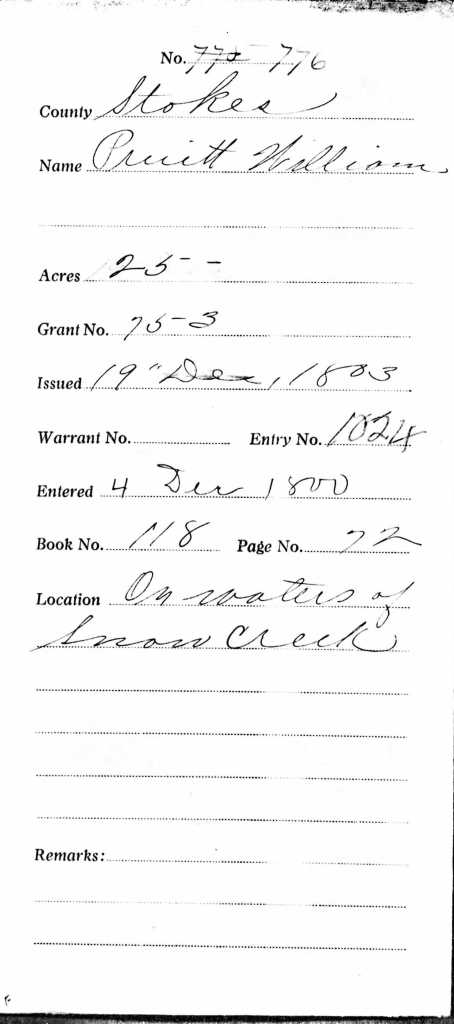


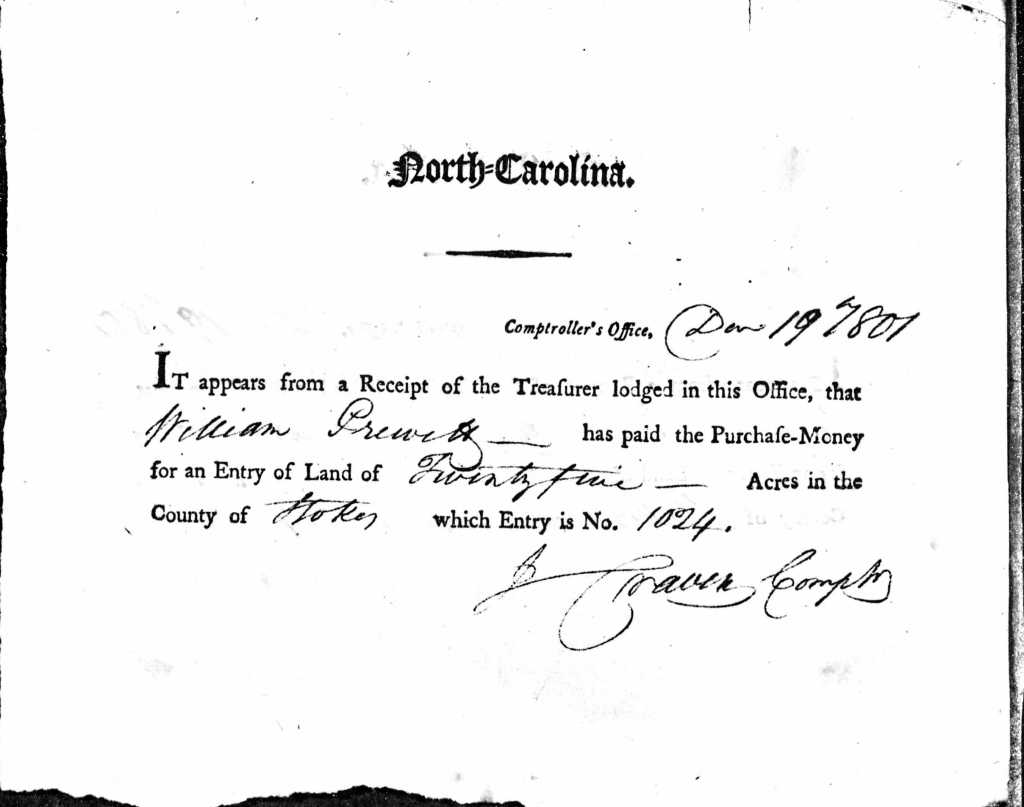
On 19 December 1803, William Pruitt had a land grant for 25 acres on Snow Creek in Stokes County.[41]The land bordered Charles Whitlock, Elections Musick, and Jacob Nelson. William had entered the land on 4 December 1800.
On 3 December 1808, William Pruitt sold to Robert Flinchum, both of Stokes County, the 140 acres on Snow Creek he had bought in January 1802 from Elections Musick.[42] As noted above, William’s brother-in-law John Whitlock and wife Caty witnessed this deed.
On the same day, 3 December 1808, William also sold Robert Flinchum the 25 acres on Snow Creek granted to him in December 1803, again with his brother-in-law John Whitlock and wife Caty as witnesses.[43]
As I note above, I find William Pruett on the 1820 federal census in Stokes County, and after that time, I no longer find him on the federal census in Stokes County. I have also not found a will or probate record for him.
In the next posting, I’ll provide information about the final two children of Charles and Esther Whitlock, their sons Charles and John.
[1] Richard E. Whitlock, John Whitlock and Keturah Quine Whitlock and Their Descendants to December 31, A.D. 1937, with Miscellaneous Data Pertaining to Their Antecedents Back to 1758 and Their Family History and Pioneering Days in Grainger County, Tennessee and Vermilion County, Illinois (Sioux City, Iowa, 1940), p. 6. Other published works that appear to be citing Richard E. Whitlock’s information about the dates of birth and death of James Whitlock include Leroy Cecil Bennett, The James Y. Bennett Family, Starke County, Indiana Pioneers: A Record of the Ancestors, the Family and the Descendants of James Yeargin Bennett 1822-1873, Hannah Humbert Bennett 1823-1887 (Plymouth, Michigan, 1988), p. 72; and Thomas Edward Roach, Whitlock Gleanings: A Genealogical Work Book (Rutledge, Tennessee, 1982), pp. 14-53. See also Thomas E. Roach’s query in Echoes from the East Tennessee Historical Society 27,2 (July 1981), p. 83, giving the same dates of birth and death for James Whitlock.
[2] Whitlock, John Whitlock and Keturah Quine Whitlock, p. 10.
[3] Ibid., p. 6.
[4] Henry County, Virginia, Will Bk. 1, p. 29. The will is transcribed in ibid., p. 8.
[5] Whitlock, John Whitlock and Keturah Quine Whitlock, p. 6.
[6] 1790 federal census, Stokes County, North Carolina, Salisbury district, p. 179.
[7] Roach, Whitlock Gleanings 1,4 (September 1982), p. 3.
[8] Ibid., p. 12 and Roach, Whitlock Gleanings: A Genealogical Work Book, p. 62. See also Bennett, The James Y. Bennett Family, p. 92; Virginia Biddle Thode, John Thompson (Born 1772, Married Valentine’s Day, 1800, in Grainger Co., Tennessee), Early Settler in Vermilion County, Illinois in 1820s: His Wife, Anna Golden and Their Descendants (Tuscola, Illinois, 1983), p. 3; and Thomas Edward Roach, Whitlock Gleanings 1,4 (September 1982), p. 3.
[9] Thode, John Thompson, p. 3.
[10] Ibid., p. 30.
[11] Grainger County, Tennessee, Court Minute Bk. 2, p. 84. Grainger court minutes on 19 May 1814 name the heirs of James’s estate, as they petitioned for a division of his land (Bk. 3, p. 181).
[12] The original will is on file with the North Carolina Archives; see also Stokes County, North Carolina, Will Bk. 2, pp. 153-4.
[13] Thode, John Thompson, p. 3.
[14] Whitlock, John Whitlock and Keturah Quine Whitlock, p. 6.
[15] Lynchburg Virginian (22 November 1841), p. 3, col. 4, available digitally at the Virginia Chronicle pages of the Library of Virginia website.
[16] See Chris Crookston, “The James Whitlock Family of Rowan & Surry County, NC…Part 2,” at his blog Will The Real Isaac Jones Please Step Forward?
[17] Peter Whitlock, “Thomas Whitlock of Rowan County, North Carolina,” Whitlock Family Newsletter 32,2 (June 2013), pp. 10-11, online at the website of Whitlock Family One-Name Study. See Louisa County, Virginia, Inventory Bk. 1743-1790, pp. 39-40, for the settlement of James Whitlock’s estate in November 1757.
[18] Crookston, “The James Whitlock Family of Rowan & Surry County, NC…Part 2, and Peter Whitlock, “Thomas Whitlock of Rowan County, North Carolina.”
[19] Surry County, North Carolina Deed Bk. D, pp. 378-9.
[20] Crookston, “The James Whitlock Family of Rowan & Surry County, NC…Part 2.
[21] See Patrick County, Virginia, Court Order (Common Law) Bk. O for these dates; the book is unpaginated.
[22] Ibid.
[23] Augusta County, Virginia, Chancery Court case, Whitlock vs. Whitlock, box 10, file 38 (1803-4), available digitally via Library of Virginia’s Virginia Memory chancery records collection
[24] The original will and estate papers are held by North Carolina Archives. See also Surry County, North Carolina, Will Bk. 3, p. 84.
[25] Patrick County, Virginia, Court Order (Common Law) Bk. 2 for this date (unpaginated).
[26] O.E. Pillson, History of Patrick County, Virginia (Stuart, Virginia: Patrick County Historical Society, 1999), p. 83.
[27] 1830 federal census, Patrick County, Virginia, p. 178.
[28] 1840 federal census, Patrick County, Virginia, p. 36.
[29] Richmond Whig (8 April 1841), p. 2, col. 4.
[30] Patrick County, Virginia, Will Bk. 3, pp. 10-11.
[31] See supra, n. 15.
[32] Patrick County, Virginia, Will Bk. 3, pp. 80-2.
[33] Ibid., p. 216.
[34] Ibid., pp. 469-470.
[35] 1800 federal census, Stokes County, North Carolina, Salisbury district, p. 585.
[36] 1820 federal census, Stokes County, North Carolina, p. 362. The surname is spelled Prewit here.
[37] Richard A. Prewitt, “Prewitt – Pruitt Records of North Carolina” (Des Moines, Iowa, 1995), p. 14, available digitally at the website of the Pruett/Pruitt/Prewitt DNA Project.
[38] North Carolina Land Grants, Stokes County, entry #2127, grant #1059, Land Grant Bk. 70, p. 57.
[39] NARA, Revolutionary War Pension and Bounty-Land Warrant Application Files, RG 15, file of Micajah Pruett, R8505, available digitally at Fold3.
[40] Stokes County, North Carolina, Deed Bk 4, p. 391.
[41] North Carolina Land Grants, Stokes County, entry #1024, grant #753, Land Grant Bk. 118, p. 72.
[42] Stokes County, North Carolina, Deed Bk. 5, p. 455.
[43] Ibid., p. 462.
 BEGATS AND BEQUEATHALS
One thought on “Children of Charles Whitlock (abt. 1739 – 1814) and Wife Esther: James, Thomas, and Mary Whitlock”