I want to interrupt that Brooks project now with another posting about my recent project of sorting, labeling, and scanning batches of family pictures that have come to me from various sources — my grandparents, my parents, aunts, uncles, cousins — a project about which I posted several days back (and here). As the two postings I’ve just linked say, many of the postings I’m now sorting through and scanning came to me when my mother’s youngest sister and I divided the contents of my grandmother’s house when the last family member living there, my mother’s unmarried oldest sister Kat Simpson, died in December 2001.
My aunt Billie, the youngest child in my mother’s family, did not want the collections of photos we found in boxes, drawers here and there, and old trunks in the attic. I took them and had not taken time until now to go through them carefully. As the second of the two postings linked in the previous paragraph states, an initial step I took in this sorting process was to try to identify what I call “gatherings” of photos, photos that seemed to have belonged to the same family member or to be photos of a particular branch of my mother’s family.
One “gathering” consists of photos that I evidently took from the trunk of my grandmother’s brother John R. Batchelor (1891 – 1948). After John’s wife Frances Tucker Batchelor died of tuberculosis in 1921, and after my grandfather William Z. Simpson died in 1930, John came to live with his sister Hattie, my grandmother, and his old trunk ended up in the attic of her house in Little Rock, Arkansas, full of mementoes of his years as an American soldier in World War I, of his life with Frances, and so on. The trunk contained a diary Frances kept from the time she was pursuing a master’s degree in classics at University of Arkansas up to a few days before her death, which I have donated to the Butler Center for Arkansas Studies in Little Rock. In the trunk were pictures collected by both John and Frances, pictures of members of the Batchelor and Tucker families, of John and Frances’s son George and his aunts Mary and Ruth Tucker who raised him after Frances died, as well as of their circle of friends.
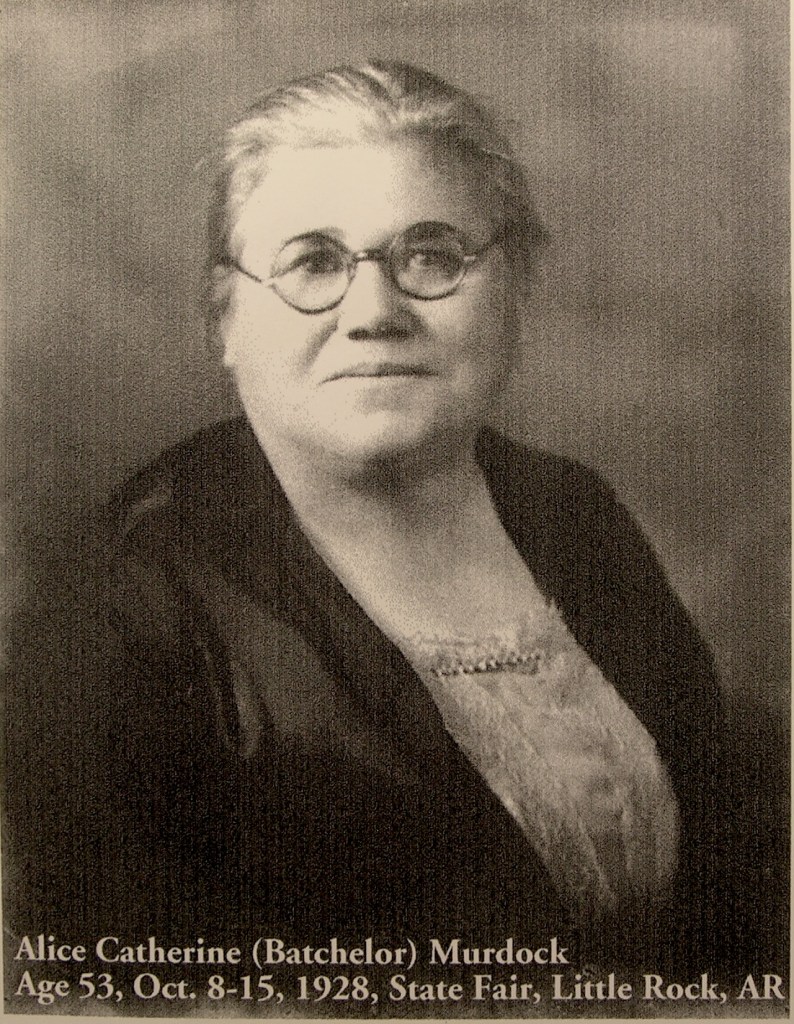
Another “gathering” I’ve identified in pictures that once belonged to my grandmother — and perhaps some of these were her brother John’s, as well — is a gathering of pictures of members of the family of Hattie and John’s sister Alice. Alice Catherine Batchelor (1875 – 1936) was an older sister of Hattie and John. In 1900, she married Thomas Marion Murdock. On the same day that Alice and Tommy married, Alice’s brother Moses Valentine Batchelor (1881 – 1949) married Tommy’s sister Mary Murdock: siblings in one family married siblings in another family, all on one day.
Perhaps because she and Alice and their families were particularly close to each other, my grandmother had numerous pictures of members of Alice’s family. When their mother Catherine Ryan Batchelor died in 1910 (my great-grandfather George R. Batchelor had died in 1907), the four youngest children still at home and unmarried went to live with older married siblings. My grandmother Hattie (1888 – 1968) was among those children, and she went to live with her sister Alice and Alice’s husband Tommy in the town of Redfield, Arkansas, a few miles from where they grew up in Grant County, Arkansas.
In 1912, Hattie then married a Redfield merchant, William Z. Simpson, and Hattie and Billy Simpson raised their family just a few houses from the house in which Alice and Tommy lived. John, one of the other four children not married when their mother died in 1910, also lived in Redfield near Alice and Hattie, working as a clerk in a store until he joined the Army and then married Frances Tucker and lived in Pine Bluff. Redfield is twenty miles south of Little Rock along the Arkansas River, halfway between Little Rock and Pine Bluff, the county seat of Jefferson County in which Redfield is located. (The two other unmarried boys in the Batchelor family, Monroe and Ed, went following their mother’s death to live with their older brother Val and his wife Mary near Broken Bow, Oklahoma, with Ed then returning to Arkansas in the mid-1920s and living with wife Flora Wallin Batchelor in Pine Bluff and El Dorado.)
As I was growing up, the four daughters of Tommy and Alice Batchelor Murdock — Marie, Mae, Lucille, and Bernice — often came to see my grandmother, and we also made many trips to see Mae, who lived in Pine Bluff, and Bernice, who lived in Redfield. After marrying, Marie (who was called Reedie) and her husband Charles Hugh “Boss” McCaskill settled in California and then moved to Texas in their final years. Lucille and her husband Robert Richard Moseley also went to California, and when Reedie and Lucille and their husbands came back from California to Arkansas to see relatives, they always made a point of spending time with their Aunt Hattie. I grew up knowing the four Murdock nieces of my grandmother, Reedie, Mae, Lucille, and Bernice, as well as their brothers, and can fairly quickly spot their faces in the family photos I’m sorting — and am not surprised that my grandmother had many pictures of members of this family, given the deep ties of their family and my grandmother’s family as both families raised their children.
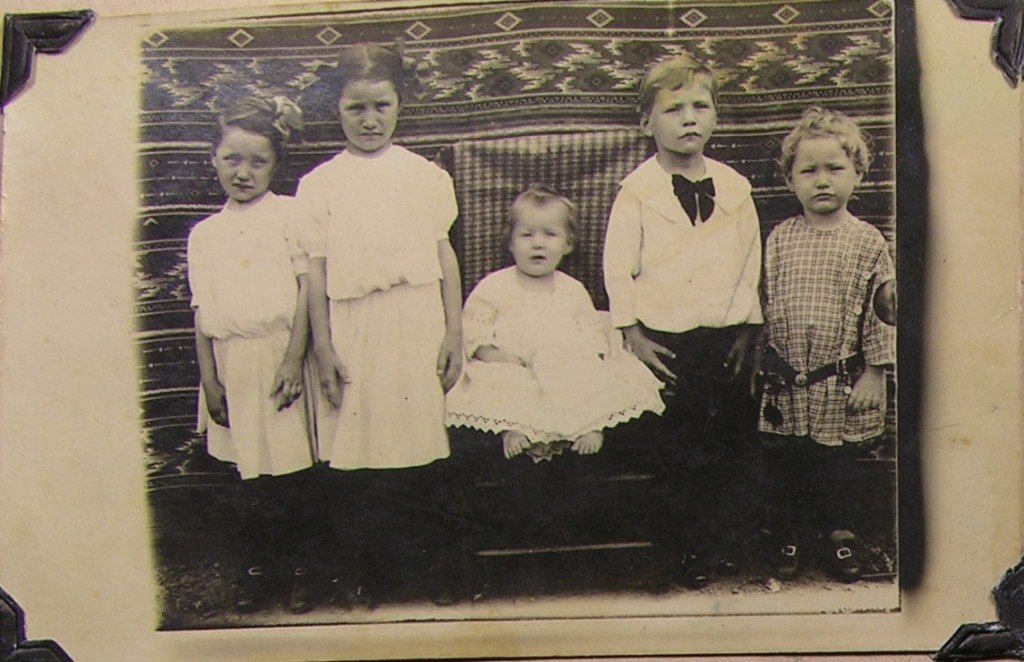
As the older sister who took her younger sister Hattie in when their mother died, Alice was something of a second mother to my grandmother, who was thirteen years younger than her sister Alice. Alice also played a maternal role in helping my grandmother raise her six children and step-son, as she herself raised her six children (a seventh had died as an infant). My mother and her siblings spoke often about how they loved to go up the road to visit their aunt Alice, who permitted them to play freely and enjoy themselves in a way a Simpson aunt, who lived a few houses in the other direction on the same road, didn’t. With their Simpson aunt, they were expected to mind their manners, sit quietly, exhibit ladylike demeanor in the case of the five girls, and read, preferably the bible.
Their aunt Alice understood that they were children and let them have fairly free rein, with certain clear limits: she wouldn’t tolerate sassy or coarse behavior, or unkindness, and she was capable of threatening to take a switch to her nieces and nephews, as she did to her own children, if they exhibited any such behavior. One of the things my mother and her siblings remembered with special fondness about their aunt Alice was what a marvelous cook she was. She had, they used to say, a knack for taking what seemed nothing at all in her pantry and icebox and, in no time at all, turning dribs and drabs of this and that into a table of groaning, delicious food.
I always found those stories believable, because Alice’s daughter Bernice, whom, as I say above, I knew growing up, was also an outstanding cook who had that same talent for whipping up an amazing meal in no time at all from what seemed like meager ingredients stored in her pantry and icebox. For quite a few years, in fact, she cooked school lunches in the local school system, and I’ve heard from people who went through school when she managed the cafeteria and its cooking that they won’t ever forget the delicious meals she served them.
My mother and her sisters and brother also remembered with gratitude that, on the day their father died in May 1930, their aunt Alice came down the road to their house and insisted on taking all of them to her house, so that they would not have to be at home as their father lay dying, and would not have to witness his death. They never stopped remembering this act of kindness on their aunt’s part.
In the “gathering” of pictures I’ve sorted, labeled, and scanned that I can identify as pictures of the family of Alice Batchelor Murdock is a collection of photos that came to me sometime in the latter half of the 1990s from Reedie Murdock McCaskill’s daughter Patsy Ruth. Patsy mailed me a batch of photos that had belonged to her mother Reedie, along with an old photo album of her mother that had begun to fall apart. She told me she couldn’t identify most of the people in the photos, though the loose ones that hadn’t been pasted into the album sometimes had names written on the back. She wanted me to have the album.

After I had looked through the album and the loose photos and identified any I could recognize for Patsy, I put this batch of pictures into a large manila envelope and stored it in the old photo box that had belonged to my parents and which I now have. Life then intervened, and only recently have I been able to go through these photos carefully.
I’ve found that quite a few of the photos are ones my branch of the Batchelor family also has — photos of my grandmother’s brothers John and Ed, for instance, and of Alice and Tommy Murdock and their children. Others are new to me.

Among the photos new to me are ones I initially labeled “Murdock girl, unknown,” since I could see at a glance that this was a photo of one of the four daughters of Tommy Murdock and Alice Batchelor, but I couldn’t immediately figure out which of the four was in the photo: they all looked much alike to me, or, at least, Mae and Reedie looked like each other, as did Lucille and Bernice. Then, having sorted out a congeries of “Murdock girl” photos, I began comparing these to other, known, photos I have of the four daughters of Thomas Murdock and Alice Batchelor, and in a number of cases, I surprised myself by being able to figure out exactly which of the “Murdock girls” was in a particular photo.
The photo at the top of this posting is a case in point. As soon as I saw it, I knew that it was either Reedie or Mae Murdock — but I wasn’t sure which of those two it was.
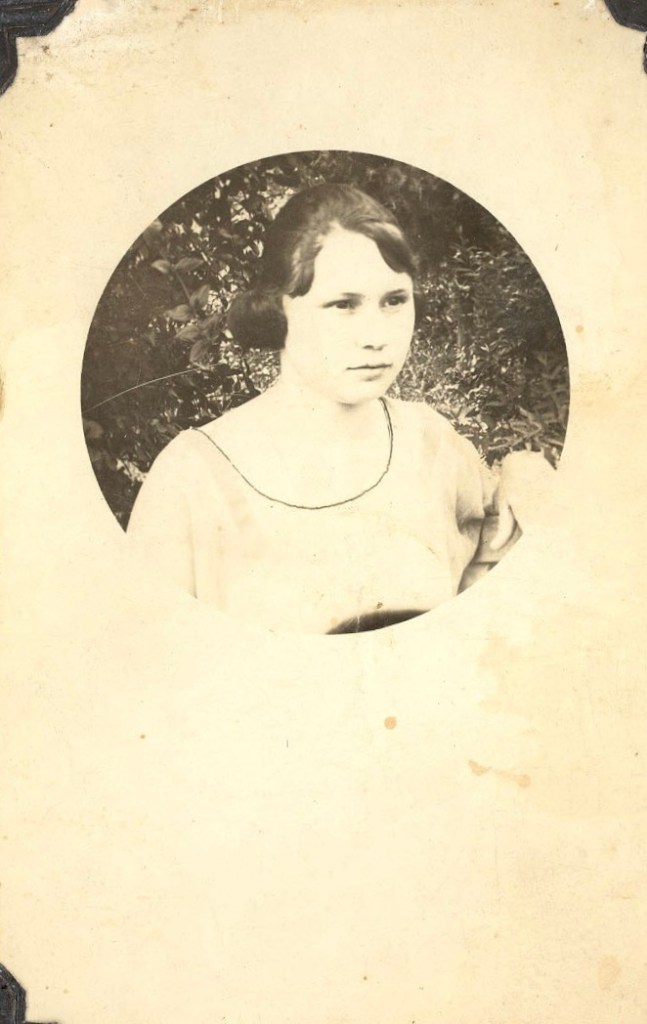
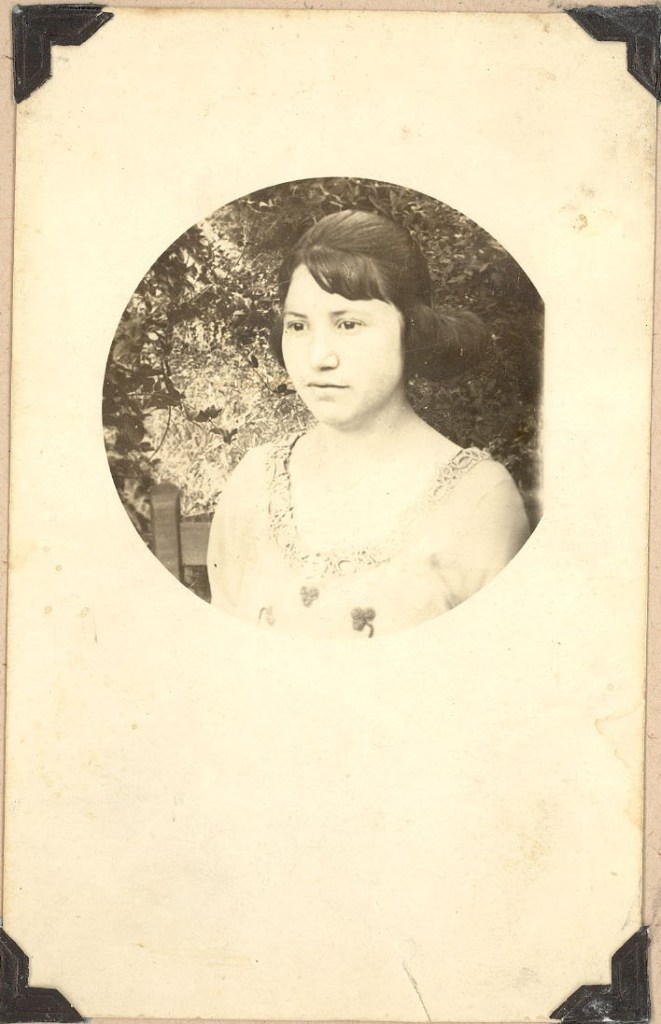
When I took the mystery photo of the “Murdock girl” depicted with her child in the photo at the head of the posting and enlarged her face, I immediately realized that the woman in this photo looked very much like Mae in a photo of her I have that must have been taken not too long before that photo was taken — not long before she married Walter Norrell Triplett of Pine Bluff in 1927.
After I had made that identification, I then recognized that the little boy in the photo was Mae and Walter’s first son Charles Lee Triplett. In fact, his face in this photo looks surprisingly like his adult face. Same eyes, same expression, same smile, same facial shape….
So I’ve pleased myself that I can now not only identify the woman in the “Murdock girl” photo at the head of the posting as Mae Murdock Triplett, but I can fairly well pinpoint when this photo was taken: it would have been taken in 1929, probably the first half of the year. Charles Lee (who has always been called “Char’Lee” by family members) was born in August 1928.
And I can go further in specifying where this photo was taken, too: the background and “style” match photos I have of other family members taken at that studio, including ones of the children of my grandmother’s brother Ed Batchelor and his wife Flora, who are posed against the same backdrop and in a fashion similar to the posing of Charles Lee in this photo.
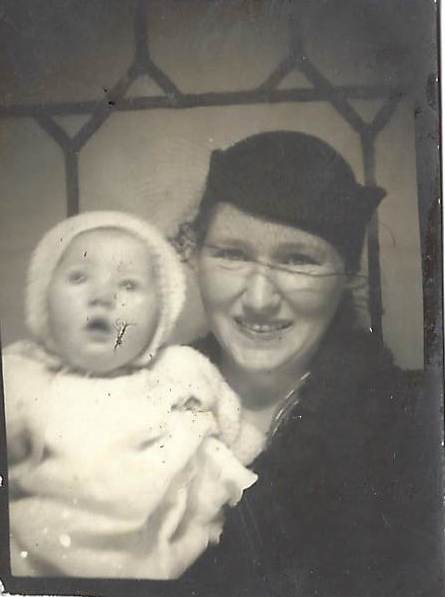
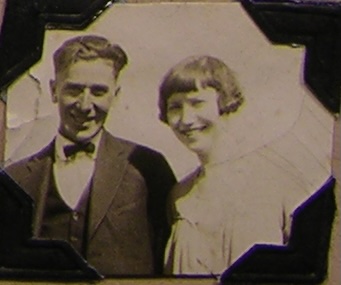
Then there’s this photo. It’s not one I had any difficulty in identifying, really. When I saw it, I recognized immediately that this was Mae’s sister Bernice. But it’s not a photo I had ever seen. I was especially interested in the fact that Bernice is wearing black clothes and has a black hat with a veil on it. As I thought about this picture, it became clear to me when it was taken and who the baby in the photo is.
Bernice, who was born in 1914, married Solon Fray Mobley in 1934. The following year, ten months after they married, in September 1935, Bernice and Fray had a daughter Helen. In February 1936, Bernice’s mother Alice Batchelor Murdock died. As I looked at this photo and thought about it, it became clear that this is a photo taken at the time of Alice’s death, in which Bernice, a young mother of 21, is holding her first child Helen, as Bernice wears mourning clothes for her mother. Helen would have been five months old when her grandmother Alice died and when this photo was taken. She did not live to adulthood: she died tragically before her sixth birthday when she was crossing a road and a car hit her.
There’s nothing earth-shattering in this posting, in terms of genealogical discoveries, bells and whistles regarding photo identification, etc. I am finding I’m learning quite a bit as I work with my photo-identification project, however. I’m learning how useful tools many of us lacked in the past — e.g., the ability to take two old photos, blow up the faces in them using computer technology, put them side by side, and study the faces carefully — can be at identifying folks in photos. And I’m learning how “reading” photos carefully, observing what people are wearing, what’s in the background of the photo, the probable age of the people in the photo: all can help us pinpoint when and where a particular photo was taken.
I take particular delight in identifying these two photos of my mother’s first cousins Mae and Bernice, because I have very fond memories of both. I remember Mae, who resembled my grandmother Hattie more than any other of my grandmother’s nieces, and who was always quiet and gentle, rescuing me once at some large family gathering. I had been cornered by one of her first cousins who was interrogating me about why I wanted to have that old beard covering my face. Mae saw what was happening and overheard what the elderly cousin was saying to me, and without fanfare and very quietly, she took me by the arm and steered me away from that cousin — whose sister Mae drove to church every Sunday when other family members were embarrassed to be seen with her, since she attended church in high heels with bobby socks. Mae was just the kind of person to think nothing at all of being seen with a cousin whose sartorial choices embarrassed other members of her family.
I have similarly fond memories of Bernice, whose personality was more boisterous than that of her sister Mae. As I was growing up, my mother and her sisters would often drive my grandmother to visit her niece Bernice, with my brothers and me in tow. People in the past in Southern families with rural roots thought nothing of dropping in on relatives totally unannounced.
We’d drive up to Fray and Bernice’s house, toot the horn to announce our arrival, pile out of the car, knock on the door, and inevitably be greeted with smiles and a loud “Come in!” followed by hugs, and before you knew it, Bernice would be in the kitchen cooking a delicious meal and insisting we stay for it.
Then there’s this: when my father died in December 1969, I was away in New Orleans at college. I flew home the next day, having gotten word from my mother early in the morning of his death, and, as the day went on, neighbors, friends, and family gathered at our house. I remember sitting talking to my favorite English teacher from high school, Margaret Hamilton, who had come by especially to see me and offer me her condolences.
As we sat and talked, up came Bernice. She had gotten into her car and driven 100 miles to be with my family and to attend the funeral the following day. As I was talking to Margaret Hamilton, I glanced up and saw Bernice coming towards me, arms extended wide, a look of such deep compassion on her face. I stood up and she folded me into her arms, and I burst into tears for the first time since I had gotten news that my father had died. I won’t ever forget the warmth of her greeting and the maternal solicitude of her embrace at that time of sadness.
That’s just the kind of person she was. As with her sister Mae, she didn’t give a fig for what others thought of her when she chose to do what seemed right and kind to her. She lived a few houses away from an elderly African-American woman who had long been a friend of her family and of mine in the years in which my family lived in the town of Redfield along with Bernice’s family. In the final stage of the life of that neighbor, Ms. Green, Bernice thought nothing of walking to her house and spending the night taking care of her, looking after her. That was what neighbors did for each other, and color lines be damned.
They were all that way, the Murdock girls. Reedie, whose photo album her daughter Patsy sent me, died one night in October 1992 after she did something she did every night in the final part of her and her husband “Boss” McCaskill’s life: he was frail, declining, and she fretted about his getting cold during the night. So she’d wake up each night in the middle of the night and walk from her bedroom to his to check on her husband and to pull extra cover around his legs. On the night of her death, she had just finished doing that when she dropped dead from a stroke at the foot of the bed.
I don’t mean to say that any of these family members were plaster of paris saints. They were real-life human beings who had faults and foibles like any of us, and also virtues aplenty. They had grown up in a family with an exceptionally nurturing mother, and had the traits of that mother. And family stories about ordinary relatives who are really extraordinary people: they’re important to cherish and transmit, aren’t they? Who will know these stories or tell them if I don’t share them? Who will praise the famous women in our lives who have so often been overlooked by historians and everyone else? One can’t look at old family photo albums and not hear stories repeating in one’s head, can one?
 BEGATS AND BEQUEATHALS
Eva Mae Murdock (Triplett) was my grandmother. My father, Walter, was the youngest of 4 children. Charles was the oldest, followed by Bobby, Mary Alice and finally my father. I recognize several names that you mention in this article.
LikeLike
It’s great to hear from you, Jeff. I have suc hfond memories of your grandmother Mae. Of all the nieces of my grandmother Hattie Batchelor Simpson, Mae reminded us the most of my grandmother. They looked so much alike. My grandmother had a special place in her heart for Aunt Alice’s children, and loved for us to take her to Pine Bluff to see Mae and Redfield to visit Bernice, and loved when Lucille and Reedie came to visit her. I miss these special cousins who have gone on now.
LikeLike